 |
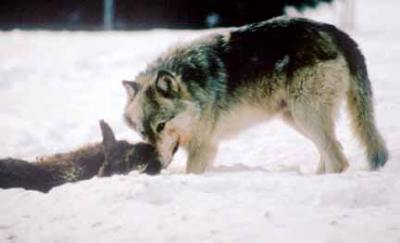
| The Rocky Mountain wolf (Canis lupus occidentalis) is also sometimes called the Alaskan or Mackenzie Valley wolf. This subspecies inhabits much of western Canada and Alaska, including Unimak Island in the Aleutians, and is the subspecies which was reintroduced into Yellowstone National Park (YNP) and Idaho. Legal shooting and trapping of wolves occurs throughout Alaska. Over the past decade 11 to 20 percent of Alaska's wolf population has been harvested each year. Studies indicate that wolves could sustain an annual harvest of 30 to 40 percent without decreasing the population. The wolf population in Alaska is estimated at 7,000-10,000 wolves. The population in YNP and Idaho are estimated at 160 and over 140 respectively. In Alaska, the Rocky Mountain wolf has a coat of black, white, gray, tan, and even blue-ish. Gray or black wolves are the most common. Wolves typically stand about 30 inches at the shoulder and weigh between 85 and 115 pounds, although they can weigh as much as 145 pounds. Pack sizes in Alaska are generally 6-12 wolves, with some packs as large as 20-30. Territory size averages 600 square miles. Wolf packs in YNP average 9.2 wolves with an average territory of 348 square mile, while wolf packs in Idaho average 11.1 and 364 square mile territories. The prey base of the Rocky Mountain wolf is moose, bison, elk, caribou, Dall sheep, Sitka black-tailed deer, mountain goats, beaver, salmon, vole, lemmings, ground squirrels and snowshoe hare. |
| Rocky Mountain Wolf |
|