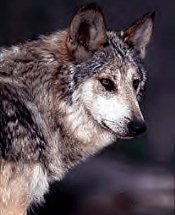
The Mexican gray wolf (Canis lupus baileyi) is the most genetically distinct subspecies of gray wolf in North America. Of the five North American subspecies, the Mexican wolf is the smallest in size. A typical Mexican wolf is about 4.5- 5.5 feet long, from snout to tail, weighs from 50 to 90 pounds, and has a coat with a mix of buff, gray, red and black. Like all wolves, the Mexican wolf communicates using body language, scent marking and vocalization. Typical prey for Mexican wolves consists of white-tailed deer, mule deer, elk, javelina, jack rabbit, cottontail rabbits and smaller mammals.
Commonly called "lobo", the Mexican gray wolf has all but disappeared from its historic range in the southwestern United States and throughout Mexico. Predatory controls from the late 1800s to the mid-1900s made it the rarest gray wolf in North America. By the late 1970s, the Mexican gray wolf had virtually disappeared in the southwestern United States. It was listed as endangered on the federal endangered species list in 1976. Recovery goals of a wild population of at least 100 wolves over 5,000 miles of its historical range were approved by the U.S. Fish and Wildlife Service and the Direccion General de la Fauna Silvestre in Mexico in a 1982 recovery plan.
In 1997, a plan was approved calling for the reintroduction of Mexican wolves in Arizona and New Mexico. In March 1998, 11 Mexican gray wolves in three family groups were released into the wilds of the Apache National Forest of southeastern Arizona. Two additional wolves were released later that year. The highlight of the recovery program took place in 1998 when, for the first time in 50 years, a Mexican gray wolf pup was born in the wild.
Subsequent releases of Mexican wolves include 21 wolves in 1999, 19 first time release (ftr*) wolves in 2000, and 6 ftr to date (May 15th) in 2001. Several of the released animals are no longer a part of the wild populations, as 5 have been shot, 1 disappeared, 1 was hit by a car and 5 have been returned to captivity.
At the end of 2000, there were 15 confirmed wild Mexican wolves, with the population of up to 28 possible. Currently, the free ranging population of Mexican wolves consists of 22 collared animals, 3 missing collard animals, and 6 uncollared animals. The Captive population was 192 as of 2000.
|