|
The word
"LEADERSHIP" can refer to:
1. the process of leading
2. the
concept of leading
3. those
entities that perform one or more acts of leading.
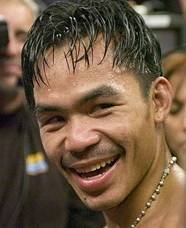
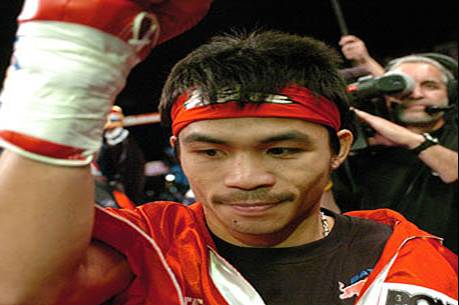
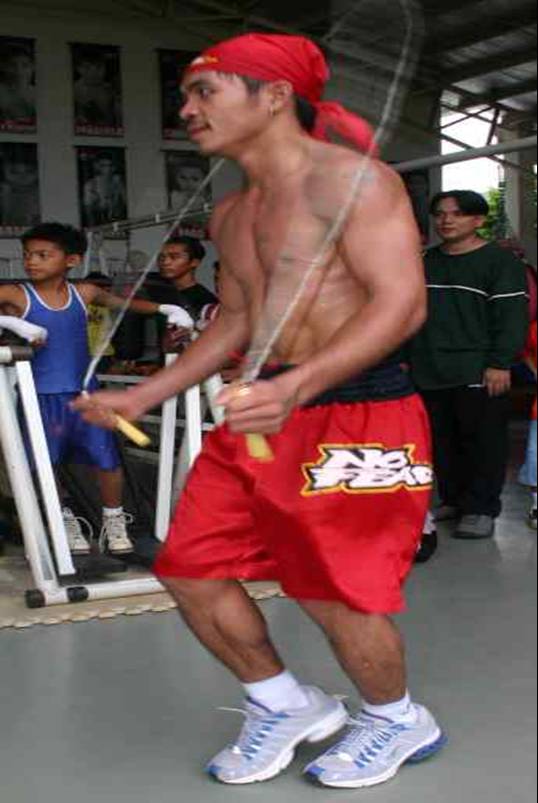
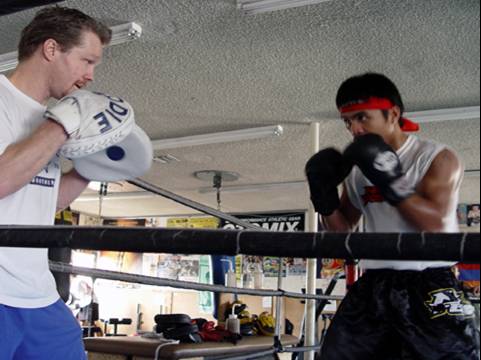
Pacquiao has the
ability to influence,
motivate, and enables others to contribute toward the effectiveness and
success of his country of which they are members.
Most
of the people believe that leadership
is the period of
authority, as in "During the 1940s Russia was under Stalinist leadership".
Like in formal
hierarchies
the term serve to describe the position or relationships which
allow and legitimize the exercising of what one might term "leadership
behavior". But Pacquiao, by just being himself, he showed leadership
as the power to go beyond the expectations and criticism of the world.
In
fact, he's poor and he fail to finish schooling, but, inspite all these he
was able to reach the highest point of the fight in which only few had
achieved.
By just being his own and
by showing his potentials, the determination, perseverance, courage,
hardworks and above all these his faith to the almighty he has become a
visible figure as a fighter and a leader to all the Filipinos. . . to
every youth. . . and
to the whole world.
Pacquiao has his own
personal strategies that
one can use to guard against the unrealistic expectations associated with
belief in leaders include:
1.
Maintaining a questioning and
skeptical
attitude
2.
Bolstering confidence in one's own
decision-making
abilities
Home
I
Profile
I
About Us
I
Biography
I
Politics
I
Features
I
Leadership
I
Bibliography
CATEGORIES AND TYPES OF LEADERSHIP
One can categorize the exercise of leadership as either
actual or potential:
-
Actual
- giving guidance or direction, as in the phrase "the emperor has provided
satisfactory leadership"
-
-
Potential
- the capacity or ability to lead, as in the phrase "she could have
exercised effective leadership"; or in the concept "born to lead".
Several types of entities may provide or exhibit leadership,
actual or potential, including:
-
A
person in the position or office of
authority,
such as a
President
-
A
person in a position or office associated with expertise, skill, or
experience, such as a
team
leader, a ship's
captain,
a
chief
engineer, or a
parent
-
A
group or person in the
vanguard
of some
trend
or movement, as in fashion trend-setters.
-
A
group of respected people, (called a "reference group" by sociologists) such
as business commentators or union spokespersons
-
A
product that influences other product offerings in a competitive
marketplace.
Leadership can come from an
individual, a collective group of leaders, or even from the disincarnate —
if not mystical — characteristics of a celebrity
figurehead
(compare
hero).
Yet other usages have a "leadership" which does little active leading, but
to which followers show great (often traditional)
respect
(compare the courtesy title
reverend).
Followers often endow the leader with status or prestige. Aside from the
prestige-role
sometimes granted to
inspirational
leaders, a more mundane usage of the word "leadership" can designate current
front-runners that exercise influence over competitors, for example, a
corporation
or a
product
can hold a position of "market
leadership" without any implication of permanence or of merited respect.
Note that the ability to influence others does form an integral part of the
"leadership" of some but not all front-runners. A front-runner in a sprint
may "lead" the race, but does not have a position of "leadership" if he does
not have the potential to influence others in some way. Thus one can make an
important distinction between "being in the lead" and the process of
leadership. Leadership implies a relationship of
power
— the power to
guide
others.
Home
I
Profile
I
About Us
I
Biography
I
Politics
I
Features
I
Leadership
I
Bibliography
LEADERSHIP:
POSITIONS OF AUTHORITY
In
representative democracies
the
people
retain
sovereignty
(popular
sovereignty) but
delegate day-to-day administration and leadership to elected officials. In
the
United States,
for example, the
Constitution
provides an example of recycling authority. In the
Constitutional Convention
of 1787, the American
Founders
rejected the idea of a
monarch.
But they still proposed leadership by people in positions of authority, with
the authority split into
three powers:
in this case the legislative, the executive, and the judiciary. Under the
American theory, the authority of the leadership derives from the power of
the voters as conveyed through the
electoral college.
Many individuals share authority, including the many legislators in the
Senate
and the
House of Representatives.
Home
I
Profile
I
About Us
I
Biography
I
Politics
I
Features
I
Leadership
I
Bibliography
LEADERSHIP CYCLES
If a group or an organization wants or expects identifiable
leadership, it will require processes for appointing/acquiring and replacing
leaders.
Traditional closed groups rely
on
bloodlines
or
seniority
to select leaders and/or leadership candidates:
monarchies,
tribal
chiefdoms,
oligarchies
and
aristocratic
societies rely on (and often define their
institutions
by) such methods.
Competence or perceived
competence provides a possible basis for selecting leadership
elites
from a broader pool of potential talent. Political
lobbying
may prove necessary in
electoral systems,
but immediately demonstrated
skill
and
character
may secure leadership in smaller groups such as
gangs.
Leadership as a phase in human life-cycles
Some cultures, especially
those with a reverence for age and wisdom, see leadership as a standard part
of the life-cycle of a person: see
http://www.ima-art.org/cycles/
. Just as a youth becomes initiated into adulthood, so an adult may gain
initiation as a leader. Such societies may require special re-inforcement of
the
respect
and
kudos
due to such senior members in order to maintain their position. If aged
adults can no longer hunt or fight or play a full part in physical labor,
for example, those adults' positions in society must rest on respect and
implied wisdom and teaching roles, whether or not they show identified
"leadership traits".
Home
I
Profile
I
About Us
I
Biography
I
Politics
I
Features
I
Leadership
I
Bibliography
SYMBOLISM OF LEADERSHIP
Various symbolic attributes —
often varying according to the cultural milieu — mark out authority-figures
and help make them seem special and revered.
A.
Leadership amongst primates
Richard Wrangham and Dale
Peterson, in Demonic Males: Apes and the Origins of Human Violence
present empirical evidence that only
humans
and
chimpanzees,
among all the
animals
living on
earth,
share a similar tendency for a cluster of behaviors:
violence,
territoriality,
and
competition
for uniting behind the one chief male of the land.
[5]
(Note the status of chimpanzees as humans' closest species-relatives: humans
inherited 98% of their genes from the ancestors of the chimpanzees.
By comparison,
bonobos,
the second-closest species-relatives of man, do not unite behind the
chief male of the land. The bonobos show deference to an alpha or
top-ranking female that, with the support of her coalition of other females,
can prove as strong as the strongest male in the land. Thus, if leadership
amounts to getting the greatest number of followers, then among the bonobos,
a female almost always exerts the strongest and most effective leadership.
An alternative explanation suggests that those individuals
best suited to lead the a group will somehow rise to the occasion and that
followers (for some reason) will accept them as leaders or as proto-leaders.
In this scenario, the traits of the leaders (such as gender, aggressiveness,
etc.) will depend on the requirements of a given situation, and ongoing
leadership may become extrapolated from a series of such situations.
B.
Leadership as a vanguard
Sometimes followership can
occur without intentional leadership. Despite (or because of) its mythical
origin, the image of swarms of
lemmings
which follow the first lemming off a cliff appears frequently in
characterizing followers. The animal kingdom also provides the actual model
of the
bellwether
function in a mob of
sheep.
And human society also offers many examples of emulation. The
fashion
industry, for example, depends on it. Fashion marketers design clothing for
celebrities, then offer less expensive variations/imitations for those who
emulate the celebrities.
The term "leadership"
sometimes applies (confusingly) to a winning position in a race. One can
speak of a front-runner in a sprint or of the "leader" in an election or
poll as in a position of leadership. But such "leadership" does not involve
any influence processes, and the "leader" will have followers who may not
willingly choose to function as followers. Once again: one can make an
important distinction between "in the lead" and the process of leadership.
Once again, leadership implies a
relationship
of
power
- the power to
guide
others.
Leading from the front, in a military sense, may imply
foolhardiness and unnecessary self-exposure to danger: these do not
necessarily make for successful long-term leadership strategies
Home
I
Profile
I
About Us
I
Biography
I
Politics
I
Features
I
Leadership
I
Bibliography
SCOPE OF LEADERSHIP
One can govern oneself, or one can govern the whole earth.
In between, we may find leaders who operate primarily within:
 families
bands
tribes
states
and
nations
empires
Intertwined with such
categories, and overlapping them, we find (for example) religious leaders
(potentially with their own internal hierarchies), work-place leaders (executives,
officers,
senior/upper managers,
middle managers,
staff-managers, line-managers, team-leaders,
supervisors
...) and leaders of voluntary associations.
Some anthropological ideas
envisage a widespread (but by no means universal) pattern of progression in
the organisation of society in ever-larger groups, with the needs and
practices of leadership changing accordingly. Thus simple
dispute resolution
may become legalistic dispensation of justice before developing into
proactive
legislative
activity. Some leadership careers parallel this sort of progression: today's
school-board chairperson may become tomorrow's city councillor, then take in
(say) a
mayordom
before graduating to nation-wide politics.
Home
I
Profile
I
About Us
I
Biography
I
Politics
I
Features
I
Leadership
I
Bibliography
SUPPORT-STRUCTURES OF
LEADERSHIP
Though advocates of the "big
man" school of visionary leadership would have us believe that
charisma
and
personality
alone can work miracles, most leaders operate within a structure of
supporters and executive agents who carry out and monitor the expressed or
filtered-down
will
of the leader. This undercutting of the importance of leadership may serve
as a reminder of the existence of the follower: compare
followership.
A more or less formal
bureaucracy
(in the
Weberian
sense) can throw up a colorless nonentity as an entirely effective leader:
this phenomenon may occur (for example) in a
politburo
environment. Bureaucratic organizations can also raise incompetent people to
levels of leadership.
In modern dynamic environments
formal bureaucratic organizations have started to become less common because
of their inability to deal with fast-changing circumstances. Most modern
business organizations (and some government departments) encourage what they
see as "leadership skills" and reward identified potential leaders with
promotions.
In a potential down-side to
this sort of development, a big-picture grand-vision leader may foster
another sort of
hierarchy:
a
fetish
of leadership amongst subordinate sub-leaders, encouraged to seize resources
for their own sub-empires and to apply to the supreme leader only for
ultimate
arbitration.
Some leaders build coalitions and alliances: poitical
parties abound with this type of leader. Still others depend on rapport with
the masses: they labor on the shop-floor or stand in the front-line of
battle, leading by example.
Home
I
Profile
I
About Us
I
Biography
I
Politics
I
Features
I
Leadership
I
Bibliography
Determining what makes an
EFFECTIVE
"LEADERSHIP"
The simplest way to measure
the effectiveness of leadership involves evaluating the size of the
following that the leader can muster. By this standard,
Adolf Hitler
became a very effective leader for a period — even if through delusional
promises and coercive techniques.
However, this approach may measure power rather than leadership. To measure
leadership more specifically, one may assess the extent of influence on the
followers, that is, the amount of leading. This may involve testing the
results of leadership activities against a goal, vision, or objective.
James MacGregor Burns
introduced a normative element: an effective Burnsian leader will unite
followers in a shared
vision
that will improve an organization and society at large. Burns calls
leadership that delivers "true" value, integrity, and trust
transformational leadership.
He distinguishes such leadership from "mere"
transactional leadership
that builds
power
by doing whatever will get more followers.
[8]
But problems arise in quantifying the transformational
quality
of leadership - evaluation of that quality seems more difficult to quantify
than merely counting the followers that the straw man of transactional
leadership James MacGregor Burns has set as a primary standard for
effectiveness. Thus transformational leadership requires an evaluation of
quality, independent of the
market demand
that exhibits in the number of followers.
The
functional leadership model
conceives leadership as a set of behaviours that helps a group perform a
task, reach their goal, or perform their function. In this model, effective
leaders encourage functional behaviors and discourage dysfunctional ones.
In the
path-goal model
of leadership, developed jointly by Martin Evans and
Robert House
and based on the "Expectancy Theory of Motivation", a leader has the
function of clearing the path toward the goal(s) of the group, by meeting
the needs of subordinates.
Home
I
Profile
I
About Us
I
Biography
I
Politics
I
Features
I
Leadership
I
Bibliography
SUGGESTED
QUALITIES OF LEADERSHIP
(For Effective Leader)
Studies of leadership have suggested qualities that people
often associate with leadership. They include:
Guiding
others through modelling (in the sense of providing a
role model)
and through willingness to serve others first (compare
followership)
Talent
and technical/specific skill at some task at hand
Initiative
and
entrepreneurial
drive
Charismatic
inspiration
- attractiveness to others and the ability to leverage this esteem to
motivate others
Preoccupation with a rôle - a dedication that consumes much of leaders' life
- service to a cause
A clear
sense of purpose (or
mission)
- clear goals - focus - commitment
Results-orientation - directing every action towards a mission -
prioritizing activities to spend time where results most accrue
Optimism
- very few pessimists become leaders
Rejection of determinism - belief in one's ability to "make a difference"
Ability to encourage and nurture those that report to them - delegate in
such a way as people will grow
Role models
- leaders may adopt a
persona
that encapsulates their mission and lead by example
Self-knowledge
(in non-bureaucratic structures)
Self-awareness
- the ability to "lead" (as it were) one's own self prior to leading other
selves similarly
Understanding what others say, rather than listening to how
they say things - this could partly sum this quality up as "walking in
someone else's shoes" (to use a common cliché).
The approach of listing
leadership qualities, often termed "trait
theory", assumes
certain traits or characteristics will tend to lead to effective leadership.
Although trait theory has an intuitive appeal, difficulties may arrise in
proving its tenets, and opponents frequently challenge this approach.
Other situational
leadership models introduce a variety of situational variables. These
determinants include:
the nature of the task (structured or routine)
organizational policies, climate, and culture
the preferences of the leader's superiors
the expectations of peers
the reciprocal responses of followers
The contingency model of Vroom and Yetton uses other
situational variables, including:
the nature of the problem
the requirements for accuracy
the acceptance of an initiative
time-constraints
cost constraints
However one determines
leadership behaviour, one can categorize it into various leadership
styles.
Home
I
Profile
I
About Us
I
Biography
I
Politics
I
Features
I
Leadership
I
Bibliography
LEADERSHIP STYLES
The listed leadership
"styles" covers:
1.
Outstanding leaders articulate an ideological vision congruent with the
deeply-held values of followers, a vision that describes a better future to
which the followers have an alleged moral right.
2.
Passion
and
self-sacrifice.
Leaders display a passion for, and have a strong conviction of, what they
regard as the moral correctness of their vision.
3.
Confidence,
determination,
and
persistence.
Outstanding leaders display a high degree of
faith
in themselves and in the attainment of the vision they
articulate.
4.
Image-building.
Outstanding leaders are self-conscious about their own image. They recognize
that that they must be perceived by followers as competent, credible, and
trustworthy.
5. Role-modeling.
Leader-image-building sets the stage for effective role-modeling because
followers identify with the values of role models whom they perceived in
positive terms.
6.
External representation. Outstanding leaders act as
spokespersons
for their respective organizations and symbolically represent those
organizations to external
constituencies.
7. Expectations
of and confidence in followers. Outstanding leaders communicate expectations
of high
performance
from their followers and strong confidence in their followers’ ability to
meet such expectations.
8.
Selective
motive-arousal.
Outstanding leaders selectively arouse those motives of followers that the
outstanding leaders see as of special relevance to the successful
accomplishment of the vision and mission.
9.
Frame
alignment. To persuade followers to accept and implement
change,
outstanding leaders engage in "frame alignment". This refers to the linkage
of individual and leader interpretive orientations such that some set of
followers’ interests, values, and beliefs, as well as the leader’s
activities, goals, and
ideology,
becomes
congruent
and complementary.
10.
Inspirational
communication.
Outstanding leaders often, but not always, communicate their message in an
inspirational manner using vivid
stories,
ceremonies.
Even though these ten
leadership behaviors and approaches do not really equate to specific styles,
evidence has started to accumulat[citation needed] that a
leader’s style can make a
difference.
Style becomes the key to the formulation and implementation of strategy
and plays an important role in
work-group
members’ activity and in
team
citizenship.
Home
I
Profile
I
About Us
I
Biography
I
Politics
I
Features
I
Leadership
I
Bibliography
LEADERSHIP AND
VISION
No matter how one defines
leadership, it typically involves an element of
vision
— except in cases of involuntary leadership and often in cases of
traditional leadership. A vision provides direction to the influence
process. A leader (or group of leaders) can have one or more visions of the
future to aid them to move a group successfully towards this goal. A vision,
for effectiveness, should allegedly:
appear as a simple, yet vibrant, image in the mind of the leader
describe a future state, credible and preferable to the present state
act as a bridge between the current state and a future optimum state
appear desirable enough to energize followers
succeed in speaking to followers at an emotional or spiritual level (
For leadership to occur,
according to this theory, some people ("leaders") must communicate the
vision to others ("followers") in such a way that the followers adopt the
vision as their own. Leaders must not just see the vision themselves, they
must have the ability to get others to see it also. Numerous techniques aid
in this process, including:
narratives,
metaphors,
symbolic
actions, leading by example,
incentives,
and
penalties.
|