| TWO DAYS that's all it takes for you to die of EBOLA!!!! (but the incubation period can last up to 21 days) |
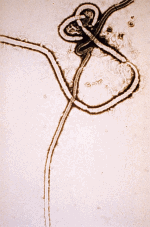
| For years I have been fascinated with the Ebola virus. Back when I was in eighth grade I tracked the outbreak of the Ebola-Sudan virus that occurred in Uganda during the 2000-2001 year. I have watched "Outbreak" the movie dozens of times and have read The Hot Zone countless others. Maybe I'm just interested in how many people have died from it, or the four distinct subtypes of Ebola. But I think I just like how it presents itself on an electron microscope. Look at how menacing it looks! |
| The Ebola HF virus is one of four RNA viruses in the Filoviridae family. It is named after the river in Congo although the natural reservoir of Ebola HF is unknown. It is thought that an African animal is the host but it has yet to be found. Contraction of the virus is often seen as a death wish. Unfortunately, it is very easy to catch the virus. |
| I Pity the Fool who doesn't read more about Ebola: CDC Special Pathogens Branch World Health Organization (WHO) Factsheet |
 |
 |
| Menacing Menacing Menacing |
| Ebola Hemorrhagic Fever (HF) The Virus, How It Will Kill You, and The Chances That You Will Die |
| Ebola HF is native on the African continent, but it has been detected in the Southern Pacific, England, Italy, and the United States as well. The first known outbreak occurred in 1976 in Zaire and killed over 300 people. The birth of this virus is not known, but it has popped up sporadically throughout the world and has taken four distinct forms. |
| Ebola-Zaire (1976)-This is the most lethal type of Ebola. On average, 75-90% of its victims die. Ebola-Sudan (1976)- Not as lethal as only 40%-70% of victims die. Ebola-Reston (1989)- Only found in the United States and England. Lethal in primates, but flu-like symptoms occur in humans. Detected in Texas, Pennsylvania, Virginia, and England. Ebola-Ivory Coast (1994)- Found in the Tai Forest. A researcher became ill while performing an autopsy on an infected chimp. He was treated in Switzerland and lived. Only one case exists. |
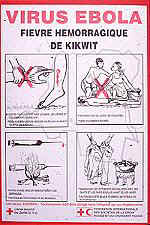
| Direct contact with infected blood or bodily fluids. Direct contact with an infected person (dead or alive). Handling of infected chimps/monkeys (dead or alive). Spread through airborne particles (in lab setting) Ebola HF is often transmitted throughout hospitals known as nosocomial transmission. This is caused by inadequate sterilization procedures. |
| "Once you got it, you got it." |
| Currently there is no cure or effective vaccine for the contraction of Ebola. The only thing a health professional can do is help to keep you hydrated with water and replace lost electrolytes from vomitting. And pray that you are the 10-25% of the people that survive. Otherwise you will eventually die from choking on your own blood and liquified organs. |
| Other Symptoms: |
| Headache and Nausea Extreme Fatigue and Weakness Vomitting, Rashes, Red Eyes Internal and External Bleeding |
 |
|
|
 |
|
|
|
|
|
 |
|
|
|
|
|
 |
 |
| Contraction and Transmission |
 |