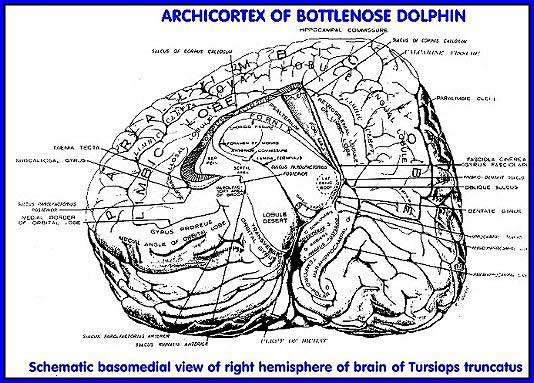
Exploring Tursiops truncatus Cognition
| ...... | Teschuang-Tse and Hui-Tse were standing on
the bridge across the Hao river. �Tschuang-Tse said: "Look how the minnows
are shooting to and fro! That is the joy of the fishes."
"You are not a fish," said Hui-Tse. �"How can you know in what the joy of the fishes consist?" "You are not I" answered Tschaung-Tse. �"How�can you know I do not know in what the joy of the fished consist?" "I am not you," Hui-Tse conceded, "and I do not know you. All I know is that you are not a fish; therefore, you cannot know the fishes." Tschuang-Tse answered: �"Let us return to your questoin, you asked me: "How can you know in what the joy of the fishes consists?" Esentually you knew that I know, and yet you asked me. �No matter: I know it from my own joy of the water," Old Chinese Tschuang-Tse [Haan, 1946]
|
...... |
There is a large amount of evidence that supports highly evolved intelligence
is among these animals.
This paper �will be �focusing on those
cognitative process �exhibited �by the Tursiops turncatus.
�Cognition is a general term; therefore, it needs to be operationally
defined.� �For this paper, cognition is defined as: �The
�various modes, �levels �and aspects of �understand
�and �knowing. � �This �includes perception,
recognition, judging, remembering, conceptualizing and reasoning. Thus, it
potentially �includes all the �inner mediating �systems;
�whereby, �an organism processes stimulus information and construes,
represents, organizes, interprets and responds to ongoing events. In other
words, cognition is the many levels of how organisms structure and organize
their environments including the basic processes involved.
At this time I would like to also point out that we measure other species
by our standards and our instruments only measure what we as humans use and
not what other species are gifted with. I must admit, I wrestled with the
philosophy of us, as humans, trying to measure what we deem as intelligent
in other species. The Old, and what I see as inaccurate, Human hypothesis...
"they are different from us; therefore, they must be less than, or lower
than us"... keeps popping up.
Tursiops turncatus
Dolphins, along with their cousins the whales,
belong to the order of Mammals called Cetacea with large and complex brains
and are all highly developed beings. Their sub-order is Odontoceti, meaning
"tooth whales" and the family is called Delphinidae. This research paper
will be discussing primarily the Tursiops turncatus (bottle nose dolphin)
genus species of the Delphinidae. . This research paper will
be discussing primarily the cognitive aspects of the Tursiops turncatus (bottle
nose dolphin) genus species of the Delphinidae.
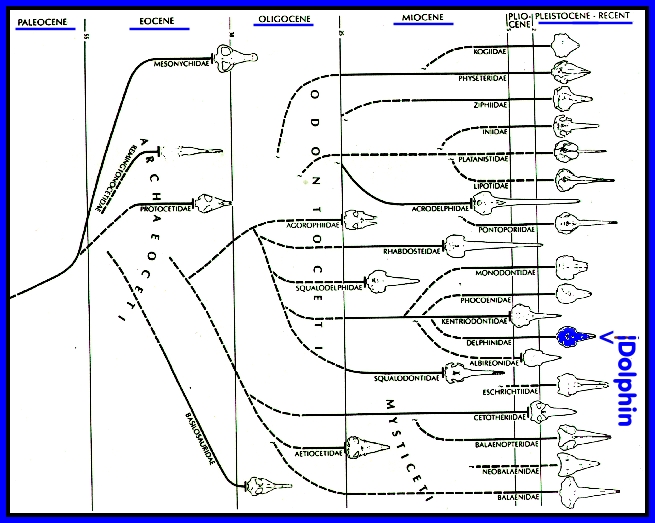 |
These mammals have been evolving for millions of years and are believed to have originated from terrestrial mammals (Kelly). Dolphin embryos show distinct traces of their terrestrial roots, with a domed cranium, rudimentary external ears, some hair, a nose & mouth, along with constricted neck and hind limbs (McCulloch). Currently, the oldest known fossil comes from the late Miocene period, about eleven million years ago(Evans) as shown in the graph above.
Throughout history there has been much documentation regarding human/dolphin interaction including numerous citings of dolphins saving stranded humans giving rise to their capacity toward intelligence.
| All around the world, for thousands of years, indigenous tribes have had a symbiotic relationship with local dolphins. The Chumash's word for their beloved dolphin is "A' lol' quoy" which means "to protect" or "to go in peace". According to the Chumash, they are a people who originally migrated to what is now, California USA, from what might have been an ancient Pacific civilization of Lemuria about 12,000 years ago. Their grand-mother, Goddess Hutash, built them a Rainbow Bridge on which to cross. She warned them to not look down as they may fall into the ocean and die. Some did, so from her great love of her children, she turned them into dolphins. The dolphin sculpture and fountain in Santa Barbara, California are a tribute to the Chumash dolphin. |
| All Australian aboriginal tribes view the Dolphin as deeply sacred, being their wise, elder brother...for when an aboriginal dies, his spirit becomes a Dolphin. Dolphins span both the physical and spirit worlds, guiding and protecting their brothers and sisters who have chosen to journey through this life in Human form. The Aboriginal's deepest and most sacred mediation is their "Dolphin Dreamtime" where they experience deep communication with their brother Dolphin, and are given all the answers they need to all their tribal quesitons and decisions. As longas the Dolphins remain there, the tribe feels safe from threat, as their wise spirit brothers are looking after and guiding them (Alphers) |
| ............ | Diviner than the Dolphin is nothing yet created, for indeed they
were aforetime men exchanged the land for the sea and put on the form of
fishes. But, even now, the righteous spirit of men in them preserves human
thought and human deeds.
....Oppian of Silica, 200 A.D. |
............ |
DELPHINIDAE INTELLIGENCE
For decades, scientists working in the field of animal behavior endeavored to legitimize their discipline by avoiding abstract words such as intelligence, thought, awareness, mind or consciousness when referring to animals (Bavidge). �Many concentrated instead on what could be directly observed, scientifically, tested and statistically validated. �Many experiments emphasized simple behaviors such as pigeons pecking, rats pressing levers, cats opening doors, etc. �Human biased words and concepts became taboo among many of these professionals because they were too unscientific to warrant study (Bavidge).
Between the 1880's and 1920's, the Darwinian revolution was well under way in the field of Biology along with the newly emerging field of Psychology. Biologists were searching for evidence of evolutionary changes in organ systems and psychologists were interested in the behavioral heritage of humans from their animal ancestors (Bavidge). This was also the period when psychologists were devising, then refining the first standardized tests of human intelligence. �The notion that the brain was the organ of mind and intellect was already well established by that time. �Obviously an area of interest to both disciplines was the evolution of the brain.
Research on the Order Cetacea has received more public attention in recent years pertaining to their behavior, communication and intelligence than probably all other combined research areas regarding this order. �This is probably due for several reasons. �First, a landmark in legitimizing expansion beyond the early conservative postion of animal behaviors were in 1981 at the Dalhem Conference entitled: "Animal Mind, Human Mind" �which was held in West Berlin. �This confderence was attended by well-known psychologists, zoologists, physiologists and other experts with an interest in exploring new frontiers in animal behavior. �Papers presented there have spurred further professional interest into the nature of the "animal mind". �Second, the almost human-like quality of captive dolphins throughout the world along with movies such as Flipper making the term dolphin a house-hold word.
Physiological Brain Size
Does brain size predict intelligence? �ever since the brain was recognized as the seat of intellect and the organ that coordinates behavior, its size and complex shape have intrigued scientists and thinkers alike (Helweg, Herman, Jerison, Ridgway). �
In 1886, one of the early pioneers of brain evolution research was Othniel Marsh, a leading paleontologist, who redefined Dubois's 1843 concept pertaining to brain and organism size as grounds for intelligence (Colbert). �Marsh proposed several laws of brain evolution that had a major impact on his contemporaries and is still influencing researchers today. �In brief, the laws state: (1) the size of the brain increased in comparison to the size of the body. (2) the increase was mainly in the cerebrum (forebrain). �(3) the increase in the size of the cerebrum was accompanied by a progressive increase in the number of complexity of convolutions on its surface (Colbert).\
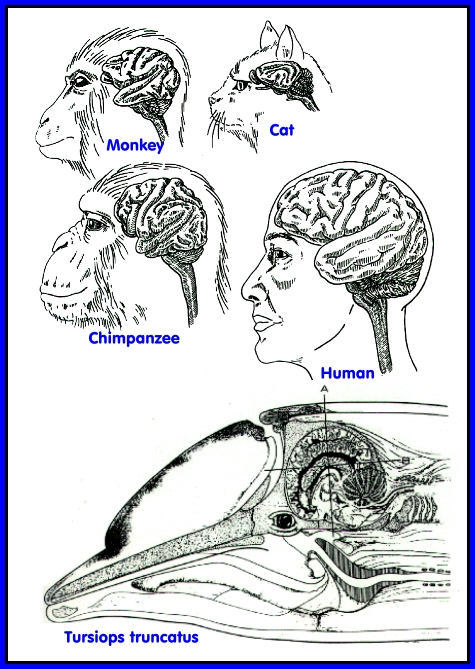 |
The cerebral hemospheres occupy a much greater proportion of the brain in humans than in the rat, cat. Today, many individuals continue to infer the correlational approach that the physical brain size and weight per body size and weight ratio gives evidence for their comparable intelligence or lack of. The brain size of a Tursiops truncatus (bottle-nosed dolphin) is comparable to ours at birth and, during their lifetime develops well into the upper levels of the maximum size for modern man -- about 1700 grams. A dolphin's brain size increases very rapidly during youth, as the same with the human mind, and seems to slow down at nine years of age. This decrease is less than our slow down which occurs at our equivalent age of 17 years and afterwards. In Jerison's 1986 report, he states the following.
Absolute Weight of Brain: Man & Tursiops
truncatus
This chart shows how brain weight between man and dolphin compares during
normal growth. If brain weight versus body weight is an accurate indicator
of intelligence, then the above chart would indicate that a dolphin continues
to increase it's intelligence as it ages.
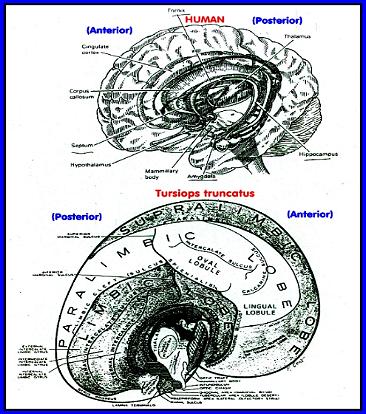
The one unique featue of the human brain is the gross appearance of the cerebral
cortex which has numerous folds or convolutions called folia. If a single
fold were rolled out into a flat sheet, it would have a serface of 2cm (anterior
to posterior) by 10 cm (medial to lateral) (Rosenweig).
The bottlenose dolphin's brain is more convoluted than that of any other
mammal including humans; however, its cerebral cortex is only half as thick
as a humans, but thicker than any primate indicating its superior intelligence
(Shanti).
Of all the species of organisms known to man, the family Delphinidae most
closely resembles the human brain. �No wonder, this family of mammals
have been the fucus of attention in the past several decades.
Research On Delphinidae Intelligence
Before any research can be discussed, a set of procedures and empirical
markers must be established with some degree of consisitency and consensus
for purpose of defining and indentifying "intelligence". �How can we
determine whether an Oranism is intelligent or not? �To begin with,
one must consider the distinction between "intelligence" as an abstract concept
and "intelligent behavior" as something which is observable and measurable.
the concept of the presence or absence of intelligence is a conclusion based
on whether the observer judges the behavior to be intelligent. �Therefore,
intelligence is not a biological property, like height, gender or brain size;
it is an abstraction based on value judgments about an organism's behavior
made by the researcher or observer. �If the organism that is being tested
does not do well on the test, it is judged to have low intelligence; and,
if it posses ample quantities of the behavioral characteristics that the
observer values, it is said to be intelligent. �Therefore, careful
consideration must be taken when evaluating an organism's intelligent
behavior.
Self-awareness as a preambulate of intelligence:
Self-awareness, consciousness, and the mind are all a reflection of the
same process (Gallup). �Trying to assess self-awareness in animals is
a formidable challenge. �Some Psychologists feel that the concept of
self-awareness is simply not amenable to objective empirical study in other
organisms (Gardiner). �Other researchers feel that humans are unique
in their capacity of self-conception (Buss) �There are even those who
argue that apparent instances of self-aware behavior in both humans and nonhumans
can be assumed by a simple reinforcement analysis (Marten)(Parker)(Boccia).
Even in humans, self recognition of one's own reflection whether it be
in a mirror, or through other objects is relative common place, but not
universal. �The capacity to recognize one's reflection appears to be
subject to maturation. �The ability to correctly interpret mirrored
information about one's self presupposes prior experience. �For instance,
people born with cogenial visual defects who undergo operations in later
life providing normal vision, repond just like nonhumans and initially react
to their mirrored reflection as though they were seeing another person (Von
Senden) �Some people never learn to recognize themselves when viewing
in a mirror. �There are instances of profoundly retarted children,
adolescents and adults who have had a life-time of exposure to mirrors, but
persist in treating the reflection as another perion (Gallup) (Von Senden)
White & Cate along with Marten and Psarakos all conducted numerous
studies involving several dolphons utilizing mirrors to assess whether the
dolphins recognized contingent representations of themselves. �Under
both research teams's hypothesis, a measure of self awareness is by
�observing an animal's reaction to its mirror image. �If it realizes
it is itself by touching itself, it is self aware. �Self awareness has
been demonstrated in the primates by anesthetizing the subject, marking its
forehead, and watching it reaction when it wakes up. �When it sees the
mark in a mirror, does it investigate it by touching himself or the mirror
(Bavidge)? �These researchers replicated prior research on primates
except using the Tursiops truncatus instead of primates as the subject.
Both research teams marked the dolphins with zinc oxide on their side,
an area which would normally be not visible to the individual except when
viewed in a mirror. �Their behavior was videotaped through a one-way
mirror. �White & Cate reported: "Indeed they came to the mirror
and twisted and turned as if they were looking at their mark." �They
also tested whether their postures were self aware rather than social by
the use of controls. �They compared marked to unmarked behavior. �They
compared mirror behavior to behaviour with another "real life" dolphin. They
let the dolphins watch themselves on TV both real-time and playback and compared
the two. �The resuls of this research team strongly suggest self awareness
in the Tursiops trancatus. �
Marten & Psarakos studies hypothesized that if dolphins recognize
themselves on television, their behavior should be different with a real-time
view 'mirror mode' then it is when they are shown typed and playedback using
the same mirror mode material. �As stated before, they also ran experiments
by marking the dolphin in an area out of normal view. �The researchers
noted that the dolphins had been exposed to mirrors for approximately 160
hours propr to their television tests. �The results of these experiements
validated White & Cate's studies. �Marten & Psarakos stated:
~~~~~Please note, this is NOT the end of the paper..
just where I left off. �~~~~~
Therefore, it is not necessarily the whole brain that is indicative of
intelligence, but �those portions of the brain that deal with abstract
thought, perceptions, memory, etc. �To take this concept to a new millenium,
it is not just the size of those portions of the brain that deal with abstractrs
but also the speed and efficiency in which the brain can operate. �We
are now just being able to measure this concept in intraspecies on Homo sapiens
throuh the use of PET scans.
"A true picture of the dolphin's perceptual world can be developed
only if we accept an additional constraint. �A 'most parsimonious'
explanation for a given behavior must account for the energetic investment
of the organism in the neural control of the behavior, as well as the behavior
itself. �We must keep in mind that the world of the dolphin is constructed
by one of the largest information processing systems that has evolved in
vertebrates and that neural tissue is, energetically, the most costly tissue
in which to invest. �On the the assumption that evolution is parsimonious,
we have to establish the benefits that have balanced this costly investment
in neural tissue. �We must, therefore, consider the way large, as opposed
to small, amounts of neural tissue are invested in the control of behavior
and experience. �We must, in short, make a statement of the brain/mind
problem as a problem in neurobiology."
Brain Weight (grams)
Age of Man
Age of Dolphin
Length of Dolphin
1200
41 months
23 months
6' 6"
1350
78 months
28 months
7' 8"
1450
17 years
8 years
7' 10"
1600
10 years
8' 6"
?
?
Before we can determine this, we need to examine two basic questions.
Can interspecies difference in brain size only be related to interspecies
difference, in intelligence? And, among members of a given species, are those
with larger barins more intelligent? Obviously, the physical size of the
brain has a lot to do with intelligence; but, indeed, that is a somewhat
limited conceptual view. Certain anatomical functins may require a larger
brain size such as echolocation and this does not necessarily account for
intelligence. The majority of an organism's brain function has to do with
phsiological functions such as respiration, movement, auditory, visual and
so on .