CRY ETHIOPIA
After an immense devastation due to the war
with Eritrea, after may deaths and displacement of the rural population, while
an economic decline caused by the war is still progressing, and after waiting
for so long to know from our government the precise outcome of the ruling of
the Ethiopian-Eritrean Boundary Commission (EEBC), we are still kept in the
dark by our government especially in regard to the place known as Badme. This
name has become synonymous to the government's failure in handling the state
affairs. Many mistakes were done before and after the Ethio-Eritrean Conflict
erupted and turned to a full-blown war, and while the war was going on some
more mistakes were committed. Finally, the Algiers Agreement was signed, and
this marked the crowning of all governmental blunders.
The Ethiopian
Government (ETG) is pretending to care for the sovereignty of the country and
its territories, when it is accusing the UN Mission in Ethiopian and Eritrea
(UNMEE) for any violations of any obscure agreements. The ETG has discovered a
scapegoat for its blunders, and it is lashing at the poor Dutch General
currently (April-May 2002), who is the commander of the UNMEE. Has he done
anything wrong, if he allows people to come in to "his"
Temporary Security Zone (TSZ), which was established last year by including
sovereign Ethiopian territories? If the ETG had worked seriously to avoid the
establishment of the TSZ, as we know it today, then the current problems
wouldn't have arisen.
It would have been
appropriate to ask the Federal Parliament or Government to show us which side
of the „magic line“ of the EEBC is Badme located — if any one knows it at all.
We all learned that high-ranking officials of the ETG have claimed „victory“ due
to the EEBC ruling. The question is now, why don’t they clarify to the
Ethiopian people all matters of great concern regarding BADME and other
adjacent issues. I think victors don’t like to hide their achievements. Didn’t
the ETG show every body most of the material that documented the military
achievements while punishing the stubborn enemy that caused a lot of harm
mostly to the people of the North?
I’m writing these few
lines to express my "frustration" regarding the whereabouts of BADME
and the whole catalogue of issues around the Ethio-Eritrean conflict in general
and the border delimitation/ demarcation manipulations being conducted by the
parties involved ion particular.
Due to the reluctance
of the ETG to show the Ethiopian people every thing pertaining to
EEBC-Decision, I’ve tried at least to point out the issues that could help
understand what has been going on for a while. Well, I did some effort in
trying to find an answer to "Abebe's famous question" regarding the exact location of BADME in
relation to the black delimitation line of the EEBC. Well, this has become a
difficult job, at least until now.
The beginning of the current evils
While looking for some material
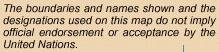
to get an answer, I remembered the UN-Map for the establishment of the TSZ that
was supposedly to be within Eritrean soil (see fig. 1). The map was issued back
in September 2000 including the following statement of reservation that is
directed at defusing the Ethiopian public anger and as a sign of the
uncertainty of the UN:
 .
.
You may remember how
Ethiopians were angry at the UN for this map, because places like Zalambessa
(Irobland) were put within the TSZ. Soon after this encounter, the map
disappeared from the web sites, and every thing remained in the dark until the
EEBC produced its maps.
By studying the maps of
the EEBC, one is stunned, to find out that the highly controversial section of
the Western borderline (Tomsa - Mai Ambessa) is "identical" to the
line put by the UN while establishing the TSZ; Badme plain is displayed as
extending on both sides of the line. (see fig. 1, 5 and 6)
Fig.
1

One may ask now: what was there first, the hen or the egg?
Didn't the EEBC just deliver a justifying text to an already established
borderline? A lot of people protested against this prejudice of the UN,
especially considering the location of Zalambessa. (see fig. 2 and 5)
Fig. 2
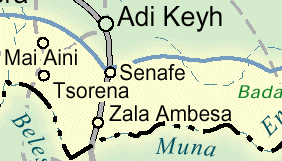
The UN has difficulty in establishing the TSZ, because both
parties wanted the border to be put somewhere else than proposed by the UN. It
was reported later that theEthiopian side didn't notice that parts of Irob were
included within the TSZ as Le monde diplomatique reported in December 2000.
This shows how careless the ETG handled the issue; nervous activities followed
to which the UN reacted with some face-saving manoeuvring for the sake of the
responsible "strongmen". One year ago on 18 April 2001, the TSZ was
established; and on 13 April 2002 the borderline was announced.
No one remembers that
the ETG protested against this vigorously; if I'm not mistaken, the
Ethio-Ambassador to the UN said something "toothless" pertaining to
the TSZ (Zalambessa) issue. The UN (UNMEE) reacted by just removing the map and
by downplaying the matter. This incident reminds of a parent soothing an
unquestioning kid, to punish him later.
The biggest negligence
that was displayed by the ETG was that it totally ignored the most sensitive
and volatile issue: The western border, Badme and the establishment of the TSZ
also on sovereign Ethiopian territory, even when it was a disputed one. To
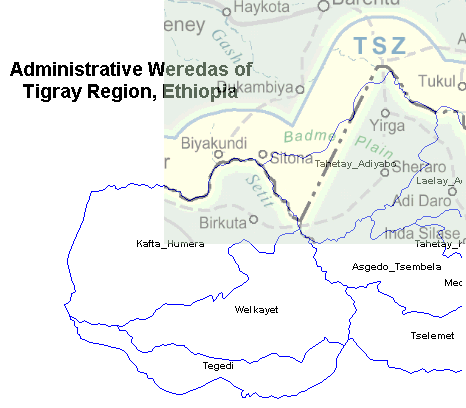
understand this assertion, one has to just overlay and adjust roughly the TSZ
map over the map of the Administrative Weredas of Tigray (see fig. 3 - 4)
Doesn't this amount to
accepting that the lands are not Ethiopian? The interpretation of the EEBC, as
pointed out in Paragraph 5.94 of its report, on page 84 (see reference below),
brings one to a conclusion that the ETG was not totally interested for the
Ethiopian cause, ever since beginning of the conflict that paved the way for
internal power struggle within the ruling party, causing the deviation of focus
and the selling-out of National Interests just as an instrument of having a
different and antagonising position, for the simple reason of being different
from the opponents. To have a different position than the meanwhile ousted
strongmen of the EPRDF, even while the different positions mean neglecting the
National Interest of Ethiopia, defines the performance of the ETG — to the
disadvantage Ethiopia, unfortunately. The price for this betrayal is a lot of
human life, natural and man-made wealth and as a crowning a "blanket of
disgrace" that is being put over Ethiopia. Must Ethiopian bear the burden
of humiliated and spoiled biography of individuals that is manifested as
self-inflicted embarrassment?
The humbleness of the
ETG on matters of National Interested increased the appetite of the invisible
powers behind the scene that are (were) supposedly working on helping to
resolve a deadly problem. The next chunk for the ETG to swallow was the
"The Algiers Agreement" as was signed in the name and for the
interest of the people Ethiopia, on 12 December 2000, few months after the
preparation of the TSZ map that apparently prepared the 'seed bed' for the EEBC
decision. The treaty supposedly puts steel chains around the hands of the
Ethiopian state. Time will tell if this would be really the case.
Fig. 3
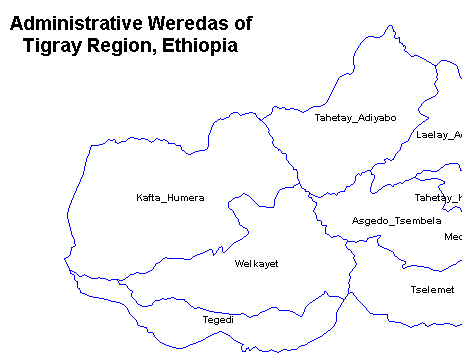
Fig.
4
If a government doesn't protect the sovereignty of the
state in all its manifestations, then what is the rationale behind producing
maps that would be of little significance?
What is Badme?
Is it a
place, an urban center, a town, a wereda, a rural area, a plain, a river a
mountain or an simply a conception or an idea of controversy? This questioning
may sound rather meaningless, considering the current discussion regarding the
issue.
Ethiopian and Eritrean
"strongmen" with equal vehemence believe, that the ruling of the EEBC
has awarded Badme to them. Well, one side will be definitely wrong — sooner or
later. Meanwhile every one knows that the EEBC hasn't fixed the matter; it
simply asserted that:
5.94 The Commission observes, secondly, that the
dates of Ethiopian conduct relate to
only a small part of the period that has elapsed since the 1902 Treaty. There
are some references to sporadic friction in 1929-1932 at Acqua Morchiti. Apart
from those, the material introduced by Ethiopia dates no further back than, at
the earliest, 1951 – a grant of a local chieftaincy to an Ethiopian general.
Even this grant, in specifying the places sought by the general, namely, Afra,
Sheshebit, Shelalo, from Jerba up to Tokomlia, Dembe Dina and Dembe Guangul,
described them as “uninhabited places” which the general wanted to develop. The
evidence of collection of taxes is limited to 1958 and 1968. In 1969 there is a
reference to a table of statistics about the Adiabo area, but of the places
mentioned in the table only two appear to be marked on the Ethiopian
illustrative figure of the claimed region. One item dating from 1970 refers to
the destruction of incense trees. There is some evidence of policing activities
in the Badme
Wereda in 1972-1973 and of the evaluation of an elementary school at Badme town. There are, in
addition, a few items dating from 1991 and 1994. (Eritrea
- Ethiopia Boundary Commission DECISION Regarding
Delimitation of the Border between The State of Eritrea, EEBC,
p. 84)
This sounds like a
fairy-tale, isn't it? The word Badme appears twice in the whole document, and
it produces little testimony for the Ethiopian assertions that Badme has been
always Ethiopian. It is disturbing to learn that the ETG and the highly paid
representatives at The Hague didn't accomplish their mission in an orderly
manner. It is widely believed that adequate and solid supporting material could
have been delivered to the EEBC. Why didn't this happen, and who hindered this
to happen? However, I'm tempted to believe that the parties involved in this
litigation are meaning different places or matters at all. Even after 13 April
2002, people are reiterating
that Badme is Ethiopian and nobody shall change this. What and where is Badme?
One cann't blame the
EEBC for the whole mess that has unfolded so far. They have done what was more
or less expected of them — however, by whom. They interpreted treaties that
favoured from the very beginning the aggressor: Colonial Italy. It was
insulting to learn that once again present day generations of Ethiopians have
to be victims of European aggression and manipulations.
One has to bear in mind
that Colonial Italy came to Ethiopia to commit its aggression and to blackmail
the existing societies to accept its terms for pursuing its colonial ambitions.
It is Colonial Italy's interest that has been put to paper, that was unfortunately
co-signed by representatives of Ethiopia. Emperor Menilik didn't go to Rome to
pursue the National Interest of Ethiopia.One hundred years later the whole
drama is being replayed, just to finish the halted mission of disgracing
Africa.
Interpreting a treaty
that was formulated to be just an instrument of subjugating Ethiopia could not
produce something good to Ethiopia, of today; it victimizes Ethiopia again
after 100 years. The Ethiopian government is willingly dancing to every tune
that is produced by people who don't have any obligations to Ethiopia.
Invoking the demons of
Colonialism allegedly for the sake of "peace and democracy" marks the
greatest swindle that is being told by those involved in the deceiving
campaign. The people who are talking of Peace and democracy in Ethiopia have
apparently a dictionary of their own making, while referring to these words of
great meaning and aspiration to humanity. If we had leaders who take the well being
of their people, then the whole mess wouldn't have grown to such detrimental
proportions, at all. Well, "Does Africans have to die for borders that are
results of Colonialism?" asked the presenter of the "Straight Talk
Africa" programme of VOA. Well, this shall be the question Eritreans have
to think about, on the first place, while going on jilting their identity.
Colonial history that
amounts to the creation of Eritrea and the nation building while denying one's
heritage as part of Ethiopia, would haunt Eritreans after these matters rest in
peace and an appraisal is conducted on costs and achieved benefits. The only
psychological motivation of Eritreans, of being better and superior, and of
wanting to have a lion's share while remaining the kitten, would undoubtedly
create the greatest depression. We are experiencing nowadays the
garbage-throwing practice again, after it was silenced due to the experience of
the summer of 2000.
History repeats itself
Ethiopian leaders at
any administration levels should be so weak that they have to be passive
spectators of the dealings of other powers. When a certain Dr. Solomon —
"parliament" speaker of the Tigray Region — asks the EEBC to tell him
where Badme lies, one is really astonished as if there is a government that
operates like governments else where. The top people in Addis were telling the
world that Badme remains Ethiopian and the gentleman from Mekelle begs the EEBC
to fix the problem. Some weeks ago, while the whole Security Council of the UN
was touring the region just to feel the emotions of those involved in the
"theater", he publicly declared, that he would never accept any
ruling that wouldn't hand over territories that are claimed by Ethiopia.
Were the reports of his
warning false? He didn't at least refute such reports. Question: What was he
talking about then, if he expects the EEBC today to say which side of the
delimitation line Badme lies. This creates some sort of repetition of history,
similar to that mentioned by the EEBC below (quotation). The governor of Tigray
100 years ago might have treated the matter by ruling out that the white man
may have evil motives. Furthermore, one has to consider that lack of
communication and manpower, the hostile nature of the territory in those days
would have highly hindered the exercise of state authority. The colonizers, as
demonstrated by ignoring the message that was according to their interest, did
not welcome even the forthcoming approach of the governor. It is widely known
that self-respect begins at home. Expecting to be loved and accepted by
foreigners rather than by one's own people has marked the betrayal of African
local chiefs and big men of any kind. People, who claim to be self-confident
and well informed regarding matters that concern them, are repeating this
behaviour today.
As history witnesses,
timid approaches by weak individuals or groups, who allegedly represent the
people's will and wishes in front of a strong "partner", are
susceptible to ridiculing treatments of the senior "Partner"; the naïve ones end up loosing. The
following excerpt from the report of the EEBC shall support his statement:
"...
On 8 August 1902, Garasellassie, the Ethiopian Governor of Tigray, acknowledged
a letter from Martini dated 3 August (not produced by either Party in these
proceedings) in which Martini had reported on the borders agreed with Menelik,
possibly along the lines of his letter to Ciccodicola of the same date.
Garasellassie stated that “Cunama is a name that we generally apply to all of the
Baria villages” and said that he would therefore “appreciate a clear
explanation on which are the villages you mentioned from Mai Ambessa and [going
to] the Setit. Please let me know the names of nearby villages so that I can
use it as a rule.” The record contains no reply to this letter. ..." (Eritrea - Ethiopia Boundary
Commission DECISION Regarding
Delimitation of the Border between The State of Eritrea, EEBC,
p. 71)
We cann't blame in retrospective
the blunders of Ethiopians rulers, and to the least the then regional ruler of
Tigray. His boss, Emperor Menelik II, gave in after all to the pressure of the
colonizers — no matter what his plans, intensions and goal might have been,
regarding this part of Ethiopia. After 100 years the outcome is displayed in
fig. 5. The blue colored area was an Eritrean claim that was not awarded;
apparently, Eritrea claimed it as a bargaining chip. The EEBC adhered simply to
the line as fixed while establishing the TSZ; the smaller map (note the smaller
charachters) in fig. 6 is a section of the EEBC map on the Western
sector. No devitaion between the TSZ map and EEBC map regarding the "Tomsa
- Mai Ambessa" line.<
Fig.
5
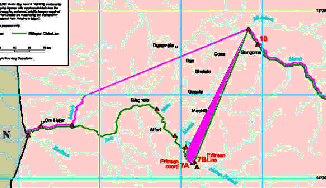
Fig. 6

Two
leaders in the service of "The scramble for Africa"
It has become very obvious to every body concerned that the
current Ethiopian and Eritrean "leaders" are preoccupied mainly with
the routine task of staying in power. They have shown little substance that
would amount to a display of love and care of their people. Many matters have
surfaced over the last years that shed light on the real nature of these
leaders. Many African leaders fought against the evils of Colonialism. They
worked hard to preserve national, historical, cultural etc. identities of their
people and countries. What is being offered to Ethiopians and
"Eritreans" is really shameful. Future generation would get a great
deal of headache, if self-identity means something to them — after the dust has
settled.
And finally, the actors said:
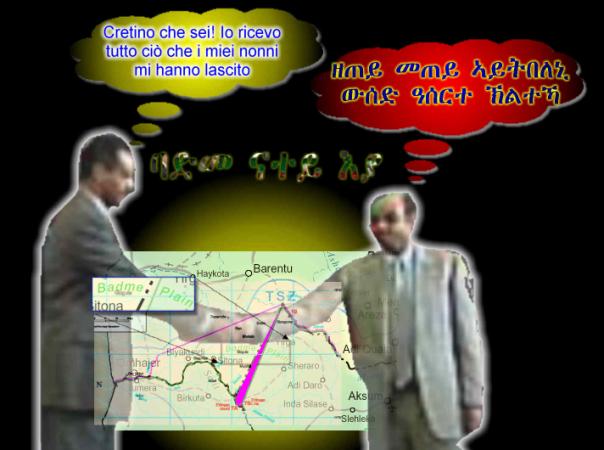
"You foolish! I will get
what my grandparents had left for me", says the gentleman on left side.
From

May 2002