Rajah Humabon (Cannon) class
Destroyer Escort/Frigate (1)
PF 11 BRP Rajah Humabon (ex USS Atherton DE 169;
ex Hatsuhi DE 263; ex Rajah Humabon PF 6)
Type: Light Frigate/Destroyer Escort
Displacement, full load: (1,390 T standard); 1,750
T
Dimensions: 93.27 m x 11.15 m x 3.56 m (306' x
36.6' x 14')
Main Machinery: 4 x 6,000 shp (4.5 mW) GM mod.
16-278A diesel electric, tandem motor drive, 2 shafts,
260 tons fuel
Speed: 20 knts
Range: [max] 20,000 km (12,430 mi); [cruising]
17,377 km (10,800 mi at 12 knts)
Complement: 165
Weapon Systems
Main Gun: 3 x Mk. 22 3"/50 SP (76 mm)
Range: 12 km (6.6 nm)
Rate of Fire: 20 rpm
Gunfire Control System: Mk. 52 GFCS, removed
Rangefinder: Mk. 51
Secondary Gun: 3 x Bofors Mk. 3 40 mm/56 (Twin)
Range: 11 km (5.9 nm); [AA] 7.16 km (3.87 nm)
Rate of Fire: 160 rpm
Gunfire Control System: Mk. 51 Mod 2 GFCS
Rangefinder: Optical
Tertiary Gun: 4 x Oerlikon Mk. 4 20 mm/70
Range: 2 km (1.06 nm)
Rate of Fire: 800 rpm
Gunfire Control System:
Rangefinder: Optical
Other Defenses: 4 x 12.7 mm HMG
Anti-submarine Mortar: 1 x Manual Mk. 10
Hedgehog (warhead 26 kg, 24 rockets), removed
Range: 350 m
Depth Charge: 1 x 8 K-gun Mk. 6 Projectors (warhead
150 kg), removed
Range: 160 m
Radars
Surface Search: Raytheon SPS-5; G/H band
Range: 37 km (20 nm)
Navigation: RCA/GE Mk. 26; I band
Sonar: SQS 17B, hull-mounted, active search and
attack, medium frequency, removed
Builders: Federal SB & DD, Newark, New
Jersey
Year(Laid Down/First Commissioned/Commissioned in PN): 14
January 1943/ 29 August 1943/ 27 February 1980
Program: The USN had six classes of destroyer
escorts during WW II and the Cannon class was the longest-ranged
DE (radar picket, long hull) ship at that time. They were
constructed as ocean-going escort ships and about 70
ships of this class were constructed between 1942 and
1944. PF 11 (ex DE 169) commissioned in 29 August 1943,
USN, operated under Task Force 62, on escort duty for
transatlantic convoys, credited for sinking the German
sub U-853 in 9 May 1945 during WW II and was awarded one
battle star for WW II service. Decommissioned from USN on
10 December 1945. Served in Japan Maritime Self-Defense
Force as DE 263, Hatsuhi from 14 June 1955 to June 1975,
reverted to USN in 1975, then sold to the PN in 23
December 1978, officially commissioned in 27 February
1980 after she was towed to South Korea. Currently
serving in the West Philippine Sea near the disputed
Spratlys under the Philippine Fleet's Patrol Force. PF 11
is currently the largest of the PN warships.
Structure: Retired in 1993 but was
reactivated in 1995 at Cavite Dockyards and
recommissioned in 1996, where she had a minor refit,
including removal of obsolete 3" GFCS, with all guns
now locally controlled using ringsights. Also all ASW
equipment removed including depth charge, torpedo tubes
and sonar due to lack of available spare parts prior to
1995.
Modernization: Towed to Korea for
modernization and overhaul, and additional guns were
added before transferred to PN. Overhauled in 1995.
Further upgraded/ refurbished in 1998. Undergone
extensive hull and engine overhaul in 2000 during the
CARAT exercises with the assistance of USN ship USS
Salvor. Additional electronics upgrades includes Furuno
Satcom and a mast-mounted FLIR package.
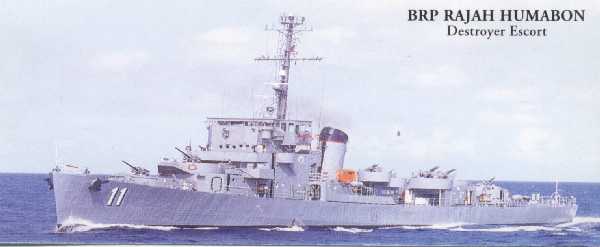
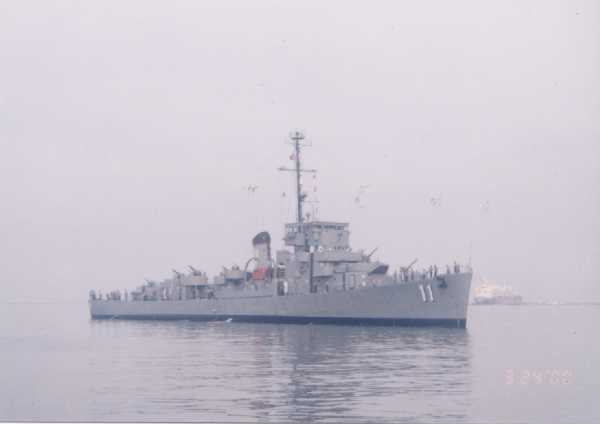  
Three views of the PN
frigate PF 11 BRP Rajah Humabon.
Back to top
Rizal (Auk) class Minesweeper/Patrol
Corvette (2)
PS 70 BRP Manuel Quezon (ex HMS Exploit BAM 24;
ex USS Vigilance AM/MSF 324)
PS 74 BRP Jose Rizal (ex USS Murrelet AM/MSF 372; ex Jose
Rizal PCE/PS 69)
Type: Corvette/Light Frigate
Displacement, full load: (1,090 T, standard) 1,250
T
Dimensions: 69.75 m x 9.82 m x 3.28 m (228.79' x
32.21' x 10.8')
Main Machinery: 2 x 3,532 hp GM 12-278 diesel
electric drive engines, [PS 70] Farrel-Birmingham single
reduction gear, 2 shafts [PS 74] Westinghouse single
reduction gear, 2 shafts, 216 tons fuel
Speed: 18 knts
Range: 10,545 km (6,554 mi)
Complement: 5 Officers + 75 Ratings
Weapon Systems
Main Gun: 2 x Mk. 26 3"/50 SP (76 mm)
Range: 12 km (6.6 nm)
Rate of Fire: 20 rpm
Gunfire Control System: Mk. 52 GFCS
Rangefinder:
Secondary Gun: 2 x Bofors Mk. 3 40 mm/56 (Twin)
Range: 11 km (5.9 nm); [AA] 7.16 km (3.87 nm)
Rate of Fire: 160 rpm
Gunfire Control System: Mk. 51 GFCS
Rangefinder: Optical
Tertiary Gun: 2 x Oerlikon Mk. 4 20 mm (Twin)
Range: 2 km (1.06 nm)
Rate of Fire: 800 rpm
Gunfire Control System:
Rangefinder: Optical
Other Defenses: 4 x 12.7 mm HMG
Torpedoes: 3 x 324 mm Mk. 32 triple tubes, Mk.
44 anti-submarine active homing (warhead 26 kg), removed
Range: 5.5 km (3 nm)
Speed: 30 knts
Anti-submarine Mortars: 1 x Mk. 10 Manual
Hedgehog (warhead 26 kg, 24 rockets), removed
Range: 350 m
Depth Charge: 2 x Mk. 9 Racks
Range:
Radars
Surface Search: Raytheon SPS-5C; G/H band
Range: 37 km (20 nm)
Navigation: DAS 3; I band
Sonar: Tarcan55 b4-a; SQS-17B, hull-mounted,
active search and attack, high frequency
Aircrafts: MBB BO-105C (PS 70 only)
Builders: Associated SB, Seattle, Washington (PS
70); Savannah Machinery & Foundry Co., Savannah,
Georgia (PS 74)
Year(Laid Down/First Commissioned/Commissioned in PN): PS
70 28 November 1942/ 28 February 1944/ 19 June 1967; PS
74 24 August 1944/ 24 August 1945/ 18 June 1965
Program: Ex USN fleet minesweepers, and were the
first class of ocean-going minesweepers designed during
WW II. PS 74 (ex AM 372) served in minesweeping
operations in Japanese and Korean waters in 1946,
participated during the Korean crisis until December 1953,
redesignated MSF 372 in 7 February 1955, decommissioned
from USN in 1957, transferred to the PN under military
assistance program in 18 June 1965 as PCE 69,
reclassified as PS 69, then PS 74. PS 70 (ex AM 324),
originally laid down for the Royal Navy as HMS Exploit
BAM 24, but the USN decided to keep her. Generally served
as an escort, minesweeper and AA/ASW patrol. Part of
MinRon 4 during the invasion at Okinawa, gunning down
several Japanese aircrafts, providing support to damaged
ships and rescuing survivors. Assigned to Task Unit 39.11.4,
afterwards until the Japanese surrendered and was then
based in Japan during the occupation. Decommissioned on
30 January 1947 She was awarded three battle stars for
her WW II service. She was reclassified as MSF 324 in 7
February 1955 and transferred to the PN as a grant-aid on
19 August 1967. Both ships stricken in 1994 but returned
to service in 1995-1996. PS 74 is among the most active
of the PN WW II era ships, sinking a Chinese fishing boat
in a collision on May 1999 off Scarborough Shoal. These
ships serves in the Philippine Fleet's Patrol Force.
Structure: Upon transfer to the PN, the
mine-sweeping equipment was removed and additional 1 x 3"/50
SP (76 mm) gun fitted aft (PS 74 only); additional anti-submarine
weapons also fitted. PS 70 has bulwarks on iron decks to
end of superstructure which PS 74 does not have. Now have
a helicopter flight deck (but no facilities) in place of
place of 3" gun.
Modernization: Both ships overhauled in 1995
with assistance from Hatch & Kirk, which involved
major engine parts replacements, with PS 74 completed
restoration in January 1996 and PS 74 in April 1996.
Recent upgrades includes a satellite radio dish, for
communications.
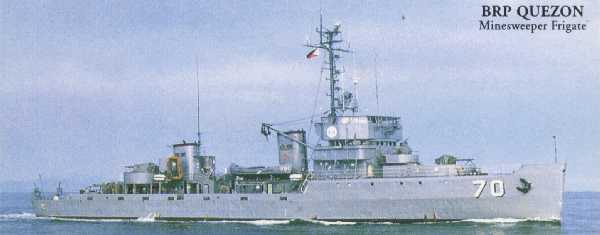
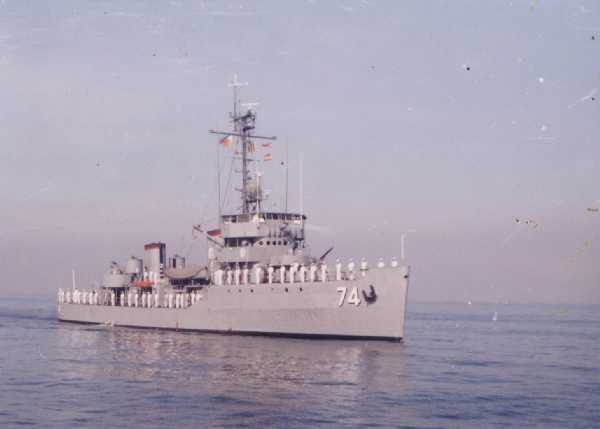 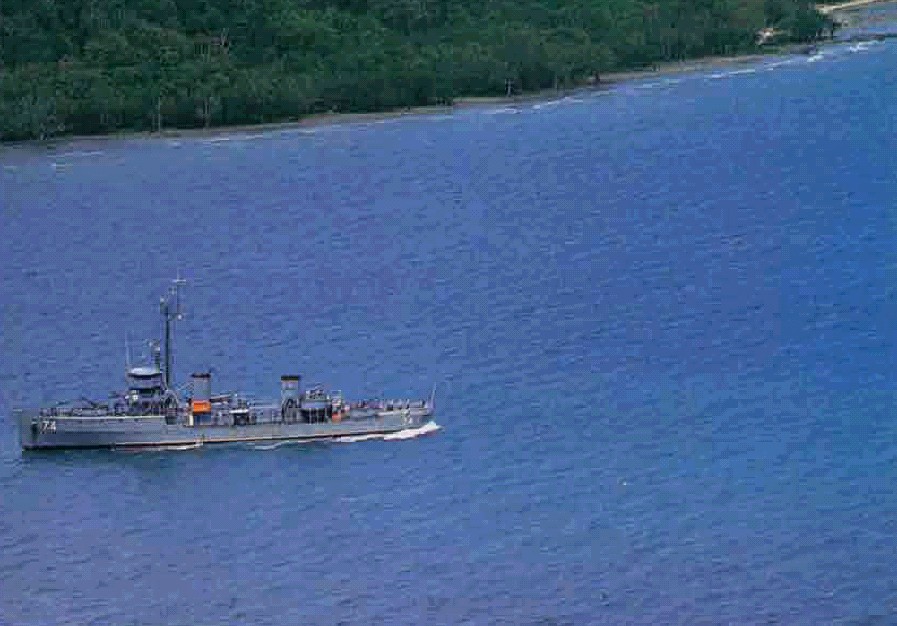
Three photos of the PN
corvettes PS 70 BRP Manuel Quezon and PS 74 Jose Rizal.
Back to top
Jacinto (Peacock) class Patrol
Corvette (3)
PS 35 BRP Emilio Jacinto (ex HMS Peacock)
PS 36 BRP Apolinario Mabini (ex HMS Plover)
PS 37 BRP Artemio Ricarte (ex HMS Starling)
Type: Corvette
Displacement, full load: 763 T
Dimensions: 62.6 m x 10 m x 2.72 m (205.32' x 32.8'
x 8.92')
Main Machinery: 2 x 7,094 bhp APE-Crossley SEMT-Pielstick
18 PA6 V280 diesels, 2 shafts, 1 x 181 shp Schottel S103
LSVEST drop-down, shrouded loiter props, 44 tons fuel
Speed: 28 knts (25 knts sustained)
Range: 2,500 nm at 17 knts
Complement: 6 Officers + 25 Ratings (44 max.
accomodation)
Weapon Systems
Main Gun: 1 x OTO Melara 76 mm/ 62 calCompact DP
(450 rds ammo)
Range: 18 km (10 nm)
Rate of Fire: 80 rpm
Gunfire Control System: [original] BAe GAS 7 Sea
Archer Mk. 1 Electro Optical Director and GEC V3800
Thermal imager; [uprated] Radamec 1500 All-weather, Day
and Night, Electro Optical Tracking and Gunfire Control
System
Rangefinder:
Secondary Gun: [uprated] 1 x MSI Defence System
Ltd. 25 mm/ 75 cal Bushmaster chain gun
Range:
Rate of Fire:
Gunfire Control System: [uprated] Radamec 1500
All-weather, Day and Night, Electro Optical Tracking and
GFCS
Rangefinder:
Tertiary Gun: 2 x Mk. 14 20 mm
Range:
Rate of Fire:
Gunfire Control System: Manual
Rangefinder: Optical
Other Defenses: 4 X 12.7 mm MG
Radars
Surface Search: Kelvin Hughes Type 1006
Range:
Navigation: Kelvin Hughes Type 1006
Sonar:
Builders: Hall Russel, Aberdeen, Scotland,
United Kingdom
Year(First Commissioned/Commissioned in PN): PS
35 1983/ 1 August 1997; PS 36 1984/ 1 August 1997; PS 37
1984/ 1 August 1997
Program: Commissioned in the Royal Navy in 1984
and originally formed the Hong Kong Squadron, sold to the
Philippines upon the return of Hong Kong to China in 1998
for $20-M for all three including plans and IPR were
transferred to the PN. These ships serves in the
Philippine Fleet's Patrol Force.
Structure: By far, among the most modern
capital surface ships of the PN. These ships are fully
air-conditioned and were designed to stay at sea during
rough weather. Bilge keels were deepened to correct
rolling problems during moderate and heavy seas. Armed
with OTO Melara 76 mm Compact DP, which can fire 6 kg
shells in excess of 15 kilometers. They carry two
additional Mk. 14 20 mm guns amidships and two 50 mm
rocket flare projectors. The ship also carries an aft
crane and two Avon Searaider 5.4 m, 40-knot Rigid-hull
Inflatable pursuit craft, which can carry six personnel.
Modernization: PN ordered nine units of
generators for the JCPV which were procured through
direct contracting, with Propmech Philippines as the
contractor for a project price of P29.868-M, with all 9
generators delivered on June 2005. JCPV uprating to
accommodate C4I systems. Phase 1 uprating (electronic and
weapons systems) was undertaken through government-to-government
contract with the UK, with the project being awarded to
QinetiQ Ltd. of UK. Contract price is at P959.44-M. The
project will enable the vessels to perform a greater
number and variety of missions. The vessels were dry-docked
at Keppel SY in Batangas where 97% of the spare parts
have been delivered on December 21, 2005. It involved the
installation of Ultra Electronics Command and Control
Systems and Radamec 1500 optronic director with a
daylight TV camera, thermal imaging camera and eyesafe
laser rangefinder. and its integration with the existing
refurbished 76 mm gun and the newly installed aft 25 mm
gun. The system provides fire control for surface
engagements with spotting corrections in both line and
range and has an effective secondary self-defense anti-air
capability. The Radamec 1500 can detect a small patrol
boat at ranges in excess of 12 kilometers day or night
and can perform in automatic of manual mode. It also
involved the installation and integration of new
navigation systems - Raytheon gyrocompasses, Sperry
Marine Bridge Master E Series radar, GPS system,
anemometer and EM logs. All ships have already undergone
Phase I uprating which resulted in the optimum
utilization of precision enfilade naval gunfire to
support land forces engaged in ISO and effective on-scene
command and control platforms for SAR, anti-smuggling and
anti-drug-trafficking operations. Phase II is for the
marine engineering/propulsion upgrade, which includes the
hull modifications and repair, overhaul of the main
machinery including all electricals, control, monitoring
and auxiliary systems and crew training. It has an
approved budget of P354-M and the prime contractor is F.F.
Cruz Marine Corp. Phase III is SLEP, which is still under
bidding. May be armed with SSMs in the future.
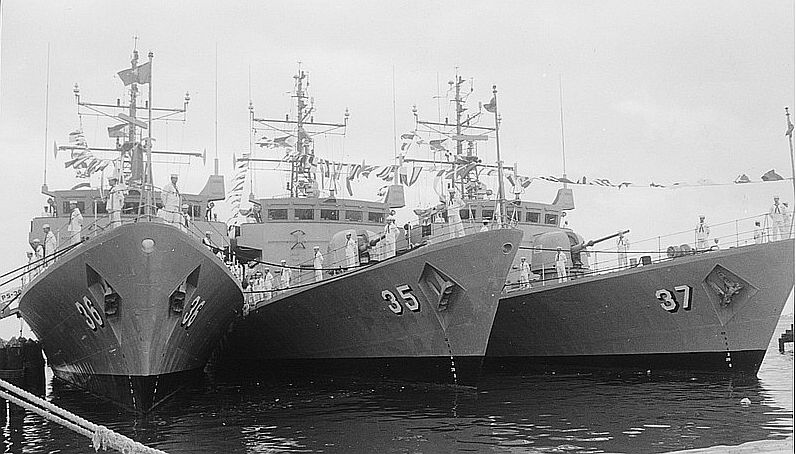 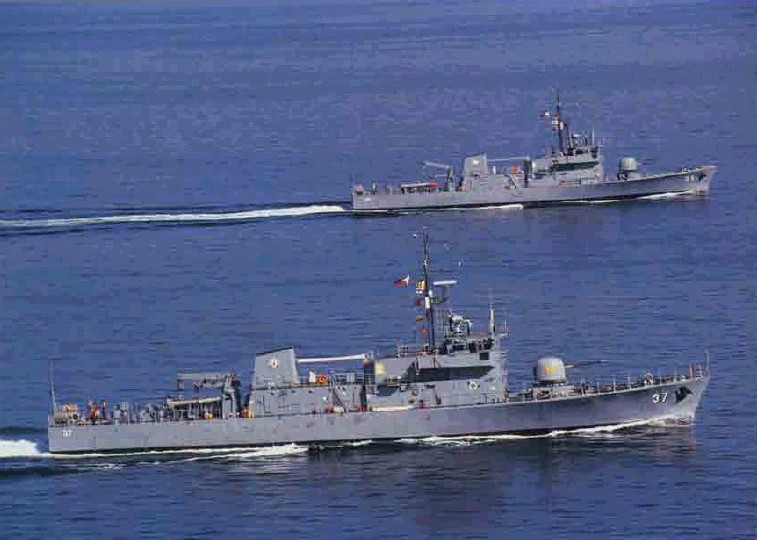
The three new ex
Peacock-class OPVs, PS 35-37 in anchorage on the left ,
and PS 35 and 37 at sea on the right
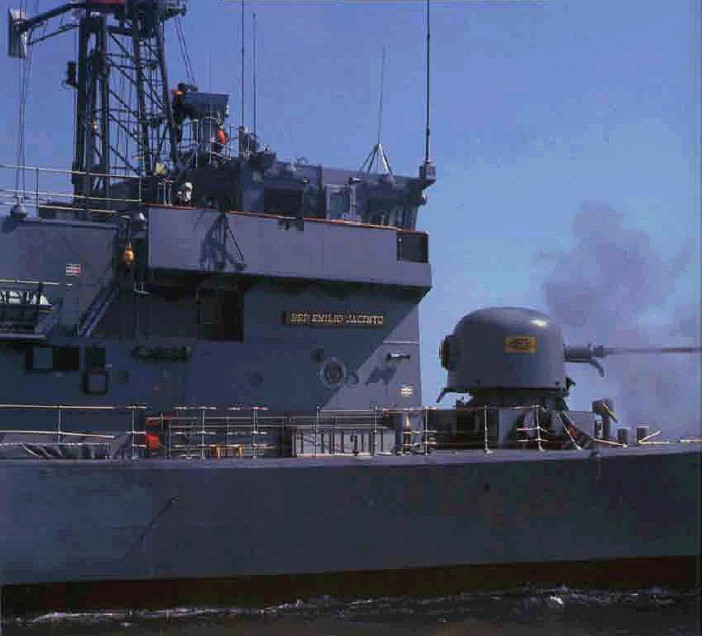 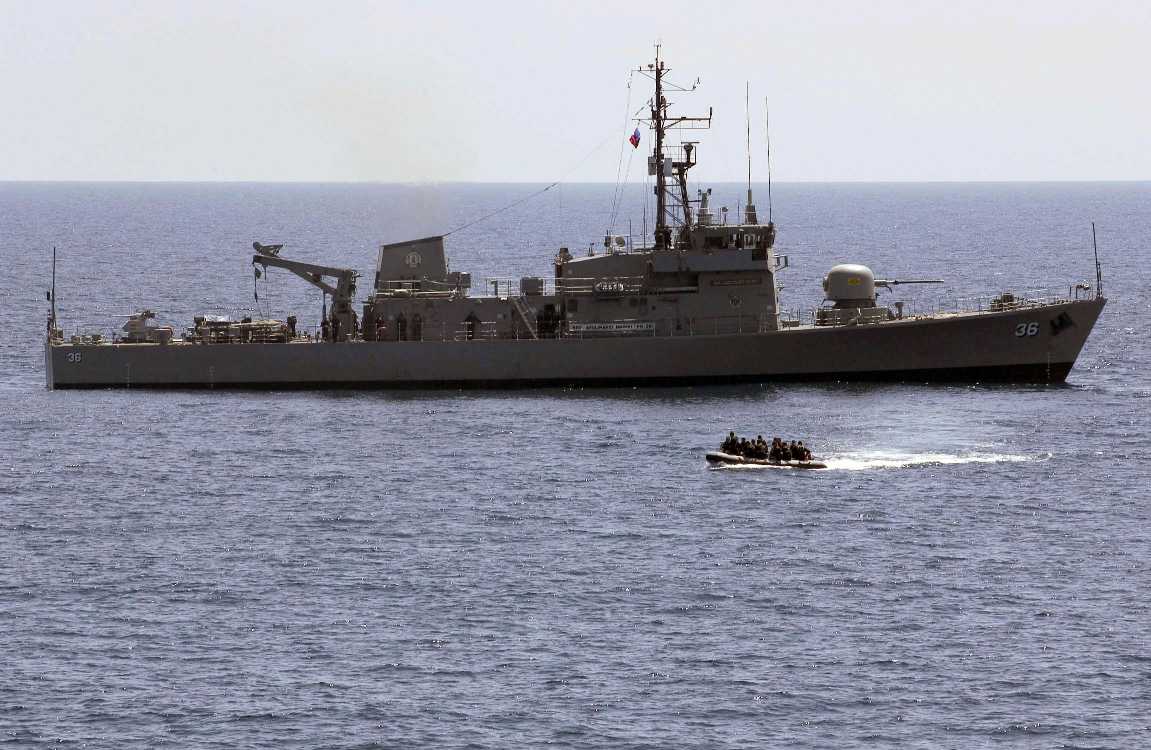
PS 35 BRP Emilio
Jacinto firing its main gun on the left and the uprated
PS 36 BRP Apolinario Mabini on the right.
Back to top
Malvar (Admirable/PCER 848/PCE 881)
class Patrol Corvette (8)
PS 19 BRP Miguel Malvar (ex USS Brattleboro PCER/EPCER
852; ex Ngoc Hoi HQ 12)
PS 20 BRP Magat Salamat (ex USS Gayety AM/MSF 239; ex Chi
Lang II HQ 08)
PS 22 BRP Sultan Kudarat (ex USS Crestview PCER 895; ex
Dong Da II HQ 07)
PS 23 BRP Datu Marikudo (ex USS Amherst PCER 853; ex Van
Kiep II HQ 14)
PS 28 BRP Cebu (ex USS PCE 881)
PS 29 BRP Negros Occidental (ex USS PCE 884)
PS 31 BRP Pangasinan (ex USS PCE 891)
PS 32 BRP Iloilo (ex USS PCE 897)
Type: Corvette
Displacement, full load: (640 T, standard); 922
T
Dimensions: 56.24 m x 10.26 m x 2.87 m (184.5' x
33.65' x 9.8')
Main Machinery: [PS 20] 2 x 1,710 hp (1.28 mW)
Cooper Bessemer GSB-8 diesels, National Supply Co. single
reduction gear; 2 shafts; [PS 19, 22-32-] 2 x 2,200 hp (1.64
mW) GM 12-278A diesels, Falk single reduction gear, 2
shafts
Speed: 15 knts
Range: 8,325 km (5,174 mi)
Complement: 8 officers + 77 Ratings
Weapon Systems
Main Gun: 1 x 3"/50 SP (76 mm)
Range: 12 km (6.6 nm)
Rate of Fire: 20 rpm
Gunfire Control System:
Rangefinder:
Secondary Gun: 2-6 x Bofors Mk. 3 40 mm/56 (Single
or 1-3 Twin)
Range: 11 km (5.9 nm); [AA] 7.16 km (3.87 nm)
Rate of Fire: 160 rpm
Gunfire Control System:
Rangefinder: Optical
Tertiary Gun: 2 x Oerlikon Mk. 16 20 mm/70
Range: 2 km (1.06 nm)
Rate of Fire: 800 rpm
Gunfire Control System:
Rangefinder: Optical
Other Defenses: 4 x 12.7 HMG
Anti-submarine Mortar: 1 x Mk. 2 81 mm
Range:
Radars
Surface Search: SPS-21D (PS 19); Sperry SPS-53A,
I/J band (PS 20); SPS-50 (PS 23); CRM-NIA-75 (PS 29, 31,
32)
Range:
Navigation: RCA SPN-18; I/J band
Sonar:
Builders: Pullman Standard Car Manufacturing Co.
Chicago, Illinois (PS 19, PS 23); Winslow Marine Railway
& SB Co., Seattle Washington (PS 20); Willamette Iron
& Steel Co., Portland, Oregon (PS 22, PS 31, PS 32);
Albina Engine and Machine Works, Portland Oregon (PS 28,
PS 29)
Year(Laid Down/First Commissioned/Commissioned in PN): PS
19 28 October 1943/ 26 May 1944/ November 1976; PS 20 /
19 March 1944/ November 1975; PS 22 2 December 1942/ 30
October 1944/ November 1975; PS 23 16 November 1943/ 15
June 1944/ 5 April 1976; PS 28 11 August 1943/ 31 July
1944/ 1948; PS 29 / 30 March 1944/ 1975; PS 31 / 15 June
1944/ 1975; PS 32 16 December 1942/ 6 January 1945/ July
1948
Program: Part of the 122 ex-USN MSFs, PCEs and
PCERs, all variations to the common Admirable class hull,
designed as A/S convoy escorts and reclassified as Fleet
Minesweepers (Steel Hull). Most had been transferred to
South Vietnam, then escaped to the Philippines in 1975
during the fall of Saigon, and were subsequently sold. PS
19 (ex PCER 852) was first commissioned on 26 May 1944,
reclassified as experimental PCER in 1946, named
Brattleboro in 15 February 1956, transferred to Vietnam
in 11 July 1956 as HQ 12 Ngoc Hoi, escaped and eventually
sold the PN in 1975. PS 22 (ex PCE 895) first
commissioned on 30 October 1944, named Crestview in 15
February 1956, transferred to Vietnam in 29 November 1961
as HQ 07 Dong Da II, escaped and eventually sold to the
PN in 1975. PS 23 (ex PCER 853), served as an escort in
the Leyte invasion, as an antisubmarine picket ship in
Lingayen, as an escort during the assault on the Ryukyu
during WW II, where she was awarded two battle stars for
service. Spent time as a training ship afterwards and
renamed Amherst in 1956. Transferred to South Vietnam in
June 1970 and served as HQ 14 Van Kiep II until she
escaped to the Philippines in 2 May 1975. PS 28 (ex PCE
881) first commissioned on 31 July 1944, transferred to
the Philippines in July 1948. PS 32 (ex PCE 897) first
commissioned on 6 January 1945, transferred to the
Philippines in July 1948. These ships serves in the
Philippine Fleet's Patrol Force.
Structure: PS 19-23 were originally
fitted as rescue ships, PCER. PS 20 is of the Admirable
class MSF the rest are PCER 848 or PCE 881class. All
minesweeping and A/S equipment removed. There may be
additional variations in the armament (PS 19 has two twin
40 mm, PS 20 has two 40 mm). Number of operational units
unclear.
Modernization: All ships underwent major
refit/overhauls between 1990-1997.
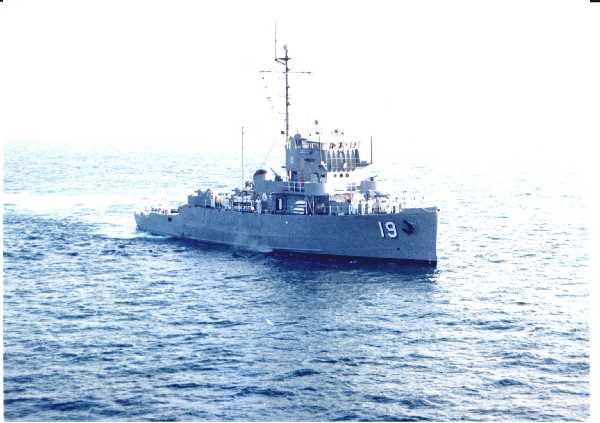 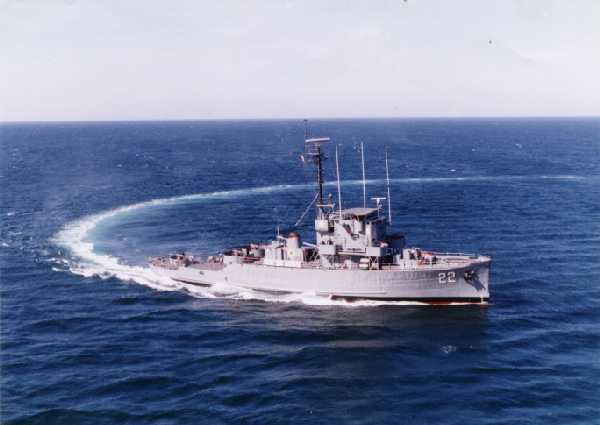
PN corvettes PS 19 BRP
Miguel Malvar and PS 22 BRP Sultan Kudarat underway
during fleet exercises.
 
A view of PS 28 BRP
Cebu's bridge supertructure, left and PS 32 BRP Iloilo at
dock, right. Thanks to Shonen Red and the IPMS site for the pic.
Back to top
Alvarez (Cyclone) class Patrol Craft
(1)
PS 38 BRP General Mariano Alvarez (ex USS
Cyclone PC 1; ex USCGC Cyclone WPC 1)
Type: Large Patrol Craft/Special Operations
Transport
Displacement, full load: 352 T
Dimensions: 54.57 m x 7.62 m x 2.44 m (179' x 25'
x 8')
Main Machinery: 4 x 3,350 bhp Paxman Valenta 16CM
Diesel, Model 16RP200M, 1,500 engine rpm,
4 shafts
Speed: [max] 35 knts; [cruising] 25 knts
Range: 957 km (595 mi) at 35 knots, 4,022 km (2,500
mi) at 12 knots
Complement: 4 Officers + 24 Ratings + 9
Commandos
Weapon Systems
Main Gun: 1 x M-242 25 mm Bushmaster low angle,
chain gun with Mk. 19 Mod. 3 40 mm grenade launcher in a
Mk. 96 mount aft and 1 x M-242 25 mm Bushmaster chain gun
in a Mk. 38 mount bow
Range: 2.46 km
Rate of Fire: 175 rpm
Gunfire Control System: Manual of Electric
Rangefinder: Electro-optical
Secondary Gun: 2 x M-2 12.7 mm HMG (Twin); 1 x
12.7 mm HMG (Single)
Range: 1.8 km
Rate of Fire: 450 rpm
Elevation:
Gunfire Control System:
Rangefinder:
Tertiary Gun: 2 x M-60 7.62 mm LMG
Range: 1.1 km
Rate of Fire: 100 rpm
Gunfire Control System: Manual
Rangefinder: Optical
Other Defenses: Mk. 52 Mod 0 chaff decoy RL
system (2 6-round Mk 137 RL)
Radars
Surface Search: 1 x Sperry Rascar 3400C X and S-band
navigation/ surface search radar
Range:
Navigation: 1 x Sperry Rascar 3400C X and S-band
navigation/ surface search radar
Early Warning: APR-39(V)1 Privateer radar
warning
Sonar: Wesmar side-scanning, hull-mounted, HF
sonar
Builders: Bollinger Machine Shop & SY,
Lockport, LA
Year(Laid Down/First Commissioned/Commissioned in PN):
22 June 1991/ 7 August 1993/ 6 March 2004
Program: US-built ships, based on the British
Vosper-Thoryncroft design (Province/Ramadan class missile
craft) but with light armament, different superstructure
and accommodations for SEAL team and delivery craft,
among other changes. They were intended as replacement
for seventeen ageing Sea Spectre Mk 3 for SEAL/SpecOps
transport and support, but were too large to effectively
serve in that role. Too cramped to accommodate additional
weapons and have limited endurance for their size.
Reassigned to USCG operational control, with Navy crews
and Coast Guard boarding teams, for homeland defense
missions. Designed to carry two 16 feet SEAL Combat
Rubber Raiding Craft (CRRC) and one 18 feet Rigid Hull
Inflatable Boat, but on completion carry only the RHIB.
There is a recessed platform at the stern for swimmer
debarking and embarking. Ammunition supply includes 2,000
rounds (25 mm), 2,000 rounds (12.7 mm), and 1,000
grenades (40 mm). PC 1 was commissioned as USS Cyclone,
USN in 7 August 1993, transferred to USCG in 29 February
2000, which has not utilized it, refurbished and
transferred to PN (including 2 years worth of spares) in
2004 as part of $115-M US military aid pledged by
Washington, This ship costs $30-M and is the most modern
ship in the ageing PN fleet. The primary mission of this
ship is coastal patrol, interdiction and surveillance.
This ship serves in the Philippine Fleet's Patrol Force.
Structure: Hull constructed from BS-4360
Grade 43A steel, superstructure constructed from 5086
aluminum alloy. Main propulsion is generated by four
Paxman Valenta 16CM-16RP200M diesels, developing 3,350
bhp, driving 12.8 cm six-blade highly skewed, variable
pitch and rake, NI-AL bronze MIL-B24480A, alloy 1
amendment 3 (nickel-aluminum-bronze alloy) propellers,
with pitch ratio of 1.465 at 0.7 radius and designed by
USN NSWCCD(Code 544 drawing number P-5237B). Four
Reintjes WVS-2232 reduction gearbox, with a reduction
ratio: 2.025:1. Fuel capacity is 47,772 liters (12,620
gallons). Oil capacity is 568 liters (150 gallons). Total
air conditioning plants production, 83.33 kW. They can
refuel at sea, using astern fueling rigs. Fully
operational at Sea State 3 with cruising speed of 25
knots, with 50% fuel capacity. Ship can survive up to Sea
State 5. Maximum ship endurance at 10 days. Electricity
supplied by two Caterpillar Model 3306 DIT Series B,
rating 150 kW @ 1,800 rpm. Reverse osmosis desalinators,
having a 1,514 liters (400 gallons) capacity per day.
Fresh water capacity is 4,701 liters (1,242 gallons).
Equipped with Vosper fin stabilization system and a stern
wedge to improve trim at high speeds. Kevlar armor is
fitted to the command space. The Sperry Vision 2100M
combat system employs the navigational radars and the
Sperry Voyage Management System integrated navigation and
control system as a combat data suite. Navigation systems
include GPS and Loran receivers. Radio gear includes LST-5C
SATCOM/line of sight UHF transceiver, A5 Spectra VHF
radio, ICM120 Marine Band radio, and RF 5000 HF, VRC-92A
VHF, and VRC-83(V)2 VHF/UHF transceivers. AN/SAT-2A
infrared signaling systems are fitted, and the Marconi
Vistar stabilized FLIR sensor with integral low light
level television camera is mounted on the mast. Have IFF
transponder but no interrogation capability, and
optionally available. Wesmar side-scanning hull-mounted
HF sonar with the sonar transducer is retracted within
the hull at speeds above 14 knts.
Modernization: Refitted by Bollinger
Machine Shop and SY for the PN in 2005 and had its stern
extended by nine feet to accommodate a deck ramp - which
extends down to below the water line, for a 20 feet Rigid
Hull Inflatable Boat (RHIB). PN plans to uprate main
weapon with a heavier caliber.
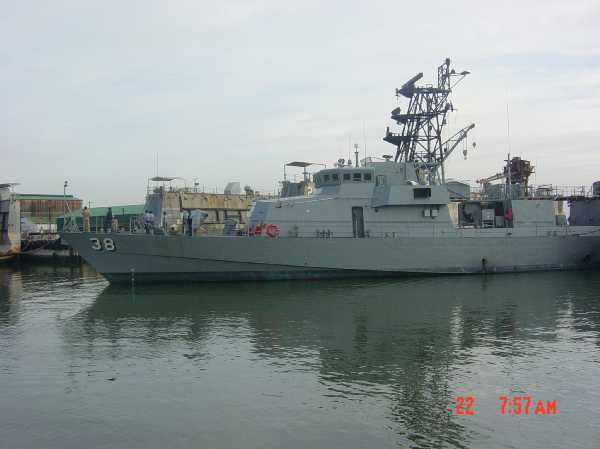
PS 38 General Mariano
Alvarez, the newest PN light corvette, photo taken in
2005 after she was delivered.
Back to top
Last modified on 3/24/09
 |