GROUND WEAPONS (Armor)
FV.101
| YPR-765 | M-113 | FS.100
| LAV-300 | LAV-150 | Ferret
| LVTH-6 | Next

Alvis Vickers Limited FV.101 Scorpion Light Tank
Type: Light Tank/Combat Vehicle Reconnaissance, Tracked-Fire Support Vehicle (CVR,T-FSV)
Country of origin: United Kingdom
Armor: 12.7-25 mm average, aluminum alloy
Crew: Commander, Gunner, Driver
Air transportability: roll-on/roll-off C-130
Dimensions
Length: 4.794 m (15.75')
Width: 2.235 m (7.33')
Height: 2.102 m (7.0')
Ground clearance:
Ground pressure: 0.36 kg/cm² (5.12 psi)
Weights and loadings
Combat weight: 8,075 kg (17,765 lb)
Power train
Engine: [original] One 190 bhp (142 kW), Jaguar J-60 Mk.100B OHC engine, 4.21 liter, 6 cc in-line gasoline, derated to 160 hp at 4,750 rpm; [uprated] One Cummins 6BT 5.9 6cc in-line diesel, 152 hp
Power-to-weight ratio: 20.2 hp/ton
Transmission: [original] Semi-automatic, 7-speed in all directions, hotshift type; [uprated] Automatic, 4 speed, 1,600 rpm
Transfer case:
Axles:
Tracks:
Suspension:
Performance
Max land speed: [road] 80.5 kph (50 mph)
Water speed: 4 kph (2.5 mph)
Acceleration: 0-48 kph (0-30), 16 sec
Range: 650 km (404 mi)
Vertical obstacle: 0.5 m (1.64')
Trench: 2.057 m (6.75')
Max fording depth: 1.07 m (3.51')
Gradient: 60%
Side slope: 30%
Turning radius: Pivot to infinite
Weapon Systems
Main gun: L23A1 76 mm/23, rifled gun
Max effective range: 1,000 m (3,280')
Rate of fire:
Elevation: -10° to +35°
Traverse: 360°
Ammunition: 40 rounds
Ammunition type: HE, HEAT, HESH, Smoke, Canister
Rangefinder: Laser
Night gun sight: White searchlight
Secondary gun: L3 7.62 mm coax MG
Max effective range:
Rate of fire:
Ammunition: 3,000 rounds
Ammunition type: Ball
Rangefinder: None
Night gun sight: White searchlight
Other defenses: 2 x Four-barrel smoke dischargers, Nightvision equipment
Variants used: FV.101 Scorpion (FSV), FV.104 Samaritan (Ambulance)
Program: Designed by Alvis for the British Army, which entered service in 1973 and served until 1994. Its primary function for the British Army was to be a fast, air-transportable reconnaissance vehicle, to be used to scout ahead of the main MBT units. Over 4,000 had been produced in the UK and Belgium by the time production ceased in the mid-90's. The Philippines initially received a total of forty-seven Scorpions through Special Supply Agreement (SSA) with UK. Of those, forty-two were basic configuration of Scorpion fighting vehicles while the remainder were its variants specially designed to perform special role requirements. Out of the ten variants acquired six were Samaritan (Ambulance), and three are Samson (Recovery Vehicles). Of the original forty-seven units only twelve units are serviceable and serves in the PA-LAD. The PA utilizes the Scorpion as a light tank using its weapons in direct fire support to infantry.
Structure: The FV.101 Scorpion is lightly armored, however its all-welded aluminum alloy armor is resistant to machine-gun bullets up to 14.5 caliber, with the side and rear capable of defeating multiple 7.62 caliber hits. Its main gun is the L23, 76 mm cannon, (designed and developed by the Royal Armament and Development Establishment and manufactured by the Royal Ordnance Factories) with 40 rounds that can fire HESH against hostile armor for up to 3,000 meters and HE shells against infantry for up to 5,000 meters. Though HESH shells have lost much of its effectiveness due to the advent of sophisticated armor, its is still effective on the side of tanks, on IFVs, APCs and lightly armored fortifications. A L37 7.62 mm with 3,000 rounds is mounted coaxial with the L23. For additional defense, four electrically-operated smoke/grenade dischargers are mounted on the side of the fully traversing turret. It can employ smoke, illuminating and training rounds. The crew of three (the commander also acts as the loader) wears helmets to provide protection against sharp corners and to use the built-in intercom. The most notable characteristic of the Scorpion is its light weight and its engine making the Scorpion highly mobile and very maneuverable. The Jaguar engine can accelerate from 0 to 48 kph in 16 seconds has a high power-to-weight ratio, fuel capacity is 423 liters. Its gear is semi-automatic, seven-speed in all directions. It has five aluminum road wheels each side with rubber tires with the first and last having hydraulic shock absorbers and has an average life of 4,820 kilometers. Its ground pressure is described as "lighter than a man's" at 5 psi allows the Scorpion to operate in boggy terrain. The Scorpion is designed to operate in temperatures of -30° to +50° Celsius. It is air-transportable and can fit inside a C-130H. The FV.104 Samaritan variant is an armored ambulance, with similar hull construction as the Scorpion but have high sides and no turrets, to give more room inside. The normal crew of three includes two medical personnel and the driver. The vehicle is fitted with an air cooler for the casualty compartment. There is space for four stretcher casualties or four sitting casualties. Entry and exit is facilitated through a rear door.
Modernization: The upgrading of the Scorpion tanks was proposed in 2001, to extend its operational life for another 15 years and improve its capabilities and performance in terms of mobility, firepower and communication, The provisions for maintainability and an increased survival capability will also be pursued as part of the program but was deferred in 2003.
In 2007, the PA top brass, initiated a concept to repower a unit with a 6BT5-9 Cummins Diesel Automatic engine, in place of the old Jaguar gasoline engine, which was getting harder to maintain and expensive to operate. This was made in collaboration with Steelcraft Industries, who made the conversion and installation "at-cost", the unit is still currently under evaluation. As such, LAD is in the process of researching, fabricating and fitting the necessary parts to perfect the integration of the diesel engine.
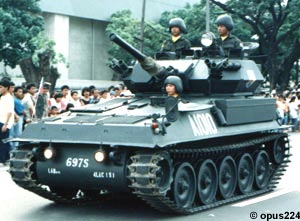

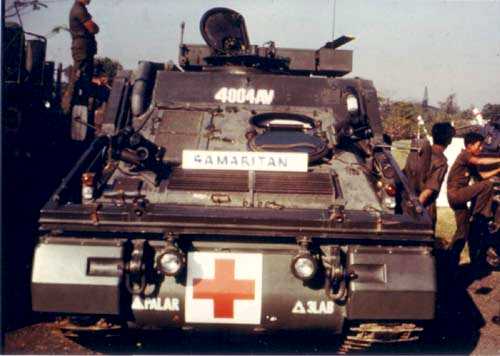
Photo at right, PA-LAD's
FV.101 Scorpion Light tank, taken from the 1990
Independence day parade at the Luneta, and at left is a
FV.104 Samaritan variant. Pictures by opus from timawa.net.
Back to top
United Defence/FNSS Savunma
Sisternleri A.S. YPR-765 AIFV
Type: Armored Infantry Fighting Vehicle (AIFV)
Country of origin:
Armor:
Crew: Commander, Driver, Gunner, RTO + 7
Infantry
Air transportability:
Dimensions
Length: 5.26 m (17.25')
Width: 2.82 m (9.25')
Height: 2.62 m (8.6')
Ground clearance:
Weights and loadings
Basic weight: 11,373 kg (25,020 lb)
Combat weight: 13,687 kg (30,111 lb)
Power train
Engine: One 264 hp Detroit V-6 Diesel Model 6V-53T,
turbocharged, fuel capacity 416 liters
Power-to-weight ratio: 21.92 hp/ton
Transmission: Allison automatic transmission
Transfer case:
Axles:
Tracks:
Suspension:
Performance
Max land speed: 65 kph (40 mph)
Water speed:
Acceleration:
Range: 490 km (305 mi)
Vertical obstacle: 0.61 m (2')
Trench:
Max fording depth:
Gradient: 60%
Side slope: 30%
Turning radius: Pivot to infinite
Weapon Systems
Main gun: Oerlikon KBA 25 mm Bushmaster III in
EWS
Max effective range:
Rate of fire:
Ammunition:
Ammunition type:
Rangefinder:
Night gun sight: Thermal imaging
Secondary gun: 7.62 mm LMG coax
Max effective range: 1,000 m
Rate of fire: 100 rpm
Ammunition:
Ammunition type:
Rangefinder:
Night gun sight: White searchlight
Other defenses:
Variants used: AIFV variant, ARV variant
Program: Designed and produced by United Defence
(formerly FMC), is basically an improved version of the M113
APC with an uprated armor and weapon system. It serves
with the armored units of the Belgian (514), and Turkish
(650) armies. This vehicle is sometimes erroneously
called Chaimite by Philippine press, which is another
separate type of wheeled armored vehicle. The Philippines
received a total of 85 vehicles as per US Library of
Congress records of which about 45 units are still in use.
The PA received two additional units from FNSS Savunma
Sisternleri A.S. of Ankara, Turkey including an Armored
Recovery Vehicle (ARV) variant in February 2004, for P55-M.
The ARV will serve as a mobile maintenance platform of
the LAD in the field or to assist in disaster relief
operations. The AIFV are utilized by the PA-LAD and the
PSG.
Structure: The AIFV is a tracked, all-terrain,
amphibious armored combat vehicle manufactured in Europe.
It is armed with an Oerlikon KBA 25 mm gun with a coaxial
7.62 mm machine-gun mounted in an Enclosed Weapon System
(EWS), which is electrically-operated and fully
stabilized, which provides a shoot-on-the-move capability.
The turret drive system also incorporates a day and night
thermal imaging system for visibility under the cover of
darkness. The 7.62 mm gun is used as anti-aircraft as
well as anti-infantry defense. Furthermore, the AIFV has
firing ports to allow its passengers to engage hostile
units under the protection of its armor.
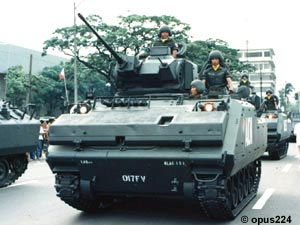
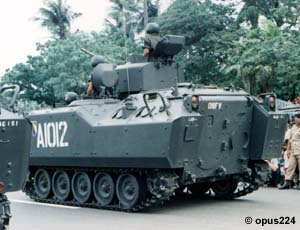
Two photos of PA-LAD's
AIFV, taken from the 1990 Independence day parade at the
Luneta. Pictures by opus from timawa.net.
Back to top
Food Machinery Corp. M-113A1/A2 APC
Type: Armored Personnel Carrier, Tracked (APC,T)
Country of origin: USA
Armor: 38 mm sloped/ 27 mm flat/ 12 mm flat,
rolled 5083/5086 H32 aluminum alloy
Crew: Commander, Driver, Gunner, RTO + 9
Infantry
Air transportability: roll-on/roll-off C-130
Dimensions
Length: 4.86 m (15.95')
Width, over track shrouds: 2.69 m (8.82')
Height: 2.5 m (8.2')
Tread: 2.16 m (7.08')
Ground clearance: [A1] 0.41 m (1.34'); [A2] 0.43
m (1.425')
Ground pressure, zero penetration: [A1] 0.51 kg/cm²
(7.3 psi); [A2] 0.55 kg/cm² (7.9 psi)
Weights and loadings
Basic weight: [A1] 9,426 kg (20,737 lb)
Combat weight: [A1] 10,920 kg (24,080 lb); [A2]
11,343 kg (25,007 lb)
Power train
Engine: One 215 bhp (81 kW) General Motors 6V53,
6-cylinder, 2 stroke diesel, 2,800 rpm
Power-to-weight ratio: 17.1 hp/ton
Transmission: Allison TX-100, 3 ranges forward,
1 reverse
Transfer case:
Axles:
Tracks: {A1] T130E1, center guide, single pin,
steel with detachable rubber pad; [A2] T150, center guide,
double pin, steel with chevron rubber pad
Suspension: Torsion bar type. Five individually
sprung dual/track road wheels. Flat track return rollers.
Ten-tooth front drive, drive sprockets. Dual adjustable
idlers at rear of track. Shock absorbers on first and
last road wheels/track, additional shock absorber on
second wheel/track on A2 units.
Performance
Max land speed: [road] 64 kph (40 mph); [cross-country]
25 kph (15 mph)
Water speed: 5.8 kph (3.6 mph)
Acceleration: 0-30 kph (0-19 mph), 11 sec
Range, cruising: [road] 483 km (300 mi)
Vertical obstacle: 0.61 m (2')
Trench: 1.68 m (5.5')
Fording depth: 1.02 m (3.33')
Gradient: 60%
Side slope: 30%
Turning diameter, minimum: 7.9 m (26')
Weapon Systems
Main gun: 12.7 mm HMG in 1-m Textron turret or
pintle-mounted 12.7 mm with cupola; M39 A3 20 mm
Max effective range: 1,800 m; 1,000 m (20 mm)
Rate of fire: 450 rpm; 1,500 rpm (20 mm)
Ammunition: 2,000 rounds
Ammunition type: Ball
Rangefinder: None
Night gun sight: Passive/IR
Secondary gun: 7.62 mm LMG coax
Max effective range: 1,100 m
Rate of fire: 100 rpm
Ammunition: 2,000 rounds
Ammunition type:
Rangefinder:
Night gun sight:
Other Defenses: Nightvision Equipment Passive/IR
Variants used: M113A1, M113A2, M113 FSV, M113 25
mm; M113 20 mm
Program: Developed and designed in the late 50's
by Ford Motor Co. and Kaiser Aluminum and Chemical Co.
from the M59 and M75. The M-113 was originally developed
and manufactured by the Food Machinery Corp. (FMC) of San
Jose, California as to fulfill the requirements for a
family of Airborne Armored Multi-Purpose Vehicle (AAM-PV).
It was utilized extensively during the Vietnam war, where
its passengers quickly learned that instead of just
transporting them to the front, they can fight from the
inside the APC's protected hull against hostile infantry,
and the workhorse APC was born. About 80,000 of all types
were developed by USA's FMC and Italy's OTO Melara and it
is still in production. The PA has about 100 units
serving with the PA-LAD.
Structure: Designed to be air-transportable,
it can be carried by C-130H "Hercules"
transport aircraft. The APC was designed simply to
transport infantry to the frontlines in a light caliber-protected
hull. The hull is built of aircraft-grade aluminum in
which the vehicle derives its versatility - it is
lightweight thereby allowing the use of a small engine, a
General Motors 6V53, 2 stroke, 6-cylinder diesel,
developing 215 bhp, at 2,800 rpm, and having a larger
payload than most vehicle its size. Can accelerate from 0
to 30 kph in 11 seconds. Has turning radius of 4.27
meters and ground pressure of 7.9 psi. Fuel capacity, 360
liters (95 gallons). DS200 controlled differential,
steering levers with differential band brakes. It has
high speed on roads, and is capable of cross-country
travel over rough terrain, though if any of its track
shoe is damaged, the vehicle may become inoperable or
unstable in motion as it may result in roll-overs, when
steering. The APC can also ford streams and lakes powered
by its tracks. Infra-red driving lights are standard,
with M19 infra-red periscope for driver. The driver is
seated on the front and left side with the engine to the
right, while the commander's hatch is at the center and
personnel compartment to the rear. Infantry enters and
leave the APC through a rear ramp. A roof hatch is also
located above the troop compartment, where an additional
pintle-mounted, shielded machine-gun can be emplaced, in
addition to the primary gun, which is usually 12.7 mm HMG
inside a one meter Textron turret (in uprated versions),
or a 12.7 mm mounted on a cupola with shields or the more
common pintle-mounted, shielded 12.7 mm HMG. Other M-113
variants seen in service within the AFP is one that
sports a 25 mm chain gun in an EWS, similar to that in
the AIFV or the L23, 76 mm cannon and turret system
obtained from a decommissioned Scorpion unit. The M-113's
main weakness is that it is vulnerable to high-caliber
weapons and RPG hits. Survivability can be increased by
adding bolt-on armor and sand bags outside and kevlar
spall liners inside. Though it is lightly armored
compared to most IFVs, its ability to be deployable from
the air from aircraft both fixed-wing and rotary make the
M-113 versatile and indispensable. Units upgraded to A1
standards in 1964, have their gasoline engines replaced
by diesel, to increase its range and reduce its
flammability and a new power train was incorporated.
Units upgraded to A2 standard, first introduced in 1979,
had a new, improved engine cooling layout brought about
by switching the location of the fan and radiator. A
higher-strength torsion bars which increased road wheel
travel and ground clearance, and a stronger rear idler
was installed and raised 5.1 cm (2") to reduce the
incidence of ground strikes. New shock absorbers were
fitted, and shock absorbers were added to the second road
wheels on each side. New armored fuel tanks were
available as well and were fitted externally located on
either side of the rear entry ramp. They contained the
same 360 liters (95 gallons) of diesel as the internal
tank, and freed up 0.45 cubic meter (16 cubic feet) of
internal space. Weight with the external fuel tanks
increased to 11,740 kg (25,880 lb); 0.58 kg/cm² (8.2 psi);
and the length was 5.3 meter (17.375 feet). Smoke grenade
launchers were also made available and these four-tube
assemblies were located on either bow below the headlight
cluster. PA units though neither have the external tanks
nor the grenade dischargers.
Modernization: There are plans to
acquire/upgrade the fleet to A3 status for screening,
recon, security missions and transport of equipment
during tactical situations. The projects intends to
extend the operational life of the M113s for another 15
years and improve its capabilities and performance in
terms of mobility, firepower, communication,
survivability and maintainability. Some units are also
planned to be upgraded to Fire Support Vehicle (FSV)
status by arming them with the Singaporean company CIS'
40 mm AGL/12.7 mm HMG coax turret, which is capable of
firing airburst ammunition, approved budget for the
project is P144-M. The Singapore Armed Forces (SAF) uses
this version with the 40 mm/12.7 mm combo turret. In 2007,
the PA armed unit with the M-39A3 20 mm automatic cannon,
taken from decommissioned F-5s, the PA traded their
twelve M-134D gatling guns which they are currently
acquiring under the Phase 1 of the Capability Upgrade
Program, for the 20 mm cannons from the PAF. The gun was
modified and mounted on a M113 and have successfully
conducted evaluation tests. If the plan will be approved,
the PA envisions to get around 30-40 guns and organize a
platoon of AVs armed with 20 mm to be issued to line
battalions. This will give the Army an mobile anti-aircraft
platform. Other plans may include additional add-on armor
and reconfiguring some units as mortar carriers, with one
unit have been evaluated with an 81 mm mortar mount in
March 2008.


Two views of PA-LAD's
M-113 APC, taken from the 1990 Independence day parade at
the Luneta. Pictures by opus from timawa.net.
Back to
top
GKN Defence Land Systems/Alvis
Vickers Limited FS.100 'Simba' 4x4 APC/ACV/IFV
Type: Armored Personnel Carrier/ Armored Combat
Vehicle/ Infantry Fighting Vehicle
Country of origin: United Kingdom
Armor: 8 mm, conventional steel alloy, proof
against 7.62 mm AP ammunition
Crew: [APC] Commander, Driver + 10 Infantry; [ACV/IFV]
Commander, Driver + 6 Infantry
Air transportability:
Dimensions
Length: 5.35 m (17.55')
Width: 2.5 m (8.2')
Height: [APC] 2.19 m (7.2'); [IFV] 2.53 m (8.3')
Ground clearance:
Weights and loadings
Basic weight: 9,500 kg (20,900 lb)
Combat weight: 11,200 kg (24,640 lb)
Power train
Engine: One 212 bhp (158 kW) Perkins Phaser 210Ti
turbocharged V-8 diesel, intercooled, 2,500 rpm
Power-to-weight ratio: 19.43 hp/ton
Transmission: Clarke 13.7 LHR 28422
Transfer case:
Axles:
Tires: [APC] 13.00x20 radial tires, run-flat
inserts; [IFV] 14.75x80 radial tires, run-flat inserts
Suspension: Semi-elliptical springs and
hydraulic shock dampers at each wheel station.
Performance
Max land speed: 100 kph (62.5 mph)
Water speed:
Acceleration:
Max range: 660 km (410 mi)
Vertical obstacle: 0.45 m (1.47')
Trench: 0.41 m (1.53')
Max fording depth: 1.0 m (3.28')
Gradient: 60%
Side slope: 40%
Turning radius: 8.38 m (27.5')
Weapon Systems
Main gun: [APC] 12.7 mm HMG QCB in 1-m Textron
turret; [IFV] Boeing M-242 25 mm Bushmaster chain gun in
a Thales (formerly Helio) FVT925 turret
Max effective range: [APC] 1,800 m; [IFV] 2,460
m
Rate of fire: [APC] 450 rpm; [IFV] 175 rpm
Ammunition: [APC] 1,200 rounds
Ammunition type: [APC] Ball
Rangefinder: Optical
Night gun sight: White searchlight
Secondary gun:
Max effective range:
Rate of fire:
Ammunition:
Ammunition type:
Rangefinder:
Night gun sight:
Other defenses: 2 x 66 mm Multi-barreled smoke
dischargers
Variants used: APC variant , IFV 25 mm variant,
Ambulance variant
Program: Designed as a private venture by UK's (formerly
GKN Sankey) for FMS. Developed in 1980 as a complement to
the Saxon, with the prototype first produced in 1981 with
development continued through the 80's. The AFP ordered
150 units at P360,000 each, complete while most of them
were assembled from completely knocked-down units by
Asian Armor Vehicles Technologies Corp. (formerly by
Philippine International Trading Corp.) under license
from UK's GKN Sankey Limited, actual assembly work was
undertaken by Philippine Corp. at its Subic Bay facility
with Clark Equipment and Perkins Engines as major
subcontractors. Total cost of the deal was $46-M. As a
private venture, under this program, GKN exported the
bare units which did not include arms and tires, and PITC
assembled the parts and added locally made components. It
is the only country that uses this APC. The first
production units were commissioned in 1991. They were
used in operations by the PA-LAD in the South against
insurgents, where some units were lost to RPGs. Also
utilized by the PSG. A total of 152 units were produced (including
Alvis' 2 prototypes). Asian Armor Vehicles Technologies
Corp. is Simba's the sole licensed assembler.
Structure: All-welded steel alloy
armored monocoque hull. Simba which means "Lion"
is powered by a Perkins 210Ti turbocharged diesel,
intercooled, developing 212 bhp at 2500 rpm, fuel
capacity 296 liters (78.72 gallons). A 24V electrical
system with two 12V, 90 Ah batteries are fitted. Clark
Equipment provided the 13.7 LHR 28422 automatic gearbox
with one reverse and four forward gear ratios. A two-gear-ratio
transfer case offering a choice of two or four wheel
drive is standard, and steering is power assisted. While
two wheel drive is available, the Simba is considered to
be a four-wheel drive vehicle. The suspension system uses
semi-elliptical springs and hydraulic shock dampers at
each wheel station. The 13.00x20 radial tires are fitted
with run-flat inserts. The Simba is considered suitable
to tropical and rugged terrain, and can ford up to 1
meter deep water. The driver is seated in front at the
left side with the gearbox and engine to the right. The
driver is provided with bulletproof windows and a single-piece
hatch cover. All automotive components are commercially
available. It has three crew members and can transport
from ten to twelve infantrymen which can enter and leave
through a door at the rear and at the left side. In the
basic APC, the commander sits in the middle, slightly
above the driver, and is provided with a cupola with four
vision blocks. The troop compartment, located to the rear
of the vehicle, seats the infantrymen across from one
another. Armored vision blocks and firing ports are
positioned along the sides of the troop compartment.
Normally armed with a 12.7 mm HMG in a manned turret,
some IFV variants are also seen with a Boeing M-242 25 mm
chain gun mounted in a Thales (formerly Helio) FVT925
turret, (which increases the unit's height to 2.53 m) or
the 40 mm AGL/ 12.7 mm HMG combo turret from CIS of
Singapore. Other variants available but not used on PA
units includes a 90 mm FSV model sporting a Cockerill Mk.
3 90 mm gun, a 81 mm mortar carrier, which can be fitted
at the rear of the vehicle, a proposed anti-tank variant
sporting BGM-71 TOW, M-901 Improved TOW or the
Euromissile with HOT HCT turret and the Internal Security
Vehicle variant, which can be fitted with riot screens,
barricade removers, PA system and turret with smoke and
tear gas launchers. Standard equipment on the Simba
includes a fire extinguishing system, run-flat inserts
for the tires, a forced air ventilation system, and
interior roof insulation. The optional equipment includes
air conditioning, an auxiliary power unit, searchlights,
a heating system for both the crew compartment and engine,
a front-mounted winch, and other specialized internal
security equipment. A larger version of the Simba dubbed
as the MX-1 Kalakian APC, was developed for the PA which
reportedly ordered about 20 units. Some Simba units were
seen outfitted as armored ambulances.
Modernization: Proposed SRDP projects in
2002 included the fabrication of view blocks for armored
vehicles and tire changer, to be supervised and
implemented by the RDC, ASCOM, PA.
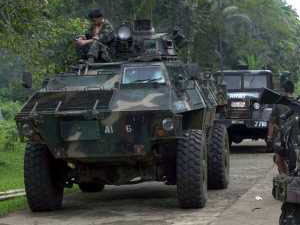
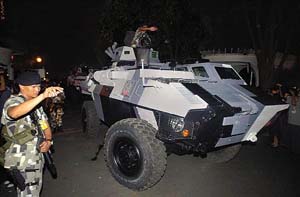
Two views of the FS.100
Simba ACV, the picture in the left serves with the PA-LAD.,
while that on the right is with the PSG. Pictures by opus from timawa.net.

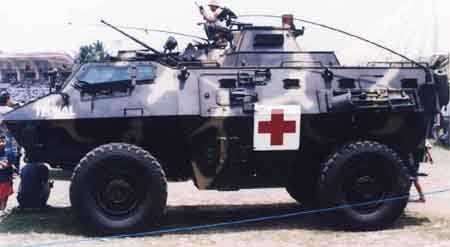
Two more views of the
FS.100 Simba ACV, the picture in the left is armed with a
25 mm Bushmaster chain gun., an ambulance variant is
shown right. Pictures by opus from timawa.net
Back to top
Textron Marine & Land Systems
Division LAV-300 Mk. 2 'Commando' 6x6
Type: Armored Personnel Carrier, Wheeled (APC,W)
Country of origin: USA
Armor: 16 mm max, Cadillac Gage Type 2001 Cadloy
high hardness ballistic steel plate, proof against 7.62
mm ball ammunition (vision blocks and periscopes hardened
to same level)
Crew: Commander, Gunner, Driver + 8 Marines
Air transportability: roll-on/roll-off C-130
Dimensions
Length: 6.7 m (22')
Width: 2.54 m (8.3')
Height, hull: 1.98 m (6.5')
Ground clearance, nominal: 0.53 m (1.75')
Wheelbase: 2.21 m (7.25')
Weights and loadings
Basic weight: 12,292 kg (27,100 lb)
Combat weight: 14,545 kg (31,999 lb)
Power train
Engine: One Cummins 275 hp QSC 6 CTA 8.3,
turbocharged, after-cooled V-8 diesel engine, 2,500 rpm
Power-to-weight ratio: 18.94 hp/ton
Transmission: AllisonMD3560, 6-speed
Transfer case: Single speed, helical gears
Axles: Single reduction hypoid - silent locking
differential
Tires: 14.00R20, run flat inserts
Suspension: Independent trailing arms with coil
springs and shock absorbers
Performance
Max land speed: 105 kph (65 mph)
Water speed: 4.8 kph (3 mph)
Acceleration: 0-32 kph (0-20 mph), 10 sec
Range: 953 km (575 mi)
Vertical obstacle: 0.61 m (2')
Trench: 1.52 m (4.99')
Max fording depth: 1.98 m (6.49')
Gradient: 60%
Side slope: 30%
Turning diameter, nominal: 20 m (68')
Weapon Systems
Main gun: [FSV] Cockerill Mk.3 90 mm/36 cal
rifled gun; [APC] 40 mm AGL
Max effective range:
Rate of fire:
Ammunition: [FSV] 42 rounds (9 rounds ready)
Ammunition type:
Rangefinder:
Night gun sight: White searchlight
Secondary gun: [FSV] 7.62 mm LMG coax, 7.62 mm
anti-aircraft LMG; [APC] 12.7 mm HMG coax
Max effective range: [FSV] 1,100 m; [APC] 1,800
m
Rate of fire: [FSV] 100 rpm; [APC] 450 rpm
Ammunition: [FSV] 400 rounds (coax), 200 rounds
(anti-aircraft)
Ammunition type:
Rangefinder: x8 power monocular sight and x1
power periscope for gunner, three vision blocks for
commander
Night gun sight: White searchlight
Other Defenses: None
Variants used: V-300 APC, V-300 FSV
Program: Developed by Textron Marine and Land
Systems (formerly Cadillac-Gage) as a private venture to
complement their existing LAV-150 4x4 series for FMS. The
AFP acquired about twelve V-300 6x6 APC units and twelve
V-300 6x6 FSV variant from the US in February 1995 under
FMS program and is the PMC's share in the US Bases
compensation program (where they were initially offered
LVTP-7 in the 80's). All of the AFP's V-300s are assigned
to the PMC's Light Armor Vehicle Company (LAV Co),
Assault Armor Battalion (AABN), and were extensively used
during the height of the 2000 conflict in Mindanao with a
confirmed loss of a FSV variant.
Structure: The V-300 is basically a
bigger and improved version of the V-150. This 6x6 APC is
powered by a Cummins QSC 6 CTA 8.3, turbocharged, after-cooled
V-8 diesel engine, developing 275 hp, which can
accelerate from 0 to 32 kph under 10 seconds and can
travel as fast as 100 kph on roads. Fuel capacity is 200
liters and it can run on Jet A-1, kerosene or other
lighter fuels in place of diesel. Six driving wheels (6x6),
front wheel steering, with dual hydraulic brakes permits
the vehicle to go from 32 kph to 0 in approximately 12 m
(40'). Front axle has solid beam on trailing arms. Rear
axles have independent trailing arm with coil springs and
one shock absorber. The minimum silhouette hull is
constructed of high-hardness ballistic steel plates which
can defeat 7.62 mm AP hits in the front, and 7.62 mm ball
hits point blank on the side and rear. The survivability
is further enhanced from low observable technology to
minimize levels of thermal, seismic and audio signatures,
and minimal radar return. Optional upgradeable armor
floor plating can protect the crew from landmines and
hand grenade blasts. It has a crew of three and can carry
up to nine infantrymen, which can enter and leave through
a rear ramp, which was a modification from the original
rear hatch. The V-300 can also ford water through the
additional waterjets installed though it can be run by
the propeller action of its radial tubeless tires as well.
The 6x6 tires are capable of running even when it is
punctured and can be optionally outfitted with run-flat
inserts and a central tire inflation system, to further
enhance mobility. The Marine V-300 also has a trim-vane
added but the provisions for the smoke/grenade
dischargers and winch were omitted. The Marines uses the
basic APC, with a 12.7 mm HMG and a 7.62 mm coax mounted
in a manned 1-m Textron turret, which can traverse 360°,
and the fire support Mk. 2 variant, which sports a
Cockerill 90 mm gun in a two-man CSE 90 turret, which can
power traverse 360° at 30° per second. The front of the
FSV's turret can stand up to 14.5 mm hits in the front
and up to 7.62 mm hits elsewhere. The FSV variant also
has a coaxial 7.62 mm LMG and an additional pintle-mounted
12.7 mm shielded HMG atop the 90 mm's turret.
Modernization: The PMC's APC variants
were uprated with the Singaporean company CIS' 40 mm AGL/12.7
mm HMGs coax turret to increase its firepower, with the
assistance of FIC of Tanay, Rizal in 2003. The 40 mm AGL
can also be interchangeable with a 7.62 mm LMG. The
modifications also involved changes in the periscope and
vision blocks to enable the gunner to fire highly
accurate shots, with a variety of 40 mm AGL ammunition
such as HE, Smoke, and FIC's Canister loaded with 300
shotgun pellets for use against close-in ambushes by
hostile infantry. It may also be uparmored with
additional bolt-on armor and the proposed RPG mesh system
to enhance its defensive systems.
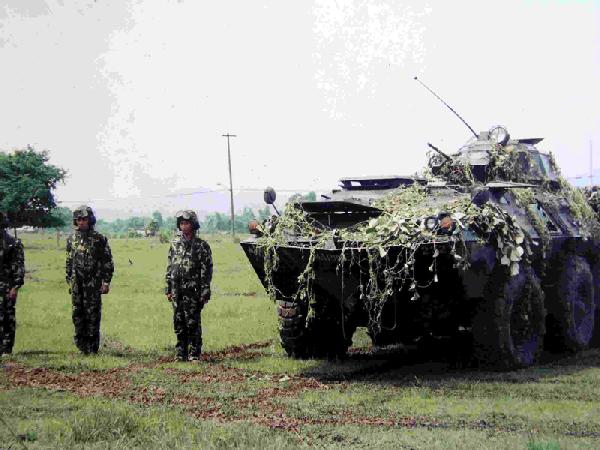

Two views of the
Marines' V-300, one is the APC variant and the other is
the FSV variant sporting a 90 mm gun. Pictures by opus from timawa.net.


More photos of the
Marines' V-300, one is at the left sports a makeshit
wooden applique armor, another view of the FSV variant at
the right.. Pictures by opus from timawa.net.
Back to top
Gage-Cadillac LAV-150 (M-706) 'Commando'
4x4 APC
Type: Armored Personnel Carrier, Wheeled (APC,W)
Country of origin: USA
Armor: 6.4 mm (¼"), Cadloy steel plate
protects against 7.62 mm ammunition
Crew: Commander, Driver + 10 Infantry
Air transportability: roll-on/roll-off C-130
Dimensions
Length: 5.69 m (18.66')
Width: 2.26 m (7.41')
Height: 1.98 m (6.5')
Ground clearance:
Weights and loadings
Basic weight: 7,484 kg (16,465 lb)
Combat weight: 9,545.45 kg (21,000 lb)
Power train
Engine: One 191 hp Chrysler V-504 liquid cooled
V-8 diesel engine; Cummins 6BT5-9 turbocharged diesel (on
uprated units)
Power-to-weight ratio: 20:23 hp/metric ton
Transmission: Allison 4x4 , 5-speed
Transfer case:
Axles:
Tires: 14x20, run flat
Suspension: Solid beam ale, semi-elliptical
multileaf spring suspension with double hydraulic shock
absorbers
Performance
Max land speed: 90 kph (56 mph)
Water speed: 5 kph (3 mph)
Acceleration:
Range: 812 km (505 mi)
Vertical obstacle: 0.61 m (2')
Trench:
Max fording depth:
Gradient: 60%
Side slope: 30%
Turning radius: 8.38 m (27.5')
Weapon Systems
Main gun: 12.7 mm HMG in 1-m Textron turret
Max effective range: 1,800 m
Rate of fire: 450 rpm
Ammunition: 1,200 rounds
Ammunition type: Ball
Rangefinder: M-20 gunsights
Night gun sight: White searchlight
Secondary gun: 7.62 mm LMG coax
Max effective range: 1,100 m
Rate of fire: 100 rpm
Ammunition:
Ammunition type:
Rangefinder:
Night gun sight: White searchlight
Other Defenses: 2 x Multibarrel smoke
dischargers
Variants used: V-150, V-150ST
Program: Designed by in 1962 by Textron Marine
and Land Systems (formerly Cadillac-Gage) as a
reconnaissance vehicle, convoy escort, command, patrol
and riot control platform, it saw service during the
Vietnam war. The US Army does not use this APC but is
used for FMS with about 3,000 in service to foreign
armies. The AFP has about 165 units delivered including
several older V-100s and 20 units of its Portuguese copy,
Chaimite and 10 V-150S delivered in 1994, and are in
service to the PA-LAD, PNP-SAF, PSG and PMC's Light Armor
Vehicle Company (LAV Co). It is arguably the most common
armored vehicle used by the PA from the 70's up to the
late 90's, but is now being superseded by the Simba ACV.
Structure: Powered by a Chrysler liquid
cooled V-8 diesel engine, developing 191 hp, with a five-speed
transmission, giving the vehicle a maximum cruising speed
of 90 kph on four 14 x 20 run flat tires, which can still
run 45 kph for about 150 kilometers after being punctured.
The vehicle has a range of 643 kilometers on its 303
liters fuel capacity. It is fully amphibious, needing no
special preparation and can ford streams and lakes at 5
kph from the propeller action of its tires. Four wheels
powered (4x4), with front wheels steering and solid beam
ale, semi-elliptical multileaf spring suspension with
double hydraulic shock absorbers. It has a crew of two
and can carry eleven infantrymen. Its quarter inch thick
armor can defeat up to .30 caliber at point blank range.
Optional 3/8" armor can withstand .50 cal round hits.
The V-150 is available in various configurations,
including command, recovery, mortar, TOW, air defense
vehicles, and armored personnel carrier. A variety of
armament stations can be installed, including most light
and medium automatic weapons, missile systems, mortars,
and cannons up to 90 mm. Main armament options used in
the AFP for the V-150 includes 2 x 7.62 mm (800 rounds
ready, 3000 in hull), and 2 x 12.7 mm (400 rounds ready ,
1,000 in hull). Other variants includes 1 x 20 mm
Oerlikon (200 rounds ready, 200 in hull), or 1 x 25 mm (200
rounds ready, 200 in hull), or 1 x 12.7 mm MG and 40 mm
AGL, or 1 x 90 mm (8 rounds ready 31 in hull), or 1 x 81
mm mortar (62 rounds in hull). The AFP Logistics Command
also developed two, local prototype version of the V-150
called the Hari-Digma, which has a US-made engine and
locally manufactured components.
Modernization: Some twelve units of V-150s
were upgraded in 1998 to V-150ST, where they have
extended rear compartments and turbocharged engines. Gage-Cadillac
Textron undertook the Light Armor System Upgrade (LARSU)
in 2004, which involved the mobility upgrade of twelve
units of V-150 APCs by refitting the power train with 6-cylinder
in-line internal combustion engines, for P170.88-M. In
2006 some of the PMC's V-150's have installed additional
rear 12.7 mm HMG mounts taken from decommissioned units.
The PMC's own LARSU Phase I project conceptualized as far
back as 1994 will start on August 2006, with Textron
Marine & Land Systems Division as the prime
contractor to be done in Laguna. Under this program the
Marine's V-150 Chrysler diesel engines will be uprated to
the Cummins turbocharged diesel engines (similar to those
in the V-300s), which will require the cutting and
extension of the hull, which did not just involved the
cutting and insertion of the section between the rear-end
of the vehicle and the main body. Gage-Cadillac actually
fabricated a whole new rear-end to accommodate the new
engine, with the old aft sections to be utilized for
future use. The power-pack, consisting the new Cummins
engine, Allison transmission, transfer case, cooling
system and electrical modifications, is packaged at the
Textron Marine & Land facilities in New Orleans and
shipped to the Philippines for installation. Furthermore
the old engines and the old aft section were reconfigured
and installed on four V-100 Chaimite APC also to be
reconfigured as ambulances and mortar carriers, if funds
are allocated. Phase II of the PMC LARSU program involves
the installtion of RCWS. The PA is still considering on
repowering their V-150s with the Cummins diesel engines.
The V-150 maybe also be considered for additional bolt-on
armor (some units were seen with improvised wooden
appliqué armors to predetonate RPG warheads in the
Mindanao campaigns) and the proposed PMC RPG mesh system.


Two photos of Marine V-150,
the left pic have an additional 12.7 mm HMG mount.
Pictures by opus from timawa.net, infos from Manokski
and mblt6.


Two photos of Marine V-150S,
note the extended hulls. Pictures by opus from timawa.net.
Back to top
British Daimler Ferret MX-7 Scout
Car
Type: Armored Scout Vehicle
Country of origin: UK
Armor:
Crew: Commander/Gunner, Driver
Air transportability:
Dimensions
Length: 3.7 m (12' 2")
Width: 1.91 m (6' 3")
Height: 1.88 m (6' 2")
Tread:
Ground clearance:
Ground pressure, zero penetration:
Weights and loadings
Combat weight: 14,500 kg (31,900 lb)
Power train
Engine: One diesel engine
Power-to-weight ratio: 35.1 hp/tonne
Transmission:
Transfer case:
Axles:
Tracks:
Suspension: 4x4 wheel
Performance
Max land speed: 93 kph (58 mph)
Water speed:
Acceleration:
Range, cruising: [road] 306 km (190 mi)
Vertical obstacle:
Trench:
Max fording depth:
Gradient:
Side slope:
Turning diameter:
Weapon Systems
Main gun: 7.62 mm
Max effective range:
Rate of fire:
Elevation:
Traverse:
Ammunition:
Ammunition type:
Rangefinder:
Night gun sight: None
Other defenses: 2 x Four-barrel smoke
dischargers
Program: Designed as a light armoured, all wheel
drive, cross country scout car which was produced between
1952 and 1971. The PA acquired a unit for the single
purpose of using the unit as a reference for the locally-designed
Escort Vehicle MX-8, built by Steelcraft Industries. Its
designation MX-7 come from Steelcraft as well.
Structure: Built from an all-welded monocoque
steel body, making the drive extremely noisy as all the
running gear was within the enclosed body with the crew.
Four wheel drive was incorporated together with run-flat
tires. The turret, carries a single 7.62 mm machine gun,
with six grenade launchers fitted to the hull (three on
each side) carried smoke grenades. It is fast and small
enough to be used in an urban environment but strong
enough to negotiate rugged terrain off road. The PA have
the upgraded, diesel version of the Ferret.
Back to top
Ingersoll/Pacific Car and Foundry Co.
LVTH-6
Type: Landing Vehicle, Tracked, Howitzer
Country of origin: USA
Armor: 6.4-16 mm rolled homogenous steel
Crew: Commander, Gunner, Driver, Loader, Crew
chief + 2 Ammunition passers
Air transportability:
Dimensions
Length: 9.04 m (30')
Width: 3.57 m (11.71')
Height, over AAMG: 4.08 m (13.38')
Tread: 2.96 m (9.725')
Ground clearance: 0.43 m (1.42')
Ground pressure, zero penetration: 0.64 kg/cm²
(9.1 psi)
Weights and loadings
Combat weight: 39,300 kg (86,600 lb)
Weight, amphibious: 38,200 kg (84,200 lb)
Power train
Engine: One 704 hp Continental LV-1790-1, 4
stroke, 12-cylinder 90° gasoline, 810 hp at 2,800 rpm
Power-to-weight ratio: 19 hp/ton
Transmission: Allison CD-850-4A or -4B, 2 ranges
forward, 1 reverse
Transfer case:
Axles:
Tracks: Center guide, single pin, steel with
inverted grouser
Suspension: Torsilastic type. Nine pairs of
dual/track road wheels. Five dual/track return rollers.
Seventeen-tooth rear drive sprockets. Dual compensating
idlers at front of track. No shock absorbers
Performance
Max land speed: 48.3 kph (30 mph)
Water speed: 11 kph (6.8 mph)
Acceleration:
Range, cruising: [road] 306 km (190 mi); [water]
92 km (57 mi)
Vertical obstacle: 0.91 m ( 3')
Trench: 3.66 m (12')
Max fording depth: Floats
Gradient: 70%
Side slope: 60%
Turning diameter:
Weapon Systems
Main gun: M-49 105 mm in T-172 mount
Max effective range:
Rate of fire:
Elevation: -4.1° to +59° (manual, stabilized)
Traverse: 360° (at 21°/sec, manual or
hydraulic)
Ammunition: 151 rounds (12 rounds ready)
Ammunition type:
Rangefinder:
Night gun sight:
Secondary gun: M-1919A4E1 7.62 mm coax MG
Max effective range:
Rate of fire:
Ammunition:
Ammunition type:
Rangefinder:
Night gun sight: None
Other defenses: M-2 HB 12.7 mm roof HMG
Variants used: LVTH-6
Program: First saw service in 1957 and well into
the Vietnam war, where about 210 LVTH-6 variant were
produced. The LVTH-6 (Howitzer) variant were used as fire
support vehicles (FSV) during the early Mindanao
campaigns in the 1970's (and thus does not carry
additional personnel other than its crew). The PMC
currently has four fully-operational LVTH-6A1s and about
five in reserve. These units are utilized by the PMC's
Assault Amphibian Vehicle Company (AAV Co), Assault Armor
Battalion (AABN).
Structure: Basically the same as the
LVTP-5, with identical hulls and specs, but the H-6 model
armed with a short barreled 105 mm howitzer mounted on a
traversing turret, over the cargo compartment, capable of
both direct, indirect and high angle fire. The commander
seats in the rear, right, the gunner at the rear, front,
with the loader at the rear, left, the driver at the left,
front, the crew chief in front, right. The commander and
loader have their own hatches in the turret. For
amphibious operations weight is reduced by having only 51
rounds of ammunition. The turret has 25 mm front armor,
19 mm on the sides and 7 mm on the top. They also have an
additional .30 cal coaxial LMG and a 12.7 mm pintle-mounted
HMG atop the turret. In 2005 the PMC have brought back
two additional units and will be utilized as Urban Fire
Support Vehicles by the Marine Ready Force (MRF) based in
Manila. They have additional frontal armor (and about 580
kg of extra weight) but their amphibious capabilities
were initially not restored, fuel lines were also
reinforced as well as some other internal modifications.
Both sport the Berlin Brigade camouflage, similar to the
one used by armored units of the PSG. A fifth LVT is
being brought to operational status by reservists lacks
the 105 mm gun and is an E1 (Engineer, model 1) version.
It will be mounted with an Oerlikon Mk.4 20 mm/70 and
will be used as an anti-aircraft platform and to ram road
blocks. A sixth LVT is under consideration pending its
role. A recent amphibious exercise in General Santos
revived the Navy's interest in having an amphibious
capability. The operational LVTs will have rubber linings
and bilge pumps re-installed to reincorporate its
amphibious functions, though its add-on armor may pose
some weight and buoyancy problems, which may be
compensated by the LVTH-6 having a lower ammunition load.
This is why the PMC have reactivated some LARC-Vs to
compensate for the lessened ammunition load of the LVTH-6s.
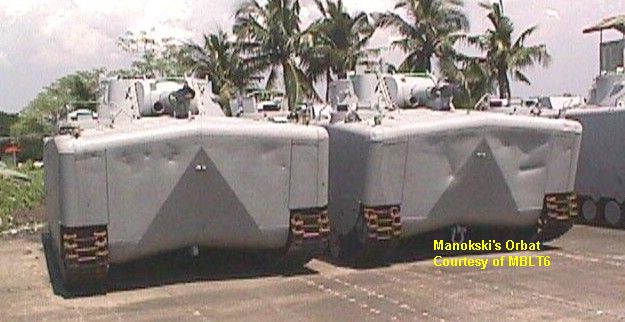

Photo of a Marine
Ready Force's LVTH-6A1, with additional frontal armor.
Pictures by opus from timawa.net, Manokski, and mblt6.
Back to
top
Last
modified on 01/24/08
Best Viewed with Internet Explorer 4.0 &
up at 1024 x 768 resolution
Copyright © 2001 BakaInu Design Bureau. All Rights
Reserved. Site maintained by sumomo.
For comments, suggestions, questions, grievances
and/or violent reactions,
email the webmaster at [email protected].