| My latest projects (since my mad sewing spree to costume myself for Newport Dance Week in August 2004) |
|
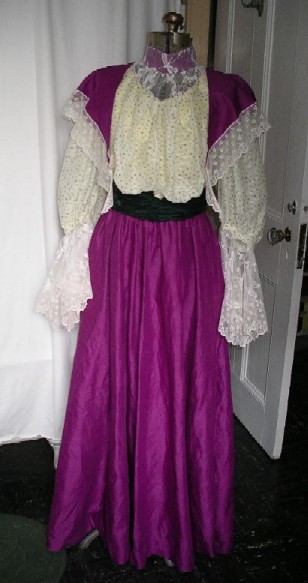 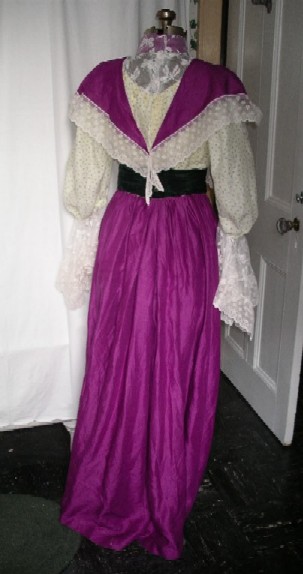 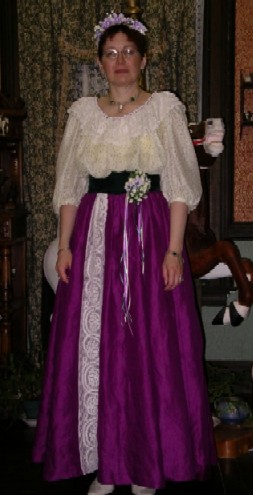 |
This is a 1904-ish afternoon gown, suitable for teas, afternoon calls, etc. It's a dramatic remodeling of the 1904 ballgown shown on the right, which I never liked. The original gown was made from a custom pattern drafted from the Edwardian Modiste, and fit beautifully, but it seemed neither fish nor fowl, half ballgown, half not. I was hampered by only having a small quantity of each of the two fabrics (a fine cotton and a light linen), not enough for ruffles, etc. The gown was made for a 1904 World's Fair Ball, but this style simply doesn't flatter me, being far too much dress! But I hated to waste my investment. So I lengthened the hem from dance length to street length, with the lsightest hint of a train in the back. The sleeve trim is based on dress in a Janet Huunnicut book, while the inspiration for the neckline and shoulder trim came from a c. 1905 day dress being offered by Vintage Martini. While this still isn't my preferred style, the dress now seems more accurate, and I was able to salvage the time and materials that went into it originally. |
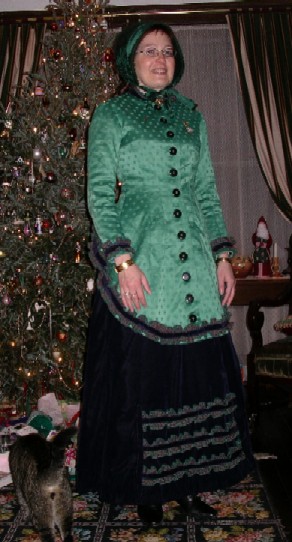 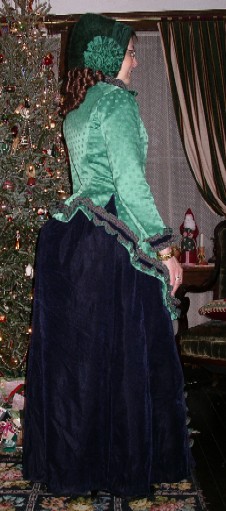 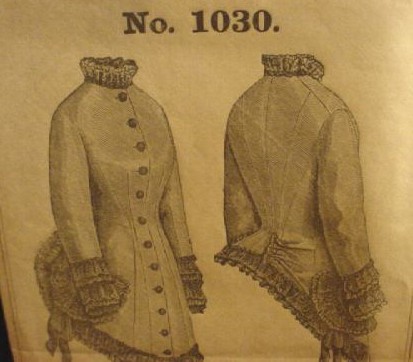 |
A costume for skating, preciptated by the purchase of that green plush and silk bonnet at the Cape May antiques show and our vintage dance club's annual gown Central Park rink outing. The bodice is based on an antique pattern (pictured) I didn't win on eBay. So I altered the trusty Truly Victorian TV460 Cuirass Bodice until it looked like the original. The fabric is emerald green cotton brocade, lined in plaid cotton flanned left over from my Civil War daydress on this page. The skirt is navy blue velvet, lined in cotton and hemmed to ankle length for safety while skating. I used the Old World Enterprises 1880s bustle ballgown pattern for the simple skirt. The trim is gathered plaid ribbon (more than 10 yards) with a strip of blue velvet down the center. |
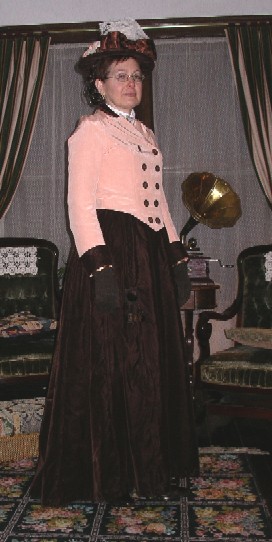 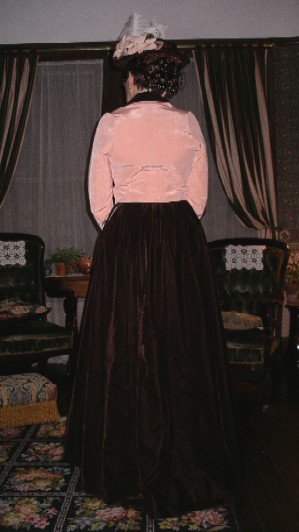 |
This 1890s suit is inspired by one in the Morris County Historical Society's collection. The jacket is the Rocking Horse Farms Eton Jacket, which went together fairly simply and fits well, although I had to add length to the bottom. It's done in a peachy moire, with brown velvet collar and cuffs. I have a vintage furpiece consisting of two whole skins which can be worn as an overcollar if I choose. The skirt is the rocking Horse Farms #987 Eight-Gore Skirt. This skirt was remarkably difficult to make, as the fullness is all supposed to be gathered into the back three panels, but the other five already went completely around my waist. I finally had to redraft most of the panels to eliminate about 18" from the total waist circumference. This is much more difficulty than a skirt should entail! The skirt's made in brown velvet with an unattached cotton lining, and is trimmed on the two front seams with a pair of vintage crochet-and-fur-and-pendant ornaments. The hat is a straw boter form, covered completely with brown velvet and ornamented with brown ribbon, silk orchids, silk ribbon leaves patterned on antique ones in my collection, and two ostrich plumes. |
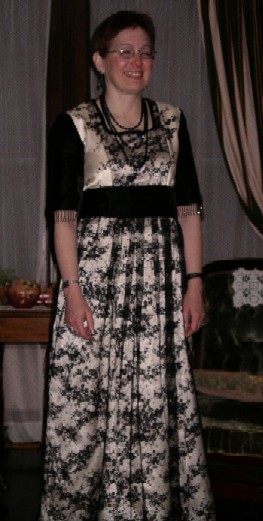 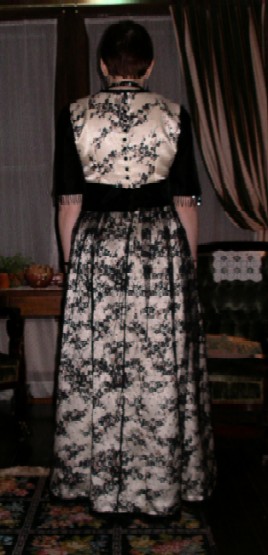 |
A ragtime ballgown made from Wal-Mart fabric, lace, and beading, with black velvet sleeves, belt, and neck and hem facing. It's made from what my sewing circle calls the "Famous Rocking Horse Pattern," their 1915 New Empire Day Dress, from which it's said you can create anything. This versatile and comfortable gown has been to period balls as well as to modern-era black-tie Christmas parties. I have a calico day version of this as well as a modern daffodil print version I made for our family's Easter dinner. |
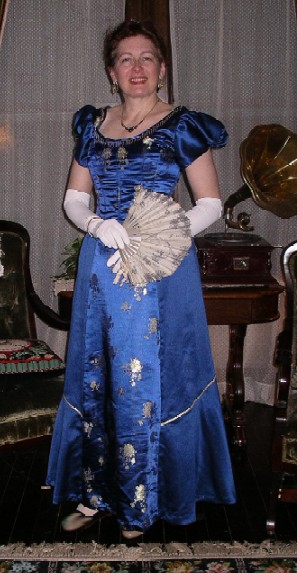 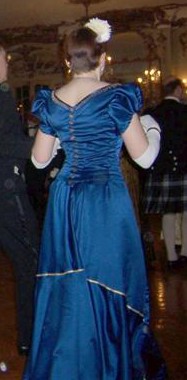 |
Truly Victorian's 1890s Ball Bodice and their flared skirt. The chrysanthemum-embroidered segments are Chinese silk; the rest is faux silk in a matching solid blue. The flounce on the skirt is highlighted with gold ribbon, and there is beading on the neckline. I used the "chrysanthemum sleeve" option. |
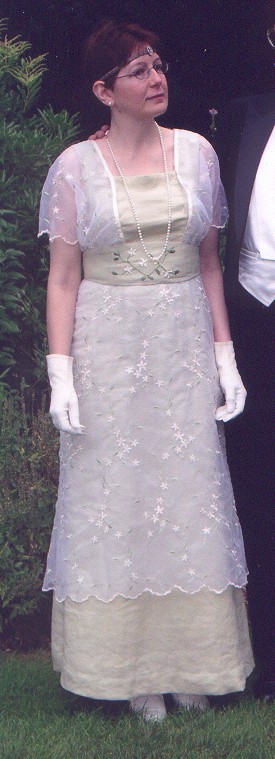 |
A summery ragtime ballgown in light green linen, with an embroidered overskirt and oversleeves. These take advantage of the sheer fabric's scalloped edges. The linen belt dips almost to ground level in the back and has ribbon embroidery to match the embroidered daisies and leaves of the overskirt. I used the Laughing Moon "Titanic" gown pattern; it was easy enough to work with but the cut of the bodice is for someone with a different shape from mine. I plan to recut the top using the Rocking Horse Farms pattern as above. |
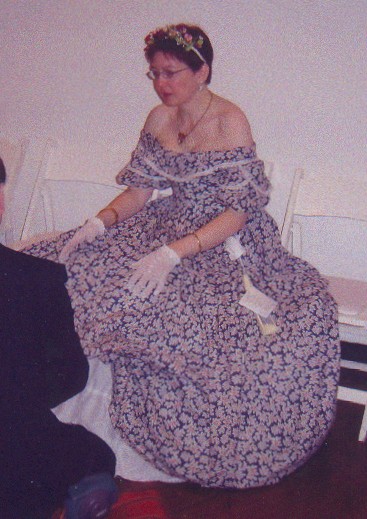 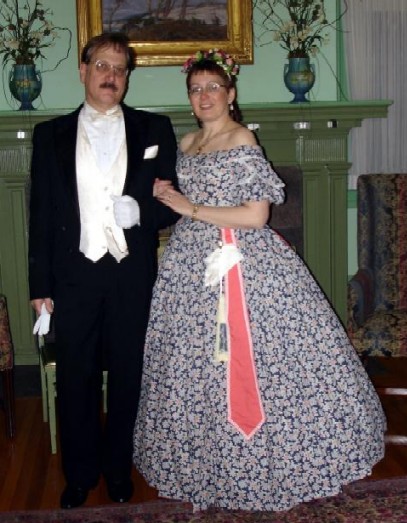 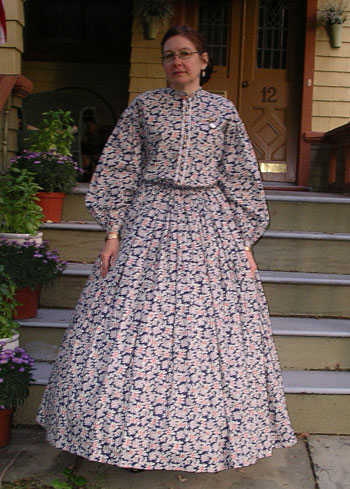 |
A summer-weight hoop gown made for Newport. The bodice is from the Fashion Historian Simplicity 5724 ballgown; the skirt is lengths of fabric gauged onto a waistband. The lace trims are all antique cotton lace. I like working with this bodice pattern, but skipped an important step -- reinforcing the neckline with twill tape. By the end of the evening, when the first photo was taken, it had sagged scandalously low. This was remedied before its next outing. I also added contrasting sashes, trimmed in more lace, attaching them to the bottom of the bodice. Since I've also made a matching day bodice with crocheted buttons and soutache trim, I didn't want to dress up the skirt too much, and this allows it to have a different look based on the bodice being worn. |
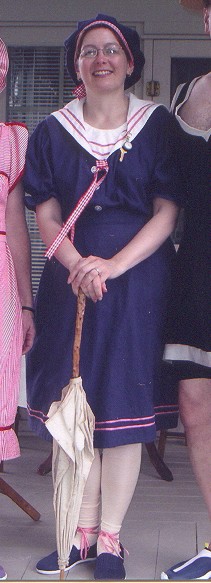 |
Folkwear's bathing suit pattern, in an authentic navy blue flannel. Wonder what the SPF of that is? The sailor-collared top and bloomers are one piece; the skirt buttons on to that. Worn with the requisite cap and silk stockings. |
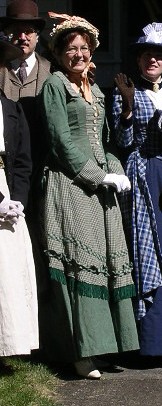 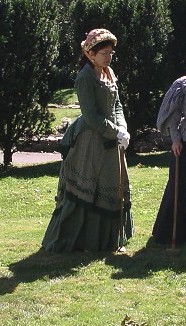 |
An 1870s walking suit from three different green homespun checks, using the Truly Victorian Basque Bodice and their trained bustle skirt for the underskirt, with an overskirt of uncertain origin (it's a copy of a borrowed pattern). The buttons are all antiique crocheted ones, and the trimming is ruffles and bias strips as well as dark green bullion fringe. |