 |
|
|
Sushi is basically various types of fish or seafood pressed onto small
mounds of vinegared rice.
Great skills and effort is required to prepare good sushi, thus sushi
chefs are often held in high esteem.
Also, the freshness of the ingredients used is of great importance.
The color and taste of the sushi depend greatly on the freshness.
Traditionally, sushi is served on wooden platforms. Nowadays, sushi
is usually served on porcelain dishes or even plastic plates.
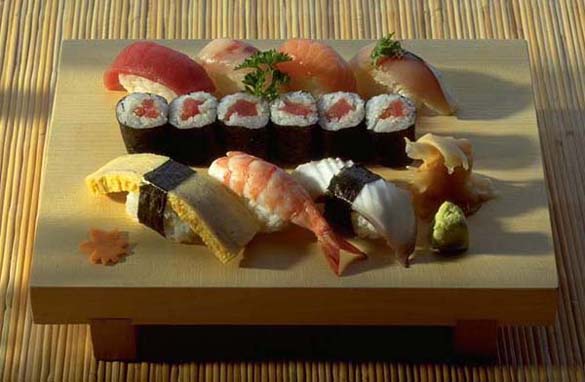
Usually, sushi is accompanied by the following :
Gari : Pickled ginger. Usually comes in pink slices.
Shoyu : Soy sauce.
Wasabi : Japanese horse radish. In the form of a green paste with such a powerful taste that it is capable of killing the bacteria on the raw seafood.
There are 3 basic categories of sushi :
Nare Sushi - Pickled fish sushi.
Nigiri Sushi- Also known as Edomae Sushi.
Temari Sushi - Also known as Kyoto Sushi.
Oshi Sushi - Also known as Osaka Sushi.
Nare-sushi :
This is the original form of sushi in Japan. One way to preserve fish
was to gut it, slice the meat with or without the skin and pickle / ferment
it in rice.
The fish could then be presented at meals after having taken it out
of the pickle jar, cleaned it and served it with the usual Japanese fare
of rice, miso soup and pickles.
Then one day, a fishmonger in Edo ( Now known as Tokyo ) came upon
the idea of wrapping the fish around balls of vinegared rice .
These balls were 2 or 3 times as big as nowadays and 3 balls would
be enough for a meal. This form of sushi is rarely encountered or available
these days.
One modern extension of this technique is "Zuke".
The fish is first dipped in hot water for a while, then transfered
into iced water to stop it cooking and then finally marinated into a pickle
brine ( tsuke shiru ).
When cut, the surface is cooked and slightly harder, while the inside
is still soft and comparatively raw. If it is not dipped in brine it becomes
"tataki".
Note :
"Zuke" also means leaving the fish slices in a mixture of soy sauce,
marinated after a certain amount of time before making any kind of sushi.
Each restaurant has its own original secrets and recipes.
Nigiri-sushi ( Edomae Sushi ) :
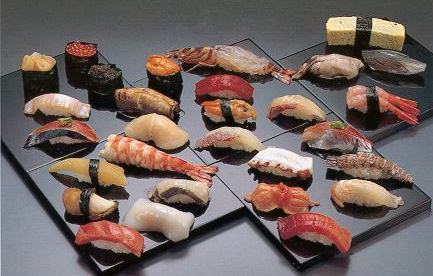
The term "nigiri sushi" basically means "pressed sushi". Made by pressing
slices of fish or seafood onto small hand-formed ball of vinegared rice
called "shari".
Usually, a small portion of Japanese horse-radish called "wasabi"
is added between the seafood and the rice.
Wasabi is known to kill the bacteria on the seafood.
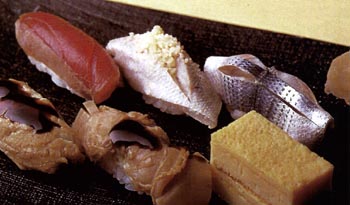
Other variations of nigiri-sushi include :
Nori-maki
- A long thin roll wrapped in dry seaweed, the cut into 2,3 or 6 portions.
Futo-maki
- Similar to nori-maki, but the roll is thicker.
Inari-sushi
- Sushi in a pouch made of sweet tofu skin.
Chakin-sushi
- Similar to Inari-sushi, but a pouch made of a piece thin omelete
is used instead.
Te-maki
- Sushi in the form of a cone. The cone is made of a single piece of
dry seaweed.
Ha-maki
- Similar to te-maki, but lettuce is used instead of seaweed.
Temari-sushi ( Kyoto Sushi ) :
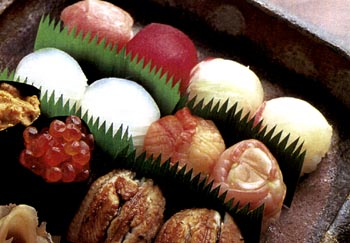
The temari-sushi looks like a small, round nigiri-sushi, and its size
is extremely popular with diet-concious ladies.
Oshi-sushi ( Osaka Sushi ) :
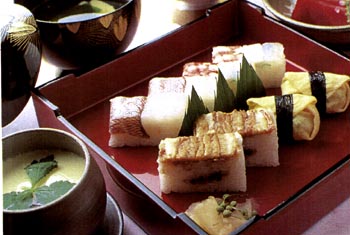
This type of square-shaped sushi is made from stuffing vinegared rice
into small wooden boxes, then smeared with wasabi.
Finally thin slices of fish or other seafood are carefully arranged
on top usually so as to form a pattern.
A wooden lid will then be placed on top of the sushi to press it evenly
and firmly.
The sushi will be then slid out out of the box and cut into regular
rectangular portions to be served accordingly to the chef's taste and skill.
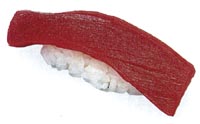
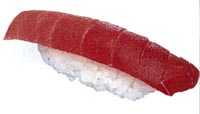
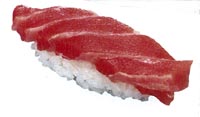
| Name of Sushi : | Translation & Description : |
| Aji | Japanese horse mackeral. |
| Akagai | Ark shell. |
| Akami | Lean tuna. |
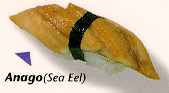
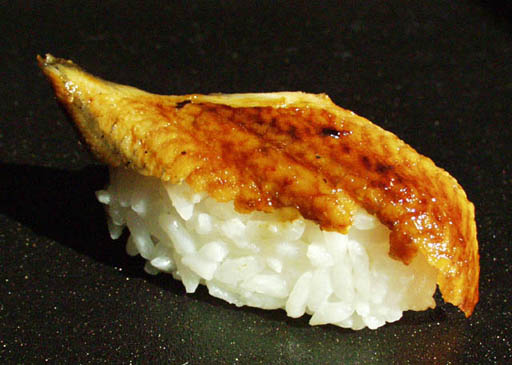
| Anago | Seawater eel. |
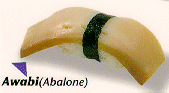
| Awabi | Abalone. |
| Ayu | Sweetfish. |
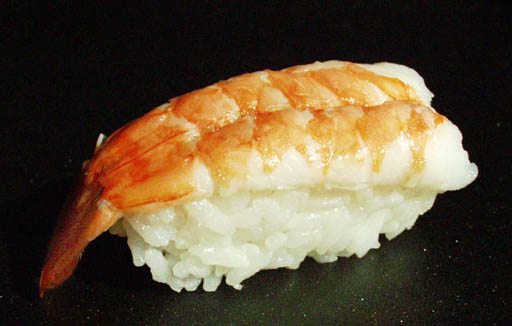
| Ebi | Prawn. |
| Ebikko | Prawn roe. |
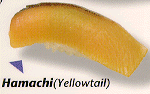
| Hamachi | Yellowtail. |
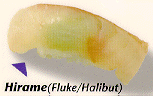
| Hirame | Flounder / Halibut. |
| Ika | Squid. |
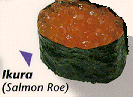
| Ikura | Salmon roe. |
| Inari | Vinegared rice wrapped in sweetened tofu skin. Another variation is known as Aburage. |
| Kajiki | Swordfish. |
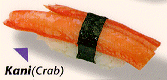
| Kani | Crab. |
| Katsuo | Bonito. |
| Kohada | Shad. |
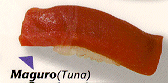
| Maguro | Tuna. |
| Masu | Trout |
| Natto | Fermented soy beans. Has a foul smell and sticky taste. |
| Oshinko | Japanese pickled radish. |
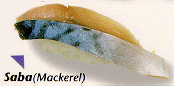
| Saba | Mackeral. Marinated versions are known as Shime Saba. |
| Sake | Salmon. |
| Suzuki | Sea bass. |
| Tai | Red snapper. |
| Tako | Octopus. |
| Tamago | Egg. |
| Tobiko | Flying fish roe. |
| Toro | Fatty part of the tuna's belly. |
| Unagi | Freshwater eel. |
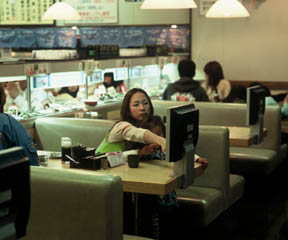
Kaiten Sushi ( Revolving Conveyor-belt Sushi ) :
The fashion nowadays is having a sushi feast in Kaiten Sushi restaurants.
With sushi moving on conveyor-belt, you can choose whatever you like.
Sushi used to be a delicacy, and not everyone can eat sushi very often.
Kaiten Sushi enables almost everyone to eat sushi at an affordable price.
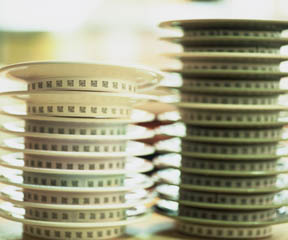
The pricing is usually calculated by the number of plates of sushi
comsumed.
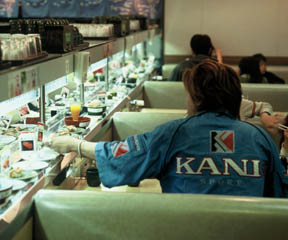
Some Kaiten Sushi restaurants even have a computerised system which
customers can order the sushi not found on the conveyor-belt.
The chefs would then receive the order over at the sushi bar. When
the sushi is prepared, it would be placed onto the coneyor-belt for collection.
Freshness of the sushi is very important. In fact, sushi ingredients
should be stored an air-conditioned environment.
The taste of the sushi will be affected when placed in open-air for
too long, and bacteria may grow on the sushi.
So, how do we ensure that the sushi is really fresh ?
No worries. Every individual plate is encoded. The plates of sushi
that are left on the conveyor-belt unconsumed for over 55 minutes are removed
to ensure the freshness of the sushi.