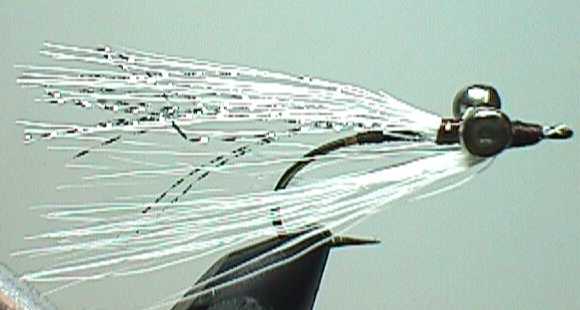
Matt Tucker's "Clouser Minnow"

Hook Mustad 34007, #4 - 2/0
Thread 6/0 to match
Wing Bucktail with Krystal Flash or Flashabou
Throat (underwing) Bucktail
Eyes Dumbell eyes

Tying Directions:

  1. Place the hook upright in the vise. Secure the thread on the shank, approximately 1/3 of the way back from the hook eye, and cover the spot with a few wraps of thread to provide a base for Step 2.
  2. Place the metal eyes on the first 1/3 of the hook shank on the top. Leave enough space between the metal eyes and the hook eye to attach the wing materials and make a proper head for the fly.
  3. Secure it by wrapping the thread diagonally across the eyes, alternating wraps from the left and right side of the metal eyes to straighten them. The thread wraps will form an "X" cross the center of the dumbell. To tighten the diagonal "X" wraps, wind the thread around the base of the metal eyes -- on top of the hook shank -- in a circular motion. Finish by wrapping the thread around the hook shank in front of the metal eyes and secure with half-hitches. Apply a drop of head cement, super glue, or Sally Hansen's Hard-As-Nails on the wraps to hold the metal eyes to the shank.
  4. Place the wing/tail material that will become the bottom (or belly) color on top of the hook. The length should be determined by the species you intend to fish for (shorter for toothy fish such as trout; longer for bass that take streamer flies head first). Secure the bucktail, or other material, between the eye of the hook and the eyes and wrap the thread forward to create a cone-shaped head. Pull the material across the cleavage between the two eyes then wrap the thread to behind the eyes.
  5. Holding the material up, spiral-wrap over it approximately 2/3 the length of the shank -- usually aligned with the hook shank. Securing the material this way keeps it on top of the hook shank, helping to keep it from twisting and causing an "underwrap" while casting. Turn the hook over in the vise so the hook point is riding up. Tie in your choice of flash material -- silver, gold, pearl, or a combination. When the fly is completed, trim the flash so that it extends just beyond the tips of the body material.
  6. Secure a second, equal length of wing material (double the amount) in front of the hook eyes and wrap the thread forward to the hook eye, completing the head of the fly. As for colors, you can use a combination here such as chartreuse in the middle and blue on top, or pink in the middle and olive on top (to make a Little Rainbow Trout). Finish wrapping the head and seal it with head cement.
Note: When using synthetics such as Superhair and Ultrahair, Clouser ties all of the materials beneath the hook shank to provide the necessary baitfish profile.

Notes:

The original Clouser is easy to tie, even for beginners. The most important step is tying the dumbell-shaped eyes securely to the hook shank. Unless the eyes are tight, they will twist and make the fly useless. The eyes can be attached to the shank of the hook as the first step of tying the fly. You can also pre-wrap a number of hooks with eyes, then tie the completed Clouser Minnow as needed. I find it very useful to have several dozen hooks with eyes in different sizes tied and ready to go.

The Clouser Minnow was originated by Bob Clouser. It is a useful fly for all sorts of fish, including trout, bass, and other types of fish. I am not going to reinvent the wheel in terms of tying instructions, as a most excellent tying instruction sheet has been written by Ben Ardito and posted on The Virtual Fly Shop's Archive of Patterns (http://www.flyshop.com). Above is Mr. Ardito's tying instructions for the Clouser Minnow.

With regards to my tying preferences to this pattern, I have only been tying flies for less than a year (at the time of this pattern sheet) and have found myself concocting  wild color combinations to imitate most everything (from the colors of a crawdad, to the colors of the AC Plug that I fish with while tournament bass fishing). The color combinations are endless with this pattern. Have fun with it, Matt Tucker.

BACK TO SMALLMOUTH VI

1