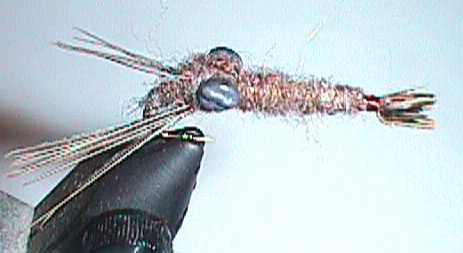
Marcus Harton's "Skip's Dad"

Hook Regular to heavy wire, 1X to 3X long, sizes 6 - 12
Thread Brown 8/0, 6/0, or 3/0
Tail the butts of the pheasant tail fibers that form the back pinchers
Nose Brown Antron, dubbed
Weight Lead barbell eyes
Rib Fine Copper Wire
Abdomen Brown Antron, dubbed

Tying Directions

  1. Start the thread at the bend. Dub the nose of the crawdad down into the bend, then attach the weight behind the bend.
  2. Invert the hook. Cut about 1/2 inch of Pheasant tail fibers from the stem, divide into two bunches. Tie in the tips of one bunch over the weight so the bunch sticks out at about 45 degrees from the hook. Tie in the other bunch so it sticks out the other side.
  3. Tie down the butt ends of the fibers for about 1/8" down the hook. Use figure 8 wraps of dubbing around the eyes to fill out the head.
  4. Pull the butt ends toward the bend of the hook and tie them down. (After dubbing the body, you'll pull them back toward the eye to form a shellback of sorts.) Tie in the copper wire and let it dangle off the bend end of the hook.
  5. Dub the body so that it has a slight taper from the head (bend) to the tail (eye).
  6. Pull the pheasant fibers back toward the eye and give them a wrap or two of thread. As you tighten down the thread, pull the butt ends of the fibers down and fiddle with them to get them to fan out a little bit, then tighten down on the thread and secure the fibers. Trim the ends of the fibers to give the impression of a crawfish tail.
  7. Bring the rib toward the eye. Tie it down and trim excess. Whip finish.

Notes:

Morris says the way to make this fly work is to make it act like a crawfish. Let it sink to the bottom, drag it slowly an inch or so and let it sit before another short, slow retrieve. He says if that doesn't work, try a quick low swim over the bottom as if the crawdad were escaping from something.

BACK TO SMALLMOUTH V

1