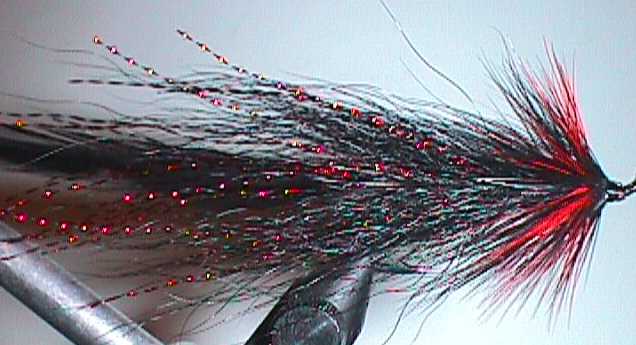
Joe Cornwall's "Flat Wing Deceiver"

Hook Tiemco TMC 7999 salmon hook, size 4
Thread Black
Tail 2 black saddle hackles tied flat (90 degrees to the hook bend) Hackles are sandwiched between a few strands of red crystal flash on the bottom and top.
Body black thread built up to a taper where wing/belly are tied in
Wing/Belly two sections of black bucktail tied in on the top and bottom of the hook
Hackle black saddle or schlappen followed by red followed by black
Head black thread

Tying Instructions

  1. Tie in four to six strands of red crystal flash as a tail about twice the hook shank length.
  2. Tie in two black saddle hackles "flat" to the hook. Saddles should be about twice the shank length and should be fairly well webbed and flexible.
  3. Tie in four to six strands of red crystal flash as a topper to the saddles.
  4. Build a nice taper to the thread and add a drop of head cement. Allow to dry.
  5. Even the tips of a small clump of black bucktail and tie in at the 1/3 point of the shank as though you were tying a traditional bucktail wing. The bucktail should not extend more than 1/3 of the length of the saddles past the bend.
  6. Tie the same amount of bucktail under the hook bend to "sandwich" the hook and saddle hackle tail.
  7. Trim the bucktail butts so you can tie a nice conical taper. Add a drop of head cement and let dry.
  8. At the 2/3 point of the shank, tie four strands of red crystal flash on the top and four strands on the bottom of the hook. Then add another bucktail wing/belly just like the above. Again, build a nicely tapered finish and add a drop of cement. (I like to make sure flies are as indestructible as possible - it only takes a second or two.)
  9. Tie in a wide, webby black saddle hackle or schlappen feather. Stroke the hackle barbules all to one side and wrap the hackle as though you were tying a soft-hackle. All saddles are tied in by the butt and wrapped with the shiny side forward.
  10. Tie in a wide, webby red saddle hackle or schlappen feather as above.
  11. Tie in a wide, webby black saddle as above.
  12. Finish with a nice tapered head and cement with high gloss cement. (I use clear "Hard As Nails")

Fishing the Fly

I tied this fly more for lake fishing for smallmouth bass than streams. I fish it on a full sinking line. The flat wing allows the fly to hover in the water and sink very slowly with lots of action. It should be fished with a slow, hand-twist retrieve. This fly is a very good leach imitation. It does work well in rivers and streams where I fish it as a leach or mad tom imitation on a sinking or sink tip line with a down-and-across cast and slow retrieve. Keep the fly close to the bottom where these prey items live.

Once exception to the above is for largemouth fishing. This is an excellent fly for largemouth when fished on a floating line around lily pads, brush, or timber.

This fly fishes best in early morning, late afternoon and after dark. It is also an excellent choice for high or muddy water. The hackles provide lots of motion and the fly moves a lot of water making it easy for the fish to target it. Try fishing this fly in late autumn for shallow water walleye at night!

BACK TO SMALLMOUTH V

1