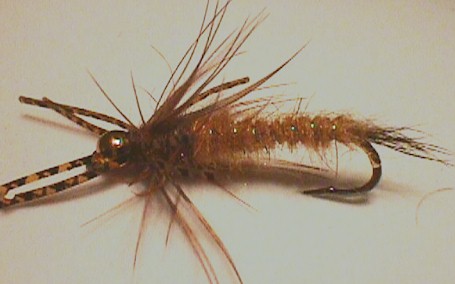
Tying Directions:
- Attach thread and wrap the shank entirely. (Dave roughs up hook shank with
a small file prior to this.)
- Place 10 - 12 wraps of .025" lead on the shank just behind the hook
eye. Wrap over thread several turns and cement.
- Wrap thread back to the start of the hook bend. Tie in a strand of
Flashabou, Pearl Gold if you have it, and wrap it half way down the bend
toward the hook point. Wrap it back to the tie in point and secure with a
couple of wraps.
- Leave the excess flashabou attached for the rib.
- Cut a small bunch of fur from the back on a Red Fox Squirrel hide to make
the tail. Be sure to comb out any stray material and just leave the
multi-colored squirrel back hairs.
- Attach the tail at the normal tie in point and wrap forward to tie down
all loose ends. Return the thread to a point at the start of the bend.
- Now take a dubbing mixture of 50% RFS belly fur and 50% orange Antron and
dub a tapered abdomen. (I used standard dubbing techniques on the flies I
sent in, but have since purchases a Turbo Spinning Block from Hareline
Dubbin and used dubbing brushes recently to make the abdomen and thorax. The
flies should be more durable made this way, and they surely do look better.)
- After dubbing the body with the "orange" blend, tie off and wrap
the Flashabou rib up to the abdomen tie off point.
- Tie off the rib, and now dub the first half of the thorax using a blend of
50% RFS back hair and 50% brown Antron, and then secure with tying thread.
- Tie in a partridge feather or golden hen feather and wrap 1 or 2 turns to
form the legs.
- Pull these back and finish dubbing the thorax and tie off, but do not clip
the excess dubbing off yet. (This makes the legs appear to be
"growing" out of the thorax. It also helps make the leg turn back
toward the tail and lie closer to the abdomen.)
- Be sure to leave some room behind the hook eye for a thread head. Now tie
in 2 rubber legs on each side of the thorax and spread them to look like
legs on an insect. Take 1 or 2 turns of dubbing over the rubber legs at the
tie in point and a turn or two in front of the legs to flair the front legs
away from the hook eye.
- Wrap a thread head, apply head cement, and start fishing!!
Personal Comments:
To tie the Dave Whitlock version of the Red Fox Squirrel Nymph, we must
decide first the particular version of this fly that we wish to tie. For the
Smallie IV swap, I decided to tie the full blown version that has a bead head,
rubber legs, and full dress.
I saw Dave Whitlock in Charlotte on Saturday, March 11, 2000 and he tied one
of these flies for me. He also signed a matt for a shadow box that I now have
this fly in. I have not fished his version of course, and had not tied any of
these pattern until I entered this fly swap. I did purchase Dave's video showing
how to tie the RFSN, but had not gotten around to it. You guys got me off dead
center, and now I have an armada of RFSN's. I may have to devote an entire fly
box to this particular pattern. In the video, Dave shows how to tie up to 6
versions of this fly to imitate almost everything you might find in a stream
below the surface or in the film. Dave simply varies the hook size and type
along with leaving off some of the materials mentioned above to create other
versions of this fly. Take a look at the video if you would like to see some of
the other versions, or send me your e-mail address and I will get the info to
you. Good luck fishing and tying the Red Fox Squirrel Nymph.
BACK TO SMALLMOUTH IV