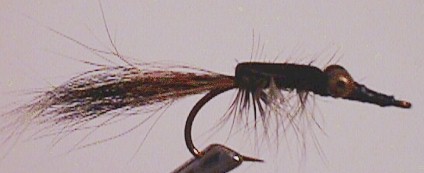
Tying Directions:
- Begin by tying the thread just behind the eye, and build two small thread
bumps about 1/3 of the way to the hook bend. These will help hold the bead chain
eyes in place.
- Secure the eyes using a figure 8 wrapping, and cinch tight
with a couple of horizontal wraps between the eyes and the hook shank. A drop of
super-glue may be used to insure that the eyes don't rotate.
- Continue winding a thread base to a point just above the hook point and tie
in a small bunch of squirrel tail equal to the length of the hook, or slightly
longer. Keep the hair from rotating around to the sides and bottom of the hook,
if possible.
- On top of these windings, secure the end of an 1/8 inch wide strip of
foam. I used black, but olive or brown would work well too. This should be tied
in with the long piece toward the rear of the hook.
- On top of this tie-in point,
secure a small grizzly hackle by the butt-end, and advance the thread to just
behind the eyes.
- Palmer the hackle forward to just behind the eyes, and secure
with several wraps.
- Now fold the foam strip forward, and make several wraps of
thread, securing it just behind the eyes. It makes a neater fly if you trim the
hackle flat along the top of the hook, prior to this step.
- After the foam
is secure behind the eyes, move the thread to just in front of the eyes, and
make several more wraps over the foam, securing it again in front of the eyes.
-
Cut off the foam strip, leaving about 1/8 inch, which is now over-wrapped with
thread, tapering it to the hook eye.
- Whip finish, and coat thread wrappings with
cement.
Notes:
This is a fly that I found in Fly Tyer Magazine, and which was developed by
Bruce Baby of Canal Winchester, OH, as a countdown pattern. It works well on the
surface and on the bottom, and is effective for smallmouth bass, rock bass,
sunfish, and carp.
Len Schattler email
BACK TO SMALLMOUTH IV