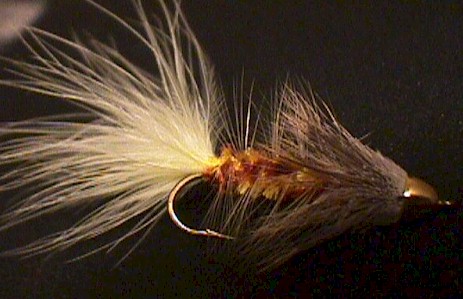
Tying Directions:
- Slip on the conehead.
- Start the tying thread about 1/8th of an inch behind the
conehead and build a thread-base back to the hook bend. (As you build the
fly, you will be leaving that 1/8th inch space blank for spinning
the deer hair head.)
- Tie in the marabou tail the length of the hook shank.
- Tie in the body chenille starting where the tying thread starts, but leave
it unwrapped.
- Tie in the hackle by the tip.
- Wrap the body forward to where the tying thread began.
- Wrap the hackle forward to where the body ends.
- Clean a pencil-thick bunch of natural deer hair. Stack it by the tips.
- Cut the butts of the deer hair off, leaving the bunch 1" to
1.25" in length.
- Tie in the deer hair at the halfway point and spin it to distribute it
evenly around the hook.
- Use the conehead to pack the deer hair back toward the body.
- Clean another bunch of deer hair, stack by the butts, cut to 1" to
1.25" in length and spin in front of the previous bunch. Often it doesn’t
spin to distribute evenly. You can reedy this by massaging the deer hair
with you fingers. The massage also causes the deer hair to fill-in behind he
conehead and pack tightly.
- Tie off behind the conehead. The thread will disappear.
- Trim flat on the bottom and follow the shape of the conehead on the top
and sides.
Notes:
(Also, sometimes also called the just the Conehead Wooly Bugger, which is
incorrect because a Wooly Bugger doesn’t have a deer hair head. The Bow River
Bugger does.)
I fish this fly on a sinking line/short leader rig in big water and on a 9ft,
3-4x leader in smaller water.
This fly can also be tied in olive or black. In black, I use a peacock herl
body wrapped with copper wire. An olive version took an 7-8 lb brown from the
AuSable last June.