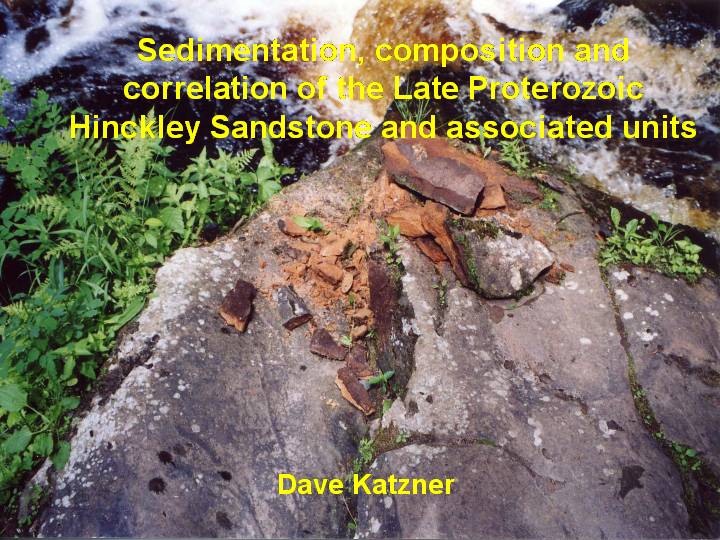
By: David Katzner
St. Cloud State University
Fall, 2003
Abstract
The Proterozoic Hinckley Sandstone is mineralogically mature quartz arenite deposited the late stages of the Mid-continent Rift sedimentation. Previous work interpreted the Hinckley Sandstone as shallow-water lacustrine deposit (Tryhorn & Ojakangas, 1972) and a shifting mosaic of eolian and fluvial, and possibly lacustrine environments (Beaster, et al, 2001). No real detailed studies on the source or the correlation of the Hinckley have been done. The purpose of this study is to reevaluate the depositional environment, suggest the source, and see if any correlation can be done.
The study area is located in the Mid-continent Rift area of east-central Minnesota and northwest Wisconsin. Outcrops were located. Then a field trip was taken to retrieve samples and obtain sedimentary structure data. The depositional environment based on paleo-geography and sedimentary structures reflects the conclusion of Beaster, et. al (2001).
Petrography of the Hinckley Sandstone shows quartz grains have abraded overgrowths and residual weathering. This suggests at least some of the quartz grains are from a pre-existing sedimentary rock, which in this case is the underlying Fond du Lac Formation. Paleocurrent of the Hinckley Sandstone is toward the southeast. Dip of the Hinckley Sandstone and Fond du Lac Formation are both about 5� toward the southeast. The paleocurrent and dips suggest a northwest source.
Tryhorn & Ojakangas (1972) suggested the Devil�s Island Sandstone of Wisconsin possibly correlates with the Hinckley Sandstone. Correlation could not be done due to the tectonic disruption, specifically faulting, of the rift region. Most of the Devil�s Island Sandstone has been removed by erosion.
Introduction
The Late Proterozoic Hinckley Sandstone is a quartz arenite composed of on average 96% quartz (Tryhorn & Ojakangas, 1972). This is a geologic problem because it is such a clean sandstone. Three major questions that arise: 1) What was the depositional environment? 2) What is the source? And 3) Is there any correlation between the Hinckley and other sandstone units? These questions are very difficult to answer due to the tectonic setting of the Mid-continent Rift (Figure 1). Figure 2 shows the stratigraphic sequence in the Lake Superior Region.
Background Information
The Hinckley Sandstone along with the underlying Fond du Lac Formation are part of sediment fill of the Mid-continent rift. Seismic evidence suggests the Keweenawan sandstones are as thick as 7,000ft (Fond du Lac 5000ft and the Hinckley 2000ft) in the vicinity of Hinckley, MN (Tryhorn & Ojakangas, 1972). The age of the Hinckley is between 700 million years to 900 million years old. Outcrops are limited to only a few locations in East Central Minnesota (Figure 3).
Sedimentation
Possible Depositional Environments
The first possible depositional environment for the Hinckley is eolian, or wind deposition. The average grain size transported by wind is .15-.30 mm. (Easterbrook, 1999). The overall average grain size of the quartz in the Hinckley appears to be 0.4 mm. Quartz has a density of about 2.65 in �granitic� type rock, which is average for silicate minerals. Being average it will be assumed to fit in the average grain size transported by wind. To be the main contributor to the deposition of the Hinckley, winds would have to be sustained at about 40 mph for a long period of time (calculated from table 17.1, Easterbrook, 1999). Furthermore, eolian sediments are typically among the best-sorted deposits in nature. (Easterbrook, 1999) The Hinckley Sandstone is generally not as well-sorted as expected for a quartz arenite (Figure 4). However, an area with thin beds, possibly laminations did look characteristic of eolian deposition in Sandstone Topographic Quadrangle at the place marked �cave� in the NE, NW, NW, section 10, T 42 N, R 20 W (Figure 5). Samples were not taken at this location.
The second possible depositional environment for the Hinckley is fluvial-deltaic. Evidence for this is abundant cross-bedding within beds of sandstone, particularly channel-trough cross-stratification (Figure 6).
The third possible depositional environment is lacustrine. The Mid-continent rift, based on paleo-geography, was a closed basin or nearly closed basin in the Late Proterozoic (Hamblin, 1965). There is no paleontological evidence to suggest the Hinckley was deposited under marine conditions (Tryhorn & Ojakangas, 1972). If there is a fluvial-deltaic system supplying sediment and water to a basin, then a shallow lake would probably form in the deepest part. A model for the deposition of the Hinckley is shown in (Figure 7).
Considering the evidence of the depositional environment, the Hinckley Sandstone was probably deposited in a fluvial-deltaic system, especially near the edges of the basin. A shallow lacustrine system probably persisted in the deepest parts of the basin, which was fed by alluvial sediment from the fluvial-deltaic system. Finally, minor eolian deposits are located throughout the system.
Source
In general, quartz arenites exhibit the best sorting, best rounding, the highest concentration of quartz, and the most restricted heavy mineral suit of any of the sands (Pettijohn, et. al 1972). On the basis of these characteristics most investigators have concluded most if not all quartz arenites were derived from pre-existing sandstones due to their mature nature (Pettijohn et. al, 1972). The petrography of the Hinckley Sandstone reveals proof at least some of the grains of quartz have come from pre-existing sandstones; 1) abraded overgrowths and 2) overgrowths from older sandstones the have been weathered away. Field and lab observations point out a definite maturation process of the sediment in the Mid-continent Rift was made. Figure 8 shows the field and lab observations of the Hinckley Sandstone, which is the most mature sedimentary rock in the Mid-continent Rift. Figure 9 shows the field and lab observations of the Fond du Lac Formation, which is not near as mature as the Hinckley. Figure 10 shows the field and lab observations of the Basal Fond du Lac Formation.
Since most all quartz arenites are derived from pre-existing sandstone and an progressive maturation in the rift formations is found, the direct source of the Hinckley Sandstone is probably the underlying Fond du Lac Formation. Reworking of the Fond du Lac Formation in the depositional system proposed previously probably yielded the Hinckley Sandstone.
If the Fond du Lac is the source of the Hinckley, where did the Fond du Lac and Basal Fond du Lac sediment come from? Average paleocurrent direction of the Hinckley is 134 degrees, or from northwest to southeast (Tryhorn & Ojakangas, 1972). Dip averages 5-8 degrees in the same direction (Tryhorn & Ojakangas, 1972). Fond du Lac also dips 3-12 in the same direction (Craddock, 1972). This suggests the source for both the Hinckley and the Fond du Lac is from the northwest. Pettijohn et. al (1972) said of 44 examples of quartz arenites in the literature, all but 5 are Precambrian or Paleozic in age. Back in the Precambrian and Paleozoic, the stable continental bedrock masses were much more exposed than they are today. Because of this, Pettijohn et. al (1972) concludes quartz arenites seem to be derived from stable continental cratons and are most prominently located along the cratonic margins. This is probably true for the Hinckley. Since the paleocurrent in toward the southeast, you must look to the north or northwest for a stable continental cratonic bedrock mass. Just to the northwest is the southern limb of the Canadian Shield, in particular the Granite-Greenstone terrain Superior Province as shown in Figure 11. Exposed at the surface the previous billion years before deposition of the Keweenawan sandstones was the rock of this terrain. The granite of this terrain in particular probably is the original source of the Keweenawan sedimentary rocks since it is to the northwest and would contain the quartz, feldspar, and rock fragments found in the basal Fond du Lac.
In conclusion, the source of the Fond du Lac is probably the Granite-Greenstone terrain of the Superior Province of the Canadian Shield. Weathered material of the granite in particular probably contained adequate amounts of quartz, feldspars, and rock fragments as seen in Basal Fond du Lac.
Correlation
The Devils Island Sandstone in Wisconsin is apparently correlative to the Hinckley Sandstone (Tryhorn & Ojakangas, 1972). This rock is not found at Pattison State Park in northwest Wisconsin, which is only 12 miles from eastern most Minnesota outcrops at Holyoke. The Keweenawan Orienta Sandstone, which is correlative to Minnesota�s Fond du Lac Formation is found here. There is a fault cutting through Pattison State Park and terminates the Hinckley Sandstone somewhere between there and Holyoke, MN (Figure 12). The map in Figure 12 suggests the Hinckley extends 20-30 into Wisconsin. Since Pattison State Park is only about ten miles into Wisconsin, a minor revision to the bedrock map in Figure 12 is proposed (Figure 13). The change shows the Hinckley barely extending into the subsurface of Wisconsin, if at all.
The fault shown that terminates the Hinckley between Holyoke, MN and Pattison State Park, WI is called the Douglas Fault, a major thrust fault propagating through basically the center of Mid-continent Rift basin. The Douglas Fault did cut off the Hinckley somewhere between Holyoke and Pattison State Park. On the east side of the Douglas Fault in Minnesota and the southeast, south sides in Wisconsin, the Hinckley (and the possibly correlative Devil�s Island) was thrown up on a horst and eroded away, exposing volcanic rift basalt where the Hinckley Sandstone once was. A picture in Figure 14 shows the fault trace at Amnicon Falls State Park, WI, which is about ten miles east/northeast of Pattison State Park. Since this fault terminates the Hinckley, correlation of the Hinckley Sandstone with the Devil�s Island could not be done. Outcrops in Wisconsin of the Devil�s Island Sandstone are very limited, but are possible in North Central Wisconsin as shown in Figure 15. From Iron River, WI through Cornucopia, WI to Devil�s Island in the Apostle Islands, WI remnants in the subsurface and possible outcrops may be present in these areas.
In conclusion, the correlation between the Hinckley and the Devil�s Island could not be done partly due to difficulty of the tectonic setting, particularly the disruption caused by the Douglas Fault, of the region in northern Wisconsin. It is hard to locate outcrops of the Devil�s Island, thus definitively telling us if it correlates with the Hinckley.
Discussion
As was said in the opening, the questions posed are difficult to answer due to the tectonic setting of the region. Through this research, more questions than answers have surfaced. A couple of things are for sure: 1) The Hinckley Sandstone was not deposited in one single depositional environment 2) A definite maturation process is occurring in the rift 3) The main problems posed here are by no means solved and 4) New ideas and interpretations are always welcome.
Nothing real new was found in doing this project in comparison to what Tryhorn & Ojakangas (1972) discovered. Many geology professionals in the upper Midwest have also been working on this problem recently, and have also not had any luck finding anything new. This is an on-going problem that may never be adequately solved.
References
Anderson, R.R., 2003. Location of the Midcontinent Rift. Accessed 11/24/03.
http://www.igsb.uiowa.edu/browse/rift/mrs_loc.htm
Cannon, W.F., Morey, G.B., Barber-Delach, R., 1997.Geologic Map and Mineral Deposits of the Lake Superior Region: Minnesota, Wisconsin and Michigan. USGS Open-File Report 97-455 (version 3, Nov. 1999)
http://pubs.usgs.gov/of/of97-455/
Craddock, C., 1972. Keweenawan geology of east-central Minnesota and southeastern Minnesota. Published by the University of Minnesota and in Geology of Minnesota: A Centennial Volume, p. 419.
Easterbrook, D.J., 1999. Surface Processes and Landforms, 2nd Edition. Published by Prentice Hall, p. 472-475.
Ojakangas, R.W., Dickas, A.B., 2002. The 1.1-Ga Mid-continent Rift System, central North America: sedimentology of two deep boreholes, Lake Superior region. Published by Elsevier Science B.V. and in Sedimentary Geology 147 (2002) p.21.
Ojakangas, R.W., Matsch, C.L., 1982. Minnesota�s Geology. The University of Minnesota Press, p. 59.
Pettijohn, F.J., Potter, P.E., Siever, R., 1972. Sand and Sandstone. Springer-Verlag Berlin, p. 214-227.
Tryhorn, A.D., Ojakangas, R.W. 1972. Sedimentation and Petrology of the Upper Precambrian Hinckley Sandstone of East Central Minnesota. In Sims, P. K. and Morey, G. B. Geology of Minnesota: A Centennial Volume: Minnesota Geological Survey, p. 431-435.