NEWTON ABBOT, SATURDAY JULY 22, 1922
---
NEWTON'S WAR MEMORIAL
UNVEILING ATTENDED BY THOUSANDS OF PEOPLE
---
Impressive Ceremony
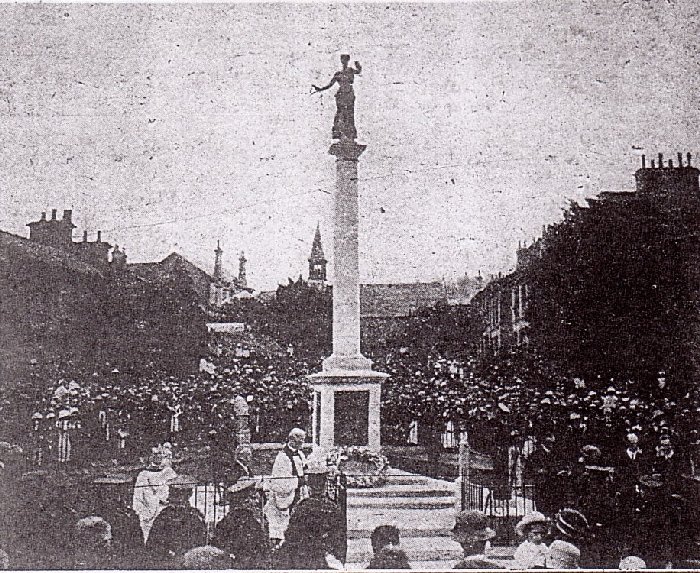
Newton's tribute to her sons who fell in the Great War was unveiled and dedicated on Sunday afternoon in the presence of a huge crowd of people who could not fail to be impressed with the solemnity of the occasion.
All traces of the scaffolding had been removed within a few hours, the turf relaid, a flower bed planted, and the railings replaced. The base of the monument, with the tablets bearing the names, had been covered with a Union Jack.
The Newton Territorials formed a guard of honour.
A large square was made by the Newton Company of the Territorial Cadets, Newton College Contingent of the Officers' Training Corps, the Ambulance and Nursing Divisions of the Newton Corps of the St. John Ambulance Brigade, and the ex-service men. Inside the square places were assigned to the relatives of the fallen men, the Town and Salvation Army bands and the massed choirs of the places of worship in the town, who led the singing of the hymns and the National Anthem.
Just before the service commenced two soldiers and two sailors, with arms reversed, took up positions at the corners of the memorial steps. A general salute was accorded Lieut-General Sir Chas. Louis Woolcombe K.C.B., K.C.M.G. On his arrival.
The service was beautifully arranged, The opening sentences, said by the Rev. E.G. Beckwith, ended with the most appropriate "Greater love hath no man than this - that a man lay down his life for his friends." Then came the well-known hymn "O God, our help in ages past," and a passage from the Revelations, read by the Rev. S. Lyne.
At the invitation of Mr. W.R. Vicary, Chairman of the Council, Sir C.L. Woolcombe unveiled the Memorial and the troops presented arms. "The Last Post" was sounded by buglers, who followed it with the "Reveille."
The dedicatory prayers were offered by the Rev. C.A.W. Russell, Wolborough's Rector. There was an impressive moment when the beautiful town wreath was laid at the foot of the memorial by Mrs Viola Hamlin and her son, Stoker P.O. W. Hamlin. She lost six of her family of seven sons in the service of the country.
The hymn "For all the Saints" was sung, and the memorial was handed over by Councillor W.H. Brock, the Chairman of the War Memorial Committee, to the Urban Council, and the brief service concluded with the singing of the National Anthem.
Wreaths were placed on the memorial by Sergt. Crispin, M.M. And bar
and Croix de Guerre, for the Territorials; Sergt. Found for the Ambulance
Corps.; Capt. W.J.V. Watts for the Comrades; and Mr R.S. Stephens for the
All Whites.
Councillor W.R. Vicary J.P. On behalf of the Council and townspeople
of Newton Abbot, thanked Gen. Woollcombe for coming to unveil the memorial
which had been erected to the memory of the Newton men who had fallen in
the war. Gen. Woollcombe, as a soldier, would realise only too well the
solemnity of that moment and also the feelings of many of those present
that afternoon. When he lowered the flag they would see on the bronze panels
the names of those brave men who had fallen and were now at rest. It was
through the action of men such as these that we were now able to walk about
in freedom without being molested by an armed enemy in our land.
Sir Charles Woollcombe said he could not help feeling that it would have been more appropriate had they had a resident of Newton Abbot to unveil the memorial. But as they had done him the honour to ask him to perform the ceremony his services were at their disposal. He did not feel he was a stranger to Newton Abbot. His father, mother and sister lay in Wolborough Churchyard; he had many relations living here and he had paid the town many happy visits. Perhaps he might mention one more reason why he did not feel altogether a stranger and why ita was not altogether inappropriate that he should perform the ceremony - his second son, who fell in the war, was born in Newton Abbot.
"We are here this afternoon" he continued "to unveil this monument to the memory of 230 men of Newton Abbot who gave their lives in the war. May this memorial go down to all posterity with the names of these men to be remembered with honour, gratitude and praise. I think there were seven hundred thousand men of our Empire who gave their lives in the war and all over England and the Colonies we find memorials of this sort put up in their memory. I know there are `a great number of people who think that money should not be, as they say, wasted in putting up a memorial like this - they would like to see perhaps a ward in a hospital, an almshouse or something of that sort founded with the money. Of course they are entitled to their opinions, but personally I think this is the most appropriate form of memorial we can have.
"We are not here only to unveil this monument to the memory of the dead. There are other points we must think of. To the relatives of those whose names are on the tablets I, on behalf of everyone present, offer respectful sympathy. In addition to the seven hundred thousand men who fell, a million and a quarter were wounded in the war. Some of them have come home maimed, blinded and broken. We must never let them want; we have to remember they have to be cared for. We must take care that those who are still able to earn their living do not suffer for having served their country. Many of those who went abroad, threw up their employment or appointments and lost everything; while others were unable to complete their training.
"Finally we have to remember the spirit that animated those who went to the war and every time we look at this monument and think of those who died, let us remember that spirit and do our best to hand it down to all posterity. We must instil that spirit into our children and descendants.
The General then entered the memorial site and lowered the Union Jack which covered the bronze tablets, with the words "To the Memory of those 230 men who have fallen I unveil this monument."
Councillor W.H. Brock as Chairman of the War Memorial Committee asked the Urban Council to accept the memorial to keep and preserve for all time.
It was a tangible and lasting memorial to the brave men of Newton who answered their country's call at the time of their country's need, who fought and died that we might live.
After a sympathetic reference to the bereaved, Councillor Brock said great care had been taken that the name of every fallen man should be placed on the panels but one or two had been left off and arrangements had been made for an additional panel to be provided.
He congratulated Newton people on their admirable response to the clarion call to wipe off the deficit of £200 in less than a week.
The chairman of the Council accepted the gift and said the town would always be proud of the magnificent memorial to her fallen sons.
(There follows a list of those who laid wreaths - this can be seen here )
Last updated 22 May 2004