Email Me
Home
Calendar
Composers
Other Writings
Share
View comments
Previous Next
| The Musical Almanac ��by Kurt Nemes | 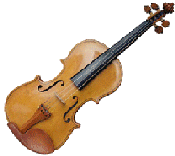 |
June 4. Anonymous: The Play of Herod
Today I put on an album that someone at my college dorm-the French House-introduced me to some 24 years ago. It dates from the early 1960s and was a rediscovery, by the New York Pro Musica under the direction of Noah Greenberg, of a medieval mystery play. It contains some of the most beautiful choral music I know and it lifted my spirits to hear it again all these years later.
After about 15 minutes, my 12 year-old daughter Claire muttered �This music is so irritating,� as she reached for her �NSYNCH� album. �Can we put this on?�
�Claire,� I said, �this is the first time I�ve played this since before you were born. Can�t we just listen to what I want for a change?�
�Ugh!� said Claire.
�Claire," said my wife, Judy. "You had all day after school to listen to your CD.�
�And dad had all day at work to listen to his music.
The fact is that I didn�t. This disk is out of print and I only have it on an old vinyl LP. Way to big for the slot in my work computer.
�If you like this kind of music, why don�t you join a chorus?�
�Why don�t you form a pop group,� I shot back.
�Because I can�t sing.�
�But you never really tried. It�s like learning an instrument. You have to study.� She should know better: she spent five years learning to play the violin. But sometimes, you just can�t argue with a pre-teen.
�Who wants to listen to bloody medieval music?,� were her final words as she stormed out. I thought she might, because she had to study the middle ages last year in school and she had gotten quite interested in recreating a banquet using bake-able modeling clay. And in addition to being quite beautiful, sometimes medieval music is kind of funny.
Half the reason I probably fell in love with medieval music was the number of bizarre instruments used to produce it. They had the weirdest sounding names-crumhorns, rackets, sackbuts, cornets, snake and recorder. Some of the the double reed instruments produced sounds resembling a drunk making a protracted Bronx cheer. There was something pleasantly na�ve about this type of music. Later I learned that back then musicians often improvised quite a bit, and in a way this music was much more spontaneous and real than the full blown orchtral works that became the mainstay of �serious� music.
This Play of Herod seems to be out of print and I can�t find any reference to it at a number of the music sites. I own another recording by the same name, but it�s not nearly as good as the one by the New York Pro Musica, recorded in 1964 on the Decca label. The MCA website is under construction and I found a reference on another site saying excerpts from the Greenberg production have been put on a compilation on that label, which ate up Decca.
Tracking it down would be worth your while, because this piece is a real forerunner to a lot of medieaval groups that have now become popular, for example Anonymous 4. In the first scene, for example, there is a piece called �Angel Choir� in which sopranos sing the most ethereally beautiful pieces I have ever heard. My favorite part, however, is the opening processional in which male tenors sing of how the Magi went out on their asses carrying gold, myrrh, and frankincense to go in search of the Christ child. I still find it a moving and haunting melody. The words, however are kind of funny as they spend a lot of time describing the donkeys on which the kings ride:
�Heigh, Sir Ass, oh heigh
While he drags long carriages,
Loaded down with baggages,
He, with jaws insatiate, fodder hard doth masticate.�
I thought for sure that would have cracked up Claire, who loves animals. Maybe I should have shown her the words first.
| Enjoy |  top top |