Email Me
Home
Calendar
Composers
Other Writings
Share
View comments
Previous Next
| The Musical Almanac ��by Kurt Nemes | 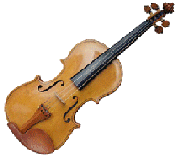 |
May 21: J.S. Bach Chaconne from 2nd Violin Partita BWV 1004
Someday soon, I expect to see the following ad for a concert at the Kennedy Center: "Internationally renowned violinist, Komiko Kim, joins the National Symphony Orchestra in a performance of Beethoven�s Violin Concerto in D. This marks Kim's American debut and her first performance since being born last month.
Nowadays, promoters and agents seem obsessed with finding younger and younger prodigies. I suspect the blame lies with yuppies. Most of us want our kids to be geniuses and enroll them in music and sports programs almost as soon as they learn to walk. Every parent dreams of siring a Mozart. Prodigies who make it big do sell tickets and draw crowds. Even music teachers buy into that myth. But something is lost when box office receipts becomes one�s sole motivation for doing something. If you think that something is not worth doing unless you become famous doing it, then why do it at all? I knew a teenager who once gave up swimming because her coach said she had started too late and would never be an Olympic medallist. And thinking that to be a successful writer I would have to set my goal on becoming the next James Joyce kept me from trying my hand at other types of writing.
It hasn�t always been that way. When I lived in the French House at Indiana University in the early 1970s, several of my dorm mates were majoring in performance (violin, piano, and voice) and though in their late teens and early twenties had set their sights on making it big. One of these was a Brit named Tony, who lived a few doors down the hall from me. He was one of the few unabashedly straight males in our dorm and had little use for the campy crowd with which I hung out. He was rail thin, always seemed to be wearing gray flannel slacks, and atop his slender frame sat a large round head with angular cheekbones, closely shorn hair, and a bulging forehead. He looked a bit like a taffy apple and was arrogant as sin.
Tony had learned, like many Brits living in the former colonies, that by simply turning on a British accent, he could reduce most Americans into fawning toadies. Me included. Once he bragged that as a girl, his mother, having been born in Dorset, England, had known Thomas Hardy and used to accompany the writer on long walks. Tony�s father once showed up looking the perfect English country gentleman-driving a Jaguar and wearing a tweed jacket with leather patches on the elbows.
Tony was majoring in violin and loved played the part of the sneering, temperamental artist. He treated most people with either disdain, condescension, or derision. Most of the time, he kept his door closed, and you could hear him practicing away frantically. He would emerge from time to time on weekends to join in the local soccer game in our little meadow where many foreign males would congregate. (Back then, few Americans played the sport.)
Growing up in Indiana, I had no idea about how strongly accents in England mark one's social class. Until college, the only English accent I had ever heard belonged to Audrey Hepburn as Eliza Doolittle in My Fair Lady, which of course started out as cockney. (I hadn't become a fan of Monty Python yet.) One day I bumped into Tony in the hall and said something like "'ello, 'ello, 'ello!" He looked at me and said, "It's funny how all Americans, when they try to imitate a British accent, do cockney, which is lower class." I also had a run in with Tony once, which caused him to dismiss me completely. One day, I walked by his door and noticed he had completely busted up his bow and taped it to the door. I knocked on his door, and when he appeared, I told him that I thought that was a really wasteful thing to do. He gave me another withering look and said, "Bows wear out. It wasn�t a great bow anyway." Since then, I've learned that a great bow can cost as much as a good violin. So maybe his was expendable. He still was an asshole.
At the end of the semester, he invited everyone to his end of the year recital. He had chosen to play the Bach Chaconne from the 2nd Violin Partita. This piece ranks as one of the most intricate, soulful and passionate piece Bach wrote and it has been transcribed by a number of composers and performers for other instruments. Segovia did a version transcribed by Busoni, and I have a great version of it played by the violinist, Nathan Milstein.
The Chaconne must put incredible demands on the violinist. Bach uses double stops quite extensively, in which produces chords and manages to create fugal patterns with bowing that alternates rapidly between the strings so that each string ends up playing a different melody.
Tony acquitted himself very well technically during this performance. It was one of the most soul-less performances I have ever seen. True, he managed to play every note flawlessly, but he literally attacked his violin with an intensity that showed that he hated the piece. His body language said "I am going to show you who's boss." But there was no love there, no respect for the emotions that Bach put into this piece.
I don't know whatever happened to Tony. There don't seem to be any Tonys among the current crop of world-famous virtuoso violinists. What astounds me is that the current set of mostly Asian female violinists-some of who are in their teens-manage to be technically brilliant and play with great emotional depth. I know from my own experience that at that age I had the emotionally nuanced range of a flat worm, so I don't know where these kids get it. Of course, when you are a kid, the few emotions you do have run very deep, but how they are able to express a wide range is a mystery. I wonder if Tony ever softened his heart.
| Bach Bio | Midi | Description of work | Recording |
| Enjoy |  top top |