Among the American Indian tribes, the smoking of the Sacred, or Ceremonial Pipe was not only an invitation to peace, but also the most solemn of religious acts.
---------------------------------------
When white men arrived in North America, they quickly learned that if invited to sit in and smoke the Sacred Pipe, that the native Americans took this very seriously.
---------------------------------------------
It was used when greeting a stranger, asking the Great Spirit for rain, or even to prepare for war.
While each tribe had developed it's own unique patterns for ornamentation on it's Sacred Pipes, all were similar in their form.
The stem was about two feet in length, and was made from a slender branch of an ash with the pith removed.
-----------------------------------------------
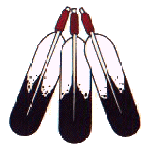
Craftsmen then carved elaborate figures of animals and birds into the stem, and feathers and strings of beads were added to complete the ornamentation.
------------------------------------------
The pipe bowl was designed from pottery or carved from rock.
Plains Indians carved theirs from catlinite, a reddish brown mineral that was mined from a common quarry.
---------------------------------------------
The ritual of actually smoking the Sacred Pipe was a sign that the Indians had invited the scrutiny of the Great Spirit, whose witness thereby insured adherence to any agreement that was reached.

First, the Indian leaders would sit down in a circle and call for the keepers of the pipe.
The Religious men, the high priests of the tribe would present and load the pipe with tobacco, thereby bringing the Great Spirit into the ceremony.
---------------------------------------------
Then the Chief would light the pipe and blow puffs of smoke towards the earth-Mother of all, and towards the Great Spirit, in thanks for good fortune and obtaining good fortune, towards the sun, in thanks for constant light, and then to the four winds, who represented the messengers of the higher beings.
-----------------------------------------------
Then the pipe was handed slowly around the circle, making certain that it completed the circuit smoothly, for any mishandling of the pipe could lead to bad fortune for the tribe.
Some tribes went as far as to kill those who interrupted the passing of the pipe.