 |
| Shanghai, continued... |
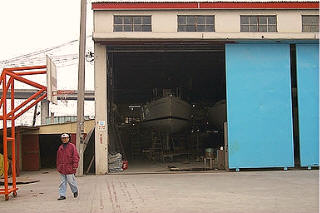
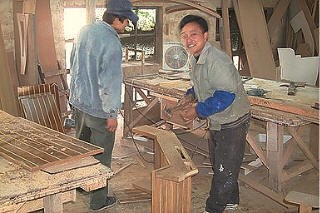
| The Hampton Yard The morning after our arrival, we went out first thing to visit the Hampton yard, where Sequoia was receiving her final touches. Mr. Ji drove us south from Shanghai, out of the concrete city, through rice fields and new housing developments. Just after crossing the Huang Po River, Mr. Ji made a couple of quick turns and we were heading toward the south river bank. The road went from gravel to paved, a uniformed guard rolled open the gate, and we were in. Mr. Ji led us upstairs in an old building, and we were ushered into a conference room, served hot tea, and asked to wait. I was anxious to see the boat immediately, but evidently the formal process required the tea and the waiting. After a few minutes, Phil appeared, and led us back down the stairs and across to a large building with blue sliding doors. There were four boats inside, three sail and one power, in various stages of construction. The smell of fresh cut teak permeated the air. We saw 20 or 25 workers using table saws, power planers and sanders. But others had hand-made planes or bow saws with tension controlled by twisted string. |
|
 |
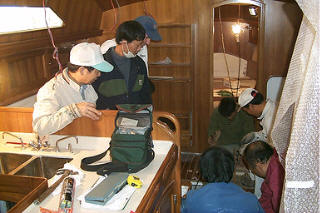
| Sequoia was the focus of most of the activity. Phil had warned us that our trip was scheduled a few days too early for final completion. But having the first inspection with all the hatches off, doors off, and much of the cabin sole missing wasn�t such a bad idea. We could easily see the wiring, plumbing, and through-hull fittings. The only trouble was that there were workers everywhere, sanding, varnishing, adjusting, fastening or polishing. None spoke any English but we soon learned �ni hao� (hello) and �xie xie� (thank you). Chip and Craig set to work with detailed inspections and measurements. Chip identified a few things that could be easily fixed during our stay in Shanghai, such as hose configurations, solenoid location and wiring size and protection issues. (Chip told us, in good humor, that the back of the 110 volt wiring panel should have a cover plate saying �110 volts -- Do not touch, Gringo!� Although he didn�t actually put those words in his report, I�m tempted to make a sign, saying just that, and mount it somewhere conspicuous in his honor.) |
 |
 |
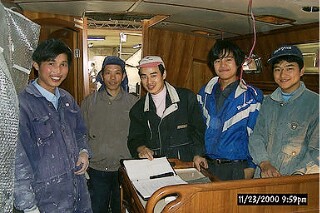
| Kit and I watched two workers bending stainless steel tubing with old rusted equipment and brute force. Like other areas of the yard, the contrast between the exceptionally high quality finished product, and the sometimes primitive tools and methods used to achieve it was nothing short of astonishing. We watched another worker paint the basketball standard which had recently been welded up for the workers� lunchtime recreation. They all seemed to be avid basketball players. Some of them were fascinated with Craig�s Nike clothes and shoes, and he made a mental note to send them a Michael Jordan poster. We learned that most of the workers were skilled craftsmen from distant towns. Some lived, dormitory style in another part of the building where we had first been received. This is a good job for them, and they were apparently pleased to be there, and pleased to have us inspecting their work. |
| There was a canal on one side of the yard leading into the Huang Po River, where many similar barges lumbered past the boat yard � some powered by their own clop-clop diesel engines, and others tethered together and being towed in a line-up of 6 or 7 barges. Each sported a little red Chinese burgee. Each was so loaded down that any significant wave action would have swamped it. Some barges carried bicycles, and others had potted trees. Most had laundry hanging out, taking advantage of the unusual (for late November) dry, sunny weather. |
 |
| Above: First view of Sequoia at the Hampton Yard. Below: Our companionway steps in the carpentry shop. |
| Above: Glueing the galley countertop |
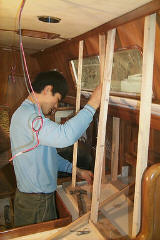
| Above: Checking the fuel tanks under the cabin sole. |
| Left: Some of the skilled craftsmen standing in the main cabin. Photo by A.W. Gardes |