1-Km High Structure,
Taller than the CN Tower
By Michelle Nichols
By Michelle Nichols
MELBOURNE (Reuters) - The world's tallest
man-made structure could
soon be towering over the Australian outback as part of a plan to capitalize
on the global push for greater use of renewable energy.
By 2006, Australian power company
EnviroMission Ltd hopes to build a 1,000 meter
(3,300 feet) solar tower in southwest New South Wales
state, a structure that would be more than twice
the height of Malaysia's Petronas Towers,
the
world's tallest buildings.
Currently, the world's tallest free-standing
structure is the Canadian National Tower
in Toronto at 553 meters.
The 200 megawatt solar tower, which will cost A$ 1 billion ($563 million)
to
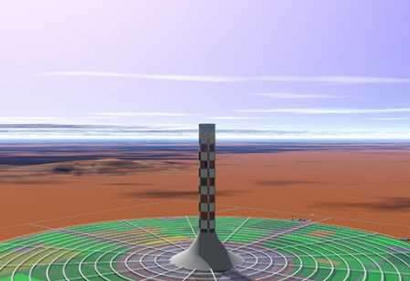
build, will be of a similar width to a football field and will stand in
the center
of a massive glass roof spanning seven kilometers
in diameter.
Despite its size, the technology is simple -- the sun heats air under the
glass roof, which slopes upwards from three meters at its outer perimeter
to
25 meters at the tower base.
As the hot air rises, a powerful updraft is also created by the tower that
allows air to be continually sucked through
32 turbines, which spin to
generate power 24 hours a day.
"Initially people told me 'you're a dreamer', there's no way anything that
high
can be built, there's no way it can work," EnviroMission chief executive
officer Roger Davey told Reuters.
"But now we have got to the point where it's not if it can be built, but
when it
can be built."
EnviroMission hopes to begin construction on the solar tower before the
end
of the year and be generating enough electricity to supply
200,000 homes
around the beginning of 2006.
The company also hopes the project will save more than 700,000 tonnes of
greenhouse gases a year that might otherwise have been emitted through
coal or oil-fired power stations.
The company has signed agreements with Australian-listed Leighton
Holdings Ltd and U.S.-listed Energen Corp to determine the commercial
feasibility of the solar tower, which Time Magazine recently voted among
the
Best Inventions of the Year. "
The tower has received the support of the Australian and New South Wales
governments, which have defined it as a project of national significance.
EnviroMission plans to build the tower in remote Buronga district in New
South Wales. The district is near the border with Victoria state and is
25 km
(15 miles) northeast of Mildura town.
It will generate about 650 gigawatt hours (GWh) a year toward Australia's
mandated renewable energy target, which requires electricity retailers
to
supply 9,500 GWh of renewable energy a year by 2010.
The Electricity Supply Association has said A$48 billion needs to be
invested in electricity infrastructure during the next two decades to meet
the
country's growing demand. Davey said he is keen to keep the tower's costs
as low as possible to ensure its success.
"We have proved that it does work and that it can be built, but what we
have
got to get a handle on is the cost and we are working very strongly through
that now," Davey said.
The tower -- originally known as the solar
chimney -- is the invention of
German structural engineers Schlaich Bergerman, who constructed a 200
meter high demonstration power plant in Manzanares, Spain,
in 1982.
The 50 kilowatt plant produced electricity for seven years and then closed
down after having proved the technology worked.
Schlaich Bergerman now
work with EnviroMission.
The project has already been given clearance by the Civil Aviation Safety
Authority of Australia and will be fitted with high intensity obstacle
lights to
warn aircraft in the area.