South Koreans 1 ............ Russians zero
 .
. 
Nov. 11th, 1998
The
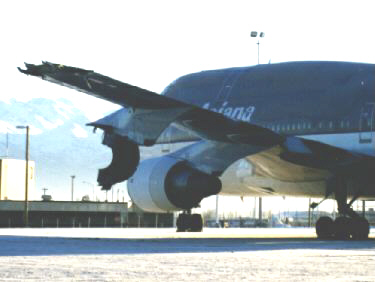
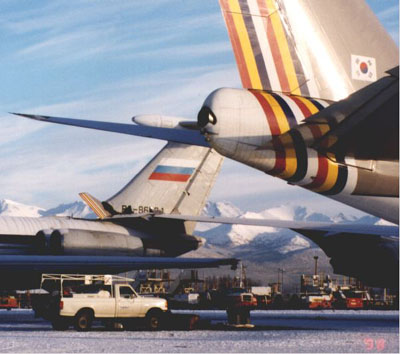
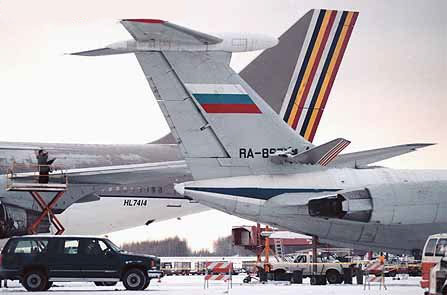
wing of an Asiana 747-400 cuts into the tail of a parked Aeroflot Ilyushin
62 at Anchorage Airport while trying to make a U- turn in a
parking bay. No serious injuries reported. The best part of the story
was forwarded by a Captain witnessing the event from a safe distance:
Good
day folks, true story, worth reading... Just into Anchorage and looking
at all the Korean debris on the airfield. What a beautiful job the
Asiana boy did in his 747 . ( word is he was an ex KAL guy )
Asiana
is KAL's "opposition" company, also run by the military cronies.
Pranged in Anchorage trying to do a "U" turn in a parking bay...
in a 747-400 ? !
Poor Aeroflot was in the way though, minding his business, parked at the gate with passengers on board. Asiana thumped his #1 engine against Aeroflot’s wing and tore open the engine cowling and fuel lines on the 747, leaking fuel all over the apron. With standard Korean procedure, that calls for more power so you can get out of the way and hope nobody saw anything. He did, but it was icy on the ramp. The skid started and took out 2 Evergreen staff vehicles sending the occupants fleeing for cover. THE CIRCUS HAD BEGUN !
Still
more power and he put his left wing ( last 15-20 feet ) into the
vertical stabiliser of the IL62 and cut into the tail about 15 feet. When
he reached the main spar of the vertical stab... the 747 stopped... you
guessed it...
MORE
POWER ! ! !
I believe he thought there was still time to run for it but he didn't seem to be going anywhere.....SO..... MORE POWER ! In trying to escape the grips of the Russian aircraft, he managed to reach take-off thrust, and in doing so, put a bunch of containers behind the aircraft through the terminal building and trashed it.
Still no shutdown or evacuation (fuel spilling everywhere over the apron from the 747 # 1 engine). The ground mechanics finally managed to run over and told them to shut the aircraft down, but the crew was busy writing a report for management to apportion the blame. mmmmmmmm.....YES, PLEASE ???!!! Hell, no one is safe around these guys ! The Asiana aircraft is looking quite sad.
Took all day yesterday to separate the 2 aircraft and in desperation, the mechanics finally had to cut about 20 feet of the Asiana left wing off to get the aircraft apart. Talk about "dog luck" ! The engine is off and the cowlings are all torn open. The opposition (Aeroflot) was taking cover in the hangar... Good idea !
Well,
not to be outdone, KAL landed a 747 freighter the very next day on
the runway lights on runway 6R ! Lights, tires, stuff everywhere...
you know the rest. That makes 9 accidents in 2.5 months for KAL of which
one was a 747-400 hull write off. Hard to beat that record !
Passengers will be delighted that their excess baggage is no longer a problem on our long haul flights !..........Sign Guestbook............ View Guestbook
* * * * * * * * * * * * * * * * * * * * * * * * * * ** * * * * * ** *
Here is part of the NTSB report on what really happened.......
The Asiana flight was taxiing to parking after landing at the Anchorage International Airport, Anchorage, Alaska. The 18 crewmembers and 220 passengers on board the Boeing were not injured. The Ilyushin was parked at gate N-2 . The crew of 11, and one contract cleaner, were on board preparing for departure; the passengers for this flight had not yet boarded.
Several other witnesses who were positioned either on the N-6 jetway, or on the ground, described the Boeing 747 taxiing in faster than normal, observing the nosewheels turn and slide sideways, hearing an increase in engine noise, and seeing a snow cloud behind the Boeing 747 (statements attached).The ground marshaller for the Asiana airplane told the NTSB that as the airplane reached N-6, he observed the nosewheels turn left, but the airplane continued straight ahead, with the nosewheels sliding sideways. The marshaller stated: "I gave the emergency stop sign (crossed wands). The aircraft slowed and then I heard an increase in engine power, then a reduction in power, and then a bigger increase in power. The aircraft disappeared in a cloud of snow..." He saw the airplane continue past gate N-4, and begin a right turn, away from the gate area. He then heard the collision.
The left, outboard, engine (number 1) of the Boeing struck the left wingtip of the Ilyushin, and then the left wingtip struck the vertical stabilizer of the Ilyushin.
The lead mechanic for another airline, who was sitting in a ground vehicle at gate N-8, provided a written statement which said, in part: "I was waiting for the Asiana 747-400 to clear the gate area, which I also had full view of.... As the Asiana flight approached, I observed it execute a right turn at N8. It was passing me when I saw, and heard, surprisingly, the unmistakable sound of thrust being applied to its engines. Within 2-3 seconds, I, and my vehicle was engulfed in a massive snow "whiteout". The 747-400 completely disappeared into the cloud of snow.... I arrived on the scene exactly at the same time as the emergency people did.... I do not remember if the Asiana airplane had any of its engines running when I arrived but I don't believe it did. I don't remember being in any sort of jet blast and there certainly would have been that given where I was standing. One thing I do know, is that the Asiana 747 applied power as it taxied by me."
The Asiana captain and first officer told the NTSB IIC during two separate interviews in the Asiana airport offices on November 11 (at 0300, and again at 1130), that when the captain turned the steering tiller to turn left into gate N-6, the airplane did not respond to tiller inputs, and that after passing gate N-4, they saw the Ilyushin in front of them at gate N-2. The captain stated that he applied right tiller, and right side brakes to turn to the right, away from the Ilyushin and the terminal, but was unable to miss striking the Ilyushin. The crew indicated they then shut down all four engines, and disembarked the passengers using a stair truck. During both interviews, and all subsequent interviews, an interpreter was provided by Asiana Airline.
The captain told the NTSB IIC during the first interview on November 11, immediately after the accident that he did not use any reverse thrust, that he did not apply power, and that he kept the throttles at the idle position. He said he did not use differential power to turn. Both the captain and the first officer told the IIC that the captain was manipulating the controls, not the first officer. During the second interview on November 11, both the captain and first officer indicated that the taxi speed they read from the cockpit ground speed display was 6 or 7 knots. They said that for slippery/icy taxi operations, they are limited to 10 knots or less.
The captain wrote in his NTSB Pilot / Operator report that "ground speed was 5-6 knots. I add little power to gain momentum for the turn to N-6. However the a/c slipped to N-2 thru N-4. I tried to stop the a/c by applying brakes to no avail then the a/c continued skidding toward the parked IL-62M on N-2."
Cockpit Voice Recorder
A Cockpit Voice Recorder Group was convened at the NTSB laboratory in Washington, DC. This group was comprised of a chairman from the NTSB Office of Research and Engineering, a Korean speaking radar specialist from NTSB headquarters, and a 747-400 rated captain from Asiana Airlines.
After the Boeing 747 landed, the tower controller asked Asiana Flight 221 for a braking action report. The copilot transmitted to the tower that "the touchdown zone area is ah normal braking action ah mid is a poor." The captain then stated to the copilot "the braking action at touchdown was okay. ... but when we turn off from the runway. ... because it snows a lot. Wow."
The following chronology appears on the CVR:
0131:37 the first officer tells the captain "right side clear" as they prepare to turn off of taxiway "E." 0131:51 the captain says "we are skidding." Then three seconds later he says "turning right."
0132:25 the captain states "we have to make a guess, what can we do. Got to keep going."
0132:28 the first officer says "oh, what's going on, the aircraft is not turning."
0132:30 the captain replies "what, not turning?"
0132:32 the first officer says "yes, aircraft is not turning, the aircraft is skidding."
0132:33 the captain says "is that right?"
0132:35 there is a momentary increase in engine noise.
0132:39 the sound of the takeoff warning horn is heard(This horn activates when the N1 value from engines number 2 or 3 reaches 71.0%, and the flaps are not configured for takeoff).
0132:40 the first officer says "yes, uh oh it's not control," followed by "brake off, brake off."
0132:45 the captain says "this way, turn this way,"
followed by the first officer saying "yes, I'm pushing it fully. We are going to collide."
An off duty crewmember then is heard to say "looks like we are going to collide."
0132:50 the first officer asks "is it going to be okay?"
The captain replies "it will be okay, let's keep turning."
The first officer again asks "is it going to be okay?"
The captain replies "yes" followed three seconds later by the sound of collision.
The first officer then says "what is it? It seems we are locked? Stop, stop, stop."
0133:08 the captain says "we are collided."0134:55, 1 minute and 55 seconds after the collision, a ground crewman on the ground interphone states "cockpit ground...shut the engines first," to which the captain replies "yes."
0135:02 the ground crewman again says "shut the engines first."0135:40 the ground crewman asks "what happened?" to which the captain responds "we were skidded. While we were taxiing to spot six we just kept skidding. Then we started turning to the right to avoid collision but left wing collided with Russian aircraft." The ground crewman asked "why did you use so much power to ramp in?" The captain replied "no, the power was at idle." The ground crewman then stated "no, the power was not idle. It looks like you turned the aircraft with increased power."
Digital Flight Data Recorder (DFDR)
A Digital Flight Data Recorder Group (report attached) was convened at the NTSB laboratory in Washington, DC. This Group consisted of a chairman from the NTSB Office of Research and Engineering.
A review of the DFDR data showed:
0131:52 (31 seconds prior to the collision), while on a magnetic heading about 030 degrees, all four engines N1 values begin to increase from 13%, to a peak of 38% at 0132:02 (21 seconds prior to the collision). The N1 values then reduce to 25% until four seconds after the collision, when they begin to reduce to 13%. 0132:00 (23 seconds prior to the collision) the rudder pedals deflect about 11 degrees to the right, and both the top and bottom rudders are deflected 15 degrees to the right, where they stay until the collision. 0132:04 (19 seconds prior to the collision) the master warning illuminates (and is accompanied by the takeoff configuration warning horn). 0132:10 (13 seconds prior to the collision) the magnetic heading begins to turn to the right, and stops about 125 degrees. 0132:23 a lateral acceleration (impact) is noted, concurrent with a thrust reverser deployed indication on the number 1 engine. 0132:26 a second acceleration is noted concurrent with the magnetic heading ceasing change to the right. Thirteen seconds after the collision the engine N1 values reduce to their minimum values of 13%.
DAMAGE TO AIRCRAFT
The Boeing 747 sustained substantial damage to the left wingtip, and number 1 engine. The number 1 engine and nacelle assembly required removal and replacement. The outboard 10 feet of the left wingtip had to be cut off to separate the airplanes.
The Ilyushin was determined by the owner to be beyond economical repair.
OTHER DAMAGE
Gate N-2 at the international terminal sustained structural damage and was determined to be unusable by the airport authority. The left side of the parked Ilyushin impacted the jetway. The floor structure of the jetway was buckled.
A ground handling baggage cart which was positioned near the nose of the Ilyushin was blown over. This cart came to rest halfway between the Ilyushin and the terminal building, in a line directly aft of the exhaust section of the Boeing 747 number one engine. The baggage cart struck an unoccupied van.
Two lavatory servicing trucks parked between jetways N-2 and N-4 were blown into each other and sustained minor damage.
**************************************************************
One Year Anniversary
I see her every now and then.
I often wonder how things would be if I was still on the first floor.
Would she still say hi ? Would we be friends ?What I think about most when I see her, though, are the words she so forcefully uttered lecturing a colleague one year ago tomorrow.
Some of you know these words.
For those who don't, you will learn them..................For many of us, what she said that night represents the joy, pain, sorrow, laughter and happiness of not only this past year, but many years to come.
It represents how we see ourselves, the lives we lead and the work we do.
And yet, we don't even know her name.I couldn't let this week pass without honoring one of the most profound statements ever made in the halls of this office building.
Without further ado, I give you the quote that will live with me, and possibly all of us, for the remainder of our lives.Without pause nor regret she said:
" I do my goddamn work. May not be the best of work, but I do it. "
The First Floor Cleaning Lady
Century Office Building
October 3, 1996
7:21 p.m.