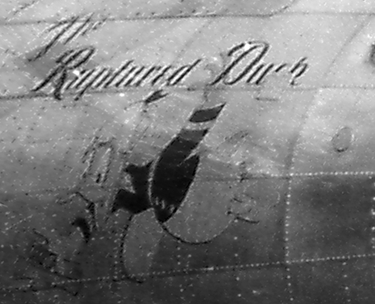
This B-17 remains clearly in my memory. On April 17, 1945, just a few weeks before the end of the war, the 91st Bomb Group was attacked by three newly introduced ME262 jet fighters. I believe this was the only time the 91st was attacked by this unbelievably advanced German fighter. If you have evidence of other attacks on the 91st by ME 262 on other missions, please forward it to me as my research has not discovered any.
Ray Bowden's book, which we have found to be very accurate, is incorrect on the history of "The Ruptured Duck" as it indicates that its last mission was September 8, 1944. Its last mission was April 17, 1945. Below is a section from "Vignettes" in which I tell the story of "The Ruptured Duck's" last mission.
On April 17.1945, my thirty-third mission, our primary target for the day was the southern marshaling railroad yards in Dresden. The briefing officer cautioned us that if we were shot down, the information intelligence had given him was that the German civilians were so angry that they were murdering any Allied airmen they captured. This was not very happy news for a combat pilot with only three more missions to go.
By this point in the war, the Germans only held a narrow strip along the east side of Germany carrying down into Czechoslovakia. The Eighth Air Force had not encountered attacks by the Luftwaffe in many weeks except for those by a new fighter plane just recently introduced to intercept our heavy bomber streams. This was not just an improvement on existing models of German fighters; it was a brand new generation of interceptor aircraft. It was in a new league that far outdated our greatest fighter, the P-51. Its designation was the ME 262. Built by Willy Messerschmidt, it was a marvel of German ingenuity, engineering and manufacturing skill: the world's first operational turbojet fighter. This was Hitler's greatest secret weapon and if introduced just six months earlier before Germany's oil supplies were turned to rubble, could have brought to an end the massive attacks of the mighty Eighth Air Force.
This jet aircraft easily cruised at 500 miles per hour while P-51s could reach 450 miles per hour top speed and for only short periods of time. It was a hundred miles per hour faster than our best fighter cover and three hundred miles per hour faster than the B-17. Its armament was not fifty caliber machine guns but four twenty-millimeter canons that fired exploding shells. One shell could inflict terrible damage to a B-17.
We had been cautioned at each briefing since the ME 262's introduction, that these lethal German aircraft were prowling our bomber streams. Our fighters controlled the skies over Germany and waited above German fighter fields to shoot them down when they were most vulnerable, while they were taking-off. Though the Germans were turning these aircraft out in large numbers, their Achilles' heel was the lack of petrol necessary to fly them due to our incessant bombing of their oil refineries. On this mission of the 17th of April 1945, our crew had been chosen to fly deputy lead of the 324th bomb squadron. In this position we led the high right element of the squadron and would take over as squadron lead if the lead ship were unable to continue to lead the squadron for any reason. All went well till our squadron passed the IP and started on our bomb run. We were flying in as close formation as possible to leave a good bomb pattern in the strike area. Flak had just begun to explode as the anti-aircraft gunners searched for our range. We were easy for them to spot, as our contrails were heavy that day, pointing like fingers in the sky toward our squadron as it flew straight and level on its bomb run.
Suddenly, every gun on our ship seemed to open fire at once. Flying as leader of the high element, my attention was on the lead ship but in my peripheral vision appeared small explosions starting fifty yards in front of us and continuing in a straight line for perhaps another hundred yards. Next in my vision, between our aircraft and the lead aircraft, a distance no greater than thirty-five yards, flew the most beautiful aircraft I had ever seen. It was a ME 262, and was so close that I could clearly see the pilot looking at me as he flew by. It had swept back wings with a jet engine mounted on each wing. Its skin was so smooth that it looked like it had been sandpapered.
There wasn't a rivet to be seen. Strangest of all, it had no propellers. We had been told about ME 262's but to an airman who had never in his life seen a plane fly without propellers this seemed unreal.
An element of three ME 262s had attacked our element of three B-17s coming in through and hidden by our contrails until the last moment. I looked around and found we were the only B-17 left in our element. The crew reported seeing both wingmen still flying under control in an eastward direction. We thought they were trying to reach the Russian lines so as to make emergency landings in Allied territory. I moved our ship, Yankee Gal, the only remaining ship in our element over and flew as second right wingman off the lead ship. The gunners continued to fire at the ME 262s, as they appeared to be turning for a second pass but our little friends, the P-51s dove down from above and herded them away from our formation. In seconds the encounter was over.
We couldn't believe that in one pass the ME 262s had shot down two of our squadron. That's how lethal the four twenty millimeter cannons carried by the German jets were. Our guardian angels were with us again for the explosions we had seen fifty yards in front of our B-17 were twenty millimeter cannon shells meant for us. The ME 262 pilot who flew between our ship and the lead ship must have been thinking as he looked at me, "Damn it, I missed."
The encounter was over in seconds but our right wing-man, Lt. Camp and his crew, flying Skunkface III, were the last crew in the 1st Division of the mighty Eighth Air Force to be lost in air-to-air combat, eight of the crew were killed in action with one, the tail gunner, taken as a prisoner of war. Our left wingman, Lt. Moyer and his crew, flying The Ruptured Duck, had two of his crew, the tail gunner and the radioman, wounded in action. The aircraft was so badly damaged by the attack that Lt. Moyer had to make an emergency landing in Allied occupied Germany. The B-17 was declared salvage.
Three ME 262s also attacked the 323rd Bomb Squadron of the 91st bomb Group. In this attack one B-17, Ragan's Raiders flown by pilot Lt. Skawianski and his crew, was badly mauled, resulting in the death of the ball turret gunner. The following is quoted from the casualty report for aircraft 3263, B-17G, Ragan's Raiders, of the 323rd Bomb Squadron, "The BTG (ball turret gunner) was badly wounded in air and the pilot landed on an airfield in Germany. (Allied occupied, Ed.) The crew took him to a tent hospital and was lined up with wounded ground troops. Finally the doctor looked and said 'no hope', walked to a water bag for a drink and was killed by a sniper." The crew went back to Ragan's Raiders, took off and went back to Bassingborne.