| The
Moon landings - fact or fiction?
Some of the common arguments for and against
|
|||
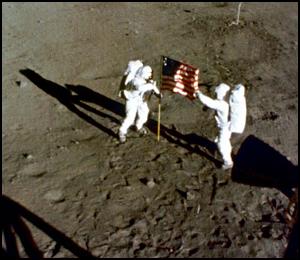
Neil Armstrong and Buzz Aldrin erect a U.S.
flag on the moon in 1969
|
One of the most prolific claims
that the conspiracy theorists put up on the web to support the argument
that a hoax had been perpetrated against the American people was the seemingly
fluttering US flag in the lunar environment where no breeze exists.
Nasa counters with the argument that not every flag that waves is caused
by a breeze. When the astronauts were erecting the flag pole they
rotated it back and forth to ensure it penetrated the lunar soil.
|
. | |
| The existence of inconsistent
shadows also featured prominently on a number of the conspiracy theory
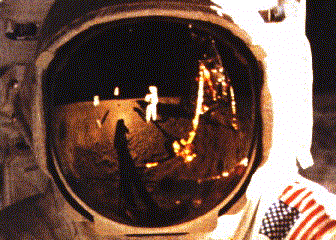
pundits' web sites, as do anomalies associated with reflections off the
astronauts' (referred to by some as "astro-nots") helmets. One example
cited is that only two men walked on the moon during the Apollo 12
mission and as the astronaut reflected in the visor has no camera, who
took the shot?
|
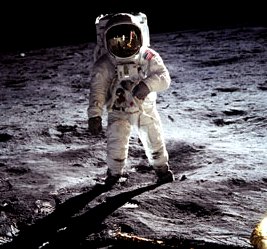
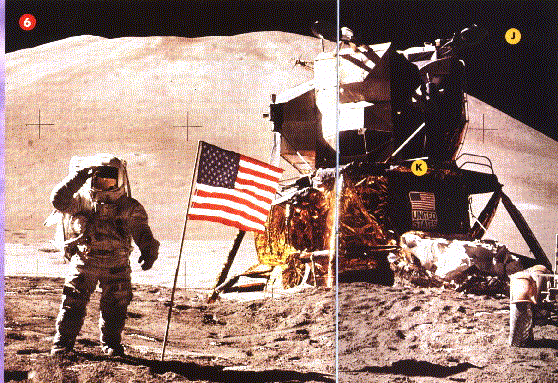
Leopard Photo Caption Nasa defends the helmet reflections and lighting anomalies with typically scientific explanations coming up with all sorts of arguments to support their claims:
|
||
 |
Conclusions:
The argument over whether man did or did not land on the moon is an intriguing one in itself with both sides able to present some very compelling evidence to support their perspective positions. I believe it is made all the more fascinating because of the way the anomalies and inconsistencies can be presented and countered on the Web through a combination of multi media formats such as text, audio, video and photography. (Although I accept that an unsrupulous person would be able to manipulate certain evidence to support their own position). The Web is an ideal medium to carry out research on a controversial subject such as this because of the enormous amount of content available and the ease in which this can be accessed and assessed in a relatively short space of time. It is a rich medium that allows for robust debate and a divergent range of opinions with the ability in most cases to email the creator of the web site to ask a direct question or contest their findings. And yet while I acknowledge that the Web is an excellent, modern research tool, the efficacy of its usage is contingent upon good old fashioned research techniques. Looking at it from this perspective, the Web is neither no more - nor no less - reliable than any other medium. |
||
| References and
Related links:
http://www.primeline-america.com/moon-ldg/ http://pirlwww.lpl.arizona.edu/~jscotii/NOT_faked/ http://home.vicnet.net.au/~einstein/archive/apollohoax.htm
|
|||