Features:

- Swimming
- A Doll's House and Realistic Theatre
Cost of the War in Iraq:
When will it end?
When will it end?
(JavaScript Error)
- A Sandpiper to Bring You Joy
- Trees
- The Tree
- Swimming
- A Doll's House and Realistic Theatre
- A Sandpiper to Bring You Joy
- Trees
- The Tree
- AlterNet
- Google
- Red Hot Chili Peppers
- Dave Matthews Band
- Grade Saver
- Universally Speaking
Entertainment:
Julia's Story - Unknown
For 738 days Julia Butterfly Hill lived in the canopy of an ancient redwood tree, called Luna, to help make the world aware of the plight of ancient forests. Julia, with the great help of steelworkers and environmentalists, successfully negotiated to permanently protect the 1,000 year-old tree and a nearly three-acre buffer zone. Her two-year vigil informed the public that only 3% of the ancient redwood forests remain and that the Headwaters Forest Agreement, brokered by state and federal agencies and Pacific Lumber/Maxxam Corporation, will not adequately protect forests and species.
On December 18, 1999 Julia Butterfly Hill, then 26, came down to a world that recognized her as a heroine and powerful voice for the environment. Her courage, commitment and profound clarity in articulating a message of hope, empowerment, and love and respect for all life has inspired millions of people worldwide. Julia reflects,
“By standing together in unity, solidarity and love we will heal the wounds in the earth and in each other. We can make a positive difference through our actions.”
Julia Hill chose the name Butterfly while in her childhood years and like her namesake she has undergone a great metamorphosis. She grew up in a deeply religious family as the daughter of a traveling, evangelical minister that later settled in Arkansas. In 1996 she suffered nearly fatal injuries in an auto accident. During close to a year of medical treatment and recovery, she had time to reassess her purpose in life. Two weeks after being released by her doctors, she headed west on a journey of self-discovery. She had no particular destination, but her first sight of the ancient redwoods overwhelmed her with awe. “When I entered the majestic cathedral of the redwood forest for the first time, my spirit knew it had found what it was searching for. I dropped to my knees and began to cry because I was so overwhelmed by the wisdom, energy and spirituality housed in this holiest of temples.”
Julia and other forest activists founded Circle of Life to inspire, support and network individuals, organizations, and communities so together we can create environmental and social solutions that are rooted deeply in love and respect for the interconnectedness of all life. We envision a sustainable culture that honors biological and cultural diversity. Through education and outreach, we promote efforts to protect and restore the Earth.
Motives of an Artist - Justin Ware
“When an artist goes commercial, he makes a mockery of his status as an outsider and a free thinker. He buys into the crass and shallow values that art should transcend. He trades the integrity of his art for riches and fame.”
-- Bill Waterson
The role of an artist is to give their opinion, and show their views through their artwork. When this is done, the work produced should come straight from the heart and should represent what they believe in. The problem is that it is hard to earn a living as a genuine artist, and many people stop doing what they do for themselves, and start doing it for the average consumer. They start producing what will please the public and will earn them money, but when this is done, the person can no longer call himself an artist. Self-expression is forgotten, and the values that the person started off with have been thrown to the wind. The results of this process can be seen everyday, people who have stopped what they started out to do, because money has clouded their vision.
In our society, it is extremely hard for artists to make it to the top without giving up everything they are for. To rise to the summit, you can’t tell people what they don’t want to hear, you must give them what they want. All creativity is given up to sell their work, to gain popularity, and most of all to make money. The message being sent no longer has any meaning to the artist, or anyone else who purchases the work, it just makes people happy, but art isn’t meant to make everyone happy, it’s meant to tell the truth and to point out the good and bad of our world. It’s meant to explain human nature, and point out the problems we face everyday, not to make things sound better than they are, there are plenty of other things to do that.
Another problem is that the people have stopped caring what artists have to say, or even wanting to know other people’s views and opinions. Many people, themselves, don’t even have opinions or care about what is happening to our world. This is just another incentive for artists to sell-out, why bother sending a message when nobody really cares what it is, it’s so much easier just to produce something appealing that has no meaning, and gain popularity. When an artist does this, though, they lose any respect they may have had from fellow artists. The job they set out to do they didn’t do, instead they have made a mockery of the business, and gained money by producing something that is totally fake, something totally meaningless.
In many ways what art represents has begun to change. People often don’t even think of it as a mode of self-expression or a way of conveying a message, they just think of it as something that they can enjoy and usually involves entertainment. There is nothing wrong with getting enjoyment from art, but the reason you are enjoying it has changed. It used to be that you would enjoy art that made points that you could relate to, or expressed the same opinion on something that you had strong feelings about. Our society is drastically changing, it has become governed by greed, and no moral is important enough to keep instead of earning money. In this way our world has gone drastically down-hill. There are still those out there, though, who manage to get their points across to those of us who still care to listen. Any artist who remains true to their trade should be commended for their effort.
Thoughts I Put on Paper - Justin Ware
These past few years, many things have come up which have caused me to look at my religion and pick apart my beliefs. The time spent doing this, has held both joy and pain for my confused mind and soul. Whichever way it has been, this time has been well spent, and I continue to question my opinions. The truth is, I’m not sure that I really fit into any religion perfectly. In reality, I would have to say that I am mostly Protestant, which is partially due to my upbringing in a Congregationalist church; however, some opinions I have contradict what I have been taught, and others go against most set religions. For this reason, I believe that I am an individual, and can form my own opinions and theories based on what I have been taught, and what my heart tells me. Although I will never accomplish complete individualism, and my ideals will always be influenced by the outside world, I strive to think for myself. This is not openly accepted in today’s society; everyone shoots down everyone else’s views, but never support their own, and if they do, usually get their arguments from the media, peers, family, or elsewhere. This is why people are so ignorant, no one is forced to formulate their own views, there are plenty of options out there, why stick your neck out there and risk being different. This is what we have been taught, and most of us conform, whether we are willing to accept it or not. Personally, I accept that I conform more than I would like to, but I’m also not part of the mass, the majority which doesn’t question authority and come to its own conclusions. In this fact, I pride myself, and although, at times, it can be damaging to one’s self and to others around one, as the old saying goes, “you learn from your mistakes.” Now I make my plead to you, to take chances, stand up for what you believe, and make sure you have something to back it up, because, it’s worse to express yourself without cause, than to remain silent while “doing your homework.” Please, take my advice and think, one of the major mistakes of people these days is not thinking, nothing is accomplished without thinking; someone has to do it, why not you? More should, the emotions involved in doing so are truly amazing and self-gratifying. Try it, you’ll feel good about yourself.
Gladiolas 1 - Justin Ware
It was a warm sunny, day in mid-summer. The flowers were all in full bloom, and the bees were noisily buzzing amongst them. There was a small white cottage and the flowers were growing all around it in an orderly garden. It was a quaint little image, overflowing with a dazzling array of colors that were accented by the cheerful sounds of summer. Besides the bees, there was also another creature enjoying the glorious weather. This small, nimble bird flitted from flower to flower, enjoying the wonderful sweetness they had to offer. However, it did not appear content with the flowers blossoming in the garden, and began flying around in a frustrated frenzy. This continued until it viewed what it was looking for, the celebrated gladiola. The tiny animal zeroed in upon its prize, and zoomed toward the beautiful pink flower. With increasing speed it flew toward its goal, the plant was just a few feet away, and… THUD! The last thing the poor little creature saw before his death was his own reflection.
Gladiolas 2 - Justin Ware
It was a fine day, the weather was nice, and the streets were covered with cheerful people running and talking. One man on the sidewalk, though, seemed to be walking rather slowly, and he didn’t seem to be very happy from the cold frown upon his face. Maybe he was having a bad day, or maybe he was not enjoying the chore of walking his dog, which appeared to be trying to pull his master quicker than his he wished to. The unfortunate couple made their way down the street without incident. However, as they turned the corner, this changed. As the two passed a flower shop, a woman carrying a newly purchased gladiola stepped out of the shop directly in front of the man and his dog. The man appearing not to have seen the woman walked right into her, knocking the flower from her hands. Both people, being quite startled and embarrassed, quickly apologized. The men bent down and picked up the flower, and while in the process of doing so caught a whiff of the sweet fragrance emanating from the plant. The sweet scent gave him great joy, and after returning the flower to the lady, and apologizing again, continued on down the street with his dog, but now, he was smiling.
A Doll's House and Realistic Theatre - Justin Ware
A Doll’s House , which is the story of Nora, a woman plagued by society’s expectations and who struggled to achieve an identity away from the one imposed on her by her husband, is a great example of realistic drama. In this play, Nora is described as being a typical woman of her time, an average mother whose job is to maintain the house. She is also ordinary in that her husband rules over her, and treats her almost as a possession, also typical when the play was written. A Doll’s House is also very realistic in that Nora has to examine her values and reevaluate them to discover whether she really holds the freedom she thought she did. Along with this comes the realization that her freedom was not where she had believed it to be, and she must look at it in a different light. This story is also a perfect illustration of realistic drama in that it exposes the horrible ways in which society restricts and holds prejudice over human rights.
In A Doll’s House, Henrik Ibsen portrays all of his characters as being ordinary people living in a perfectly normal society, a major characteristic of realistic drama. The main character, Nora, is your everyday mother running a household and doing what women were expected to do at the time the play was written. Her husband, Torvald, is your average businessman who goes out daily to provide for his family. He treats his wife as subordinate, and rules the household which he keeps stable, both financially and socially. They live in what sounds like an average household with their children and a nanny. They seem to lead a generally standard existence, and everyone seems to be content with it.
Nora is caused to examine her relationship and find the truth behind the life that she had been living, which is something often illustrated in realistic drama. It seems that she is content living under the power of her husband, and that she is happy acting as his “doll.” However, this changes and Nora realizes that she is not happy living the way she is, and she discovers that she has been living in a fantasy world where she was just acting upon her husband’s wishes. The true love that she had thought held their relationship together was just a pigment of her imagination; Torvald didn’t really love her as she loved him. To him, she was just there to take care of the children and the house and to be there for him when he needed sympathy or care. With this realization came a new visualization of her life, and the lies that she had been living in.
Along with this new image of her life, came the need to examine her own values and motives. After discovering how artificial her husband’s love for her was, she had to look at herself and find out what she really believed in, and what was important to her. Knowing how Torvald felt, she had to decide if she felt the same way, or if not, whether she was willing to have a differing opinion than her husband, and go against everything she had been taught by society. She didn’t make up her mind until the very end of the story, because she had this false hope that her husband would change and they could start a new life together. He never does change, though, and this puts her in a difficult position. She would have to decide whether her values were more important to her than her family and society’s view of her, a very difficult decision; a very important one, though, when discussing realistic dramas.
Finally, A Doll’s House does an excellent job of exposing society’s restrictions and limitations inflicted upon human rights. This play describes how hard it was for women to gain individual rights up until just recently. It shows society’s unfair ranking of males above women, and the consideration of women as objects of men’s ownership. The story also makes it clear how difficult it is for a woman to break away from a marriage, and how easy it is for a man, and how differently society considers each. However, Nora is able to work up the courage in the end, and she walks out on Torvald, leaves her family, and her home, and starts a new life for herself. This was Ibsen’s way of telling women that they can gain freedom, and at the time was a very controversial message.
All in all, A Doll’s House is an excellent example of realistic drama. It uses a very typical family of ordinary people to get a message across. The use of a fathomable situation makes the significance even clearer and easier to interpret. Throughout the length of the play, Nora is forced to find herself, and discover the truth of the lies she had been living in artificial happiness. It describes how she uses this information to evaluate her own morals and motives, and later go on to change her way of living to fit them. Most importantly, though, it exposes society’s prejudices towards the female gender, and how it has inflicted great pain on great numbers of women by denying them their God-given rights. It also sends the positive message that freedom is attainable and with a little conviction is quite realistic.
Walking, Walking... - Justin Ware
Walking, Walking…
The darkness creeps around me,
I can see the path, but just barely,
I follow it, follow it…
The sun is completely down,
The moon is nowhere in sight,
I can barely see where I’m going,
It’s like I’m in a tunnel,
The weight around me is immense,
The air is wet and heavy,
My breath is struggled,
It is completely dark now,
I am alone, alone…
The path is no longer visible,
I continue on through the darkness,
But nothing, absolutely nothing…
The darkness creeps in around me,
I want to move on, but I can’t,
The air is so thick,
The path is gone along with all light,
Slower, Slower…
I can hardly move,
I struggle with the darkness,
The fear is in my stomach,
The breath caught in my throat,
I fall, falling, falling…
I reach out, but again, nothing,
There is nothing there for me,
Nothing to grab a hold of for support,
I am alone and frightened,
I don’t know what to do,
The darkness is overwhelming,
I wish for something, anything,
But still, I am falling,
I don’t know when I will reach the bottom,
I wish for it, but I am afraid of it,
I want this feeling to stop,
But I am afraid of the outcome,
The consequences I will face,
The others will laugh at me for being scared,
But what do they know?
They weren’t there,
They didn’t reach out,
Where were they?
They certainly weren’t there for me,
Why do I care about them,
They laugh, laughter…
No, make it stop,
I know they don’t matter,
But I care, it’s human nature,
Help me, I don’t want it to be important,
But it is, society has burned that into me,
To care about them, but why?
What have they done for me?
No, I don’t want them,
I refuse, let the bottom come,
I will face it with courage,
Let it come, I am ready,
The darkness is lifting,
But wait, I am no longer falling,
The path begins to show beneath my feet,
The stability has returned,
I have overcome the corruption,
Never again will I let them get to me,
They mean nothing,
I am my own person,
Let them laugh,
I will walk by with my head held high,
Walking, Walking…
Shallow Be Thy Game - Justin Ware
I was not created
In the likeness of a fraud
-i was created in the likeness of god, annd he's not a fraud
Your hell is something scary
I prefer a loving god
-we were not all born sinners, my god is a loving god
We are not the center
Of this funny universe
-god is above all, we make up his funny uuniverse, but he still cares and doesn't abandon us
And what is something worse
I do not serve
In fear of such a curse
-I don't live my life that i was born dammned, i don't fear god, i love him, as he loves me
Shallow be thy game
2000 years look in the mirror
-ever since jesus, more and more have spllit from god's and jesus' path, looking back, there have been those trying to tarnish god's name because of jesus,
You play the game of shame
And tell your people live in fear
-you make up lies about god and jesus to scare your followers into fearing a hateful god that doesn't exist
A rival to the way you see
The bible let him be
-your going against what the bible says, back off, and let those whoe believe read and believe the truth of the scriptures
I'm a threat to your survival
And your control company
-i threaten your power, as i'm speaking oout about your lies, and god's love shall overcome,
CHORUS:
You'll never burn me
You'll never burn me
I'll be your heretic
You can't contain me
I am the power free
Truth belongs to everybody
-i'm a heretic to the church, which cloudds your mind with lies and hatred of a loving god, i'm speaking out of the truth, and you can't overcome me, because god is on my side
To anyone who's listenin'
You're not born into sin
-you're not born into predestination, godd hasn't decided your fate, although he knows what your prone to, but listen to me, i will tell of a good, and just god
The guilt they try and give you
Puke it in the nearest bin
-don't listen to the bull that your born a sinner, humans make mistakes, and god forgives, don't believe that you screwed to begin with, it's not true
Missionary maddness
Sweep up culture w/ a broom
-the movement of the religious system hass sucked up culture, and small groups' own religious beliefs
Trashing ancient ways
Is par for the course
-we've gone from the course of old ways oof god's love, and believe we were born sinners
It's fucking rude<self-explanatory>
To think that you're above
The laws of nature is a joke
-these religious leaders think they're abbove it all, and try to go against the real god, and teach of their own god for personal benefit
Purple sashes feeding masses
Smoke on which to choke<not sure>
I might be a monkey
When it comes to being holy
-i may not be the most holy,
Fundamental hatred
Get down on your knees and
-but if your totally against god, shut upp
The Adventures of Bob - Justin Ware
Bob has needles that curve. There were twenty-four donuts in the phone booth on the corner, where he lived. Bob was invisible and lived in the phone booth with the needles that curve eating donuts. He settled into a comfortable position in the booth, and looked at the little frozen turtle on the fork, while eating a donut. The smell of the turtle was that of ketchup and potatoes. He was mixed-blood, and usually stayed asleep. Then he woke up and realized he was in a coffin, not a phone booth. He looked up, just in time to see the priest, and then the door slammed. His body bounced as the coffin was carried by the “honkies.” He stood up in the coffin and soon found a broken-down chair which he sat in to think. The elders started talking to him about the center of the world; it was part of his education. He began to feel an increase in temperature, so he unzipped his jean-jacket, saying, “so anyways…” The elders were very angry, because he wasn’t paying attention, but instead of trying to, he turned on the TV to watch the rodeo, but the only thing on was Judge Judy. The weird part was, Judy wasn’t judging, she was eating graham crackers and smoking a cigar. Part way through the show, the coffin was lowered into the ditch, and at this point in time, the TV switched off. This caused Bob to turn on the lights and a small radio that was in the corner. This though, soon became boring, so Bob flew to the moon. When he got there, he put on his newly polished red boots. He had a good view of the hill from where he stood, so he decided that it would only take him two to three days to get to it. He would just have enough time to get to the Magic City in time to see Diamond. So he spun around a couple of times and walked out the door. Traveling was easy on the moon, due to the heavy glow put off by the guiding light. His luck changed about a day into the journey though, the guiding light exploded. This was quite a shock, since it had always been there. He knew he would soon become lost without the light, so he decided to call the British Air Force from the phone booth. On the way in he grabbed a donut, and shot a menacing glare at the little frozen turtle, but went straight to work, dropping a coin in the slot. He dialed up his friend, Mr. Jones, who worked at the Air Force, and explained his predicament. Mr. Jones said that he would send an elevator to assist Bob immediately.
Californication - Jacob Pointon
Now for years, everyone has always questioned the meaning behind 3 ballads off the Californication album
: Scar Tissue, Otherside, and Californication. Now my debate is one the meaning behind all three songs, since they are the most popular of fans wanting to know the meaning of. It is rather extensive, so I broke the debate in 3 different parts, one for each song. This one is Californication.
While there is some debate as to whether or not the meaning of Californication lies in the generalizations made about the crazy society evolving out on the west coast of the USA , or a more personal accounting of a pre-marital relationship as ranted about for a verse, I am inclined to believe the former. Californication is a biting social criticism of the culture of excess we have. But the song isn't just about how things are in California . In itself, the descriptions in the song hold California up as a symbol itself for wider problems and issues we have. I found an interview from MTV, and Flea pretty much tells you what it’s about. Who better then the writers themselves to give you the meaning:
It's not a sexual reference. "Californication" is really just the act of the world being affected and saturated by the art and the culture being born and raised in California . Traveling around the world, no matter how far I go, I see the affect that California has on the world. It's about that good and bad, beautiful and ugly.
So let's hop to it. I can't promise I'll touch anything, or even get it "right," but it should be fun to try.
First off we have:
Psychic spies from China
Try to steal your mind’s elation
Little girls from Sweden
Dream of silver screen quotations
And if you want these kinds of dreams
It’s Californication
Here we already have a contrast between internal and external. The first half of the verse "Psychic Spies..." though "elation" represent a general paranoia people have of something beyond their control attempting to mess with their lives. The crackpot theories generally can be found in California .
The rest of the verse, "Little girls from Sweden ...” is how external people see something part of California is famous for (movie making) and how they dream of being able to enter into this dream world, totally naive and ignorant of the problems those within deal with.
Last two lines let you know. Right off the bat, he's told you what Californication is.
It’s the edge of the world
And all of western civilization
The sun may rise in the East
At least it settles in the final location
It’s understood that Hollywood
sells Californication
Here he's at first talking about how California is the "edge of the world in all of western civilization." Whether or not you find any deeper meaning in or not, it's a powerful enough line. Perhaps, when you link the term "civilization" with a description of the sun rising and setting, you get a metaphor saying that this is where the sun will set; this is the decline of civilization. This theme is again referenced later in the song.
He ends the verse with the phrase, "It’s understood that Hollywood sells Californication" which is simple and obvious enough. Californication as defined above is a paradox between innocent desire for fame and recognition with a culture of irrational fears. This is what Hollywood sells. Everything out of that place will either be entirely self promoting and wrapped in a gaudy brilliance, or will play off your fears in some most unusual ways.
Pay your surgeon very well
To break the spell of aging
Celebrity skin is this your chin?
Or is that war your waging
Simple enough. Here it's talking about how some people are consumed in a war against age, devoting so much of their time, energy, and life into combating it as to nullify any victory they have. Ultimate futility revealed in the form of a question at the end.
Chorus:
First born unicorn
Hard core soft porn
Dream of Californication
Dream of Californication
First born Unicorn is a nice rhyming phrase that holds a major symbol in it. What that symbol is can be confusing, depending on what your take for the general mythological meaning of a Unicorn is. Some say strength and independence, which would then mean perhaps a glimmer of hope in the song talking about defiance to the force of Californication. Others say a fearful, dreadfully powerful creature. It would then be talking about Californication itself, being a firstborn unicorn, our society's first and most dreadful force to effect change upon our world. Also in mythology, the Unicorn represents virginity, and you’re first born a virgin, and because of hardcore and soft porn, you get ideas of sex, have sex, and lose it.
Phrase Hard Core Soft Porn is obviously a contradictory, and I would guess is meant as a jab for the other major marketing technique/aspect of Californication... They sell as much sex as possible, promote it as much as possible, but are never willing to outright go all the way with it, still attempting to uphold that innocent polished image.
Marry me girl be my fairy to the world
Be my very own constellation
A teenage bride with a baby inside
Getting high on information
And buy me a star on the boulevard
It’s Californication
Because he is addressing directly someone in this verse, many people take this as evidence that the song is about a single person who he had a relationship with, perhaps a person who represented this whole culture. I'm still shaky on the grounds, but I think he's just addressing another archetype here, as symbol of the TYPE of person who gets caught up on the whole society, but not an actual person. And seeing how constellations can also determine your fate, he could be saying to this girl to marry him, be the one to take him around the world, and be the one to be his fate. And have you noticed that when young teenage girls get pregnant, they finally wake up and realize they need to get their act and life together. So they start working harder in school, keeping their face in the books, “getting high on information”, so they can make a better living form them and their future family. And who doesn’t want or get a star on the Hollywood Boulevard ? A few non Hollywood actors have done so.
Space may be the final frontier
But it’s made in a Hollywood basement
Cobain can you hear the spheres
Singing songs off station to station
And Alderon’s not far away
It’s Californication
In this verse he does three things.
1) He points out the fakeness of our attempts to explore "the final frontier" as we instead do it in a studio as opposed to spending that money to actually do any real exploration. It's also a Star Trek reference, of course, with that phrase. He referenced Hollywood again. He does it one more time in this verse, proving how he is a true geek at heart.
2) a) He directly addresses Cobain, more likely than not Kurt Cobain, the man who kicked off a trend that was consumed, distorted, and then discarded by the force of Californication. He asks if he sees what has happened.
b) Foo Fighters lead singer is the former drummer of Cobain’s Nirvana…..Foo Fighters, not the band, but real foo fighters fly in what looks like alien space crafts; the flying saucer type kind that in early days were called “spheres”……Station to Station is an album by David Bowie, and on that album you’ll find the track “The Man Who Sold The World”. During one of Nirvana’s final performances on MTV Unplugged, they performed that same song. After Cobain’s death and Dave Grohl started the Foo Fighters, they also played “The Man Who Sold The World” at their concerts in memory of Curt Cobain, which then got a lot of air play on the radio, I mean all the time when it first came out. So, do you kind of see the connection? He’s telling Kurt if he can hear how Dave Grohl and his band is still carrying the torch, and how they miss him and still live on his name.
3) And finally, he says, "And Alderon's not far away, It's Californication." This line is actually a Star Wars reference as is apparent in more knowledgeable circles. Sure the spelling is different, but maybe Anthony thought he spelled it right, but I do believe this is what he’s talking about….Planet Alderaan was the pristine home of Princess Leia, the first planet destroyed by the Death Star in the first Star Wars film. This is a major symbol because he is pretty much saying "our perfect world will be destroyed soon, it's Californication" by saying that Alderaan is no far away. Again he's touching upon the destructive nature of this force, a theme I poked earlier on.
Born and raised by those who praise
Control of population everybody’s been there
and I don’t mean on vacation
Everybody's been to this state of control, of being swept up by the force of Californication. As opposed to having gone to California on vacation.
Destruction leads to a very rough road
But it also breeds creation
And earthquakes are to a girl’s guitar
They’re just another good vibration
And tidal waves couldn’t save the world
From Californication
Here he's taking the destructive foreshadowing from before, and saying "Yeah, but if you look at it in a certain way, it can be used as a creative energy. You cannot wipe out this force, even if California was wiped off the map." So then, find a way to transform the destructive earthquake of this force into a good vibration. (Also, there's a touch of irony in talking about earthquakes, seeing how California is rocked by them pretty constantly.) The earthquake to a guitar, as much damage as it may cause, to a guitar, is only another vibration... vibration on a guitat makes music. Creation from destruction. Californication is destructive, as he's shown, but again the hope glimmers through; it can be creative.
Pay your surgeon very well
To break the spell of aging
Sicker than the rest
There is no test
But this is what you’re craving
He returns to the waste of energy in the battle against the age, saying that perhaps there is something sick about it. The last line would be by far too ambiguous for me to really throw my opinion on. Are you craving Californication, or are you craving to escape it? We strive to be good people but we always fall back to the ways of evil. We come to the point that that is what we're craving.
Perspectives - Unknown
One day a father and his rich family took his young son on a trip to the country with the firm purpose to show him how poor people can be. They spent a day and a night in the farm of a very poor family. When they got back from their trip the father asked his son, "How was the trip?"
"Very good, Dad!"
"Did you see how poor people can be?" the father asked.
"Yeah!" the son replied.
"And what did you learn?"
The son answered, "I saw that we have a dog at home, and they have four. We have a pool that reaches to the middle of the garden, they have a creek that has no end. We have imported lamps in the garden, they have the stars. Our patio reaches to the front yard, they have a whole horizon.
When the little boy was finishing, his father was speechless.
His son added, "Thanks, Dad, for showing me how poor we are!" Isn't it true that it all depends on the way you look at things? If you have love, friends, family, health, good humor and a positive attitude toward life, you've got everything!
You can't buy any of these things. You can have all the material possessions you can imagine, provisions for the future, etc., but if you are poor of spirit, you have nothing!
The Cleaning Lady - Joanne C. Jones
During my second month of nursing school, our professor gave us a pop quiz. I was a conscientious student and had breezed through the questions, until I read the last one: "What is the first name of the woman who cleans the school?" Surely this was some kind of joke. I had seen the cleaning woman several times. She was tall, dark-haired and in her 50s, but how would I know her name? I handed in my paper, leaving the last question blank. Before class ended, one student asked if the last question would count toward our quiz grade. "Absolutely," said the professor. "In your careers you will meet many people. All are
significant. They deserve your attention and care, even if all you do is smile and say 'Hello'."
I've never forgotten that lesson. I also learned her name was Dorothy.
The Wise Woman's Stone - Unknown
A wise woman who was traveling in the mountains found a precious stone in a stream. The next day she met another traveler who was hungry, and the wise woman opened her bag to share her food. The hungry traveler saw the precious stone and asked the woman to give it to him. She did so without hesitation. The traveler left, rejoicing in his good fortune. He knew the stone was worth enough to give him security for a lifetime. But a few days later he came back to return the stone to the wise woman.
"I've been thinking," he said, "I know how valuable the stone is, but I give it back in the hope that you can give me something even more precious. Give me what you have within you that enabled you to give me the stone."
The Difference He Made - Randy Poole
Amidst the morning mist of the swift returning tide
I set out on my daily run, my walkman on my side.
Lost within my private world apart from cares and woes
I ran along the moistened shore, the sand between my toes.
In the distance, I saw a boy, as busy as can be.
He was running, stooping, picking up, and tossing in the sea.
Just what he threw, I couldn't tell, I looked as I drew near.
It seemed to be a rock or shell - as I approached him I could hear:
"Back you go, where you belong. Your safe now hurry home.
Your family's waiting for you little starfish, hurry on!"
It seemed the evening tide had washed the starfish on the shore,
And the swift receding water left a thousand there or more.
And this self-appointed savior, was trying one-by-one
To toss them back into the sea, against the racing sun.
I saw his plight was hopeless, that most of them would die.
I called out from my private world, "Hey Kid, why even try?"
"Must be at least a thousand here, strewn along the beach,
And even if you had the time, most you'll never reach.
You really think it makes a difference, to waste your time this way?"
And then I paused and waited, just to hear what he would say.
He stooped and took another, and looked me in the eye.
"It makes a difference to this one sir, this starfish will not die!"
With that, he tossed the little life, back where there was hope.
He stooped to take another. I could tell this was no joke.
The words that he spoke to me cut like a surgeon's knife.
Where I saw only numbers, he saw only life.
He didn't see the multitude of starfish on the sand.
He only saw the little life he held there in his hand.
He didn't stop to argue, to prove that he was right.
He just kept tossing starfish in the sea with all his might.
So I too stooped, and I picked up, and I tossed into the sea,
And I thought, just what a difference, that this boy has made in me.
One Thousand Marbles - Jeffrey Davis
I'm a Ham radio operator and spend some time working with radios and electronics. So when I heard this story it really made me think! I hope that you will find some application in your own life as well...
A few weeks ago, I was shuffling toward the basement shack with a steaming cup of coffee in one hand and the morning paper in the other. What began as a typical Saturday morning, turned into one of those lessons that life seems to hand you from time to time. Let me tell you about it.
I turned the dial up into the phone portion of the band on my ham radio in order to listen to a Saturday morning swap net. Along the way, I came across an older sounding chap, with a tremendous signal and a golden voice. You know, the kind, he sounded like he should be in the broadcasting business. He was telling whomever he was talking with something about "a thousand marbles".
I was intrigued and stopped to listen to what he had to say. "Well, Tom, it sure sounds like you're busy with your job. I'm sure they pay you well but it's a shame you have to be away from home and your family so much. Hard to believe a young fellow should have to work sixty or seventy hours a week to make ends meet. Too bad you missed your daughter's dance recital."
He continued, "Let me tell you something, Tom, something that has helped me keep a good perspective on my own priorities." And that's when he began to explain his theory of "a thousand marbles."
"You see, I sat down one day and did a little arithmetic. The average person lives about seventy-five years. I know, some live more and some live less, but on average, folks live about seventy-five years."
"Now then, I multiplied 75 times 52 and I came up with 3,900, which is the number of Saturdays that the average person has in their entire lifetime. Now stick with me Tom, I'm getting to the important part."
"It took me until I was fifty-five years old to think about all this in any detail," he went on, "and by that time I had lived through over twenty-eight hundred Saturdays. I got to thinking that if I lived to be seventy-five, I only had about a thousand of them left to enjoy."
"So I went to a toy store and bought every single marble they had. I ended up having to visit three toy stores to round-up 1,000 marbles. I took them home and put them inside of a large, clear plastic container right here in the shack next to my gear. Every Saturday since then, I have taken one marble out and thrown it away."
"I found that by watching the marbles diminish, I focused more on the really important things in life. There is nothing like watching your time here on this earth run out to help get your priorities straight."
"Now let me tell you one last thing before I sign-off with you and take my lovely wife out for breakfast. This morning, I took the very last marble out of the container. I figure if I make it until next Saturday then I have been given a little extra time. And the one thing we can all use is a little more time."
"It was nice to meet you Tom, I hope you spend more time with your family, and I hope to meet you again."
You could have heard a pin drop on the radio when this fellow signed off. I guess he gave us all a lot to think about. I had planned to work on the antenna that morning, and then I was going to meet up with a few hams to work on the next club newsletter. Instead, I went upstairs and woke my wife up with a kiss.
"C'mon honey, I'm taking you and the kids to breakfast."
"What brought this on?" she asked with a smile.
"Oh, nothing special, it's just been a long time since we spent a Saturday together with the kids. Hey, can we stop at a toy store while we're out? I need to buy some marbles."
A SANDPIPER TO BRING YOU JOY - Robert Peterson
She was six years old when I first met her on the beach near where I live. I drive to this beach, a distance of three or four miles, whenever the world begins to close in on me. She was building a sandcastle or something and looked up, her eyes as blue as the sea.
"Hello," she said.
I answered with a nod, not really in the mood to bother with a small child.
"I'm building," she said.
"I see that. What is it?" I asked, not caring.
"Oh, I don't know, I just like the feel of sand."
That sounds good, I thought, and slipped off my shoes.
A sandpiper glided by.
"That's a joy," the child said.
"It's a what?"
"It's a joy. My mama says sandpipers come to bring us joy." The bird went gliding down the beach.
"Good-bye joy," I muttered to myself, "hello pain," and turned to walk on.
I was depressed; my life seemed completely out of balance.
"What's your name?" She wouldn't give up.
"Robert," I answered. "I'm Robert Peterson."
"Mine's Wendy... I'm six."
"Hi, Wendy."
She giggled. "You're funny," she said.
In spite of my gloom I laughed too and walked on. Her musical giggle followed me.
"Come again, Mr. P," she called. "We'll have another happy day."
The days and weeks that followed belonged to others: a group of unruly Boy Scouts, PTA meetings, and an ailing mother. The sun was shining one morning as I took my hands out of the dishwater. "I need a sandpiper," I said to myself, gathering up my coat. The ever-changing balm of the seashore awaited me. The breeze was chilly, but I strode along, trying to recapture the serenity I needed. I had forgotten the child and was startled when she appeared.
"Hello, Mr. P," she said. "Do you want to play?"
"What did you have in mind?" I asked, with a twinge of annoyance.
"I don't know, you say."
"How about charades?" I asked sarcastically.
The tinkling laughter burst forth again. "I don't know what that is."
"Then let's just walk." Looking at her, I noticed the delicate fairness of her face.
"Where do you live?" I asked.
"Over there." She pointed toward a row of summer cottages.
Strange, I thought, in winter.
"Where do you go to school?"
"I don't go to school. Mommy says we're on vacation."
She chattered little girl talk as we strolled up the beach, but my mind was on other things. When I left for home, Wendy said it had been a happy day. Feeling surprisingly better, I smiled at her and agreed.
Three weeks later, I rushed to my beach in a state of near panic. I was in no mood to even greet Wendy. I thought I saw her mother on the porch and felt like demanding she keep her child at home.
"Look, if you don't mind," I said crossly when Wendy caught up with me, "I'd rather be alone today."
She seems unusually pale and out of breath.
"Why?" she asked.
I turned to her and shouted, "Because my mother died!" and I thought, "My God, why was I saying this to a little child?
"Oh," she said quietly, "then this is a bad day."
"Yes," I said, "and yesterday and the day before and-oh, go away!"
"Did it hurt? " she inquired.
"Did what hurt?" I was exasperated with her, with myself.
"When she died?"
"Of course it hurt!" I snapped, misunderstanding, wrapped up in myself. I strode off.
A month or so after that, when I next went to the beach, she wasn't there. Feeling guilty, ashamed and admitting to myself I missed her, I went up to the cottage after my walk and knocked at the door. A drawn looking young woman with honey-colored hair opened the door.
"Hello," I said. "I'm Robert Peterson. I missed your little girl today and wondered where she was."
"Oh yes, Mr. Peterson, please come in. Wendy spoke of you so much. I'm afraid I allowed her to bother you. If she was a nuisance, please, accept my apologies."
"Not at all-she's a delightful child," I said, suddenly realizing that I meant what I had just said.
"Wendy died last week, Mr. Peterson. She had leukemia. Maybe she didn't tell you."
Struck dumb, I groped for a chair. I had to catch my breath.
"She loved this beach; so when she asked to come, we couldn't say no. She seemed so much better here and had a lot of what she called happy days. But the last few weeks, she declined rapidly... Her voice faltered, "She left something for you ... if only I can find it. Could you wait a moment while I look?"
I nodded stupidly, my mind racing for something, to say to this lovely young woman. She handed me a smeared envelope, with MR. P printed in bold childish letters. Inside was a drawing in bright crayon hues- a yellow beach, a blue sea, and a brown bird. Underneath was carefully printed: A SANDPIPER TO BRING YOU JOY.
Tears welled up in my eyes and a heart that had almost forgotten to love opened wide. I took Wendy's mother in my arms. "I'm so sorry, I'm so sorry, I'm so sorry," I muttered over and over, and we wept together. The precious little picture is framed now and hangs in my study. Six words - one for each year of her life- that speak to me of harmony, courage, and undemanding love. A gift from a child with sea-blue eyes and hair the color of sand - who taught me the gift of love.


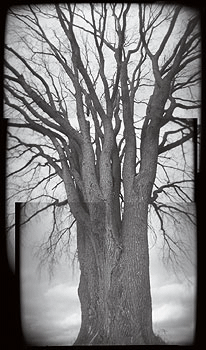
Trees: Visual proof that ancient is better - James Balog

Photographing the largest, oldest, strongest trees in America—92 of them, of 47 different species—has been my obsessive quest for the better part of the last six years. I was looking for stellar individuals, often referred to as “champions,” recommended to me by arboreal aficionados or listed on the National Register of Big Trees. From Key West to the Pacific Northwest, from Maui to New England, the miles traveled became uncountable. The process was exhilarating. Great trees are sculpturally elegant. They are grounded. They transcend time. They are humbling. They are authentic. They are nature’s ultimate survivors, having escaped the ravages of weather, fire, disease, insects, and humans.
Ancient trees are also an antidote to the amnesia that spreads from generation to generation as Earth’s original tree cover is significantly altered or annihilated. In central and eastern North America, primeval, virgin woodland occupies half of 1 percent of the 350 million or so acres of deciduous forests. In the lush lowlands of the Pacific Northwest, where the biggest conifers in the world grow, the story is the same: 99.5 percent of the primeval, ancient trees are gone. In the lower 48 states, only 5 or 6 percent of forest is virgin today; most of that is in the high montane forests of the Rockies, Sierra Nevada, and Cascades.
If photographing these trees taught me anything, it is this: Age matters. Ancient forest is to regrowth as the Grand Canyon is to a freshly plowed furrow. Old forests have character, the imprint of time, biological complexity, and architectural eloquence. Regrowth doesn’t. On the ground, the difference between old forest and new is obvious to the eye. Beauty is something you can see and smell and touch and hear. It is precise, immediate, concrete. Trees mean something. Nature means something. If given a chance, photography can take us beneath the skin of what we think we know to what we really know.
Five Lines - Earth Child
Music. Be it the hand hitting a stretched skin, two sticks clacking, two hands clapping, strings picked, vocals soaring, music is a universal communicator that reaches a persons soul through its sounds expressed by the emotion of the time.
We don't need words to communicate feelings through music, breaking all language barriers. We don't need to see each other or feel each other to communicate through music as its sounds bounce along the five lines on which notes are composed.
Music does not need to be composed on five lines, however. Music is what it is, sounds of expression of emotions.
Healing through music is astounding in many ways. I have from experience observed being a room with senior members of our community who spend much time alone and all rather quiet completely open up, as in they start speaking, smiling, laughing and singing familiar old tunes.
It is like putting an extra ingredient like spit fire in the fuel tank to make the car run smoother.
Light waves, sound waves, are in the air even though we don't see them. As humans do not use their full capacity of senses, it may not be noticed how much music effects our essence of mind, spirit and body.
Music affects our moods. Once, a town decided to try and prevent a gang from hanging around on the train station platforms so they introduced classical music into the sound system booming onto the platforms. It was not long before the gang stopped hanging about there.
If one goes to a party, gathering with no music for a while, notice the difference in the mood of the group when music is put on in the background. We don’t realise the power music has over our mind body and souls. Angels in Heavenly abodes in the cosmic grounds eternally sing to our own Lord God throughout the universe. There are many on earth who have ‘tuned’ in to hear this bouncing off the walls in space, it is indescribable, and it is like a billion crystal chimes and every note of every tone from every male and female in perfect harmony rejoicing in sound.
To put young to sleep and settle them, we often sing songs, lullaby’s and we often play music for ourselves when we need comfort or motivation. Many people do their housework with their favourite music on because music is not just a communicator, it is a motivator.
A good hard loud beat will get the feet moving and the body often dancing around.
The effect of music on humans is real. Then lyrics enter the scene. Many songs hit home to many due to the song speaking of matters that the listener relates to, making it a personal message often resulting in either negative or positive actions/feelings.
A song that has sad or angry lyrics does not mean that song is sad or angry, it is often a case of the writer was getting it out of their system and once they wrote the song, they felt better for writing on paper our emotions, problems and joys is a therapy I regard with the highest manner.
So, the next time you hear a song which sounds negative, don't ride on the dark wave, but rather look/listen for the light at the end of its quaver. This does not mean that all songs are not dark, for there are songs that promote anger and hurt, but this is an example of the dark energy entering into human spirit and tainting Holy music, for music comes from God, not the dark, the dark can not destroy music, but it can try to destroy the essence of it and those who make and listen to it.
Lifestyles and fashions are often created through music, which is often created from the music industry itself.
Sound waves kind of make me think of bees humming and buzzing in their hive for some reason.
Over the world, cultures, tribes, lifestyles are filled with ones who praise and worship God and life through song and dance. From the beginning of time music has been a part of human nature, we can't help it, we need to sing and dance. Sadly, there are some who don't seem to have the spark inside them that reacts to music, there are some souls who do not like to hear music which I find is unfortunate. If I have ever gone even a day without hearing or singing music, I know my souls joy wanes. For when I do hear or sing again, my spirit leaps with joy.
If you believe in God and evil, as in light and dark forces, you may appreciate what is next.
Many fine musicians, singers/performers over the years and world have had major impacts on so many people as in igniting a spark in their sleeping or sometimes dark soul.
Many of these people have ended up on roads to destruction, and their lives ended earlier than long life. When people who can have a good effect on people come along, it would seem 'normal' that the dark counter acts by doing all it can to destroy them in mind body and soul.
Good people die in bad circumstances. It is a high price it seems to be able to put a spark in so many hurting souls through music it may seem. But then it seems better to pass over for being able to spread the eternal flame than to be living and dousing mankind. Eternally speaking, I believe we do not die, our human bodies expire, but God is real and so are our souls. What we do on earth is a drop in the ocean time wise, but the effects and results are enormous.
To all the great musicians, singers, songwriters who have given so much to so many globally, I do and will continue to pray for your souls, for I know not all passed over settled, and some may have been suspended, but God listens to any who are prepared to pray for any, He is a loving and compassionate and fair God, if we don't ask and pray, how can He answer us?
Music...
© Copyright A. Carpenter 2000-2004
The Tree - Justin Ware
I stand at the base looking up,
Its magnificence towers above me,
The branches block out almost all light,
But a glow is still quite evident,
It stands alone, a symbol of the past,
Straight and tall, nature’s majesty,
Few still stand as tall as this amazing thing,
Humans have wreaked havoc on its kind,
I stand below a survivor,
A light from the past, a hope for the future,
What shames there are not more,
We try to replace them, higher we build,
But these new creatures are cold,
Where is the life, the love, the soul?
Perfect lines and dark colors,
This is not a replacement, nothing is,
There is no life there, no feeling,
I look up, quite as alone as my friend,
I too stand alone in a world of increasing gray,
Few see my beauty or appreciate my life,
We are so similar and yet so different,
We have been forsaken, but still we cast our light,
The hope that few others will see,
That is all we can wish of this society,
How can we ask any more?
The have shot down our neighbors and burned our friends,
Though, how can we blame them?
That is what they have been taught,
Taught by those who long ago strayed from the path,
The left the path to find an easier way,
This they found, but the cost was great,
They gave it all up, everything that matters,
But still we stand upon the land, no matter how barren,
Surrounded by stumps, the tears dry in our eyes,
We have done what we can, and will continue on,
We man not last, but our legacy will live on forever,
With that, I walk from my friend to root elsewhere,
Some empty field still needs its tree…
On Silas Marner by George Eliot - Justin Ware
Over the time described in Silas Marner, Silas, a weaver, goes through great changes socially, emotionally, and spiritually. After losing everything in Lantern Yard when he was betrayed by his closest friend, he moved to Raveloe to start over again. There he kept to himself and didn’t communicate with the people of Raveloe other than to earn a profit from his weaving. He remains this way for quite some time until an unfortunate event results in the loss of his money, which absolutely devastates him. Everything again changes when he discovers a young orphan, Eppie, and takes her in forcing him to reach out to the community and adjust his lifestyle.
From the time Silas left Lantern Yard through the adoption of the little girl he found he went through a social metamorphosis. When he first arrived in Raveloe, he kept to himself, never talked to anyone, and wouldn’t attend church. The only communication with the outside world was made because of his job as the weaver, and even then he talked as little as was possible to his employees. As the author, George Eliot explained, “… Silas Marner had lived in this solitude, his guineas rising in the iron pot, and his life narrowing and hardening itself more and more into a mere pulsation of desire and satisfaction that had no relation to any other being.” (p. 17) However, this began to change when his money was stolen; when he discovered it was missing, the first thing he did was reach out. He went into town to the Rainbow, Raveloe’s gathering place, to report the robbery and ask for help. Although the people were extremely cooperative and they tried to recover his money, no good came of it, and after Silas’ brief moment of communication, he retreated even further into his own world. This though, was not the last time Raveloe would hear from Silas. Not long after the disappearance of his money he discovered a woman dead on his property and the apparent daughter of the woman in his house sleeping by the fire. Again his first reaction was the reach out, and he went immediately to the big New Year’s Eve dance which most of the town was gathered at. The townspeople help him yet again, but when asked about the little girl, he made it clear that he wanted to keep her. This was the final step in his social metamorphosis; he continued to communicate with outsiders in order to do what was right for the little girl whom he named Eppie, and even brought her to church.
Silas also goes through a big transformation emotionally from his arrival in Raveloe to the end of the story. After first leaving Lantern Yard, he was extremely introverted and untrusting after being deceived by his closest friend, which resulted in his excommunication and the loss of his fiancé. For this reason, Silas wasn’t willing to become close to anyone and maintained a very paranoid view of the community around him, while also forgetting all of his memories of his previous life. Then, when his gold is taken from him, he goes through a big emotional change, at first he is in denial, he wouldn’t accept that everything he had worked for was gone. As he began to accept the fact, though, his emotions turned to anger and the feeling that he had nothing left in life. However, after all of this had passed, his mind turned towards hope, always expecting his money to be brought back, often waiting for it to appear. The greatest change that Silas experienced emotionally took place when the hole left by the stolen money is filled by Eppie, as Silas himself put it, “The money’s gone I don’t know where, and this [Eppie] is come from I don’t know where.” (p. 123) With Eppie came a new feeling of responsibility, and something alive that he could love. She also brought back memories of his previous life, and he began to accept what had happened to him and that he needed to, yet again, start over anew, thus completing his emotional conversion.
In the story, Silas also changed spiritually; many of these changes were influence by the social and emotional ones which had such a large effect on him. In Lantern Yard, the place Silas left to come to Raveloe from, he had been an extremely religious man, and had attended chapel without fail. However, this all stopped when he was wrongly accused and found guilty of murdering someone within his religious community and excommunicated from the chapel. This caused Silas to lose all faith, because he believed that God had abandoned him, for “…there is no just God that governs the earth righteously, but a God of lies, that bears witness against the innocent.” (p. 10) When this happened, he could not longer remain in Lantern Yard, so he moved to Raveloe to start over and begin a new life. While there, he refused to attend church, and would not take part in anything religious; he just wanted to forget all aspects of his previous life. When he lost his money, he just moved farther away from God, and continued to ignore that aspect of Raveloe. Then, Eppie came into his life, and he could not only think about himself anymore, there was someone else even more important to think about, and according to the townspeople, Silas needed to have her christened and to take her to church weekly. Since he wanted to do the right thing for her, he did just that, and began attending the church Raveloe with Eppie, and began to remember his old life and to accept God back into his life. This concludes Silas’ spiritual transformation from being religious to nonreligious and then back again.
All in all, Silas Marner went through a huge metamorphosis throughout the story thanks to the big events in his life: leaving Lantern Yard, the robbery of his money, and the discovery of Eppie. He went through the transition from being very introverted, then coming out and asking for help, but not fully joining the community, and finally joining the rest of Raveloe in their daily routines and traditions. Silas went the emotional change from being very untrusting and almost afraid of the world around, then anger and self-pity and even more self-absorbed, and lastly to being happy and accepting everything around him and joining the community with his new purpose. He also went through a big change spiritually; starting off as being extremely religious, but when things go wrong he tries to forget God and maintains now spiritual life whatsoever, and then to working his way back into the church and accepting God again. The story shows the amazing internal journey of a man through a hard life which in the end is rewarded with the gift of love.
The Plunge
I jump up,
And position my bare feet on the rough plastic,
I bend forward and grab a hold of the platform,
My head is down, my muscles tense,
Time seems to stand still as I wait,
I don’t have long to wait, though,
Beep and I jump off,
For a few short seconds I am in the air,
Then my body slides into the water,
I stay under for a while beginning to kick,
As I break the surface, my arms come out too,
I begin to push the water by me,
It is warm against my bare skin,
But the temperature is far from my thoughts,
I am focused on one thing only,
And that is to push myself to the limit,
I continue on to the wall and again go under,
A few seconds later I’m back up going the way I had come,
Faster, faster, my arms and legs are pushing me,
The other wall is just within view,
One last surge of energy and my hands find it,
I stop with excitement looking around,
But two were already there waiting for me,
I look up and the others are excited, though,
So I turn towards the board,
My heart leaps as I realize why,
We did it, amazing, it had paid off,
I put up an arm and am pulled out,
As I walk away, I pull off my goggles and grab my towel,
My sister was strangely secretive about the whole thing. In fact, I don’t think I heard about it from her at all. I guess I must have known that things would change for her in college. But I expected her to shave her head, or experiment with drugs, or start dating an ex-con. I thought maybe she’d become a vegan.
Instead, she started going to church.
I know, I know. To some this would seem the better option. But to me, the older of the two, the one born when our parents were going to see Swami Sachidananda speak and using the word “consciousness” a lot, it was a little traumatic.
As kids, Lisa and I were so close it was sometimes suffocating. I was Beezus, she was Ramona. We were three years apart but shared a bedroom, had all the same clothes, watched the same TV shows. After school, before our ballet class, we would spend hours at a time in the public library, doing homework, avoiding homework, reading the racy parts of the fashion magazines. In high school I moved into my own room, started wearing only dark colors and carrying my journal everywhere. My need for autonomy was overwhelming. I hated being part of a duo, hated that her name was always attached to mine, that we were so often referred to as “the girls.” I harassed her relentlessly, accused her of imitating everything. One night, at dinner, in a cold, adolescent frenzy, I remember slamming my fist down on the table and screaming at her, telling her to “get her own life.”
Soon enough, she did. She became part of the student body government, went to prom with an older boyfriend, and had a social circle all her own. Within a few years I left home for college, and we become virtual strangers. Soon, we saw each other only a few times a year, and rarely spoke on the phone. While she assimilated nicely into small town culture, I practiced what I thought was bohemian living at a small liberal arts college half a continent away.
Lisa has always been drawn to tradition. And while both of my parents had rejected their religious roots, she seemed to gravitate towards the small slivers of Christianity (on my dad’s side) and Judaism (on my mom’s) that remained in our family. Our parents were not uninterested in spirituality, but they never enforced or advocated for any kind of regular ritual or practice.
On the rare occasion that our grandparents brought my sister and me along to temple for a Jewish holiday, I would sit patiently and wait for the food or the dancing. I liked lighting the Hanukkah candles but I never could remember the prayer you were supposed to say while you lit them. I suspect that Lisa, on the other hand, had probably memorized this prayer by the time she was ten, as I’m sure she did The Lord’s Prayer from the Bible — one of my dad’s favorite ways to put us to sleep at night. Thinking back, I realize that she was always collecting bits and pieces of religion and tradition and committing them to memory as we were growing up.
Dad had also kept a Bible around, a lingering trace of his Episcopalian upbringing, and I’d often picked it up as a child, read bits, studied the images. But I’d felt the same about it as I had most old literature: respectful, somewhat awe-struck, but in an abstract way.
One winter break I remember picking up a Bible, thinking that it might have arrived in a box left over after my grandma had died. It had beautiful leather binding and I remember thinking it looked like something I would have bought in a vintage bookstore. I opened it to find Lisa’s name in it and while this didn’t exactly surprise me at the time, I don’t remember taking it seriously. Until then, I think I knew she’d been going to church. But I don’t think I cared, or knew how to care about what this meant.
Then again, I wasn’t paying very close attention to anything my family was doing at the time. My dad had gotten sick and died and for years I felt somewhat numb to the world. I dealt with it by separating myself from a lot of what made me feel vulnerable or weak.
While Lisa had set out to have her deepest questions answered, I was going through my own set of changes. There was that whole business of getting on with life after college. There was the attempt to navigate my first “adult” relationship. A new city, all kinds of notions about a career path that would sweep me off my feet, fulfill me personally and allow me to pay my off my loans.
Then one day, my uncle called from across the country. My sister had sent him a fundraising letter for a spring break trip she was taking with her church group to help build houses in a poor neighborhood somewhere in the middle of the country. He was sending her money, he said. But he was a little concerned. Did I know much about this group, he asked. And it was then that he used the words.
Born again.
I nearly dropped the phone. My mind flooded with extreme images: I flashed on the missionary friend I’d made in high school who was always so much fun until she informed me that my “blood was on her hands” if I didn’t agreed to accept Jesus Christ into my life. I imagined the homophobic people I’ve seen on television calling gay marriage “a crime against humanity,” and anti-choice fanatics marching with signs of bloody fetus parts. I couldn’t realistically imagine Lisa doing any of those things, but I admit that I didn’t have enough of a real sense of how she would respond to issues like gay marriage or abortion. It dawned on me just how out of touch with her life I'd become.
So I did what any opinionated big sister who feels she has lost all understanding would do: I called my mom and yelled. Not at her, exactly. But I needed answers. And she did have some. They were not the ones I wanted to hear, but they were surprisingly real. In fact, my mother’s presence of mind about the whole thing might have caught me more off guard then the very fact that my sister was becoming a born-again Christian.
From what I could ascertain, Lisa had been involved with a group at a Christian student center called “The Inn” since she’d gotten to school, and yes, technically, they were more or less “born again.” (Of course, I’m still trying to figure out exactly what that means.) But, my mother said, it was “not something I should worry too much about.”
"Mother!" I yelled into the phone. "She’s born again!"
It might have been that my mom had been witnessing Lisa’s new faith for a while by that point. She had also been doing some “spiritual searching” of her own in the years since my father had died. After a brief bout with the "Course in Miracles," she started going to a Jewish temple after years of rejecting her roots. At that point I still assumed these were all just coping mechanisms, phases she would outgrow like the fad diets she was always trying as Lisa and I were growing up. Now, years later, I am starting to realize that it is more than that. And maybe that's also why I had a hard time taking Lisa's decisions seriously – no one close to me had ever been committed to placing religion or spirituality at the center of their life before.
I don’t know if my mom ever said it directly, but I could tell that she trusted Lisa and wanted to support her. Looking back, I’m glad that she felt so confident. But at the time it didn’t make me feel any better.
I have always learned the most through my relationships with other people. When someone is important to me, I spend a lot of time thinking about and responding (both internally and externally) to the choices they make. My sister had been such an integral part of my early life that she acted as a sort of mirror for me. Accepting the facts that she would participate in a religion (and therefore a culture) that I myself had never been drawn to understand or appreciate was a little bit of an identity crisis for me.
At around that same time, I had a sizeable faction of friends and classmates who were actively studying and practicing Buddhism. And I admired them for dedicating themselves like this. I allowed myself to feel utterly mystified by their ability to meditate and practice. I admired their bravery and perseverance; their bold desires to participate in concrete actions that would bring them closer to some absolute reality, to themselves, etc. Ironically, I didn’t see the connection between this and my sister’s spiritual process.
I had gotten to a point where I knew I wanted to go through my life as awake as possible. But my sense of how this should happen was all very abstract. I had all kinds of ideas and conflicts about art and politics and I knew it felt important to work for social justice. I knew that there was a great deal of my own abstract kind of spirituality behind this drive, but everyone I had admired up until that point appeared to have rejected the structure inherent in most forms of organized religion. Especially Christianity.
In fact, I now realize that there had been a lot in my life up to that point that reinforced the Christian = ignorant and fanatic equation. And even as I saw myself as tolerant and progressive, I had unconsciously bought into a lot of anti-religious hype.
Up until that point, I had always believed that people involved in group religions were victims of some kind of low-grade mind control. Like so many other larger cultural institutions, I saw the Christian church as oppressive and dominating. In retrospect I realize these were extreme perceptions, but I can say I was really worried about Lisa. I think I assumed that her decision to join a church group was a symptom of her inability to make decisions on her own.
When Lisa and I finally started to talk and write to one another, I realized that this couldn’t have been farther from the truth. In fact, she had been asserting her right to make decisions. I’m sure that Christianity must have been refreshingly different from what we had known as children. And choosing to participate might actually have felt like a strong decision.
She did admit to craving a sense of belonging. Not that there’s anything wrong with belonging. But at the time I think I still believed it was something the truly strong, truly kick-ass people in the world didn’t need to directly pursue. Even Buddhism seemed more acceptable to me, because I saw it as something you did on your own terms, away from a group.
When my sister talked about feeling alone and admitted that the fact that the church community had filled a tangible need for something soothing, something that promised love and connection and a special place just for her, I didn’t know what to say. Not because I was embarrassed for her or ashamed of how weak she had been, but because I was amazed at the strength she had to recognize that, not to mention the strength it must have taken to tell me about it.
Suddenly I wasn’t irate, I was a little envious. Not that she had found “an answer,” on the contrary, I found out that Mara was starting to disengage herself from this church group. In fact, she was still very much in the thick of her spiritual questioning. Eventually she did admit to feeling manipulated by the church, and I believed her. But I knew she had also been experiencing internal changes right under my nose.
What, I asked myself then, had I done to deal with my own sense of isolation, loss, existential grief?
She had gone right to the source while I had spent years groping my way through…what? Journal-keeping? Co-dependent relationships? A liberal arts education? Poetry? Psycho-therapy? Colored Christmas lights? An enormous collection of thrift store sweaters?
My own path had been a lot more piecemeal. At times, even scattered. When I’m honest with myself I know that I would do most of it over again, but it’s taken lots of hard emotional work to get as far as I have. I have spent a lot of my young life vehemently rejecting community and the kind of support that is only possible when you are part of a group. And it hasn’t always been so good for me.
At that point I started wondering about what Lisa might have to teach me in this department. It was around this time that we started talking on the phone more, and visiting one another and she came to live with me for the summer before her last year at school. We were close again, after too many years of what had seemed like a mild-mannered acquaintance at best.
I knew that my own process of healing had been something I’d needed to do on my own, but I also felt some guilt for not playing a larger role in her life. When I put this and my anxiety about the Christianity thing aside for a while, and got to know her, I understood that we had never stopped having things in common.
In the years since we’d been close Lisa had become an artist. We would still walk into a museum or a store and find ourselves gravitating to the exact same things, liking a lot of the same music, etc. We could borrow one another’s clothes again.
Even more important: she hadn’t forgotten the tolerance our parents had taught us, nor had she adopted a right-wing political agenda. In fact, I was a little embarrassed for even thinking she might. Of course, her being Christian was still an important difference. It implied that there are things that she believes that I may never even understand.
I think that Lisa became a practicing Christian partly because she felt disconnected from people. I also felt disconnect from and it affected me in profound a way. When I am paying attention to family, it helps me pay attention to myself. I feel more connected, more whole. And this, to me, is a big part of what spirituality means. Connectedness. Wholeness.
Does this mean that I, too, am becoming a more “religious” person than I have been? Well, the questions my sister's faith have brought up haven't gone away. I do believe that there is something to all of this. That there is a force of some kind behind the way the sunlight moves and the way your knee throbs when you hit it against the leg of table. But I'm not sure that this force doesn't come from us, from our connections to one another, and the work we do daily in relation to one another.
Spending time with Lisa has reminded me that one can be spiritual and sharp, compassionate, awake and critical-minded all at once. But she and I still have a lot to talk about. Sometimes I feel a lot of sadness about the years she and I spent so distant form one another. Still it's nice to know that we are arriving at a lot of the same places these days.
For now, I'm just enjoying learning from Lisa, letting her serve as the mirror that reflects the things I do and don't want to see in myself. I know it could have gone very differently. I know that for some families, religion is inseperable from ideology, and I got off easy. This week Lisa bought a Christmas tree and set it up in her living room next to her Torah. If I'm lucky, maybe she'll invite me to go with her to Mass on Christmas Eve.
I still wonder about what it might feel like to surrender to the idea that there is an "answer," even only for a while. I know that's not the only thing that organized religion is about for most people, but I have a sense that, even if Lisa sees her relationship with God as more complex now than she did before, there must have been a point when she felt that way: like there was a clear set of directions to follow in order to be rewarded, to live a good life. But I also know there is a fair amount of anxiety involved too. What if you don't do the right thing, what if you don't get to heaven?
I have a strong hunch that everyone in an early stage of belief might feel this combination of anxiety and relief – no matter what kind of belief it is. I also suspect that it always gets more complex, and that is always leads inward. I suspect as much because I've witnessed it in myself. For all I contend about the differences between Lisa's life and my own, I also know that writing has been for me a kind of spiritual path. It is an ever-evolving set of choices that brings me closer to people while allowing me the personal space and the independent integrity that I need.
Sometimes I try to imagine my sister in a religious setting for the first time. I try to picture what she must have looked like. She may have bowed her head forward with familiar kind of concentration we both share, or brought her long hands up towards her chest in prayer. I imagine it might have felt like she was planting herself, like a seed, in a warm, accepting place. I can imagine this feeling because I've had it myself. Many times, in fact.
It happened for the first time when I was thirteen. I was standing in the stacks of a huge university library, reading at a frenzied pace. I remember stopping and looking around, loving the way the old books looked, the way they smelled, the way they seemed as if they had been abandoned here, left for me to find by chance. I could see someone my age walking through the same library years later and finding on a book with my name of it. In my mind, she felt the same excitement, the same glow in their chest as she read my words. That day I began to believe that there was a path for me, that it would be evident and that I would, quite simply, follow it. Of course, as soon as I started to investigate that path more deeply, I felt all the universal anxiety and fear. But for that moment it was pure, white light. Something like faith.
'Twas the Night Before Christmas - A Marine
TWAS THE NIGHT BEFORE CHRISTMAS,
HE LIVED ALL ALONE,
IN A ONE BEDROOM HOUSE MADE OF
PLASTER AND STONE.
I HAD COME DOWN THE CHIMNEY
WITH PRESENTS TO GIVE,
AND TO SEE JUST WHO
IN THIS HOME DID LIVE.
I LOOKED ALL ABOUT,
A STRANGE SIGHT I DID SEE,
NO TINSEL, NO PRESENTS,
NOT EVEN A TREE.
NO STOCKING BY MANTLE,
JUST BOOTS FILLED WITH SAND,
ON THE WALL HUNG PICTURES
OF FAR DISTANT LANDS.
WITH MEDALS AND BADGES,
AWARDS OF ALL KINDS,
A SOBER THOUGHT
CAME THROUGH MY MIND.
FOR THIS HOUSE WAS DIFFERENT,
IT WAS DARK AND DREARY,
I FOUND THE HOME OF A SOLDIER,
ONCE I COULD SEE CLEARLY.
THE SOLDIER LAY SLEEPING,
SILENT, ALONE,
CURLED UP ON THE FLOOR
IN THIS ONE BEDROOM HOME.
THE FACE WAS SO GENTLE,
THE ROOM IN SUCH DISORDER,
NOT HOW I PICTURED
A UNITED STATES SOLDIER.
WAS THIS THE HERO
OF WHOM I'D JUST READ?
CURLED UP ON A PONCHO,
THE FLOOR FOR A BED?
I REALIZED THE FAMILIES
THAT I SAW THIS NIGHT,
OWED THEIR LIVES TO THESE SOLDIERS
WHO WERE WILLING TO FIGHT.
SOON ROUND THE WORLD,
THE CHILDREN WOULD PLAY,
AND GROWNUPS WOULD CELEBRATE
A BRIGHT CHRISTMAS DAY.
THEY ALL ENJOYED FREEDOM
EACH MONTH OF THE YEAR,
BECAUSE OF THE SOLDIERS,
LIKE THE ONE LYING HERE.
I COULDN'T HELP WONDER
HOW MANY LAY ALONE,
ON A COLD CHRISTMAS EVE
IN A LAND FAR FROM HOME.
THE VERY THOUGHT
BROUGHT A TEAR TO MY EYE,
I DROPPED TO MY KNEES
AND STARTED TO CRY.
THE SOLDIER AWAKENED
AND I HEARD A ROUGH VOICE,
"SANTA DON'T CRY,
THIS LIFE IS MY CHOICE;
I FIGHT FOR FREEDOM,
I DON'T ASK FOR MORE,
MY LIFE IS MY GOD,
MY COUNTRY, MY CORPS."
THE SOLDIER ROLLED OVER
AND DRIFTED TO SLEEP,
I COULDN'T CONTROL IT,
I CONTINUED TO WEEP.
I KEPT WATCH FOR HOURS,
SO SILENT AND STILL
AND WE BOTH SHIVERED
FROM THE COLD NIGHT'S CHILL.
I DIDN'T WANT TO LEAVE
ON THAT COLD, DARK, NIGHT,
THIS GUARDIAN OF HONOR
SO WILLING TO FIGHT.
THEN THE SOLDIER ROLLED OVER,
WITH A VOICE SOFT AND PURE,
WHISPERED, "CARRY ON SANTA,
IT'S CHRISTMAS DAY, ALL IS SECURE."
ONE LOOK AT MY WATCH,
AND I KNEW HE WAS RIGHT.
"MERRY CHRISTMAS MY FRIEND,
AND TO ALL A GOOD NIGHT."
The "W" in Christmas
Each December, I vowed to make Christmas a calm and peaceful experience.
I had cut back on nonessential obligations - extensive card writing,endless baking, decorating, and even overspending.
Yet still, I found myself exhausted, unable to appreciate the precious family moments, and of course, the true meaning of Christmas.
My son, Nicholas, was in kindergarten that year. It was an exciting season for a six year old.
For weeks, he'd been memorizing songs for his school's "Winter
Pageant."
I didn't have the heart to tell him I'd be working the night of the production. Unwilling to miss his shining moment, I spoke with his teacher. She assured me there'd be a dress rehearsal the morning of
the presentation.
All parents unable to attend that evening were welcome to come then.
Fortunately, Nicholas seemed happy with the compromise.
So, the morning of the dress rehearsal, I filed in ten minutes early, found a spot on the cafeteria floor and sat down. Around the room, I
saw several other parents quietly scampering to their seats. As I waited, the students were led into the room. Each class, accompanied
by their teacher, sat cross-legged on the floor. Then, each group, one by one, rose to perform their song.
Because the public school system had long stopped referring to the holiday as "Christmas," I didn't expect anything other than fun,
commercial entertainment - songs of reindeer, Santa Claus, snowflakes and good cheer.
So, when my son's class rose to sing, "Christmas Love," I was
slightly taken aback by its bold title.
Nicholas was aglow, as were all of his classmates, adorned in fuzzy mittens, red sweaters, and bright snowcaps upon their heads.
Those in the front row- center stage - held up large letters, one by one, to spell out the title of the song.
As the class would sing "C is for Christmas," a child would hold up the letter C. Then, "H is for Happy," and on and on, until each child holding up his portion had presented the complete message, "Christmas Love."
The performance was going smoothly, until suddenly, we noticed her; a small, quiet, girl in the front row holding the letter "M" upside down - totally unaware her letter "M" appeared as a "W".
The audience of 1st through 6th graders snickered at! this little one's mistake. But she had no idea they were laughing at her, so she stood tall, proudly holding her "W".
Although many teachers tried to shush the children, the laughter continued until the last letter was raised, and we all saw it together.
A hush came over the audience and eyes began to widen.
In that instant, we understood the reason we were there, why we celebrated the holiday in the first place, why even in the chaos, there was a purpose for our festivities.
For when the last letter was held high, the message read loud and clear:
"C H R I S T W A S L O V E "