This is the day we checked into our timeshare/hotel in Maria Alm. We got up early, fairly excited. The timeshare was at the "other" end of Austria (well, sort of - pretty close to it), but since Austria is about the size of South Carolina, this isn't all that big of a deal. We estimated it to be about 3 or 4 hours away (pretty close to correct).
We got directions back to the autobahn system.
(By the way, it's Germany where there is no limit on the speeds - Austria has an upper limit of 160 KPH, which works out to about 94 MPH. The driving wasn't bad at all on the autobahns. It was the REST of the mountain driving that made us look at each other and say, "did you see that?" - The Austrians think nothing of zipping around you on a blind curve).
We had been using Rick Steve's "Europe through the Back Door" (highly recommended) and his travel guide to Austria. Teresa wanted to see a castle, a monastery and the Alps. Per Rick Steve's, the time for the monastery had come.
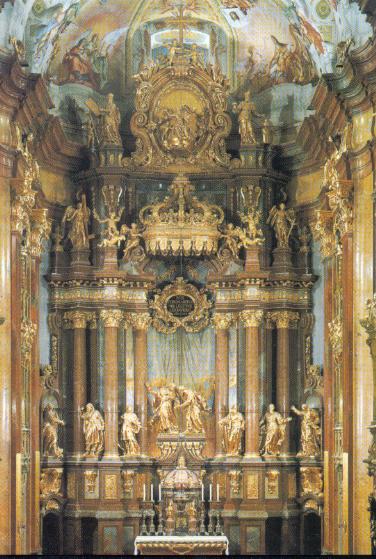
About 45 minutes outside of Vienna is Stift Melk (Stift means Abby in German - Melk is the town). Rick Steve says this is one of THE sights of Europe.
I think he's right.
Words really cannot describe this place (Web Site:
- you may need to use babelfish to be abble to translate it). It has recently been refurbished (they sold their copy of the Gutenburg Bible to Harvard to raise money for refurbishing - it was WELL spent) and is an amazing blend of the new and the old.
Napoleon made his headquarters here twice� it is understandable.
It was absolutely amazing, we would tour it again.
We then hit the autobahn again. We went around Salzburg on the autobahn and headed south. We soon passed a magnificent castle on our right (web site:
http://www.salzburg.com/SalzburgerLand_e/burgen/index.html
HOHENWERFEN FORTRESS). We decided to visit it later.
About this time, we decided that we were starting to have a bit of history overload. We had heard about it, but never actually experienced it before.
In America, something that is 200 years old is really significant. Over there, something that is 200 years old is only "middle aged".
As you drive down the autobahn, you also see old ruins of towers, forts, etc. - sometimes in the middle of a field of vegetables. After a while, you just start to overload. I came to the conclusion that a church defines a village - every village has its church at the center. Those churches usually seem HUNDREDS of years old (literally). You can see these driving down the autobahn, as well. If a village has two churches, it seems to have made it to town status, and so on.
By the way, Austria is 93% Roman Catholic - you can't drive/tour without being in sight of a steeple.
We had to leave the Autobahn and do some navigating. Most of the (non-autobahn) roads in Europe seem to be two lanes, except in town where they sometimes go to four. This does not seem to slow traffic down, however.
We didn't have any trouble following the road signs to Maria Alm (we might not be able to pronounce the place correctly, but we could match what the directions said to what the sign said). Soon, we were heading up what I thought was a "twisty, turny county road" in some awesome mountains (those words twisty turny were going to come back to haunt me, as well).
This road actually went up and through a pass in the Austrian Alps. It was two lanes all the way, and that didn't stop people from passing - going up, or going down - yes on blind curves.
Most of the drive was wooded; we stopped briefly at the top of the pass and looked around.
We then headed down the other side, passing several little villages with names we couldn't pronounce (for example "Hintermoose" - we could pronounce that one, just had no clue what it meant).
Each village is pretty tightly clustered - we would be riding through the woods, see a house, then, suddenly, the village was there. That was the way it was for Maria Alm, as well. The Alpenland Sporthotel (where we were staying) was close to the edge of town (second driveway). We pulled up, unloaded, checked into the room, breathed for a moment, then looked around.
We had gotten AMAZINGLY lucky with the timeshare trade (this was a five star hotel)- this place was absolutely beautiful, oriental rugs were everywhere.
We wandered the village for a while, then hit one of the Guesthauses for dinner. This was near the church with the local brass band playing (passing around liter beer mugs between songs) with some of the Austrian lasses selling shots of locally made (we assume) schnapps from a small wooden keg that they wore on a strap. The entire village was drinking from the same shot glass. It was great fun.