



It is, of course, notorious--we have Watson's word for it--that Sherlock Holmes loathed every form of society with his whole Bohemian soul. The word society has other connotations today. What Watson intended to convey was that social life offended the Bohemian soul of his companion; in consequence of which emotion when others might have gone off to teas or parties: buried among his books, as Watson says, and alternating from week to week between cocaine and ambition--the drowsiness of the drug and the fierce energy of his own keen nature.
In time, it is true, the doctor weaned him from the drug--to the detriment of romantic interest, whatever the benefit to Holmes--but even then it is seldom that one finds the austere detective accepting or turning down an invitation. He simply did not get them. No doubt there had been plenty of them in his youth; but in the face of his declinations--after an experience or two, perhaps with bores--he would in time, of course, be let severely alone. It is, one fancies, almost as great a nuisance to be a detective as to be a doctor; there are always guests with problems to present.
The fact is, Watson too preferred the silence or friendly arguments of Baker Street to any attraction London had to offer--a circumstance in which he is at one with his adoring readers. Each man enjoyed the company of the other and was glad enough, no doubt, even to see a client leave the premises. Even, perhaps, Lestrade or Tobias Gregson. Even, perhaps, Inspector Stanley Hopkins; although, for Hopkins, Holmes has a considerable admiration, and on a cold night a prescription containing whiskey.
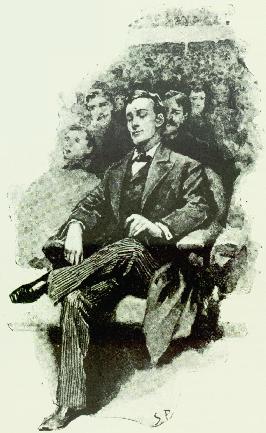 St. James Hall was a favourite sanctuary when it was possible for Holmes to interrupt his sleuthing. And now, Doctor, we've done our work; it's time we had some play, one hears him cry to Watson, after a brilliant morning of deduction. A sandwich and a cup of coffee; then off to violin land, where all is sweetness and delicacy and harmony, and there are no red-headed clients to vex us with their conundrums. The occasion of this pleasant interlude was in the intermission, as it was, before the crash in the fantastic problem of Jabez Wilson. And all that afternoon, the doctor tells us; he sat waving his long, thin fingers in time to the music--listening to Sarasate play the violin.
From time to time they traveled on the Continent, not always on the business of a client; and several parts of rural England knew them well. It was on one of these shared vacation jaunts that they chanced upon the ugly business of Ragate Squires--when they were the guests of Colonel Hayter, down in Surrey; and it was presumably a holiday adventure that brought the instructive problem of The Three Students--a sort of pendant to Holmes's laborious researches into early English charters. Again, it was a vacation trip that took them, in 1897, to the small cottage near Poldha Bay, at the farthest extremity of the Cornish peninsula, in which singular and sinister neighbourhood there befall that gruesome experience chronicled by Watson as The Devil's Foot. Once, it is certain, they went to Norway; but if ought to of criminal interest develop during the visit, it has yet to be reported.
From the vacation trips--interrupted as they were invariably by theft or murder--Holmes always returned to Baker Street refreshed. It was, however, only the thefts and murders that consoled for him the time thus away from home.
And it is at home, in Baker Street, that one likes best to think of them, alone and puttering with their secret satisfactions. Little vignettes of perfect happiness, wreathed in tobacco smoke and London fog.
Of course they took in all the daily papers and read them with a diligence almost incredible. Did the detective prop his notebook against the breakfast sugar bowl? Did Watson, as he sat down at the table, invariably thump his knee against the leg? For Watson, at any rate, Holmes usually had a lecture . . .


