Two Dissident Iranian Women Fall by the Wayside
From DEBKAfile War Diary - Day 30 of Iraq War, April 18, 2003
April 20, 2003, 12:21 AM (GMT+02:00)
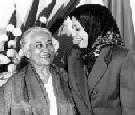
In the fourth week of the Iraq War, DEBKAfile’s Middle East sources found the adored diva of the Farsee world in a group of 100 fugitive Mujahideen fighters camping in the open air outside the Iraqi-Jordanian border post without food or water. The Hashemite kingdom refusing to recognize their documents as international refugees shut the door in their faces.
Marzieh, aged 73, found herself part of the flotsam of the Iraqi War, two months after she joined her friend, Maryam Rajavi, in the group’s military headquarters at Camp Ashraf, 100km north of Baghdad.
Maryam had made the fatal mistake of pinning her trust on her special relations with Saddam Hussein for overthrowing the ayatollahs’ rule in Iran. Her friend Marzieh may not have known that the Iraqi ruler had prepared for the US assault by posting a battalion of Mujahideen suicide guerrillas at Kirkuk with orders to torch the oil fields when the Americans invaded.
However, on March 19, the Iranian militants did not carry out their orders - any more than the Iraqi Special Republican Guards 5th Division put up a fight against the US forces advancing on Baghdad. Nevertheless, the Mujahiddin I-Khalq, after a decade of guerrilla warfare against Tehran, was to pay in full for joining forces with Saddam Hussein. Earlier this week, Tehran’s best Kurdish friend, Jalal Talabani sent a unit of his Patriotic Kurdish Front on a killing mission to Camp Ashraf accompanied by US special forces. According to DEBKAfile’s military sources, hundreds of Mujahiddin fighters died in the attack and more than a thousand were injured. Marzieh and a group of Iranian dissidents escaped, only to be brought up short at the Jordanian border, their last line of escape. Turning up at the Syrian frontier would have been suicidal; the dissidents would have been handed straight over to Iran, unlike the 300 or so of Saddam’s minions who were made welcome in Damascus.
Maryam Rajavi’s fate is unknown. According to our sources, many escaped militants were caught and executed by Iranian Revolutionary Guards agents who lay in wait outside the group’s base in Iraq during the Kurdish attack. The same fate befell those attempting to slip into Iran. Some of the group’s senior commanders were captured alive and carried off to the Iranian Revolutionary Guards’ intelligence headquarters at Kermanshah for interrogation under extreme torture.
No one has formally claimed responsibility for wiping out the Mujaheddin I-Khalq’s Iraq headquarters. General Vincent Brooks of the US Central Command, asked at his briefing in Qatar on Thursday, April 17, about a bombing of their base, had only this to say: We are working on a ceasefire and capitulation of the group and have been following them for some time. He implied that some of the Iranian dissidents were fighting on and the US command would rather have them surrender than subdued by force. Maryam Rajavi’s survival after the Camp Ashraf’s destruction would explain her followers’ continued resistance, which would most likely have petered out had she been killed or captured.
The US-backed Kurdish attack on the military headquarters of Iran’s most dangerous enemy, the Mujaheddin I-Khalq, epitomizes the complexities and inconsistencies of Washington’s working relations with Tehran in the Iraq War.
In the second week of the conflict, US forces – then too, operating jointly with Talabani’s militias, wiped out the al Qaeda-linked Ansar al Islam Kurdish fundamentalist base in northern Kurdistan, although the group received a steady flow of cash and weapons from neighboring Iran. This was a blow against Iranian influence. In the last week of the war, the same combination of forces wiped out an anti-Iranian group in the north, the Mujahiddin I-Khalq. The US command thus rooted out military positions ranged on either side of the Iranian fence.
Further south, the Americans appear to be fighting a completely different war – this one against Iran. In Baghdad, Najef, Karbala, al Amarna and Basra, they are fending off Iranian encroachments on Irag’s Shiite community and competing aggressively for influence among local Shiite clerics. Yet no American action has been taken against the hundreds of Lebanese Shiite Hizballah fighters streaming through Syria into Shiite towns to organize local extremists into an anti-American guerrilla force. This is being allowed to happen two decades after the Hizballah’s campaign of suicidal terror and kidnapping drove US forces out of Lebanon.
These inconsistencies are likely to proliferate as Washington plunges deeper into the post-war stabilization of a country rife with dissent and targeted by competing foreign interests.