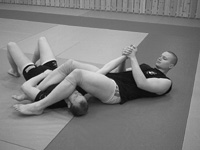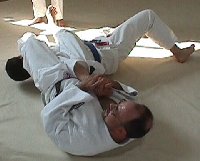

Brazilian/Gracie Jiu-Jitsu is primarily a ground-fighting art. Most techniques involve both fighters on the mat. There is a heavy emphasis on positional strategy, which is about which fighter is on top, and where each person's legs are. Positions are stable situations, from which a large variety of techniques are available to both fighters.
Specific techniques taught are designed either to improve one's position (for example, to "pass the guard", by going from being "in the guard" to getting around the opponent's legs, resulting in side control); or else as a finishing submissions are either chokes (cutting off the blood supply to the brain) or arm locks (hyperextending the elbow, or twisting the shoulder).
In the mid-1800's in Japan, there were a large number of styles of Jiu-Jitsu(sometimes spelled Jujitsu"). Techniques varied between ryu, but generally included all manner of unarmed combat (strikes,throws,locks,chokes,wrestling,etc.) and occasionally some weapons training. One young but skilled master of a number of Jiu-Jitsu styles, Jigoro Kano, founded his own ryu and created the martial art Kano-ryu Jiu-Jitsu in the 1880's. One of Kano's primary insights was to include full-power practice against resisting, competent opponents, rather than solely rely on the partner practice that was much more common at that time.
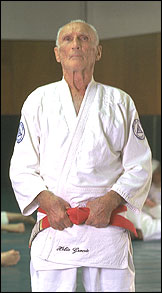
In 1925, Carlos and his brothers opened their first Jiu-Jitsu academy, and Gracie Jiu-Jitsu was born in Brazil.
They began to concentrate more and more on submission ground fighting, especially utilizing the guard position. This allowed a weaker man to defend against a stronger one, bide his time, and eventually emerge victorious.