Heat wave in Nalgonda district on 28.8.2003
Report submitted by Dr. J. V. M. Naidu, Director, Cyclone Warning Centre, Visakhapatnam & Member of the State level Committee on Heat waves appointed by Government of Andhra Pradesh vide letter no.
Consequent to the decision of the committee at the earlier first meeting on 26th July 2003, it was decide to have interactive session with the families of the deceased due to heat wave deaths. Accordingly the state government planned for tour of the committee on 28.8.2003. The tour was undertaken by some of the members, including the undersigned. Dr. J. V. M. Naidu, along with the other members of the committee in the absence of the chairman Dr. R. K. Pachaury the personal interviews were conducted. However, his nominee Ms. Atreyi Paul brought some questionnaire to be filled during the interview with the family members of the deceased. The questionnaire was subsequently modified suiting to the local conditions and the data were collected.
Meetings & Interviews held:
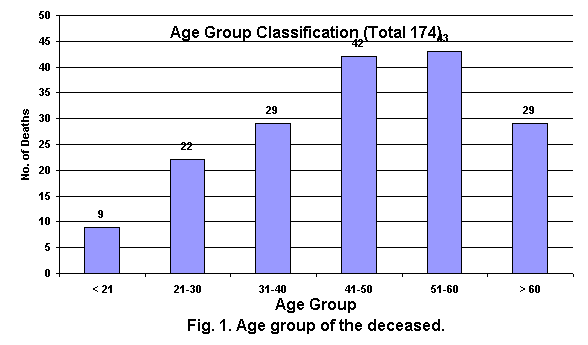
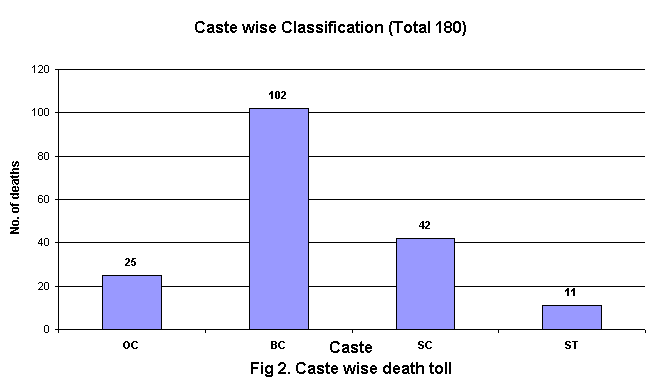
The meeting was attended by the district collector, R.P. Sisodia who requested the members of the committee to interact with the local officials from various departments like Health, Panchayat Raj and Irrigation etc. before proceeding to the visit to the villages. The undersigned addressed the gathering on the information that is to be elicited during the interactive session such as occurrence of death place and time, medical aid, information of heat wave warning, the socio economic conditions of the family, the climatological input, employment program etc. Dr. C. V. V. Bhadram, of IMD requested for revival of part time observatories at Collector’s office, Nalgonda. Dr. Raji Reddy of Agricultural University requested the gathering that drought resistant orchards cultivation to be taken up. Officials informed that several mango orchards and palm trees of several decades old died of excessive heat wave, which was not experienced for last five decades. Several birds died, and fallen to the ground from treetops. Collector pointed out due to the large barren hills located right in the district head quarters and other areas radiated more heat, which increased the death toll. He also presented some temperature data from Suryapeta division of the district which was monitored by locals indicating that the maximum temperature had gone to 40oC and above for several days in the months of April and May till June 12, the peak value was 49oC. The ground water table also reduced to a record low of about 16 m deep in the month of May. The rainfall in Nalgonda district right from November till May was nil but for 12% of the normal (6 mm against 11.8 mm of district average). The death toll due to heat wave was predominantly the agricultural labour. Most of these people belong to schedule castes and backward castes as given in the table.
Visited the village and interviewed three family members of the deceased. Out the three death cases that were reported, one was a cook, another was a Sheppard. All the three belong to the backward community and working as agriculture and a cook. All the three people reported the symptoms of high feaver and died within few hours of showing the symptoms. They also were vomiting and loose motions in the evening and dead by late night. One of the deceased had problem in urination. All these symptoms, the family members took lightly as the routine There was no transport available to take them to hospital which was about 7 km away at Choutuppal. The para medical staff were located at about 4 km away for any consultation and advice.
The son and wife of the family members of two deceased were interviewed. One of them was a Sheppard and other an agriculture labour who died by evening at 5:30 and 7:30 p.m. respectively after reporting the symptoms of extreme dehydration due to vomiting and loose motions. Here also the locals did not suspect that their death is likely during the next 4-5 hours after reporting the symptoms. They also reported cessation of urine. The village is more affected due to fluoride contamination. The district Health Officer reports that due to fluoride problems many are affected with kidney problems and repeated urinary infections in the summer. Renal stones aggravating the sunstroke would have caused the renal shock, which resulted in immediate death after few hours of sunstroke.
In this village, the sons of the two deceased were interviewed. One of the deceased is a dhobi, a lady who regularly used to wash clothes in the hot sun while the other is a weaver who has worked outdoor clearing and dying the cotton threads to under take weaving under a iron sheet roof. Both the people died the next day morning after reporting cessation of urine and high feaver. The medical was available 2 km away could not be given due to financial problem and lack of transport that was not available at night when the condition of the patient was deteriorating. District Medical Officer admits that it could be another case of renal shock due to sunstroke.
Returned to MRO office after lunch and enquired the family members of the three deceased. The first one was a lady working as roadside vender who reported loose motions and vomiting and admitted to a private hospital at 11:00 a.m. and died after one and half hour. Second one was a youth of 22 years age, a weaving labour who was in hot sun during the previous day reported symptoms at 12:30 noon and collapsed before taking to the hospital. The third one was a mason of 25 years age succumbed due to sunstroke after reporting cessation of urine.
Inferences:
From the above enquiries the following causes are being identified for the death of the sunstroke victims who succumbed within a few hours period after reporting symptoms like high feaver cessation of urine, vomiting and loose motions.
(first aid measures like giving oral rehydration salts or cold water foaming would have helped the victims against sunstroke before getting the medical aid.)
Recommendations:
So, it is proposed a green belt area around all the hills may be developed which can control the heat waves to certain extent. Wild creepers may also be grown which can cover the boulders in controlling reradiation effects.
*-*-*