|
Daily Journal
Wednesday, November 22, 2000 A smile is a smile and a laugh is a laugh in any
language. That is what I learned today on my visit to the
high school in Toyonaka City. Although it was difficult to
communicate with words, I still learned a lot.
Watching people and situations gave me a glimpse
into the world of a Japanese high school. Wherever we went,
we were swarmed with students wanting to say hello, wanting
their pictures taken, and wanting to visit with these foreign
sensii (teachers). We were given gifts by the
administration, invited to observe classrooms, and treated to a
bento (box) lunch. I visited a calligraphy class and tried
my hand at "big letters". I observed a cooking class that
taught students how to prepare a meal for their New Year
holiday.
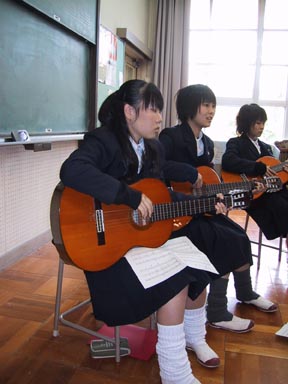
A guitar ensemble is one of their electives.
 I sat in on a math class. It was interesting to see how the teacher used letters (A, B, C) and math symbols and also used Japanese characters. They roasted sweet potatoes in an open fire pit outside the school to give us a sample of this native treat. Once again it was the little things that I found
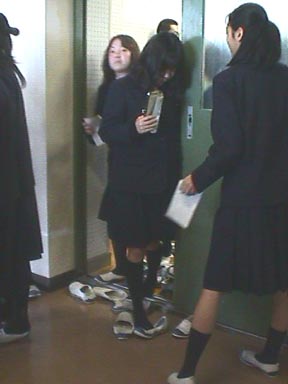
interesting. The doors into the classrooms are all sliding
doors. There are also sliding windows. When the students
went into and out of their classrooms, they left their
slippers outside the door. Watching them rush out at the end
of class and put their slippers on en masse was a sight to
see!
 I found the answer to one of your questions. The computer keyboard has the English alphabet on it as well as Japanese symbols. Here is a photo of a giant keyboard that was hanging in their computer classroom. 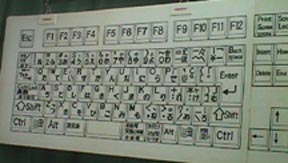 That evening, a group of fifteen of us took the train to
the National Bunraku Theater. This was something I had been
planning for months. Buraku is traditional Japanese puppet
theater. It is very similar to Kabuki in its form. There are
two men who sit on the side wing of the stage. One is the
storyteller-- he does all the voices and narration in a way
that sounds as if he is singing. One of the storytellers we
saw is a "living national treasure." In Japan, artists of
great skill are given this title as a way of showing
appreciation for their talents. It would take too long to
explain his talent to you, so I'll save that for when I return.
The next man played the shamisen, a traditional Japanese
guitar. |
|
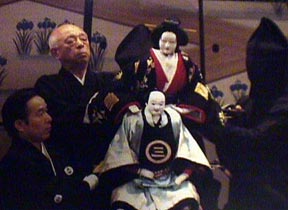 Each puppet, which was half human size, was
manipulated by three men. The first worked the right hand
and the face. His facial expressions seemed to match the
puppet's throughout the show. The second two men worked the
left arm and the legs. They wore all black including a black
mask over the faces. It was absolutely amazing how lifelike
their movements were. And seeing many puppets onstage with
all the men manipulating them was a true act of
choreography. I keep wondering how anything can top the
things we did in the last week, but it keeps getting better!
Each puppet, which was half human size, was
manipulated by three men. The first worked the right hand
and the face. His facial expressions seemed to match the
puppet's throughout the show. The second two men worked the
left arm and the legs. They wore all black including a black
mask over the faces. It was absolutely amazing how lifelike
their movements were. And seeing many puppets onstage with
all the men manipulating them was a true act of
choreography. I keep wondering how anything can top the
things we did in the last week, but it keeps getting better!