|
Daily Journal
Friday, November 17, 2000 I actually did not have to leave my room before 9:00 AM this morning. I had a choice of one of four sessions: peace education, special education, educational changes in Japan, and math education. Guess which one I chose? Of course, math. The gentleman who spoke started out by apologizing for the weather. It was 8 degrees Celsius, very cold for this time of year. Do you know what that is in Fahrenheit? One of the interesting things about Japanese math classes is the textbooks that are used. They are thin paperback books. Students are expected to take them home each night to do their homework. They have 45 minutes of math instruction each day. Although Japanese students finish number one on international math tests, they do not like math. When they get to the college level, very few students choose to take math courses. The Japanese people have a new educational plan that will be put into effect in the year 2002. Their goal is to raise the enjoyment level of math. I am going to see if I can find a store that sells the textbooks, so I can bring one home to show you. After lunch, we were privileged to see a presentation on Kabuki Theater. Oops, I just realized that I forgot to tell you about our Kyogen performance earlier in the week! Let me explain both together. Japan has four types of traditional theater. Noh and Kyogen are both 600 years old. Noh plays are tragedies in which the actors wear masks. There is a chorus of dancers and musicians playing drums and flutes. Kyogen is a comedy based on folktales. Masks are only used when they want to portray non-humans (like the devil) or very ugly characters. There is usually no scenery and very little props. The actors do all the sound effects. Our performers spoke in English so we could understand the story. I have a videotape of the show that you can see when I return. Kabuki and Bunruku, the next types of traditional theater, are 400 years old. They are staged with very fancy costumes and sets. Kabuki uses live performers, while Bunruku is puppet theater. We were told that most Japanese have never seen a live performance of Kabuki. There is very little education in the traditions of Japanese theater and arts in the schools. An American who moved to Japan 12 years ago talked to us about Kabuki while a Kabuki dancer put on her make-up and costume. She started by wrapping her hair in a special cap. Next she applied wax to her face which made her look like she had no eyebrows. White makeup was spread over her face, neck and lower arms and hands. Why white? White skin was a sign of elegance. It meant that you did not have to work out in the sun as a laborer. It also probably made it easier for people to see the actresses because the light was not very good back in the beginning years of this type of theater. She painted in her eyebrows, and her eye make-up included red circles at the end of each eye to make her eyes appear larger. 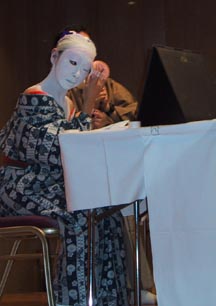 When she was finished, she put on two kimono- the first one was beautiful, but the outer kimono was magnificent. It was bright red with gold appliques. She told us that one sleeve�s appliques cost $5000! Although she applied the make-up herself, she had two men helping her wrap her kimono. The finishing touch was a very fancy wig. Her entire costume weighs about 40 pounds. It had taken her 30 minutes to complete this entire process. After our photo opportunity was complete, she started to dance. I sat there watching with tears in my eyes. That�s how beautiful it was. We were told that she had started training when she was 2 years old! Her grandfather was a famous Kabuki actor. I have a videotape of my Kabuki afternoon if you want to see it when I return. 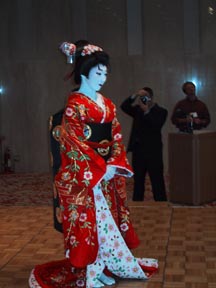 Our dinner group that evening chose to go to a Soba restaurant, a few blocks from our hotel. Soba is a noodle restaurant. At the entrance, we looked at the menu-- no English, but there were photos of the different dishes. They looked pretty safe-- nothing that appeared to be blowfish. Should we be adventurous? How would we communicate? What if we ordered something that ended up costing us a $100? "Go for it", I said. I knew how to say, "I don�t understand the Japanese menu, can you help me?" After all that work listening to the Japanese tape this summer, I needed to use it! We went in, I tried out my phrase, and a Japanese businessman, who was a customer at another table, came over to us and said, "My English is not very good, but I like to try to help." Hooray, another break for us! He showed us what to order, and once again, we had a delicious meal and a lot of fun. We sat at a large round wooden table on benches with pillows. This was not a tatami room, so we did not have to remove our shoes. Each of us was brought a cup of green tea and then a tray with a large bowl, a small bowl, and chopsticks. By the way, I am getting much better with my chopsticks. You would be impressed. The large bowl contained soup, chewy noodles that looked like fat spaghetti, shrimp tempura, bits of chicken, and some Japanese vegetables. We ladled the soup into our smaller bowls, ate the solid food with chopsticks, and slurped the soup. Yum! Not one of us could finish; it was very filling. After dinner, we walked to a Pachinko parlor. I felt as if I was in an Atlantic City casino among the rows and rows of slot machines. The consensus of the group was that we would return to this place with someone who spoke Japanese. It was all too confusing to us. So more about Pachinko later in this trip... Ja mata! (slang for see you later) Rosen San :) |
|