|
Daily Journal
Wednesday, November 15, 2000 I chose to skip breakfast this morning. I thought that 6 meals in the last 24 hours should last me through at least lunchtime today, especially after last night�s special Japanese dinner. Our day was a bus tour of Tokyo. Because Tokyo is the capital of Japan, you might guess that you�d find some of the same kind of buildings as in Washington, D.C. Well, you would be right. We started out by visiting the Diet, which is Japan�s Capital building. Japan has two legislative bodies similar to the US: House of Counselors (our Senate), and the House of Representatives (our House). We were forbidden to take any photos inside the building. There were many school groups visiting that day also. All of the students were so excited to see Americans. They waved or bowed and said "good morning" or "ohayo gozaimus" as we passed each one of them. 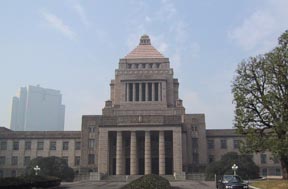 A Prime Minister governs Japan. Maybe you have been reading about him. He is not well liked here in Japan. Look for him to be removed from office in the next few weeks! There is also an Emperor who is the ceremonial head of Japan. He lives in Tokyo�s version of the White House, the Imperial Palace. Of course, security is tight around the Palace, so we could only get as close as the front gates. Actually, not quite the front gates. There is a giant moat surrounding the entire palace, but we could see the front gates from where our bus stopped. 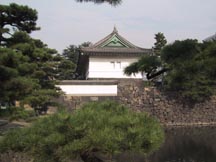 In the park around the moat was a grove of black pine trees. Like the crane, these trees are a symbol of longevity. They are planted here to bring long life to the Emperor. The city was built around the palace, so we are now in the center of Tokyo. Each time we returned to the bus, we were greeted by our Japanese hostess with "irrashaimase!" 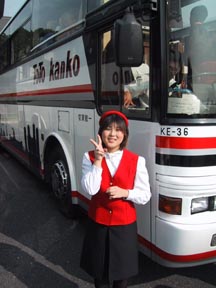 As the bus rode through different areas of Tokyo, our tour guide explained the different sections of the city. There was one business district that has a population of over 200,000 during the day, but only 72 in the evening! 900,000 people use Tokyo Station to travel by train into the city each day! Next stop, lunch. Hooray! (Remember that I didn�t eat breakfast and I was starting to get hungry.) Tempura for lunch today. Some of you may have tried tempura. It�s vegetables and seafood in a crusty batter. There were seven floors in this restaurant, each with seating for about 40 people. Our group climbed to the third floor, removed our shoes, walked on the tatami mats to our places at the low table. We sat on cushions and enjoyed a very delicious lunch. 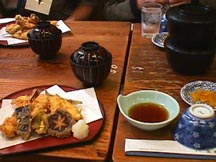 This restaurant was in the section of Tokyo known as Asakusa and after lunch we were off to explore the first of many temples, Sensoji Temple. We walked through the gate, under a giant lantern, 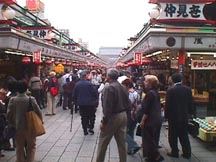 and found ourselves at the beginning of a long alley filled with small stores. They sold everything from samurai souvenirs to maneki-nekos. 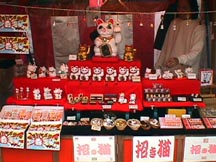 Do you remember this cat from our "Question of the Week"? No, I didn�t see any beetles for sale here. We wandered down a side alley and found a beautiful small garden with a statue of Buddha and another smaller statue with a red bib on. This was a "omizuko", which represents infants that died before they were born. Bibs and sometimes colorful caps and pinwheels are donated to console the spirits. At the end of the alley was the Temple. I looked around and found the spot where you donate money and receive your fortune. I put my 100 yen coin in the box, shook out a stick and tried to find the drawer that matched the markings on the stick. I opened the corresponding drawer and took out a paper with my fortune. It was a good one, so I did not have to tie it to the rack behind me. I will bring it home to show you. 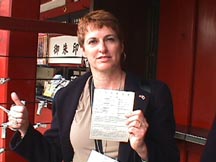 I bought a "temple book" that I will take to each shrine that I visit to get stamped. It was very fortunate that we visited the temple on a special Japanese holiday. It is called "Shichi-Go-San". I bet you can figure it out- "7-5-3". It is a day when parents bring their 7, 5, and 3 year old children to the temples to thank the gods for their children�s good health and growth. The children and sometimes the parents dress in kimono. They looked so cute, but they still acted like children! The sights and sounds of the temple area were fascinating- a great introduction to Japanese culture! That evening we had a banquet with many important government officials present. Mr. and Mrs. Sasaki returned and I had another lovely conversation with them. By the way, yesterday I asked you the question about the 17 hour time difference. The answer is: there is a 17 hour time difference in San Francisco because they are 3 hours behind Langhorne. So 14 hours plus 3 makes a 17 hour time difference. Sayonara! Rosen San |
|