A few final notes about the dive site

The site was named after Justin Menge (an Atlantic Underwater Club founder) in the early seventies.
The site lies within a marine reserve so the basic principle of conservation apply: No litter. Only take photo’s, leave only bubbles.
This site can play host to a rather dangerous surge. The Cape coast has a reputation of being a bit of a washing machine and the caves can throw you into a spin cycle. Dive within your capabilities and personal comfort zone. Offshore winds chop the sea up quickly and can make the return swim difficult so be sure to leave enough air in your tanks to be able to make a submerged return. The site is on the Atlantic side of the Cape Peninsula which is the colder side, sea temperature ranges from 7 to 14 º C so 5mm or 7mm thick wetsuits are recommended. Boats frequent this area so be wary of any surface craft. The best time of year to dive this site is in summer.
Local Decompression Chamber: SA Diving and Salvage on (021) 448-4341
Dr Jonathan Rosenthal specializes in dive related injuries, he can be reached on 082 859 1715.
Rescue Services phone number is (021) 448-4341.
Countrywide emergency phone number is 10111.
The closest phone to the dive site is across the road at Trinidad's.
33
° 58,90’ S; 18° 20,65’ E
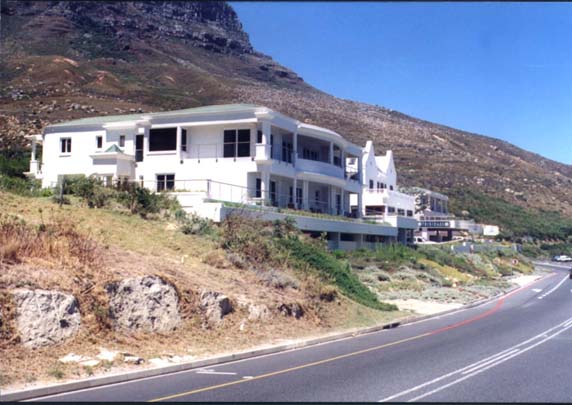
Take the coastal road from Camps Bay towards Hout Bay. About 4 km beyond the Camps Bay police station you will pass a Cape Dutch-style house called ‘Oudekraal House’ or ‘White House’ on the left. There is a new hotel called Trinidad's next to Oudekraal House that may serve as a better reference point for those of you who don't know Cape Town. (Hint: The lights of Oudekraal House are a useful visual reference when night diving in the area). Park on the shoulder inside the yellow lines opposite the cluster of big rocks jutting out to sea. The dive site is around the furtherest tall, round rock, straight out. (NB: always lock your car and keep any valuables out of plain sight, preferably locking them in the boot of the car).
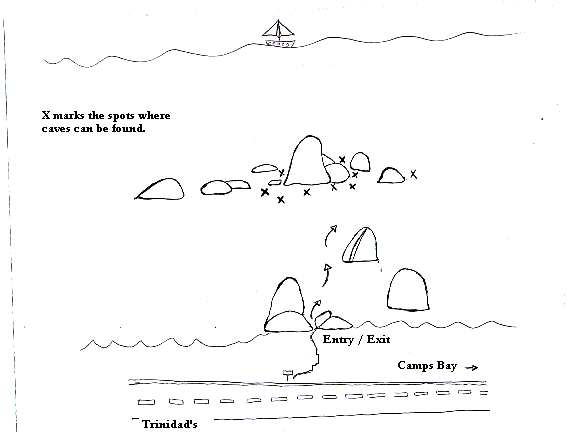
The footpath down to the dive site starts at a sign post warning against fires, litter, etc. Kit up on the road side then follow the footpath down towards the entry point, be careful as the hill is very steep and before you can get into the water you have to navigate yourself from rock to rock to get to the entry point. Watch out for loose rocks. You will want to enter at high tide for at low tide you will have to climb over the kelp for the first few meters. There is a rock just as you enter the water that is ideal to sit on while donning your fin's, mask, etc before proceeding further, once in the water the surge and kelp could make this difficult to do. The swim to the tall rock is about 150m. Please click of the image below to see larger, more detailed picture.

The caves are found at the bottom of the tall rock cluster. The average depth is 12 to 15m with a maximum depth of 18m. The dive site offers large underwater caverns and breathtaking swim-throughs. It is popular with both the novice and the experienced divers due to it being both a thrilling and a colourful dive. The marine growth on the ceiling and walls of the caverns make the site extremely beautiful, plus the sea life is abundant in the area. Both hard and soft coral are found here, along with nudibrachs, anemones and kelp. (See Marine Life). The actual number of caves is unknown, everyone will tell you a different figure. I have marked off a few that I know but I'll leave it up to you to explore and see how many you can find!
Click here to see an underwater map of the dive site!
You name it this site has it! Octopus,
Dolphins, Crabs, Jellyfish, Shyshark, Crayfish, to name a few. Rumour has it that there is an Electric Ray to be seen here, the best time to see him is at night.Other spotted sea life: Sandshark, Tiger Catshark, Striped Catfish, Leopard Catfish, Gully Shark, Houndshark, White Seacatfish, Hottentot, Blacktail, Red bait, Mussels, Urchins, Sea Cucumbers, Pipe Fish, Seahorses and Limpets.
Het Huis te Kraaiestein: 100 m swim. Average Depth 9m. This is a wreck of a Dutch East Indiaman that went down in 1698 on route to Holland. The wreck is not easy to find most of the ship is buried under sand, however 3 anchors and a dozen iron cannons can still be seen today.
Strawberry Rock: 350 m swim. Average depth 10m. Max 15m. More for the energetic and experienced diver. The site offers some interesting caves.
Geldkis: 330m swim. Average depth 12m. Max 16m. Much the same as Strawberry Rock.
A few final notes about the dive site: