33
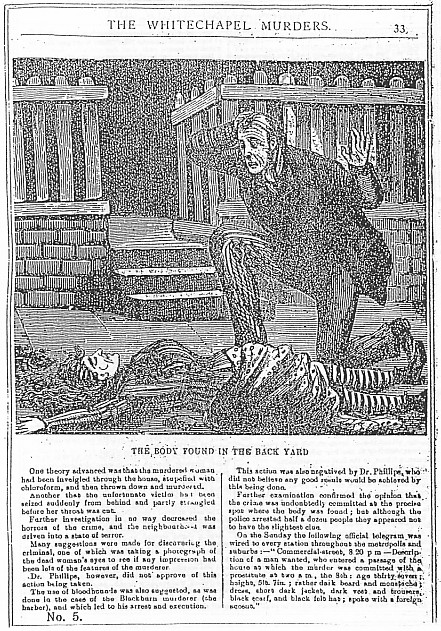
One theory advanced was that the murdered woman had been inveigled through the house, stupefied with chloroform, and then thrown down and murdered.
Another that the unfortunate victim had been seized suddenly from behind and partly strangled before her throat was cut.
Further investigation in no way decreased the horrors of the crime, and the neighbourhood was driven into a state of terror.
Many suggestions were made for discovering the criminal, one of which was taking a photograph of the dead woman�s eyes to see if any impression had been left of the features of the murderer.
Dr. Phillips, however, did not approve of this action being taken.
The use of bloodhounds was also suggested, as was done in the case of the Blackburn murderer (the barber), and which led to his arrest and execution.
This action was also negatived by Dr. Phillips, who did not believe any good result would be achieved by this being done.
Further examination confirmed the opinion that the crime was undoubtedly committed at the precise spot where the body was found; but although the police arrested half a dozen people they appeared not to have the slightest clue.
On the Sunday the following official telegram was wired to every station throughout the metropolis and suburbs:�"Commercial-street, 8.20 p.m.�Description of a man wanted, who entered a passage of a house at which the murder was committed with a prostitute at two a.m., the 8th; age thirty-seven; height, 5ft. 7in.; rather dark beard and moustache; dress, short dark jacket, dark vest and trousers, black scarf, and black felt hat; spoke with a foreign accent.
34
In the course of Saturday night and Sunday morning the police arrested two men on suspicion of being concerned in the latest crime. One man was found by an officer in Buck�s-row shortly after one o�clock in the morning. The man appeared to be hiding in the street, and when accosted by the officer rushed off at the top of his speed.
An alarm was raised, and after a sharp race the man was arrested. He was a villainous-looking fellow with long hair and shaggy beard, dressed only in a pair of ragged blue serge trousers, and an old dirty shirt. He resisted his captors, but was eventually secured and conveyed to Bethnal-green Police-station. It was said at the time that he was carrying a long knife concealed in the sleeve of his shirt, but on examination no weapon was found upon him.
He gave an account of himself when questioned, which was, in the first instance, considered unsatisfactory, but inquiries were immediately set on foot, and in the result the man, who appeared be a common vagrant, was released from custody.
The second arrest was effected in Gloucester-street, where a man, aged about forty, having the look of a seafarer, was arrested. It was pretty obvious, however, from the replies which he gave and his general appearance, that he was not the man sought for, and after he had spent some time in Commercial-street station he was also set at liberty.
A man was arrested at Debtford during Sunday afternoon, but subsequently released. In the course of Monday quite a number of persons were taken up and conducted to the station-houses, attended by clamouring crowds.
The police, however, found in most instances that the captives were decent people, totally unconnected with the crimes of which they were suspected, and able to give entirely satisfactory accounts of themselves.
Very early on Monday the popular excitement in Whitechapel was suddenly sent up to fever heat by the announcement that the man "Leather Apron," accused everywhere, directly or by implication, of the whole series of murders, had been arrested.
The suspect proved to be one John Piser, a boot finisher by trade, living at 22, Mulberry-street, and described and known as an inoffensive and fairly industrious working man.
Piser took his arrest very quietly, and accompanied the detective without saying a word to Leman-street Police-station, where he was detained for many hours.
Several persons who were said to be personally acquainted with "Leather Apron" were afforded the opportunity of examining carefully the features of Piser, but all failed to identify him with that missing desperado.
Meanwhile the police had examined the inmates of 22, Mulberry-street, and had searched the premises from top to bottom, but the only instruments found capable of being used as lethal weapons were some finishing tools used by Piser in his business
Suspicion against him was, however, sufficiently strong for the police to keep him in custody.
On Tuesday morning information was received, making, according a police, a case of suspicion against Piser.
It appears that on the morning of the murder of the woman Chapman a man was in Hanbury-street, and noticed a woman in the company of two men. They appeared to be quarrelling, and he heard the men make use of threats.
Such an incident, however, is a very common one in the district, and the man, after a good look at the disputants, passed on his way.
On Tuesday the man was requested to attend at Leman-street police-station, and on his arrival there, about one o�clock, some twenty men, mostly brought in from the adjacent thoroughfare, were paraded before him. The result somewhat startled the police, for the man without a moment�s hesitation pointed to John Piser as the man whom he heard threatening a woman in Hanbury-street on the morning of the murder.
Piser calmly protested that the man was entirely mistaken, but he was put back to the cells and more closely watched. The police during the afternoon and evening made careful inquiries into the statements made by the man who professed to identify Piser.
The manner of this man, who is apparently of Spanish blood, and displayed a blue ribbon on his coat, did not inspire much confidence in his veracity, and he was severely cross-examined by a sort of informal tribunal, consisting of experienced detective officers.
The witness added to his first statement that he not only saw the prisoner in Hanbury-street on the morning of the murder, but that he actually took him by the collar when he was about to strike the woman, but, further questioned, several times contradicted himself.
Piser�s relatives became highly indignant at his prolonged detention. His brother, in the course of an interview with a representative of the press, repeated with much emphasis that Piser did not leave the house between the Thursday and the day of his apprehension.
He took care not to do so because he had been subjected to much annoyance by being followed by women and others, who persisted in calling him "Leather Apron."
Piser, he added, is physically a very weak man, and for that reason, does not keep at work very closely. He is infirm, and has been under hospital treatment on and off for a long time past.
Each time the police searched Piser�s lodgings they found no trace of blood-stained clothes, or, indeed, anything of a suspicious character, but they carried off five knives, which were at once subjected to chemical analysis.
All are of the class used in the leather-currying trade, having blades about six inches in length, with stout handles, sometimes notched in a peculiar way.
There was, to all appearance, no blood either on the blades or the handles; but on some of the blades there were marks apparently caused by rust. This was particularly noticeable in respect of a formidable-looking curved knife, which had been sharpened recently. The chemical examination of these knives resulted in an announcement that none of the marks upon the weapons were bloodstains, and about eight o�clock on Tuesday evening Piser was set at liberty, the police never having entered a charge against him.
The next man taken up was a supposed suspicious character at Gravesend. The man was arrested on Sunday night by Police-constable Vellensworth "on information received" in the Pope�s Head tavern in that town.
He gave the name of William Henry Pigott, and seemed to be about forty years of age.
He was in a very dirty state, which he explained was due to his having tramped from London.
Upon his clothing were many stains, apparently of blood, and his shirt was torn and dirty.
35
The forefinger of his left hand was badly wounded, and he had other suspicious marks upon him.
On being pressed Pigott showed considerable trepidation, and trembled constantly, either from fear or from the effects of drink.
He admitted that he was in Whitechapel on the Saturday morning not far from the scene of the murder, and that he had an altercation with a woman, in the course of which his finger was bitten.
Detective-inspector Abberline, of Scotland-yard, proceeded to Gravesend, and, on seeing the prisoner, was struck with his resemblance to the man who entered the Prince Albert public-house in Whitechapel on Saturday morning in company, it is stated, with the murdered woman, and of whom a description had been issued by the police, on information supplied by Mrs. Fiddymont, the landlady.
Pigott was removed under police escort to London, and not long after his arrival it was ascertained practically beyond doubt that he slept at a common lodging-house in Whitechapel on the Friday, a circumstance which greatly raised the hopes of the police.
Pigott�s condition did not improve during the journey from Gravesend, and when he arrived in custody of Inspector Abberline at Commercial-street Police-station, he was in a state of mind closely resembling that of a man recovering from delirium tremens. He had assumed a sullen demeanour, and absolutely refused to speak a word to anybody. The first official to examine the prisoner was Dr. Phillips, the divisional police-surgeon.
The stains on the man�s clothing were closely investigated by means of the microscope, and pronounced to be blood.
His boots were taken off and subjected to a minute examination, with the result that they also were declared to be stained with blood, the traces of which the long tramp from London to Gravesend had failed to efface.
At a quarter-past two the prisoner was placed among a number of other men, and Mrs. Fiddymont and other witnesses who had noticed the mysterious customer at the Prince Albert tavern were called in, and one after another they inspected the row of men that were drawn up before them.
To the great disappointment of the police, not one of the witnesses were able to identify Pigott as the man wanted, and the authorities were for the moment at a loss to know what to do with their prisoner, whom they once more handed over to Dr. Phillips.
That gentleman, as the result of further inquiry and examination, arrived at the conclusion that Pigott was not in his right mind, and gave a certificate to that effect.
Armed with this document, the police removed the man to the lunatic ward at the workhouse, instituting a careful watch on his movements and keeping him practically in custody.
CHAPTER XVI.
A DOZEN PERSONS ARRESTED�EDWARD STANLEY, THE PENSIONER, TURNS UP.
DURING nearly the whole of Monday Mrs. Fiddymont and other witnesses were driven from one police-station to another, in the hope that they might identify the prisoners. But in almost every case the arrest was made simply on suspicion, and inquiry only resulted in the release of the prisoner. The arrests came chiefly from common lodging-houses and such like places.
But not one of the arrests to gave any real clue to the murder and the excitement grew greater and greater in all classes.
That the excitement was not confined to one grade of society will be proved by the fact that two prominent members of the peerage were in Whitechapel on Monday, and visited the scene of the last tragedy.
During Saturday afternoon the occupants of the house adjoining the scene of the murder charged an admission fee of one penny to people anxious to view the spot where the body was found.
Several hundreds of people availed themselves of the opportunity. In order to prevent a repetition of this, five policemen guarded the scene of the crime in Hanbury-street on Sunday.
No one was admitted unless he resided in the house. In the street half a dozen costermongers took up their stand and did a brisk business in fruit and refreshments.
Thousands of respectably-dressed persons visited the scene, and occasionally the road became so crowded that the constables had to clear it by making series of raids upon the spectators.
The windows of the adjoining houses were full of persons watching the crowd below.
A number of people also visited the house in Dorset-street where the murdered women lodged. In the course of Sunday nearly a dozen persons were arrested for rioting, and conveyed to the Commercial-street police-station.
What was at the time thought an important discovery, throwing considerable light upon the movements of the murderer immediately after the committal of the crime, was made on Tuesday afternoon.
Describing this a correspondent said: A girl happened to be walking in the garden or yard of the house, 25, Hanbury-street, the next house but one to the scene of the murder, when her attention was attracted to peculiar marks on the wall and on the garden path.
She communicated the discovery to Detective-inspector Chandler, who had just called at the house in order to make a plan of the back premises of the three houses for the use of the coroner at the inquest, on its resumption on Wednesday.
The whole of the yard was then carefully examined, with the result that a bloody trail was found distinctly marked for a distance of some five or six feet in the direction of the back door or the house.
Further investigation left no doubt that the trail was that of the murderer, who, it was evident, after finishing his sanguinary work, had passed through or over the dividing fence between Nos. 29 and 27, and thus into the garden of No. 25.
On the wall of the last house there was found curious mark, between a smear and a sprinkle, which had probably been made by the murderer, who, alarmed by the blood-soaked state of his coat, took off that garment and knocked it against the wall.
On Wednesday the supposed bloodstains upon the wall of 25, Hanbury-street, were closely examined by the divisional police-surgeon and the officers engaged in the case and the opinion was then formed that they were some kind of sewage deposit.
The colour was such as to mislead any but the eye of an expert. Renewed investigation showed that similar discolouration was apparent on the other side of the wall, proceeding from the same cause, apparently; and this fact taken in conjunction with the medical opinion, was held to render a chemical analysis unnecessary.
36
In respect to the pieces of newspaper discovered in Bayley�s yard on Tuesday afternoon, where they had been, it was supposed, thrown by the murderer, who had first wiped his hands upon them when standing in the yard of 25, Hanbury-street, it has been alleged that they been subjected to analysis, and the stains upon them proved to be those of human blood.
The pensioner, Edward Stanley, whose name had been frequently mentioned in connection with the murdered woman Chapman, on Friday night attended at the Commercial-street police-station, and made a statement, which was taken down by Inspector Helson. He gave the police a full account of his whereabouts since he last saw the deceased woman, which was on the Sunday preceding the murder. Since then he had been following his usual employment, and had taken no steps to conceal his movements.
The man is described as forty-seven years of age, and superior to the ordinary run of those who frequent the lodging-houses of Spitalfields. He states that he has known Chapman for about two years, and denies that she was of a quarrelsome disposition. So far as he is aware, there was no man with whom she was on bad terms, or who would have any reason for seeking her life.
On Friday morning a telegram was received from the police at Brentford, stating that a pensioner there answered the description of Stanley, and a detective was at once despatched to make inquiries. When, however, the real Stanley had appeared further investigation was abandoned.
Mr. S. Montague, M.P. for Whitechapel, has offered �100 as a reward for the capture of the murderer, and has asked Superintendent Arnold to issue notices to that effect.
On Tuesday morning posters were pasted up all over Whitechapel, offering a reward in these terms:� "Finding that, in spite of murders being committed in our midst, our police force are still inadequate to discover the author or authors of the late atrocities, we, the undersigned, have formed ourselves into a committee, and intend offering a substantial reward to anyone, citizen or otherwise, who shall give such information that will bring the murderer or murderers, to justice."
A reward of �100 was also offered by the proprietor of the Illustrated Police News.
The Jews also announced their intention of offering a reward.
CHAPTER XVII.
THE INQUEST.
THE terrible excitement culminated on the day of the inquest.
Though little that was new could be expected, yet men, and women too, gloated over the rehearsing of the hideous details.
The actual crowd round the Working Lads� Institute, Whitechapel-road, was but small. The great interest was centred round the mortuary.
When the jury went to view the body and the clothes, which they did with marvellous celerity, as if glad to have it over, the excitement was great.
In no country but those of the Anglo Saxon race is the institution called the coroner a cours known. In France the duty of inquiring into the causes of death, when there is suspicion, is transferred to a particular judge called juge d�instruction.
The coroner is the oldest of all judges.
The first Act of Parliament in the statute-book is that appointing a coroner.
It speaks highly for the wisdom of our ancestor. Many a foul crime would remain unknown and unpunished but for this institution.
Upon Mr. Wynne E. Baxter, coroner for South-east Middlesex, devolved the unpleasant duty.
The first witness called was the old man who found the body.
He said his name was John Davis, and he had lived at 29, Hanbury-street, Spitalfields, for rather more than a fortnight. He occupied, with his wife and three sons, one room on the top floor at the front. They all lived together, but the room was a large one.
On Friday night he went to bed at eight o�clock, and his wife followed him about half an hour later. His sons came home at different times, the last at about a quarter to eleven.
The window of the room was not open. He awoke at three o�clock on Saturday morning, and remained awake till five, when he fell asleep till he heard quarter to six strike by a neighbouring clock. Then he got up with his wife, who made him a cup of tea. After drinking it he went downstairs and into the back yard. The house was three storeys high.
The front door in Hanbury-street opened into a passage, which ran right through into the back yard. There was a back door opening into the yard, and he did not believe that either of the doors could be locked..
He had seen no lock on them, and had never known them to be fastened. Anyone who knew where the latch of the front door was could open it, and go along the passage into the back yard. When he went into the yard on Saturday morning the back door was shut.
Coroner: Before we go any further will you describe the yard?
Witness: It is a biggish yard. Facing me on the opposite side of the yard, but to the left, was the shed in which Mrs. Richardson, who occupies part of the house, keeps her wood. On both sides are close wooden fences, about five feet six inches high, separating the yard from others on each side.
Between the steps and the fence, on the left-hand side, is a recess about three feet six inches wide. As soon as I opened the back door I saw a woman lying in the corner. She was flat on her back, with her head towards the house, but not touching it. Her clothes were disarranged. I did not touch her.
I did not even go down the steps, but went back to the front door and called two men who work for Mr. Bailey, packing-case maker, Hanbury-street. I don�t know their names, although I know them sight.
Coroner: Did these men come to you when you called them?
Witness: Yes. They were waiting outside the shop to commence work. They came along the passage and saw the sight without going into the yard.
Then they ran to find a policeman. We left the house together, and I went to Commercial-street police-station to report the case. I did not inform anyone in the house of what I had discovered.
The inspector at the station sent two men off at once. After a while I went back to Hanbury-street, but did not go into the house again. Constables were there then.
I had never seen the deceased before. I was not the first that got up in the house that morning,
37
because there is a man called Thompson who goes to his work about half-past three.
I have never seen women in the lobby of the house, but Mrs. Richardson says they frequently come in. I heard no noise about the place on Friday night or Saturday morning. I returned to the house again about three o�clock on Saturday afternoon, after leaving off work.
Mrs. Amelia Palmer deposed that she lived at 30, Dorset-street, Spitalfields�a common lodging-house. Her husband was a pensioner, and she went out charing for Jews.
She had seen the body and it was that of Ann Chapman . She had known her for five years. Her husband had been dead eighteen months; but she had lived apart from him for years.
She resided in various places, principally in common lodging-houses, in the neighbourhood of Spitalfields, but for some time she lived with witness when the husband of the latter was in work.
I about two years ago she lodged at 30, Dorset-street with a man who made wire sieves. At that time she was receiving 10s. per week from her husband.
It always came by P.O.O. to Commercial-road, but the payments stopped about eighteen months ago, and the deceased then found that her husband was dead. When she told the witness she cried.
After living with the man that made sieves she was called "Sievey." The witness last saw the sievemaker twelve or eighteen months ago.
He had left the deceased, and said he had gone to live at Notting-Hill. She last saw the deceased on Friday afternoon, about four o�clock. She had seen her previously on Monday and Tuesday.
On Friday afternoon the deceased was standing opposite the lodging-house, 35, Dorset-street. She had no bonnett or jacket on, and said she felt very ill. Her right eye was black, and the witness said, "How did you get that black eye?" Instead of answering directly the deceased said, "Look at my chest," and she showed a bruise there.
Both bruises had been done by another woman, who, like the deceased, was acquainted with a man called "Harry the Hawker."
The deceased told the witness that an Saturday, September 1st, she was with a man named Ted Stanley, a very respectable person, in a beershop at the corner of Dorset-street and Commercial-street.
"Harry the Hawker" was also there. He was under the influence of drink. He put down a two-shilling piece to pay for some beer, and the woman already alluded to picked it up and put down a penny.
"Harry the Hawker" accused the woman of taking the two shillings, and she had some ill felling against the deceased because she believed that it was she that had told "Harry the Hawker" about the two shillings.
The same evening she met the deceased, and inflicted the bruises on her that the witness had seen.
On Tuesday the witness met the deceased walking near Spitalfields Church. She said she felt "queer," and should go into the casual ward to pull herself round. She was looking very pale.
She had had nothing to eat that day. The witness said, "Well, I�m not doing very well; but here is twopence. Get yourself some tea, but don�t take any rum." The witness had seen her the worse for drink many times. She used to do crochet work, make antimacassars, and sell flowers.
She was not at all particular how she earned her living. She was often out late. On Friday she went to Sratford to sell anything she had. She did not see her from Tuesday till the Friday, about five o�clock in the afternoon, in Dorset-street.
She appeared perfectly sober. The witness said, "Are not you going to Stratford to-day?" and the deceased replied, "I feel too ill to do anything."
Ten minutes afterwards she found the deceased still standing in the same place. She said, "It is of no use giving way. I must pull myself together and get some money, or I shall have no lodgings." She added that she had been in the casual ward. That was the last that the witness saw of her alive.
She was a very straightforward woman when sober, and a very industrious, clever little woman in crochet and things of that kind.
Although often the worse for drink, the witness did not think she could take much. She had been living a very irregular life during the whole five years she had known her. Since the death of her husband she seemed to have given way altogether. Her mother and a sister lived in Brompton, but they were not on friendly terms with her.
On Monday, however, she said, "If my sister sends me the boots, I will go hopping." She had two children, a boy and a girl.
The next witness called was Timothy Donovan, the deputy at the common lodging-house, 35, Dorset-street, Spitalfields. For the last four months the deceased lodged there, except that she was not there the previous week till Friday afternoon about two or three o�clock. He heard afterwards that she had been in the casual ward.
She was not at his place the last week until Friday afternoon about two or three o�clock. She asked him if she could go into the kitchen.
The deceased went down to the kitchen, and he did not see her again till half-past one or a quarter to two on Saturday morning, when he saw her come in at the front door and go down-stairs again.
His sent to ask her about the bed. She came up, eating potatoes, and said, "I have not sufficient money. Don�t let it, Tim. I shan�t be long before I am in again." The money required was eightpence for the night.
When she left the house to get the money it was just before two o�clock.
The next time he saw her was in the mortuary, dead. She had had enough to drink on Saturday morning, but could walk straight. He remarked to her that she could find money for beer, but not for her bed. Her reply was that "she had only been to the top of the street."
There was a public-house there called The Ringers. The deceased did not say whether anybody had given her the drink, and he did not see her with any man that night.
She had been in the habit of bringing a pensioner, whose name the witness did not know, to the lodging-house on Saturdays.
At other times she had brought other men to whom he had refused admittance, the pensioner having told him not to let her in with any other men.
He did not see her with any man last week. The pensioner and the deceased were together at the lodging-house on Sunday September 2nd.
He was about forty-five year old, of rather dark complexion, and about 5ft. 6in or 5ft. 8in. high.
Sometimes he was dressed like a dock labourer, and at other times he had a gentlemanly appearance.
38
The deceased was always on very good terms with the other lodgers, and the witness never had any trouble with her.
Last week but one, however, she had a bit of a "row" with another woman in the kitchen. That was when she got the "clout." He had not heard of the witness having any other "row."
John Evans, the night watchman at the common lodging-house, said that on Saturday morning last, about two, he saw the deceased leave the house and go into Freshfield-street, where she turned towards Whitechapel.
He had no idea anything was wrong, and watched her from curiosity only.
He had heard her say that night that she had been to her sister at Vauxhall.
When she left the house she said that she had not enough money for her lodgings, but would go and get some. With the exception of the pensioner, the witness did not know any man that she associated with. He was not acquainted with the pensioner�s name or address.
On Saturday morning he called and asked for the deceased, and when witness told him she had been murdered he went straight out of the house without saying a word.
The witness had never heard any man threaten her, and never knew her to express fear of anyone. She was always sociable and quiet.
There were many women in the lodging-house, but he did not know that any of them had ever been threatened or asked for money by strangers.
Mr. Fontain Smith, printer�s warehouseman, said the murdered woman was his sister Annie, the widow of John Chapman, who lived at Windsor, a coachman. She had been separated from her husband for about three years. Her age was forty-seven. He last saw her alive a fortnight ago, in Commercial-street, where he met her promiscuously. Her husband died at Christmas, 1836. He gave her 2s.; she did not say where she was living nor what she was doing. She said she wanted the money for a lodging.
Amelia Richardson, 29. Hanbury-street, deposed that she was a widow, and occupied half of the house�i.e., the first floor, ground floor, and workshops in the cellar. She carried on the business of a packing-case maker there, and the shops were used by her son John, aged thirty-seven, and a man Francis Tyler, who had worked for her eighteen years. The latter ought to have come at six a.m., but he did not arrive until eight o�clock, when she sent for him. He was often late when they were slack. Her son lived in John-street, Spitalfields, and worked also in the market on market mornings.
At six a.m. her grandson, Thomas Richardson, aged fourteen, who lived with her, got up. She sent him down to see what was the matter, as there was so much noise in the passage. He came back and said, "Oh, grandmother, there is a woman murdered!" She went down immediately, and saw the body of the deceased lying in the yard. There was no one there at the time, but there were people in the passage. Soon afterwards a constable came and took possession of the place. As far as she knew the officer was the first to enter the yard.
She occupied the first-floor front, and her grandson slept in the same room on Friday night. She went to bed about half-past nine, and was very wakeful half the night. She was awake at three a.m., and only dozed after that.
Did you hear any noise during the night? No.
The first-floor back was occupied by Mr. Waker, a maker of lawn-tennis boots. He was an old gentleman, and slept there with his son, twenty-seven years of age. The son was weak-minded and inoffensive. On the ground floor there were two rooms. Mrs. Hardiman occupied them with her son, aged sixteen.
She used the front room as a cats�-meat-store. The front and back doors were always left open, but she heard no sounds that night.
John Piser was then called. We give his evidence in extenso. He said: I live at 22, Mulberry-street, Commercial-road, East. I am a shoemaker.
Are you known by the nickname of "Leather Apron"? Yes, sir.
Where were you on Friday night last? I was at 22, Mulberry-street. On Thursday, the 6th inst., I arrived there.
From where? From the West End of town.
Coroner: I am afraid we shall have to have a better address than that presently. What time did you reach 22, Mulberry-street? Shortly before eleven p.m.
Who lives at 22, Mulberry-street? My brother and sister-in-law and my stepmother. I remained indoors there.
Until when? Until I was arrested by Sergeant Thicke, on Monday last, at nine a.m.
You say you never left the house during that time? I never left the house.
Why were you remaining indoors? Because my brother advised me.
You were the object of suspicion? I was the object of a false suspicion.
You remained on the advice of your friends? Yes; I am telling you what I did.
Coroner: It was not the best advice that you could have had. You have been released, and are not now in custody? I am not. I wish to vindicate my character to the world at large.
Coroner: I have called you in your own interests, partly with the object of giving you an opportunity of doing so. Can you tell us where you were on Thursday, August 30th? Witness (after considering): In the Holloway-road.
You had better say exactly where you were. It is important to account for your time from that Thursday to the Friday morning. What time, may I ask?
Coroner: It was the week before you came to Mulberry-street. I was staying at a common lodging-house, called the Round House, in the Holloway-road
Did you sleep the night there? Yes.
At what time did you go in? On the night of the London Dock fire I went in about two or a quarter past. It was on the Friday morning.
When did you leave the lodging-house? At eleven a.m. on the same day. I saw on the placards, "Another Horrible Murder."
Where were you before two o�clock on Friday morning? At eleven p.m. on Thursday I had my supper at the Round House.
Did you go out? Yes, as far as the Seven Sisters-road, and then returned towards Highgate, down the Holloway-road. Turning, I saw the reflection of a fire. Coming as far as the church in the Holloway-road I saw two constables and the lodging-house keeper talking together. There might have been one or two constables, I cannot say which. I asked a constable where the fire was, and he said it was a long way off. I asked him where he thought it was, and he replied, "Down by the Albert Docks." It was then about half-past one, to the best of my recollection. I
39
went as far as Highbury Railway Station on the same side of the way, returned, and then went into the lodging-house.
Did anyone speak to you about being so late? No; I paid the night-watchman. I asked him if my bed was let, and he said "They are let by eleven o�clock. You don�t think they are to let to this hour." I paid him 4d. for another bed. I stayed up smoking on the form of the kitchen, on the right-hand side near the fire-place, and then went to bed.
You got up at eleven o�clock? Yes. The day man came and told us to get up, as he wanted to make the bed. I got up and dressed, and went down into the kitchen.
In there anything else you want to say? Nothing.
When you said the West-end of town did you mean Holloway? No; another lodging-house in Peter-street, Westminster.
Coroner: It is only fair to say that the witness�s statements can be corroborated.
William Thicke, detective-sergeant, deposed: Knowing that "Leather Apron" was suspected of being concerned in the murder, on Monday morning I arrested Piser at 22, Mulberry-street. I have known him by the name of "Leather Apron" for many years.
When people in the neighbourhood speak of "Leather Apron" do they mean Piser? They do.
He has been released from custody? He was released last night at half-past nine.
John Richardson, (recalled) produced the knife�a much-worn dessert-knife�with which he had cut his boot. He added that as it was not sharp enough he had borrowed another one at the market.
By the Jury: My mother has heard me speak of people having been in the house. She has heard them herself.
Coroner: I think we will detain this knife for the present.
Henry John Holland, a boxmaker, stated: As I was passing 29, Hanbury-street, on my way to work in Chiswell-street, at about eight minutes past six on Saturday, I spoke to two of Bayley�s men.
An elderly man came out of the house, and asked us to have a look in his back yard. I went through the passage and saw the deceased lying in the yard by the back door. I did not touch the body.
I then went for a policeman in Spitalfields-market. The officer told me he could not come. I went outside and could find no constable. Going back to the house I saw an inspector run up with a young man, at about twenty minutes past six o�clock.
I had told the first policeman that it was a similar case to Buck�s-row, and he referred me to two policemen outside the market, but I could not find them.
I afterwards complained of the policeman�s conduct to the Commercial-street Police-station the same afternoon.
Coroner: There does not seem to have been much delay. The inspector says there are certain spots where constables are stationed with instructions not to leave them. Their duty is to send someone else.
Foreman of the Jury: That is the explanation.
Coroner: The doctor will be here first thing to-morrow.
The doctor was examined at very great length on the following day.
Further evidence having been given the inquest was adjourned.
But in the meantime a tragedy of a more appalling character was enacted.
CHAPTER XVIII.
FRESH TERROR.
WHILE the town was still talking of the first mysterious murders it was doomed to receive another fright which seems to surpass anything that ever occurred in the history of foul and hideous murder.
On this occasion two victims appear to have fallen before the merciless wretch who, there is at least presumptive evidence, has been alone concerned in the previous outrages.
It may be well to state at once, however, that the police have no evidence of any kind actually establishing it as a fact that the two murders, discovered in the dead of the night between Saturday and Sunday, were committed by the same hand.
It is just within the bounds of possibility that the two deeds may have been done by different persons, and that their happening within an hour in point of time, and within a distance of about a mile of each other, may be mere coincidences.
But from the fact of the two cases, as well as from what has gone before, it will be perceived that the presumption is almost overwhelming in favour of the supposition that the two are connected, and that these and the previous murders are the work of the same inhuman creature.
The facts that have thus far been established are, as in the previous cases, in one sense meagre in the extreme.
The first of the two murders in point of time took place in Berner-street, a narrow, badly-lighted but tolerably respectable street, turning out of the Commercial-road, a short distance down on the right-hand side going from Aldgate.
It is a street mainly consisting of small houses, but which has lately been brightened and embellished by one of the fine new buildings of the London School Board.
Just opposite this is an "International and Educational Club," domiciled in a private house, standing at the corner of a gateway leading into a yard in which are small manufacturing premises and four small houses occupied by Jewish families. The yard gates are usually closed at night, a wicket affording admission to the lodgers and others residing in the houses.
Friday or Saturday, however, brought round the close of the Jewish holiday season, and down to this part of London, where the people are largely composed of foreign Jews, some departure from regular habits was more or less general.
The International and Educational Club was on Saturday evening winding up the holidays by a lecture on "Judaism and Socialism."
A discussion followed, which carried on proceedings to about half-past twelve, and then followed a sing-song and a general jollification, accompanied, as the neighbours say, by a noise that would effectually have prevented any cries for help being heard by those around.
The hilarious mirth, however, was brought to a sudden and a dreadful stop.
The steward of the club, who lives in one of the small houses in the yard, and had been out with some sort of a market cart, returned home just before one.
He turned into the gateway, when he observed some object lying in his way under the wall of the club, and, without getting down, first prodded it with his whip. Unable to see clearly what it was he struck a match, and found it was a woman.
40
He thought at first she was drunk, and went into the club.
Some of the members went out with him and struck another light, and were horrified to find the woman�s head nearly severed from her body and blood streaming down the gutter.
The police were summoned, and, amid the intense excitement of the few who were out and about at this unhallowed hour, the poor creature was borne to St. George�s dead-house.
That is really all that is known of the matter up to a late hour, when the body of the murdered woman was identified as that of a woman who had been living in a common lodging-house in Flower and Dean-street, and had been in the habit of frequenting this neighbourhood, where it appears she was familiarly known as Long Lizzie.
It subsequently became known that her name was Elizabeth Stride. She has a sister living somewhere in Holborn, and her husband, from whom she has been separated some years, is said to be living at Bath.
Anything beyond this the police said they had been unable to discover. As to the circumstances under which the murder was committed, or the motive for it, they are entirely conjectural, and not the faintest clue to the murderer has been discovered.
The body when found was quite warm. In one hand was clutched a box of sweets, and at her breast were pinned two dahlias; she was respectably dressed for her class, and appeared to be about thirty-five years of age, about five feet five inches in height, and of dark complexion.
The theory at the police is, and it is generally endorsed by those who have inquired into the matter on the spot, that precisely the same thing was attempted as in the case of the Hanbury-street murder, and that but for interruption the same ghastly mutilation would have been perpetrated as before.
In some way, however the fiendish assailant was disturbed, as it is assumed the same individual was disturbed in Buck�s-row.
It is supposed that finding he had not time to complete what he had intended without running the risk of capture, he left his victim very possibly, as it would seem, with little or none of her blood upon him.
He may simply have seized her by the pink scarf around her neck, pulled her head hard, and given one horrible gash across the throat from behind, severing the windpipe and thus at once putting it out of the power of his victim to cry for help, though, as we have seen, even though she had cried out, it is quite possible that no one could have heard it.
All this, however, is mere speculation.
It is announced by the police that in all probability the wretch was disturbed in his work, and made off in the direction of the City with his ghoulish thirst for blood still blazing within him; that he beguiled another hapless victim into a dark secluded spot, and then again fell to his butchery.
It is certain, at least, that within a time just about sufficient to cover the distance in the leisurely manner necessary for the inveiglement of another victim, another victim was found�this time not only with the throat cut, but with the face slashed and the bowels frightfully ripped, apparently by two desparate strokes of a strong stout blade.
There had been, apparently, one frightful stab in the breast and a one downwards, and there had been another gash from below upwards.
There seems, in the opinion of the police, reason to believe that in this case the throat was cut as the woman lay upon the ground, the flow of the blood from each side of the neck seeming to indicate that she had died without movement after the cut across the neck, though the part of the face here so slashed�the nose being nearly cut off and a wound having been received under one eye�is thought to show that the unfortunate woman had some premonition of her assailant�s purpose and made a struggle for it.
Struggles, however, were in vain, and so must have been any shriek for help, for the murderer had again selected his spot with a cunning and astuteness that are in themselves among the most bewildering features of these mysterious crimes.
If the East of London had been searched for a spot in which to do such a deed, it would have been difficult to find one better adapted. Between Mitre-street and Duke-street, Aldgate, there is an exceedingly dull, badly lighted square, having, however, three ways out of it. There is an open way into Mitre-street, a long narrow passage leading into Duke-street, and a third leading out into St. James�s-street. By either of these, therefore, the assassin could have made his exit had he been again disturbed.
The spot, though close to Aldgate main thoroughfare, and lying between two streets busy enough at times, would any morning between one and two, of course, be quiet enough.
Duke-street has long been known as the Jews� fruit market, but the property all round has long been undergoing change, and warehouses have taken the place of residences or small shops.
This particular square is as dull and lonely a spot as can be found anywhere in London, and it was up in a dark corner of this gloomy retreat that at about a quarter to two a constable of the City Police who should have patrolled the spot, and, as he affirms, did so not more than twenty minutes previously, found the murdered woman.
The face was gashed, her hair matted in the blood that flooded the pavement, her clothes were thrown up over the body, and the body itself mutilated as we have described.
This was the dreadful sight that the constable flashed his lantern upon, and once more it is distressing to have to write that that flood of light revealed pretty nearly everything that is positively known upon the subject.
Whether the monster this time finished the business he set about, or whether again he was disturbed and fled before he had completed his butchery could only be conjectured.
He has left no trace, nobody appears to have caught even momentary sight of him, and whether he had this time committed the same mutilation of the unhappy woman could be known only when the results of the post-mortem examination had been made public.
So far, however, as the rough examination of the police then enabled them to judge, this had not been attempted.
It was a case of butchery, inhuman beyond the power of words to express, and absolutely purposeless.
It will be observed that this time the City police have had devolved upon them the principal share in the responsibility for the discovery of the criminal, the crime having been committed within their precincts.