25
"But I am to go?" said Mabel, her eyes sparkling with delight.
"Oh, yes."
"There is no doubt about that?" queried Mabel of the French schoolmistress.
"None," said Madame Landry, drily.
Madame was satisfied, inasmuch as she had received the money that was due to her; but she thought she had been over hasty in saying that the girl should not stop, and feared she might not return.
"You will come back in two months; will you not, dear?" she exclaimed in French. "I can give you that time, but no longer."
"That depends upon my father," answered Mabel.
"Would you not be glad be come back to me?"
"I cannot say it would realise my idea of happi-
26
ness," replied Mabel, who could not resist the temptation of saying something unpleasant to the schoolmistress.
"What ingratitude, after my kindness to you!" the other said.
"Put your money in your pocket," said Mrs. Baker.
"I do not want it all. Take what you like of it, dear Mrs. Baker," replied Mabel.
"Heaven forbid that I should touch a halfpenny of it," answered Mrs. Baker. "No, no; I have received favours from your father in the past, and he has seen that I shall not want in my old age."
"Shall I take care of it for you," inquired Madame Landry, with an insinuating smile.
Mabel hesitated.
Mrs. Baker put an end to the conversation by placing it in her pocket, saying, coldly�
"Do not trouble yourself, madame. I will mind it for her till she is on the boat, and then she can have it."
Madame Landry shrugged her shoulders, and her eyes flashed with vindictive fire.
The day was passed in making a few necessary purchases and in leave-taking, for Mabel had contracted a few friendships in the school and in the town.
Mrs. Baker accompanied Mabel in a carriage to the quay an hour before the advertised time for the starting of the boat, and saw that she had a comfortable berth in the ladies� cabin.
Then she pressed her tenderly, saying�
"Heaven bless you, dear child. He alone knows whether I shall ever see you again. But should you want me I will always fly to your side, if you write to me. Your father is a peculiar man. I don�t know whether you will be happy with him."
"Do you remember my mother?" asked Mabel.
She had put the same question twenty times to the old woman without receiving any information.
Generally she was met by a shake of the head or flat reply in the negative.
"No, my dear. I have told you before, I never saw her," said Mrs. Baker.
"Is she dead?"
"I believe so."
"I must have been young when she died, as I do not remember her."
In this sort of conversation the time was passed until the boat�s bell rung for starting.
"Heaven guard you, my sweet child!" said Mrs. Baker, kissing her again.
Making a promise to write soon to her, and giving the stewardess a gratuity to take care of her, the old lady, having previously handed the money she had taken possession of in the morning, took her leave, went on shore, and the boat started.
Mabel was soon in a profound slumber, and did not wake till daylight, when she dressed herself and went on deck, finding the ship was in the Downs, and steaming up to the mouth of the Thames.
It was a lovely summer morning, and the sea was as smooth as glass, scarcely a ripple disturbed its surface.
Mabel walked up and down the deck, enjoying the fresh air, the beautiful cliffs, and the towns nestling in the bays at intervals along the coast.
Never had she in her whole existence experienced such a delicious sensation of freedom as she then did.
No slave emancipated from galling thraldom could have felt a more lively satisfaction or a purer happiness.
It was true that she was about to enter the world, and brave the perils which beset all those who take an active part in every-day life.
To the young, however, all is roseate; there are no such things as difficulties, troubles, or cares.
They enter the battle full of spirit, courage, and determination to win the goal, which is happiness and contentment.
While she was indulging in pleasant anticipation of what was in store for her when under her father�s care, Mabel was conscious of an admiring glance, fixed upon her by a man who was also pacing the deck.
Her eye had not caught his, but her woman�s instinct told her that she was being looked at, and the crimson tide rushed to her face.
He was a handsome man, though his gaze was that of a libertine and his appearance generally that of man accustomed to dissipated courses.
Stopping in front of her so that she could not pass him, he addressed her, saying�
"What a charming morning, is it not? I cannot sufficiently praise your good taste in being up and about so early."
Mabel looked and saw the man whom we have described, who was dressed in travelling costume, and had a Scotch plaid wrapped round his breast and shoulders in that peculiar fashion which would require a long apprenticeship to learn.
Looking at him timidly, she made an effort to pass him, but finding she could not conveniently do so she turned abruptly round and walked away.
He was by her side in a moment.
"I hope I have not frightened you," he said.
"Not at all," she answered boldly.
"Why, then, do you avoid me?"
"Because you have offended me."
"In what way?"
"I am not in the habit of holding any sort of conversation with gentlemen with whom I am unacquainted," replied Mabel.
The stranger smiled.
"Oh," he said, "you admit that I am a gentleman?"
"I merely gave you a title of courtesy, and if you want my true and conscientious opinion I should say you were exactly the reverse."
"Of what?"
"Of a gentleman."
"Why?" he asked, with a puzzled expression.
"Because gentlemen don�t usually inflict their presence upon a lady when they are given distinctly to understand that it is undesirable."
"Are you a lady?" he said, rather nettled. "I took you for a maid travelling with some family."
Mabel Vaughan�s eyes flashed.
Regarding him without the slightest nervousness this time she said�
"It is a consolation to me to know that my estimation of your character is a fit one. No gentleman would behave as you are behaving. "
"What am I, then?" he demanded.
"You want me to tell you?"
"Yes, or I should not have asked you."
"A low blackguard, whose principal occupation in life seems to be to insult ladies who have no one to protect them."
"A very spirited reply, by Jove!" said the stranger, smiling. "We must know one another better, and then, I hope, you will have occasion to modify your harsh opinion of me."
27
"Never. I beg you will leave me. If I am annoyed any further shall make a complaint to the captain."
"The captain, my dear child, has no authority over me," the man replied, with provoking calmness.
"Will you cease annoying me, sir?" cried Mabel.
"Sit down and let us talk quietly, and�"
A young man who had just come on deck was walking by. Mabel espied him and exclaimed�
"May I claim your kind protection, sir?"
He crossed over at once.
"In what way can I be of service to you?" he asked, raising his hat politely.
"This person," said Mabel, "is annoying me in the most gross manner, and no remonstrance of mine has any effect upon him."
She pointed to the stranger.
The two men looked at one another.
"You hear what this lady says, my lord," exclaimed the young man. "You and I know one another, and I think you know me well enough to be aware that if I say I will throw you into the sea I will keep my word."
"It would be better for the girl to know me than one of the knocked-out members like yourself," answered the man addressed as "my lord."
"Begone at once, if you dare to say another word by heaven I�ll make you regret it, though I should be sorry to use violence in the presence of a lady," said the young man.
His lordship looked contemptuously at him, and turning on his heels walked away.
"May I ask," she said, "to whom I am indebted for what I may call a timely rescue?"
"Certainly. My name is Henry Brady," he answered.
"And that man?"
"Is Lord Leopold Lumley, one of the greatest blackguards in London. He fears neither God nor man; but we have met and tried conclusions before, so he knows what he has to expect from me."
They sat down on the seat of the after-deck, and Henry Brady, who was a trifle thinner and paler since we saw him last, offered her a coat, which he had on his arm, to put over her shoulders.
"Thank you, no," she answered; "I am not in the least cold."
"I thought the morning air might be chilly," he said.
"It is rude of me," she continued, "but may I ask why Lord Lumley called you a knocked-out member?"
A bitter smile crossed Henry�s countenance.
"Would you like to know?" he asked, in a sad voice.
"If the explanation would not pain or be unpleasant to you."
"Oh, no; I�m growing very much like granite. You must know that some few years ago I entered the world sans souci, and I have left fashionable society in pretty nearly the same condition."
"Indeed�how is that?"
"It is easily explained. My father, who made me a liberal allowance, died suddenly, and all his property has gone to my uncle. I owe a little money in London. I cannot pay it at present, and perhaps his lordship on applying to me that epithet which aroused your curiosity, �A knocked-out member,� means one who cannot pay his debts, and is posted in consequence. That is not my case, as I owe nothing on the turf; but it is not worth while to cavil at terms."
"Why do you return to London?"
"Because I wish to act boldly and look things in the face. It�s no use skulking abroad, especially when�"
He paused abruptly.
He was going to say, "When you have no money." But he did not like to humble his pride sufficiently to make this deplorable admission to his new acquaintance.
"Have you been away long?"
"Oh, yes, a very long time," he replied. "I have been travelling. I went less to escape my creditors than to recruit my health."
"It is only fair now that I should tell you who I am," Mabel said.
"I shall be very proud of your confidence," he answered.
"My name is Mabel Vaughan, and I am the daughter of Mr. Granville Vaughan."
"Bless me," cried Henry Brady. "I have known your father for some time as a man about town, but I did not know he had a daughter."
"You know my father," cried Mabel, delightedly.
"Oh, yes; well."
"I have been at school abroad for six years, and I am going home for the first time. I�m very pleased to meet a man who knows my father."
"Mr. Granville Vaughan is a great friend of Lord Leopold Lumley."
"Is it possible? How strange!"
Henry looked compassionately at her, and was silent for a brief space.
"What am I to understand," she asked, "respecting my only friend and parent? From your manner I feel that�that�"
She hesitated.
"I beg you will not. I intended in no way to disparage him," Henry hastened to explain. "Certainly I should be the last be throw a stone at any man."
"But�"
She broke off again abruptly.
"If you will excuse me, I must say that Granville Vaughan is in a fast set; still I have no doubt you will find him an excellent father."
"Oh, yes; I am confident of that."
Mabel then told him where she was to meet her father, and Henry offered to escort her to the hotel.
"If you do not know London," he said, "it will be best for you to have someone with you, in case�"
"Well?" she asked, as he paused.
"I don�t know that I ought to say it, but Granville Vaughan has the reputation of never having kept an appointment in his life."
Mabel laughed.
"Really, Mr. Brady," she exclaimed, "you are not giving my father the best possible character; but I must not be angry with you, after the chivalrous way in which you defended me just now."
"Thank you for your kindness," he replied, "and believe me when I say that I value your good opinion most highly."
The breakfast-bell now rang, and they descended to the cabin together.
Lord Leopold Lumley did not put in an appearance.
Perhaps he was ashamed of his behaviour to Mabel, or he did not care about facing her protector.
CHAPTER XIII.
WINDSOR.
SOME years ago there lived at Windsor a woman named Annie Chapman. She was the wife of a coachman.
28
Very little was known of her antecedents, and but for recent events of a terrible nature her name would have passed out of existence.
Nobody in Windsor appeared to retain much remembrance of her.
It is only known that about five years ago she left her home and came to reside in London.
Her husband, who, it was said, was in a situation, remained in Windsor.
Why�except that they had a difference of opinion, incompatibility of temper, or something of that sort�they separated no one knew.
On reaching London she went straight to Whitechapel.
She went at once to one of the common lodging-houses, which supply accommodation for the casuals and floating population of the East-end.
She had a packet of good clothing and some money, and paid a week in advance.
It was here she made the acquaintance of a woman named Palmer.
Palmer said she was a labourer�s wife, and herself lodged in Dorset-street. Her husband was also a pensioner in the army.
She had known Chapman off and on for five years.
At one time she said that her husband was a veterinary surgeon at Windsor, but it was afterwards found he was a coachman.
Ever since she came to London she had lived principally, though not altogether, in common lodging-houses in the neighbourhood of Spitalfields.
During two years of the time the lived with a man named Sievey.
All that time the was receiving ten shillings a week from her husband.
The money was always sent by Post Office orders, payable at Commercial-road.
About eighteen months ago the remittances stopped suddenly.
Mrs. Chapman wrote one or two letters, but receiving no answer, started off to tramp it to Windsor.
By this time her wardrobe had very much deteriorated, while her money was almost nil.
She was, however, a woman of perseverance and pluck, and started for Windsor early in the morning. After many halts by the way for rest and refreshment she reached the Royal borough late in the evening.
She went to a small house where she had lived some years before and found it closed.
"To Let" was written on a board.
There was a cottage close by, and, going to the door, she knocked and asked the woman who came to answer what had become of Mr. Chapman the coachman.
"He�s been dead and buried this fortnight," the other answered.
The woman reeled back and would have fallen but that she caught her and pushed her into a chair.
The woman bathed her face and waited until she came to.
"Aint you Mrs. Chapman?" the other asked, examining her face keenly.
"Yes," answered the widow.
"Thought so," continued the woman, whose name Mary Smith, "come up to the fire and have a cup of tea. You look tired."
"I have walked all the way from London," replied Annie. "My husband sent me money every week, but as none came and my letters were not answered, I came down to see for myself."
The woman bustled about and soon got her a refreshing cup of tea, after which they chatted about old times.
Mary Smith made her stop all night, and, as she resolved to return to London, made up the third-class fare for her.
She went back to Dorset-street, now cast upon her own resources.
She seemed to have been an industrious woman, and made many efforts to earn an honest living.
She used to do crochet work, make antimacassars, and sell flowers.
She was partial to rum, and had been seen many times the worse for drink.
"I am afraid," remarked one woman who knew her, "she was not particular how she earned her living."
On Fridays she used to go to Stratford to sell anything she had.
She was said to be a very industrious, clever little woman. Some witnesses said they had never seen her much the worse for drink, but she could not take much without being drunk.
During the whole five years of her separation from her husband she had led a very irregular life, especially since her husband�s death.
When she went to Windsor she visited, for a few minutes, the Merry Wives of Windsor, and made inquiries, saying she had slept the night before in Coinbrook.
She made cautious inquiries on another subject, but the person, recognising in the wretched and outcast Mrs. Chapman, was very reticent.
She wanted to know about her daughter.
She was, in reality, being brought up and educated at a highly respectable ladies� school in the Royal borough, the cost of her tuition being defrayed by Annie Chapman�s sister.
Shortly after returning to London she disconnected herself with Sievey and took up with a man known as Ted Stanley, said to be a pensioner, of whom more will be heard.
She got sometimes into the ordinary rows so common in these purlieus.
Some time ago a women saw her standing in the road opposite a house in Dorset-street, where she had been staying. She had no bonnet on.
The woman asked her what was the matter, and she pointed out a bruise on one of her temples�the right one.
"How did you get it?" asked her neighbour.
"Look at my chest," was the reply, and, opening her dress, she showed a bruise. "Do you know the woman?" and mentioned some name which the other did not remember.
She explained, however, that it was a woman who went about hawking books.
Both this woman and Annie Chapman were acquainted with Harry the Hawker.
Some time ago this acquaintance met her again.
She said, "Are you going to Stratford to-day?"
She answered, "I feel too ill to do anything."
She left her immediately afterwards and returned about ten minutes later, and found her in the same spot.
She said, "It is of no use my going away. I shall have to go somewhere to get some money to pay my lodgings."
Since the death of her husband she has seemed to give way altogether. This woman understood that she had a sister and mother living at Brompton, but
29
she did not think they were on friendly terms. She had never known her to stay with her relatives even for a night. One Monday she observed: "If my sister will send me the boots I shall go hopping."
She had two children�a boy and a girl.
Deceased was a very respectable woman in one way, and never used bad language. She has often stayed out in the streets all night.
CHAPTER XIV.
THE POLICE AT FAULT.
MEANWHILE the excitement about the Buck�s-row murder was by no means on the wane.
People met and talked as usual, and uttered all sorts of opinions.
The amount of evidence that cropped out from volunteers was something awful, and generally ended in making the task of the police more difficult.
Amateur detectives appeared on the scene, and having enjoyed a little excitement and notoriety, withdrew.
The uneasy feeling, combined with some sort of indignation at what was considered the safeness of the law, culminated in civilians taking the matter into their hands.
A meeting of the chief local tradesmen in Whitechapel was held, at which an influential committee was appointed, consisting of sixteen well-known gentlemen, with Mr. J. Aarons as the secretary. They issued a notice stating that they will give a substantial reward for the capture of the murderer or for information leading thereto. The movement has been warmly taken up by the inhabitants, and it is regarded as certain that a large sum will eventually be subscribed.
The proposal to form district vigilance committees also meets with great popular favour and is assuming practical form. Meetings were held at the various working-men�s clubs and other organisations, political and social, in the district, at most of which the proposed scheme was approved and volunteers enrolled.
Among the humbler classes there was a great feeling against the police, but in higher circles very strong opinions were expressed
It was then an absolutely deplorable, and at the tame time exasperating, spectacle of general incapacity and imbecility on the part of officials from whom the public have a right to expect the display of some reasonable amount of energy, vigilance and foresight, was presented in the evidence given at the adjourned inquest on the remains of Mary Ann Nicholls, the victim of the horrible murder and mutilation in Buck�s-row, Whitechapel.
No doubt the testimony given by witnesses belonging to what may be called the outside public was candid enough, but it had little, if anything, to do with the matter immediately in hand. The poor woman Nicholls was assassinated on August 31st, but a railway signalman was allowed to depose that on the morning of September 8th, which was the day not of the Buck�s-row but of another tragedy, "he saw a man with a knife."
According to this railway signalman the man seemed to have a wooden arm, and when he put his hand in his trousers pocket, the witness saw about four inches of a knife. Perceiving that he was followed the suspected individual quickened his pace, although in addition to a wooden arm he seemed to have a stiff knee, and the witness lost sight of him.
The man who vanished was to all outward appearance a mechanic. He did not seem to be muscular; he had "a fearful look" about the eyes; and the police have not been able to find him.
Then came a night-watchman in Winthorp-street, who said that he had not heard cries or any other noise; but in answer to further questions this worthy admitted that he sometimes dozed, pleading, however that his drowsiness was natural, inasmuch as he was thirteen hours on duty, and "had to find his own coke."
Not much more to the purpose could be elicited from the police; they knew little, and had found out nothing since the occurrence of the crime, while their relations with the people at the workhouse mortuary seemed to have been of the most blundering and slovenly kind.
This immense city of ours is destitute of a morgue or morgues, for the reason, we suppose, that the establishment of such public dead-houses on the admirable Parisian plan would encourage, forsoth, "morbid sensationalism" among the public.
Consequently the London so-called mortuaries are disgraceful hole-and-corner hovels, sometimes work-house sheds and sometimes crazy outhouses, where medical men are constrained to make post-mortem examinations with the most incomplete appliances for carrying out their delicate and difficult duty.
At five o�clock in the morning the police brought the corpse of the murdered woman to the workhouse mortuary, and left it there, without giving any instructions to the receiver of the body not to touch it, save in the presence of the authorities.
The mortuary-keeper is a pauper; he locked up the dead-house, and, when he had had his breakfast, returned, and, with the assistance of another pauper he undressed the corpse.
Let it be observed, and observed with indignant horror, that the persons who stripped the dead woman were men.
The police-officer was present; and the two paupers seriously injured the chain of evidence by absolutely cutting and tearing the garments off the body. They wanted to "make it ready for the doctor," they said.
The utterly muddled and bemused condition of the pauper mortuary keeper was sufficiently illustrated by the fact that in the first instance he said that the woman wore no stays, but subsequently he owned that in the afternoon he had tried the stays on the body and remarked how short they were.
As to the evidence of the police, it was eminently of a negative character. One inspector had not been able to find a man who passed down Buck�s-row when the doctor was examining the body. Another inspector said that he had called at one house in Buck�s-row, but had let the others unexamined, though it is but fair to this witness to take note of his declaration that when at the mortuary he had given instructions that the body was not to be touched.
No other official knew anything, and it appears that the authorities do not intend to offer any reward for the discovery of the murderer on the absurd plea that such gratuities have been known to get into wrong hands.
And so all thought.
On the evening after the last inquest of Mary Nicholls among the crowd who listened and joined in the comments were two young men who, however, said very little until they had got out of the crowd.
They were of the working class�at all events, one was�the other being the son of a small shopkeeper.
30
His mother was a widow, and had a little well-to-do business. Samuel Jones was twenty-one and had never since his childhood done a stroke of work.
He was an amateur�amateur actor, amateur politician�and now he had got into his noodles head that he would be an amateur detective.
"I will tell you what it is, Sopp," he said, to his companion, "let�s go round to all the pubs and look about."
"What for?" asked his friend, Tommy Sopp.
"The police are fools, got no eyes in their blooming head," resumed the other. "They�ll never spot the chap; but I, Samuel Jones, will."
"Be careful, Sam," said his friend. "Don�t go accusing some bloke who�ll give you one for your nob."
"Not me." And he went straight to a well-known tavern where some of the roughest characters in Whitechapel and Spitalfields used to congregate.
It was, of course, full; the tide of talk and gossip had swept along until it had filled the house.
Slatternly women, coarse-looking men, with vicious and villainous countenances, crowded the bar, discussing all the details of the crime.
The consensus of opinion here was the same as everywhere else�that the murders were the deed of one man.
Samuel Jones ordered a quartern of rum and joined loudly in the argument, if argument it could be called.
It was a little after twelve, and those who had money ordered fresh glasses.
Samuel Jones took all his meals at home, so that the money he got out of his mother every night went for drink and other worse vices.
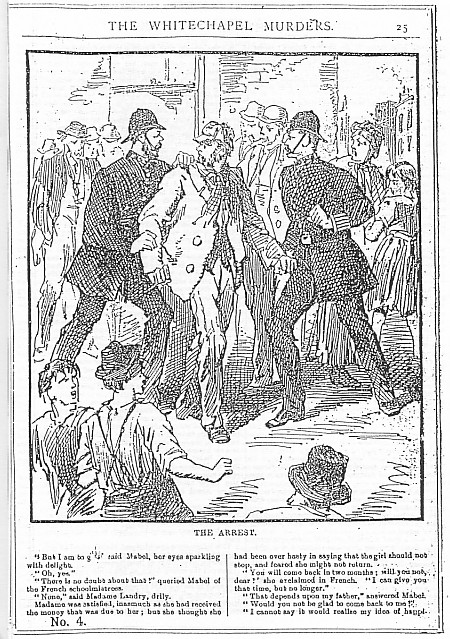
He replenished his glass, and just at this moment there was a noise outside as if of a scuffle, and then some rather strong language was heard.
In a few minutes a man, who had evidently stumbled and fell, hurting himself considerably, staggered into the tavern, and, going to the bar, asked for drink.
His nose was bleeding, and his shirt-front and waistcoat were saturated with blood.
"Eh? what?" cried Samuel Jones, who was somewhat inebriated, "what have we here? The Whitechapel murderer. I call upon all to aid me in arresting him."
"What do you mean, you scoundrel?" asked the other, who was a stout, short man, mopping his nose with his pocket-handkerchief. "Say that again and you�ll get something you won�t like."
"I repeat," said the other, obstinately, "that you look as if you were wanted. Look at this blood; I�ll be bound we find the knife if we search you."
"Take that, you vagabond," cried the stranger, hitting him straight from the shoulder and sending him back hurtling among the crowd.
Samuel Jones was up and ready in a moment, and flew at his opponent.
But at this moment two policemen entered, and, hearing the rights of the case, walked Sam and the stranger off to the station-house.
Sam persisted in charging the other with being the Whitechapel murderer, while the man in his turn charged the other with an unprovoked and drunken assault.
As they both were persistent in their accusations they were taken into custody and locked up.
Next morning Samuel Jones and his unknown assailant were taken before the magistrate, and the young man was strongly censured.
Because a man entered with blood on his clothes he had no right whatever to accuse him of being murderer.
But another and darker shadow is on the East End of London, which will efface all that has preceded it.
CHAPTER XV.
THE EIGHTH OF SEPTEMBER.
THIS is what appeared in the earliest evening papers of Saturday, the 8th of September:�
London lies to-day under the spell of a great terror. A nameless reprobate�half beast, half man�is at large, who is daily gratifying his murderous instincts on the most miserable and defenceless classes of the community.
There can be no shadow of a doubt now that our original theory was correct, and that the Whitechapel murderer, who has now four, if not five, victims to his knife, is one man, and that man a murderous maniac.
There is another Williams in our midst. Hideous malice, deadly cunning, insatiable thirst for blood�all these are the marks of the mad homicide.
The ghoul-like creature who stalks through the streets of London, stalking down his victim like a Pawnee Indian, is simply drunk with blood, and he will have more.
The question is, what are the people of London to do?
Whitechapel is garrisoned with police and stocked with plain-clothes men. Nothing comes of it. The police have not even a clue. They are in despair at their utter failure to get so much as a scent of the criminal.
A high authority then put it in this way:�Now we have a moral to draw and a proposal to make. We have carefully investigated the causes of the miserable and calamitous breakdown of the police system. They are chiefly two: (1) The inefficiency and timidity of the detective service, owing to the manner in which Sir Charles Warren has placed it, and forbidden it to move except under instructions. (2) The inadequate local knowledge of the police.
Our reporters have discovered that the Whitechapel force knows little of the criminal haunts of the neighbourhood. Now, this is a state of things which obtains in no other great city in the world but London, and is entirely due to our centralised system.
In New York the local police know almost every brick in every den in the district, and every felon or would-be felon who skulks behind it. In Whitechapel many of the men are new to their work, and others who have two or three years� local experience have not been trained to the special work of vigilant and ceaseless inspection of criminal quarters.
Now there is only one thing to be done at this moment, and we can talk of larger reforms when we do away with the centralised non-efficient military system which Sir Charles Warren has brought to perfection. The people of the East-end must become their own police. They must form themselves at once into Vigilance Committees. There should be a central committee, which should map out the neighbourhood into districts, and appoint the smaller committees.
These, again, should at once devote themselves to volunteer patrol work at night as well as to general detective service. The unfortunates who are objects of the man-monster�s malignity should be shadowed by one or two of the amateur patrols. They should be cautioned to walk in couples.
31
Whistles and a signalling system should be provided, and means of summoning a rescue force should be at hand. We are not sure that every London district should not make some effort of the kind, for the murderer may choose a fresh quarter now that Whitechapel is being made too hot to hold him.
We do not think that the police will put any obstacle in the way of this volunteer assistance. They will probably be only too glad to have their efforts supplemented by the spontaneous action of the inhabitants. But, in any case, London must rouse itself. No woman is safe while this ghoul is abroad. Up, citizens, then, and do your own police work!
This appeal to the feelings of the indignant and outraged inhabitants was quickly responded to.
Vigilance committees were duly formed, armed, and every possible means taken to capture the murderer or murderers, but with doubtful results.
And now for the terrible ghastly details.
Before the inquest on Mary Ann Nicholls had been concluded, and almost before the grave had closed over her, a woman of the same unhappy class met a precisely similar fate, and, as before, no possible trace of the murderer could be found.
"For all we can tell," said an agitated woman in the crowd assembled before the house in which the body had been found, "he may be one of the mob listening to the speechifying that is going on."
This was anything but improbable.
That the assassin should have been there would have been quite in keeping with the cool audacity which must of necessity have been characteristic of the man who, in all probability, had perpetrated all four of the murders which have so shocked all England�not to say the world.
This is what had happened:�
At a spot only a very few hundred yards from where the mangled body of the poor woman Nicholls was found just a week before, the body of another woman, mutilated and horribly disfigured, was found at half-past five in the morning.
She was lying in the back yard of 29, Hanbury-street, Spitalfields, a house occupied by Mr. Richardson, a packing-case maker.
As late as five o�clock that morning it is said the woman was drinking in a public-house near at hand called the Three Bells. Near the body was discovered a rough piece of iron sharpened like a knife. The wounds upon the poor woman were more fearful than those found upon the body of the woman Nicholls, who was buried on the previous Thursday.
The throat was cut in a most horrible manner and the stomach terribly mutilated.
The first discovery of the body was made by John Davis, living on the top floor of 29, Hanbury-street, in the yard of which the body was found.
Mr. Davis was crossing the yard between five and six when he saw a horrible-looking mass lying in the corner, partly concealed by the steps.
He instantly made for the station and notified the police, without touching the body.
Meantime Mrs. Richardson, an old lady sleeping on the first-floor front, was aroused by her grandson, Charles Cooksley, who looked out of one of the back windows and screamed that there was a dead body in the corner.
Mrs. Richardson�s description made this murder even more horrible than any of its predecessors.
The victim, who, subsequently identified as Mrs. Chapman, was lying on her back with her legs outstretched. Her throat was cut from ear to ear. Her clothes were pushed up above her waist and her legs bare.
The abdomen was exposed, the woman having been ripped up from groin to breastbone, as before.
Not only this, but the viscera had been pulled out and scattered in all directions, the heart and liver being placed behind her head and the remainder along her side.
No more horrible sight ever met a human eye, for she was covered with blood, and lying in a pool of it.
To describe the horrors is painful in the extreme, but for the matter to be understood it must be done.
Mr. and Mrs. Davies occupied the upper storey of 29, Hanbury-street, the house consisting of two storeys.
When Mr. Davis found the woman she was lying on her back close up to the flight of steps leading into the yard. The throat was cut open in a fearful manner�so deep, in fact, that the murderer, evidently thinking that he had severed the head from the body, tied a handkerchief round it so as to keep it on. It was also found that the body had been ripped open and disembowelled, the heart and abdominal viscera lying by the side.
The fiendish work was completed by the murderer tying a portion of the entrails round the victim�s neck. There was no blood on the clothes.
Hanbury-street is a long street which runs from Baker�s-row to Commercial-street. It consists partly of shops and partly of private houses. In the house in question, in the front room, on the ground floor, Mr. Handerman carries on the business of a seller of catsmeat.
At the back of the premises are those of Mr. Richardson, who is a packing-case maker. The other occupants of the house are lodgers.
One of the lodgers, named Robert Thompson, who is a carman, went out of the house at half-past three in the morning, but heard no noise.
Two girls, who also live in the house, were talking in the passage until half-past twelve with young men, and it is believed that they were the last occupants of the house to retire to rest.
It seems that the crime was committed soon after five. At that hour the woman and the man, who in all probability was her murderer, were seen drinking together in the Bells, Brick-lane.
But though the murder was committed at that late hour, the murderer�acting, as in the other case, silently and stealthily�managed to make his escape.
On the wall near where the body was found there was, according to one reporter, subsequently discovered written in chalk:�"Five; fifteen more, and then I give myself up."
This, however, appears be have existed only in the imagination of a penny-a-liner.
It was but one of the many reports that gained currency at the time, and were devoured eagerly by the excited and horror-stricken inhabitants in the neighbourhood of the scene of the outrage.
It is hardly credible that in a city which is the centre of all organisations for the ameliorations of the savage such savagery should exist in its midst.
The woman�s name, the police stated, was Annie Sievey, and her age about forty-five.
She was five feet high, had fair brown wiry hair, blue eyes, and, like Mary Ann Nicholls, had two teeth missing.
One peculiarity of her features was a large, flat kind of nose.
Her clothing was old and dirty, and nothing was
32
found in her pockets except part of an envelope bearing the seal of the Sussex regiment.
For the last nine months she had been sleeping at a lodging-house, 35, Dorset-street, Spitalfields, and she was there as recently as two o�clock in the morning eating potatoes.
She had not, however, the money to pay for her bed, and at two o�clock she left with the remark to the keeper of the place, "I�ll soon be back again; I�ll soon get the money for my does," almost the very words Mary Ann Nicholls used to the companion she met in Whitechapel-road, at half-past two on the morning of her death.
A companion identified her soon after she had been taken to the mortuary as "Dark Annie," and as she came from the mortuary gate, bitterly crying, said, between her tears, "I knowed her; I kissed her poor cold face."
The large flat kind of nose of the deceased was so striking a peculiarity that the police hope to be able to fully trace the movements of the deceased by means of it.
The clothing of the dead woman, like that of most of her class who ply their trade in this quarter of London, was old and dirty. In the dress of the dead woman two farthings were found, so brightly polished as to lead to the belief that they were intended to be passed as half-sovereigns, and it is probable that they were given to her by the murderer as an inducement for her to accompany him.
Later on, after the deceased had been formally identified as Annie Sievey, a witness came forward and stated that her real name was Annie Chapman.
She came from Windsor, and had friends residing at Vauxhall.
She had been married, her husband being an army pensioner, who had allowed her 10s. a week, but he died a twelvemonth ago; and, the pension ceasing, she became one of the hideous women infesting Whitechapel.
She lived for a time with a man named Sievey, and took his name.
According to another authority she used to live with a sieve maker in Dorset-street, and was known to her acquaintance as "Annie Sievey," a nickname derived from her paramour�s trade.
Mrs. Fiddymont, wife of the proprietor of the Prince Albert public-house, better known as the "Clean house," at the corner of Brushfield and Stewart streets, half a mile from the scene of the murder, stated that at seven o�clock in the morning she was standing in the bar talking with another woman, a friend, in the first compartment.
Suddenly came into the middle compartment a man whose rough appearance frightened her. He had a brown stiff hat, a dark coat, and no waistcoat. He came in with his hat down over his eyes, with his face partly concealed, and asked for half a pint of four ale.
She drew the ale, and meanwhile looked at him through the mirror at the back of the bar.
As soon as he saw the woman in the other compartment watching him he turned his back, and got the partition between himself and her.
The thing that struck Mrs. Fiddymont particularly was the fact that there were blood spots on the back of his right hand.
This, taken in connection with his appearance, caused her uneasiness.
She also noticed that his shirt was torn.
As soon as he had drunk the ale, which he swallowed at a gulp, he went out. Her friend went out also to watch the man.
Her friend was Mrs. Mary Chappell, who lived at 23 Stewart-street, near by. Her story corroborated Mrs. Fiddymont�s.
When the man came in the expression of his eyes caught her attention, his look was so startling and terrifying. It frightened Mrs. Fiddymont so that she requested her to stay.
He wore a light blue check shirt, which was torn badly�into rags, in fact�on the right shoulder.
There was a narrow streak of blood under his right ear, parallel with the edge of his shirt. There was also dried blood between the fingers of his hand. When he went out she slipped out of the other door, and watched him as he went towards Bishopsgate-street. She called Joseph Taylor�s attention to him, and Joseph Taylor followed him.
Joseph Taylor is a builder at 22 Stewart street. He states that as soon as his attention was attracted to the man he followed him. He walked rapidly, and came alongside him, but did not speak to him.
The man was rather thin, about five feet eight inches high, and apparently between forty and fifty years of age. He had a shabby genteel look, pepper and salt trousers which fitted badly, and dark coat.
When Taylor came alongside him the man glanced at him, and Taylor�s description of the look was, "His eyes were as wild as a hawk�s." Taylor is considered a reliable man, well known throughout the neighbourhood.
The man walked, he said, holding his coat together at the top. He had a nervous and frightened way about him. He wore a ginger-coloured moustache and had short sandy hair. Taylor ceased be follow him, but watched him as far as "Dirty Dick�s," in Halfmoon-street, where he became lost to view.
Many persons wrote giving theories of the murder.
One was as follows:�
It was evident, said the writer, at a glance that the murder had been done where the body lay. The enormous quantity of blood and the splash on the fence, coupled with the total absence of stains elsewhere, made that clear.
It was also clear that the man had decoyed the poor woman into the yard, and murdered her as she lay where she was found.
The passage through the house by which the yard was reached is twenty-five feet long and three feet wide. Its floor is bare, and nobody can pass along it without making some noise.
The murderer and his victim failed to awaken anybody, however, though people were sleeping only a few feet away.
Both front and back door were open all night, and there was no difficulty in reaching the yard.
There was a story that a bloody knife had been found in the yard, but this was not true.
The only unusual thing about the yard except the dead woman was the fact that the rusty padlock on the door of the shed had been broken.
Not a sound seemed to have been made by the woman when attacked.
Mrs. Bell, an old lady who lived next door, slept by an open window, not twenty feet from the spot, and was certain that no noise was made, as she sleeps very lightly. The probability is that the woman by five o�clock was stupidly drunk, as she was well on when Donovan, the deputy, last saw her.
In this case she could have been easily kept silent until she was unable from loss of blood to speak.