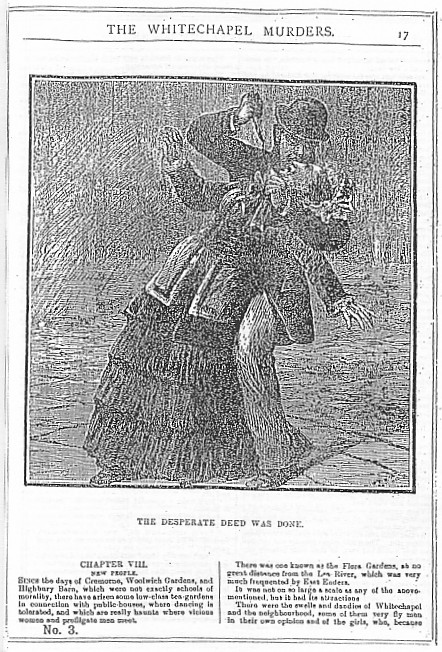
17
CHAPTER VIII.
NEW PEOPLE.
SINCE the days of Cremorne, Woolwich Gardens, and Highbury Barn, which were not exactly schools of morality, there have arisen some low-class tea-gardens in connection with public-houses, where dancing is tolerated, and which are really haunts where vicious women and profligate men meet.
There was one known as the Flora Gardens, at no great distance from the Lea River, which was very much frequented by East Enders.
It was not on so large a scale as any of the above-mentioned, but it had its attractions.
There were the swells and dandies of Whitechapel and the neighbourhood, some of them very fly men in their own opinion and of the girls, who, because
18
they wore broadcloth, smoked cigars, and wore studs and links, were looked up to as demi-gods.
The girls who frequented this little pandemonium were of two classes�a few respectable girls taken there by their friends and sweethearts, and a great many who went there to meet their so-called friends.
The place looked quite brilliant. The "thousand additional" lamps, which were the pride and the boast of old Vauxhall, may have been wanting, but lights glittered on every tree.
The band was perfect for such a place. Locomotion was difficult; yet the gay and giddy throng continued to promenade in a vicious circle, like horses turning a mill.
The merry jest and the loud vacant laugh were heard on all sides.
The bars were full, as well as the room, the abode of the select, and the platform echoed to the feet of the indefatigable dancers.
The place was crowded with girls, who, flaunting in silks and satins now, would soon be among the Whitechapel and Spitalfields outcasts of whom we have so much to say.
"A short life and a merry one" is their cry.
It is often asked what becomes of the Paphian nymphs of East and West?
Some save money, retire, marry small but respectable shopkeepers, and die in the odour of sanctity with children around them.
These are the few exceptions.
The majority seek oblivion in death, or sink lower and lower every year until they have to fly to the workhouse, where much more vice and crime hides itself than honest poverty.
There were present on this occasion, several whom, at no recent day, we shall meet in Whitechapel very much shorn of their laurels.
But what we have to do with now is with those who are present.
In one of the alcoves, which served the purpose of the "particular cabinets" of Cremorne, looking out upon the lively scene, was a party of two�both young men.
They were about the same age. One was tall, fair, with an aristocratic style about him, though not an aristocrat, with blue eyes, short whiskers, and a delicate moustache.
He was the son of a wealthy retired tradesman of the East-end, and had lately upon the death of his father come into money.
The other was shorter, dark, stout, having a face which denoted at once and the same time impudence and cunning.
The former was Henry Brady. He had never done any work, but had entered on life with a good allowance at nineteen, and at twenty-two had inherited nearly a thousand a year.
He had followed the bent of his inclination, and soon made himself notorious in the half world of the East End, where so many lose themselves at the outset of their career, shine brilliantly like a meteor for a time, and vanish suddenly, never to appear again, disappearing below the surface and staying there.
The other was Arthur Roskell, well known in fast society both at the east and the west, who had made the other�s acquaintance about six months before, when, falling into an extra two thousand, he had made an appearance like that of a falling star in the West End.
Arthur Roskell had no money but that which his arts supplied him with. He was a good a shot, a capital billiard player, had a knack of putting a few pounds on winning horses, could always ingratiate himself with men beginning a fast career, got their bills discounted for them, played, too, judiciously, belonged to one or two good clubs, and maintained a respectable appearance by skill and effrontery, and the virtue of his position, such as it was.
On the table stood a bottle of champagne. There was good champagne even at the Flora. Both were drinking and smoking. Henry Brady�s face wore a melancholy expression, and his friend in vain tried to rally him
"I can�t imagine how a fellow with your means can give way to the blues as you have done to-night, Brady!" exclaimed Arthur. "I wish I had your means. I am only miserable when I have to go into a committee of ways and means."
"Perhaps you don�t know that I have joined your division," answered Henry Brady, looking up.
"What is that?"
"The H. U."
"Oh, the hard-up division," said Arthur, with laugh. "Not you, old boy; you are too well off for anything of that sort."
"It is true, nevertheless. I sold my Hackney house this morning, and to-morrow my horses go to the hammer."
"You are joking," exclaimed Arthur Roskell, with a somewhat grave and anxious expression upon his usual careless countenance.
"Very well�have it so if you like."
"I shall be sorry, and will do what I can for you," answered Roskell, "when you do the Timon of Athens business, and call on your friends. It will be genuine, though, for I have taken a fancy to you. Ours is not a mere passing friendship."
"You will have to leech on to somebody else," said Henry Brady, rather rudely.
"Don�t be offensive," Arthur Roskell replied. "Lend me that pony I asked for until to-morrow, and I will forget that you were personal."
" �I�m not in the giving humour,� as King Richard says."
"I did not ask you to give it me; I said lend it."
"A distinction without a difference."
"Upon my word, Brady, if I thought you meant to insult me I�d�but no; we are too good and old friends for that to happen, I�m sure. The fact is, you are hipped, and make me the victim of your ill-temper; still, I am content to be the scape-goat. But touching that monkey, pony, I mean?"
"Ask me later," replied Henry Brady, almost sharply, adding immediately, "Do you think Patty will come?"
"Why shouldn�t she? You telegraphed to her place, didn�t you?" replied Arthur Roskell, biting his lips.
"Yes, hours ago. But she may have heard�"
"What?"
"That things are going wrong with me. These rumours get about, you know."
"By Jove! here she is," was Roskell�s answer, as a pretty little woman sailed up to their alcove, which was indeed one of the private rooms of the place.
Patty Brooks, or "Shoes," as her intimate friends called her�nobody knew really why�was three-and-twenty, or thereabouts, in the zenith of her beauty, and with her powers of fascination unimpaired.
She was a Whitechapel girl pure and simple, of poor origin; but this she kept to herself.
Very fair, she had the most lustrous blue eyes it is
19
possible to imagine, and the prettiest mouth that ever bestowed sweet kisses on favoured mortals.
"Am I too late?" she asked, taking a seat which Henry Brady offered her.
"Better late than never," he rejoined.
Supper was ordered and speedily brought in. The wine flowed briskly, yet Brady�s spirits did not rise. At length he exclaimed�
"I am in the humour to philosophise to-night."
"Don�t do that," said Patty, laughing. "I once knew a man who was a philosopher, and he was the most odious, hard-hearted wretch in the world. I told him I would never speak to him again when he offended me, and he answered that he didn�t care because he was a philosopher; and when I left him he didn�t trouble his head about it a bit. I have hated philosophers ever since."
"My dear Shoes," said Brady, "you are garrulous. Let me request you will check this loquacious tendency. I have a question to ask Roskell."
"To ask me?" said the young man.
"Yes. What is friendship?"
"Let me see. Friendship is to have but one purse, one sword, one pen, an identity of interest on all occasions�especially when you can�t meet a bill, and have to renew it�to love two men, and never poach on each other�s preserves."
"Excellent! I like your definition, Roskell. Are you my friend?"
"I hope so."
"Are you not sure of the fact?"
"Of course I am."
"Then you are my friend?"
"To the death."
"I am obliged to you. Now, Patty, it is your turn," said Henry Brady, with a smile.
"What am I to do?" asked Shoes.
"You are to do nothing; but you may indulge in your favourite occupation of talking. Tell me, queen of my heart, what is love?"
Patty Brooks thought a moment.
"I have it," she cried. "Love is to have two mouths which unite in a kiss, two hearts which beat only for one another, two breaths which mingle, two souls which are full of happiness occasioned by the same instinct, the instinct being love, as distinct from animal passion."
Patty had been educated in a first-class school in Highbury for a governess by a widowed mother. But she had a soul above teaching.
"Capital!" exclaimed Brady. "Jean Jacques Rousseau could not have defined it more truly and more to my satisfaction. And you, my pet, do you love me?"
"God knows I do, Henry; can you doubt it?"
"I had my doubts both about your love and Roskell�s friendship. I am indeed a happy man to be so blessed. What care I for the world and its misfortunes since I am sure of a woman�s love and a man�s friendship? I feel that I can defy fate."
"I love you," Patty murmured, softly.
He bent over and kissed her tenderly.
"I am your brother," said Roskell.
He lent forward and wrung his hand.
"Now," he exclaimed; "I am going to take you both into my confidence. In the first place, I am ruined."
Patty looked grave.
"Let me ask you a question. Can a man who has run through all his money be indicted for defacing the coin of the realm?"
A strange smile played around the corners of the young man�s handsome mouth at this specimen of Whitechapel wit.
"My landed property," he observed "is reduced to the earth in the flower-pots inside my windows."
"But your little place in the country?"
"I never had one."
"Your Highbury mansion?"
"Is sold."
"Your horses and carriages?"
"Go to the auction mart to-morrow under a bill of sale."
"Is it possible?" exclaimed Patty, blankly.
"It is a melancholy fact. But what matters? You will stick to me in storm as well as in sunshine. I never knew my father and mother. I only know a guardian named Brady, whose name I took. When I came of age I had three thousand, and plunged into a life of dissipation. My money was paid quarterly until a few weeks ago. Last month Mr. Brady died suddenly. His executors have no orders be continue the allowance. He died of apoplexy, and except a few hundreds in the bank, I am penniless�ruined."
Shoes lowered her eyes on the plate.
Roskell drank a glass of wine at a draught and exclaimed�
"Then you were not joking when you said that you were ruined?"
"Joking?"
"Yes."
"I am incapable of joking on such a subject," replied Brady, sadly. "I have not made up my mind yet. Fortunately, I am well educated. I have a certain style and talk several languages."
"Better know how to play a good game of billiards. There is nothing for you in this country. You must go to America. If you stay here you will get worse and worse, until you are obliged to cadge a few pence to get a Bohemian glass�gin-and-water, you know."
Henry Brady trembled.
There was something ominous in this reply.
"My means won�t allow me to keep you," continued Arthur Roskell, with a coarse and callous brutality, which pierced the other to the heart. "We should both become beggars; and, great as is my regard for you, old fellow, it is as well to say at once that you are a luxury I cannot afford. Fancy yourself living in a garret making thirty shillings a week."
Brady sighed deeply.
He turned to Patty.
"There�s a great deal of truth in what Roskell says, and I am wrong, perhaps, to be shocked at it!" he exclaimed. "It is in America that rapid fortunes are made. I will go over to the United States with what little capital I can rake up, start in trade, recuperate�that�s the word, isn�t it?�my shattered finances. You, dear Patty, will accompany me. We shall cheer each other in the days of our poverty, and lighten the clouds which at present surround us: abroad we will build up the edifice of a colossal fortune. With you by my side to urge me to increased exertions, I am capable of anything and everything. Westward, oh! What says my Patty?"
He extended his hand to hers, who did not respond to his impassioned and ardent address.
Henry became ghostly pale.
"What!" he said, "do you not love me?"
His lips quivered and his limbs trembled as if with a sudden attack of the palsy.
"You know I love you," she replied, coldly. "But you must be mad to dream of going abroad, and still
20
more so to think that I should accompany you. Ten years would be a short time to make a fortune in, even if you were successful in trade, which is very doubtful, as you have not been brought up to commerce. In ten years I shall be an old woman, and I could not put up with privations of any sort. I haven�t been accustomed to poverty, and have acquired habits of luxury and ease, which I cannot get out of. I should die if I lived with a poor man. I can�t walk; I can�t work; and I like being expensively and fashionably dressed."
While talking thus Patty scratched the table-cloth restlessly with the claw of a lobster, but did not raise her eyes to the ruined man.
"Heaven help me!" cried Henry Brady, as the truth burst upon him; "you are both time-servers. It is the old, old story; no longer pipe, no longer dance. I have no friend, no one�s love. My ruin is more final than I thought it was."
Overcome by bitter reflections, Brady sank back in his seat, his eyes closed, his arms dropped listlessly by his side, his lips parted; he glided gently into a corner, and appeared to have fainted away.
CHAPTER IX.
MAJOR CARLTON.
YES; Henry Brady had actually fainted. The shock to his nervous system was too great to be withstood, and he succumbed before the ill-concealed heartlessness of his mistress and his friend.
How long he remained insensible he did not know, but when he came to himself he found a man standing near, and throwing iced water into his face.
The music was still playing and the revelling in the grounds amounted to a perfect carnival.
This external mirth contrasted strangely with his wretchedness. His first care was to cast his eyes about to see if Patty or Roskell had deserted him.
They were gone.
Finding that he was utterly ruined, and not likely to be of any service to them in the future, they left him to his fate.
The man who had restored him to consciousness was tall, very dark, having short curly hair, black as a raven�s plume, and a swarthy complexion, such as you behold in this gallant Spanish hidalgo, who lords it on the Prado of Madrid.
The eyes were small, piercing, and cruel, but they burned within cavernous recesses like live coals; his nose was slightly bowed, like those of the Romans; his mouth wide, and hard at the corners; his cheeks inclined to be hollow, if not cadaverous; his teeth white and glistening; and he was in evening dress.
His studs were those small Nuremberg eggs, containing fanciful groupings of the Holy Family, infinitely more valuable than diamonds; his watch chain a series of exquisite mosaic beads.
In his manner and his face there was a terrible something which it was difficult, if not impossible, to fathom.
A something devillish and inexplicable, which made the physiognomist tremble and the indifferent observer chill to the bone.
As Henry Brady was recovering a waiter entered the cabinet and laid the bill on the table, looking from one to the other curiously.
The unknown glanced carelessly at the bill, which amounted to four pounds and a few shillings, then, putting his hand into his pocket, he drew out a bundle of notes and some sovereigns.
Selecting one note from the rest, which was for five pounds, he threw it all crumpled as it was, towards the waiter, saying�
"Keep the change and go."
The man did not require to be told twice. He went at once, shutting the door behind him, and the stranger bestowed his attention once more upon Henry.
"I have to apologise for my presence here," said the stranger, with one of his peculiar smiles; "but the fact is, I was in the adjoining cabinet, and hearing, as I thought, a fall, I hastened to render what assistance I could."
"Where is Patty?" murmured Henry.
"She went away on the arm of your friend Roskell."
"How do you know my �friend�s� name?" asked Henry, with a sarcastic emphasis on the word "friend."
"The walls are thin. I could not help hearing your conversation," replied the unknown.
"Did you hear all?"
"Every word. It is, perhaps, an incautious admission to make; but I grew interested in you, because, as soon as I heard your name, I was satisfied I knew your father."
"My father!" repeated Arthur, in a voice that trembled with emotion.
"I am sure of it."
"Who are you, if I may ask?"
"Be content to know me as Major Carlton."
"In the Queen�s Service?"
"No; I hold a foreign commission. Suffice it to say I have served in the field."
"You are now resident in London?"
"It would seem so as I am here, but I am a cosmopolite. I inhabit all cities. I am here to-day and gone to-morrow. Next week you might meet me in Paris en route for Vienna, and in less than a month I might be driving in the Central Park in New York."
Brady regarded this singular being with unfeigned astonishment.
"At present," continued Major Carlton, "you are a hero of romance."
Brady groaned.
"You are ruined after a brief and brilliant career, and not through any fault of your own. You have lost your friend and your mistress, but one thing can bring them back in penitence to your feet."
"And that is?"
"Gold!"
"You are right; but tell me, major," said Arthur, sitting up and drinking some wine, "is it worth while to buy love and friendship?"
"Love and friendship, my good sir," returned Major Carlton, "do not exist in reality. They are abstractions, toys for the poetical mind. If you want the semblance of either the one or the other, depend on my word you must buy it. The clever man knows this, and he purchases those staple commodities which all the markets of society abound with, but he does so at the cheapest possible rate."
"The truth is very dreary."
"Nevertheless, truth, by which you mean experience, must be gained by all who live in this world. Drink; there is nothing like sparkling wine to raise the drooping spirits of the crushed and wounded in the battle of life."
Henry Brady drank deeply, nothing loth.
"How am I to get the gold which will restore me to happiness!" he asked.
"I will tell you; but we must proceed gradually.
21
You are ignorant of all matters connected with your birth; is it not so?"
"Unhappily I am."
"Yet you have seen your father."
"Mr. Brady? Is it possible that he, after all, was my father?" cried Henry Brady, anxiously.
"He was your father, and died worth ten thousand a year."
"Then it is to be feared I was not born in wedlock," said Arthur, with a despairing air, as the crimson tide of shame rushed into his face.
"You are wrong."
"Heaven be thanked!" cried the young man, clasping his hands joyously together.
"Your mother," continued Major Carlton, "was a lady of rank, and your father married her privately. You were the only offspring of the union. Shortly after your birth Mr. Brady discovered that your mother was unfaithful to him. He at once broke off the connection, repudiated the marriage, and took steps to obliterate all proofs of it. Nevertheless, the proofs existed, and he took the documents necessary to prove your legitimacy abroad with him, where he remained ten years. On his return your mother was dead of a broken heart."
"My poor mother!"
"Mr. Brady would not acknowledge you as his son, though he treated you with the utmost liberality, as you know."
"The proofs!"
"Of your legitimacy? The whole of your father�s property has passed into the hands of his brother, and those documents are, with others, in his possession."
"Let us get them at once, major. I will reward you," cried the young man, growing wild with excitement at the prospect of being rich once more, and with his mind influenced at what he had heard.
In truth it was an extraordinary tale.
Major Carlton smiled a Mephistophelean smile.
"Not so fast, my young friend," he exclaimed.
Henry Brady�s face fell again.
He began to comprehend that there were difficulties in the way.
"You are entitled to ten thousand a year," the major went on.
"So you informed me."
"This large sum is partly invested in the Funds, partly in land. The two amounts are equal. If I assist you to get your inheritance you must be content to let me have the land as my share."
"But�"
"Is not the cupidity of the human heart extraordinary?" interrupted Carlton, in the same equable tone of voice in which he always spoke. "Here is a man without a penny�destitute�not having a feather to fly with. I inform him how to get five thousand a year and be murmurs!"
"I am sorry," replied Henry in a low tone. "It is just that you should have half. Tell me how I am to secure this fortune to you, and in what way we shall get it."
"Your uncle is a miser. He would rather part with his life than with a halfpenny of that which he has just acquired, though he does not want it."
"Does he know of the documents which will prove my title to the property?"
"He does; but he has not had time to find them, though he intends every day to make a search, knowing that they are among his brother�s papers, which he has carefully collected," replied Major Carlton.
"When he does find them he will destroy them?"
"Infallibly."
"How do you know all this?" asked Arthur.
"I can read the mind, and having been acquainted with your father�"
"Ah , that explains it," said Henry, not wishing to appear rudely inquisitive.
The same smile, so profound, so significant of meaning, which Henry had observed before, appeared on the major�s face.
"I am what I have told you," he continued. "It is easy to see that we have a difficult task before us."
"What are we to do?" Henry inquired, in perplexity.
"That is the point all practical men wish to come to. Now that we understand one another we can approach business."
"Yes, to business," said Henry, who was carried away by the force of the man�s manner.
"Your uncle, John Brady, must be removed."
"Removed?" repeated Henry, as if he did not quite understand the word.
"Not vulgarly knocked on the head; but slowly destroyed by a subtle vegetable poison which leaves no trace, and which I can supply you with," said Major Carlton, whose eyes seemed at that moment to burn into the young man�s very soul.
Brady turned pale.
His mind, for a moment abstracted from the scene, revisited the school of his youth.
He remembered the lessons of honour which had there been inculcated in his mind.
Major Carlton watched him closely.
Finding he would not make any reply he touched him sharply on the shoulder.
Henry Brady started.
"Major," he exclaimed, "let me tell you a dream which I had last night."
"A dream?"
"Yes; it has an application."
"I am listening," returned the major.
"I dreamed that I was in a far-off country, wandering in the woods, when suddenly a long, lithe, hideous black snake fastened round my body. Instantly I grappled with it, seizing its head, which, by the aid of a knife I had with me, I succeeded in cutting off. A fire, which some wanderer like myself had left, was smouldering near. I cast the loathsome head upon it, and heard the flesh hiss and crackle in the flame. The coils relaxed, the disgusting body fell to the ground, and I trampled it beneath my foot."
His voice while speaking rose to an eloquent pitch, but the Mephistophelean smile still hovered about the corner of the major�s lips.
"I don�t quite see the application," he replied.
"You say you knew my father," continued the young man.
"I had that honour."
"What did you find him to be during your acquaintance with him?"
"In what way do you mean?"
"Was he straight and just in all his dealings with those with whom he came into contact?"
"Yes."
"Would he have stooped to a low or dirty action?"
"No," replied the major.
"He would not?"
"Certainly not."
"In fact he was a gentleman?" continued Henry.
"In word and deed, and he would have done nothing wrong. I can give you that satisfaction."
22
"Neither will I, his son, condescend to mix myself up in your low intrigues, Major Carlton," said Brady, with flashing eyes, and speaking in a loud voice. "Are you aware, sir, that you have proposed the commission of a crime to me?"
"Perfectly aware," replied the major, with his habitual composure.
"It is murder�cool, deliberate murder!"
"That is the word."
"And you dare to insult me by�"
"My good fellow," interrupted Major Carlton, "you are very young. You are only a child, after all, and you have not a proper understanding of the meaning of words. I thought we might come to an arrangement that would be mutually advantageous to us. You seem to prefer poverty to affluence."
"Yes, on your terms," indignantly replied Brady.
"Let it be so. If you like poverty, it is a matter of the most perfect indifference to me."
"Leave my presence, sir!" shouted Henry.
"You needn�t raise your voice, and speak as if you were the Prince of Wales. I have no wish to stay with you, for your conversation is not too entertaining. Your supper bill is paid."
"By whom!"
"By me."
"This liberty�"
"You will find extremely convenient, at Miss Patty thought fit to take your purse with her," replied the major, with a smile.
Henry searched his pockets and found the major had spoken the truth.
Handing him a card Major Carlton said�
"If you will call at this address, and say you want to see me, I will keep any appointment you like to make within a month from the date of your call. If I am in town you can see me at once, but I must have time to got from St. Petersburg or the States here."
Henry Brady took the card mechanically.
On it was printed�
MAJOR CARLTON.
Albany.
"What is this for?"
"You may change your mind."
"Never!"
"You do not know," said the major, disregarding the emphatic negative. "It is disagreeable to be poor. When you have had some experience of the humanity of the world you will sigh for wealth. Then, and not before, seek me. We will resume our conversation of this evening. I have the honour to wish you good-night."
Major Carlton lifted his hat politely, and took his departure, leaving Arthur overwhelmed with astonishment.
It all resembled a dream.
A hideous and ghostly nightmare.
And yet though Arthur Brady had repudiated the idea of murder in his uncle�s case he felt he could have killed a woman without the slightest compunction.
In time the music ceased, the lights were extinguished, and only a few people remained in the room, who were gradually got rid of.
Arthur was roused by the cessation of the merriment, and he too went home.
His home was an hotel, and as he laid his head upon his pillow that night he wondered how long he would have a home, and if he would not soon be obliged to herd with those who filled the night refuges and the casual wards.
For a few days more he was seen about as usual.
Then he vanished.
No one knew whither he had fled.
Patty and Arthur Roskell met one night at the Café Ruhe, and the woman asked him if he had seen Brady.
"No," he answered. "They know nothing of him at Long�s, where he was staying. Some say the poor devil has gone to America, as he told me he should; others say he was seen at Jacquey�s in Boulougne playing billiards the night before last."
"At all events, he has vanished from our festive scene."
"That is a moral, certainly, and an actual fact."
"Has he paid his debts?"
"I can�t say. I believe there are some writs out against him, but it is a matter with which I don�t trouble my head. Have you seen Prettywell?"
"No. Who is Prettywell?"
"He�s the new plunger. Lord Prettywell is two-and-twenty and has a hundred thousand a year. I knew him at Oxford."
"Oh, do introduce me! Will you? Can you?" cried Patty, eagerly.
"Be a good child and perhaps I will. Don�t jump down his throat�he is peculiar. Let�s have some fizz. Waiter, a bottle of Roederer."
Patty sat down by his side, and favoured him with one of her most gracious smiles as he took a cigar from a handsome case, ornamented with his crest and monogram, and began to smoke.
CHAPTER X.
THE ADJOURNED INQUEST.
THE adjourned inquest on the third murder elicited but little that was fresh.
It took place on the 17th.
Still, some of the evidence was new and important.
Thomas Eade said: I am a signalman in the employ of the East London Railway. On the 8th of September I was going down the Cambridge-heath-road about twelve noon when I saw a man on the opposite side of the street to the Foresters� Music Hall. He had a peculiar appearance as if he had a wooden arm. I passed him once or twice, and as he put his hand in his pocket I caught sight of the blade of a knife which was up his sleeve. I saw about four inches of steel. After speaking to some men I followed him to give him into custody, but he slipped down some street and I lost sight of him. He was a man about five foot eight inches high, thirty-five years of age, and dark moustaches and whiskers. He wore a dark brown jacket, white overalls, and a double-peaked cap.
Coroner: How did he walk!
Witness: As though he had got stiff knees. That was what made me notice him first.
Coroner: Were his overalls dirty?
No; they were perfectly clean.
Coroner: You did not see what kind of a knife it was?
No�not exactly. The blade was about two and a half inches wide, I think.
Inspector Spratling: I have been making inquiries into this matter.
The Coroner: Have you been to every house in Buck�s-row?
Witness: No; but if anything had come to light down there we should have heard of it. I have seen all the watchmen in the neighbourhood, and they neither saw nor heard anything on the morning in
23
question. The board school ground has been searched, but nothing likely to throw any light on the matter was discovered.
Inspector Helson: We have had a constable in the street for a week, but nothing was gained by it.
The inquiry was adjourned.
The Foreman of the Jury said that if a substantial reward had been offered in the first case he believed that the last two murders would never have been perpetrated. If the matter was put before the Home Secretary, and a large reward was promised, he (the foreman) would willingly give �25. Had the murdered persons belonged to the rich and aristocratic class a reward would immediately have been offered.
The inquest itself was of not much importance, but the scene around the court in the evening, when the third murder was discussed by the light of subsequent events, was of a most exciting character.
CHAPTER XI.
AFTER THE INQUEST.
THE body of the poor woman had been removed from the mortuary the night before by some of her friends, so at least it was stoutly affirmed by the officers in charge of the place; but the police generally were unaware of this, and from time to time during the day they came in twos and threes and stopped at the top of the little paved opening, at the bottom of which the mortuary is situated, and gazed down at its gaudy green gates and talked the matter over, evidently under the impression that the mutilated victim still lay within.
At every street corner gossips clustered around anybody who could give the fullest particulars of the inquest the day before; and the end of Buck�s-row, the spot on which the body had been found, was throughout the day the scene of eager debate as to the probabilities of discovering the criminal.
Groups of hard-featured, sorrowful-looking women clustered together and bent over what they supposed to be the blood-stained paving stones, and told strange stories of the difficulties credibly reported to be always experienced in obliterating the marks of human gore.
One thin-faced, blue-eyed, little old man, who no doubt at some point in his threescore years and ten had on the stage seen Lady Macbeth trying to wash her hands of the life blood of King Duncan and still retained some vague outlines of the story, recounted what he could remember as an actual historical fact.
The narrative, distorted almost out of recognition, was listened to with the keenest interest, and was unhesitatingly accepted in corroboration of the general belief as to the ineradicable nature of blood-stains.
All through the day little mobs of twenty or thirty people thronged round the window-sill under which the glare of the policeman�s bullseye had detected the mutilated body and gave expression to their pity and their horror.
The men for the most part were sullen and taciturn. With hands deep in their pockets they puffed at their pipes and thought a good deal, but said little. But now and then they put in a word.
"I shouldn�t so much ha� wondered at the poor thing�s throat being cut," said a woman; "that might ha� been done in a quarrel as many a one ha� been done before."
"So might the other thing," said a bystander, taking a short pipe out of his mouth. "Don�t you often hear chaps threaten to do just that? Aint it common enough when a blackguard gets in a rage, for him to swear he�ll do just that very thing to a woman? Very well, one of �em�s been and done it, that�s all. That�s what comes o� that sort o� talk."
People in the neighbourhood seemed very much divided in opinion as to the probability of its being the work of one person or several.
The women for the most part appeared to incline to the belief that it was a gang that had done this and the other murders, and the shuddering dread of being abroad in the streets after nightfall, expressed by the more nervous of them, was pitiable.
"Thank heaven! I needn�t be out after dark," ejaculated one woman.
"No more needn�t I," said another; "but my two girls have got to come home late, and I�m all of a fidget till they comes."
It was really startling to stand by and listen to the gleanings of these poor people from the newspapers.
Nothing appeared to have caught the attention of anybody except some story of murderous outrage, every detail of which they had made themselves familiar with.
The report of another desperate assault was discussed with shuddering interest.
The story was that a well-dressed man inveigled another of these unhappy women near to the scene of the murder, and dragged her by the throat down a court, where he was joined by a gang of women and ruffians.
They stripped her of her jewellery and her purse, and upon her attempting to shout for help one of them laid a long knife across her throat and threatened to "serve her as they did the other."
She was eventually released, however, and told the police about it. On the face of it the tale was in the highest degree improbable, but it was unhesitatingly accepted by the people clustering together in Buck�s-row, and greatly added to the general anxiety and dismay.
There were some, however, who were sceptical about this latest outrage.
"That�s a got up yarn," said one. "I rather wish it was true. If there was a gang like that, one or t�other of �em �d split before long, and it�d all come out. Bet your money this aint been done that way."
There was a general expression of a hope that some way or another it might come out, and then, with a touch of the grim humour more or less inseparable from all dark tragedy, the motley little mob of women and girls broke out in noisy protestation of what they would like to see done to the wretch who had so barbarously butchered this poor woman.
By general acclamation it was agreed that the best thing that could be done would be to turn him out in the midst of the Whitechapel women; and then, seemingly forgetful of all the pain and pathos of the dreadful event, woman squeezed their elbows and clenched their fists, and went through a mimic performance on the person of the murderer.
Very rough and very coarse were many of these men and women and girls, who from hour to hour gathered about the little thoroughfare to talk over this awful mystery; but somehow it was not their roughness or their coarseness which most impressed the observant bystander.
If any word was said to the prejudice of the unhappy victim it was instantly met by such an emphatic expression of pity and compassion and
24
charitable extenuation of the hapless woman�s faults and frailties that the critic was abashed into silence.
"No matter what she was, poor thing. �Taint for the likes of us to judge her now."
"No," said another; "that�s right enough, whatever she was it was an awful cruel thing to do to her."
"It�s the drink as seems to ha� done it all," said one.
"Ah, curse the drink!" said another, a woman with a hard, deeply-furrowed face and thin grey hair.
Then the conversation turned on the mischiefs which originated in the public-houses, and of course they were condemned heartily and unanimously.
But the public-houses were, nevertheless, full to repletion. Fresh arrivals came up now and wanted to know all about it.
Once more the supposed stains were pointed out and the whole of the circumstances discussed again in the light of previous evidence, and people stood and silently stared at the pavement and the brickwork of the adjacent house and minutely examined the scratches and other marks in the wall, as if these things helped them to realise the horror of it all.
The same thing, of course, happens whenever murder takes place; but very rarely had anything occurred even in that quarter of London that had created so profound a sensation, and seldom have the people in this part been so appalled by a sense of insecurity.
There seemed to be a prevalent confidence that the police were doing all in their power to discover the criminal; but there was, at least, an equally general conviction that until this mysterious assassin was taken the neighbourhood should have a stronger contingent of police for its protection.
"Life aint no great things with many on us," said one little woman, whose sprightly manner and rosy cherub face rather belied her pessimism, "but we don�t all want to be murdered, and if things go on like this it won�t be safe for nobody to put their �eads out o� doors."
And so I [sic] went between those who were first collected, and then between new arrivals, some of them evidently from very different quarters of the town.
Some people came in carriages, though the carriages were left at a distance.
CHAPTER XII.
MABEL VAUGHAN.
THREE years had passed from the time when Henry Brady, Patty, and Arthur Roskell appeared upon the scene.
Brady had, we have said, disappeared, but he is about to reappear in company with one who will play a leading part in our realistic drama.
In a quiet, unromantic, almost dreary street in Boulogne-sur-Mer was, about a year ago, a young ladies� school.
It was a good school of its kind, and numbered about five-and-twenty boarders, the odd five girls being English the remainder French.
Among the English was a girl named Mabel Vaughan.
This girl had been placed there at ten years of age, and was only sixteen at the time we introduce her to the reader.
She was of average height, with a wealth of light brown hair.
A quiet manner gave almost a sedate expression to her full, handsome countenance; here eyes were full and round, her cheeks rosy, her chin dimpled; and there was nothing more extraordinary about her than about the generality of the girls of her age, except that her eyes were eloquent, and she could talk with them even when her mouth was closed.
She had been brought over to Boulogne by an old lady, who had settled down in Bresqueresque, living in cheap lodgings, and economising as people can abroad, where they can indulge in little savings of which they would be ashamed at home.
This girl, however, was doomed to a most extraordinary career; to shine as a beaming light for a short time, and then to fall into the slough of despond.
Mrs. Baker, as the woman was called, had been Mabel�s nurse, and her name was associated with all the recollections of her infancy. Her mother she could not recollect at all; but her father was often present before her as a tall, handsome man, his hair dark and flowing, well dressed, agreeable in his manner, evidently the pet of certain circles�of any society, in fact; though it was to be feared he did not favour the most virtuous with much of his company.
The summer vacation, which began in June, was about to commence, and Madame Landry, who had not received any money for the last year towards Mabel�s school bills, sent for Mrs. Baker.
Mrs. Baker came, and was ushered into the a drawing-room, where Madame Landry, a hard-featured, mercenary Frenchwoman, awaited her.
They had a long conversation respecting Mabel, and Madame Landry was determined that unless she was paid Mabel should remain no longer.
Mrs. Baker replied that she would write to England, and that she would visit the schoolmistress as soon as she had received an answer.
A week elapsed without bringing any news.
Then came a letter from Mr. Raphael Vaughan, containing an order on a well-known bank in the Rue Napoleon for more than a hundred pounds.
In the letter he said�
"Send the girl over to me at once. I find on inquiry that the boat starts for London-bridge at nine at night. Let her go by that, and I will meet her at the Terminus Hotel, London-bridge, in the coffee-room, at two the next day. If Mabel does not remember my face she must ask the waiters for me, as I am known there."
Mrs. Baker went over to the school at once and showed Madame Landry the letter and the order, which was promptly cashed and the bills settled; and Mrs. Baker handed twenty-five pounds over to her young friend as soon as she entered the room, saying�
"That money is for you to go to England with, though what you will do with so much I don�t know. Your father has sent for you, and wishes you to start by the boat to-night. There is his letter, my dear."
This information overwhelmed Mabel, who had not enjoyed a holiday for six years, unless it was a few hours with Mrs. Baker at Bresqueresque.
She put the money down on the table, and eagerly devoured the letter.
"Am I to leave school altogether?" she asked.
"I cannot tell," replied Mrs. Baker. "That letter is thoroughly characteristic of your father�hurried and disconnected. He explains nothing."