121
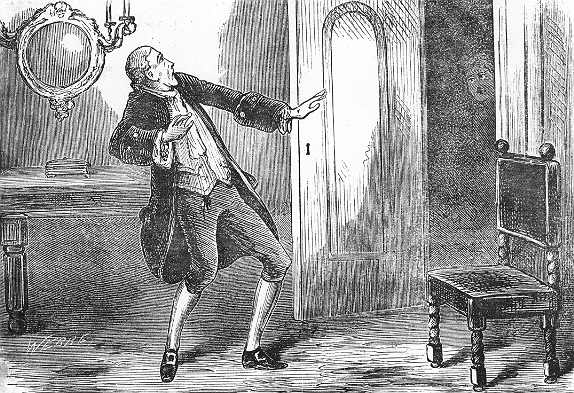
MR. DENVIL FELL BACK WITH A CRY OF HORROR AS HE SAW A PAIR OF EYES STARING WILDLY AT HIM.
CHAPTER XXV.
TOM THE LINK BOY FURTHER DISTINGUISHES HIMSELF.
IT was the duty of one of the occupants of old Fadge�s cellar to take his turn at the door to watch those who entered and those who passed out.
He had been half-dozing at his post, and now, awakened by the terrific uproar, and not knowing, of course, its cause, he started up, and glanced eagerly around him.
At this very instant Lily and Bella glided by into the half-light at the foot of the stone steps.
In an instant the door-keeper, who was a huge and sturdy ruffian, stood in their way.
"Help, here, some one is escaping!" he cried, in a loud voice.
Fortunately the din inside was so terrific that this first cry was not heard.
"Let them pass," said Tom the Link Boy, "they are friends of mine."
Unfortunately for Tom, it happened that the man who was acting as watcher was one with whom he was at enmity, and he at once, on hearing our hero�s voice, caught him by the arm.
"Oh! it�s you, is it?" he cried. "None of your sneaking tricks here. Here, Fadge, stop that infernal row in there, and send some of the boys out here; we have got some spies lurking about."
The words, however, were lost in the same way as the last.
The hubbub within was fearful.
Half the occupants of the room were drunk when the turmoil first began, and, of course, knew nothing of the reason why tankards fell upon their heads and beer from greasy tables poured into their mouths.
They, of course, struck at the first person who was near them, and the consequence was that the benches were rolled over, the tables upset, and men grappled each other by the throat upon the floor.
And the best of it all was that none knew anything about the cause of the battle.
Old Fadge at length went nearly mad with rage.
"I tell you what it is, my poys," he yelled, "if you don�t stop this tam row I shall fire a pistol at you in the dark."
At first this had no effect.
"Vat; you won�t be quiet?�vell, then, I will fire."
And, drawing a pistol from his belt, he fired, taking care, of course, to do so in such a manner that it would hurt no one.
Could the scene which the momentary flash of light displayed have been photographed it would have been indeed an extraordinary one.
It was one of inextricable confusion.
There was scarcely a single person standing in the room.
Chairs, tables, benches, human beings were all rolling about on the floor.
But the discharge of the pistol had the desired effect.
Everyone was still, and at the same instant the loud voice of the door-keeper roared out again�
"Help! there are spies escaping."
The maddening scuffle that now ensued plainly told Tom that there was no time to be lost.
"Unhand me," he said, in a low, stern voice, holding his knife back, so as to strike more forcibly. "Unhand me, or I will rip you up."
But he had not the chance.
With a swift movement the ruffian seized the other arm, and Tom was a prisoner.
"Fly!" he cried, addressing Lily and Bella, who were waiting trembling at the top of the steps.
"But whither!" cried Lily.
"Anywhere�anywhere. Do not stop to ask, but fly; you are in deadly peril."
They were but just in time.
As they fled towards the river, a yelling, bleeding, hurtling crowd came bursting out of the cellar.
"Where are they?" cried old Fadge, who was among the foremost.
"Here is one of them," cried the door-keeper.
"What, Moonlight Tom !" cried a huge Alsatian, who was half drunk, but not so much as to forget a friend. "Why, Peter, you are mad."
And, with the words, he gave the door-keeper such a tremendous blow in the stomach that he was compelled to release one hand.
Tom immediately took advantage of this, and struck the door-keeper a violent blow with his dagger on his left arm.
The man at once released him, and Tom, amid the crowd, soon made his escape.
He had observed the way which his friends had taken, and he at once hurried, therefore, towards the river.
He knew the difficulty there would be in finding them.
123
The Sanctuary at Westminster lay considerably lower than the elevated terraces and gardens of the Temple, and was, therefore, generally enveloped in the damps and fogs arising from the Thames.
He guessed, however, they would not proceed far without some one to guard them, and as soon as he reached the margin of the river he shouted, in a loud voice�
"Bella, where are you?"
No answer came, save the dull echo of his voice among the old buildings by the river side.
Again and again he shouted.
But in vain.
He felt despairing.
He had not, of course, the slightest conception in which direction Lily purposed taking her young charge.
He was hesitating thus, not knowing what road to take, when a shrill cry met his ear.
"Help! Help!"
It was evidently the cry of a woman in distress.
In an instant, Tom, drawing his knife, rushed in the direction of the sound.
It was very dark.
The whole of the river, except where here and there a dim light was reflected from some murky lamp, was enveloped in deep gloom.
Of course Tom could see nothing, and was only guided by the sound.
The voice continued as he sped on�
"Help! Help!�murder! murder!"
It was at the bottom of a narrow, dingy lane, leading from Fleet-street, that Tom came upon a struggling group.
It was at first impossible to see who and what they were, but, as his eyes became more accustomed to the dim light, he saw that two ruffians were holding a young girl by the arms, and two others were in the act of binding an old man whom they had hurled to the ground.
It was with some degree of disappointment that Tom saw that neither of the persons he was in search of was among the group.
But still his naturally brave disposition determined him to assist these unfortunate victims of ruffianism.
Dashing suddenly forward, Tom dealt one of them a blow in the face which made him fall staggering back.
Almost at the same instant he administered a second blow, which, although not so successful as the first, had the effect of enabling the old man to scramble to his feet.
As he did so, Tom observed something shining on the ground.
It was the old man�s sword.
Making a dash at it, Tom wounded one of the men in the arm, and as soon as the old man was released the link boy gave him back his weapon.
"We two will manage these ruffians," he said, "Ah! there is a splashing of oars in the river. Help! Help! I say, help!"
As he shouted this in a ringing voice, he plunged his dagger clean through the shoulder of one of the two fellows who were ill-treating the girl.
The ruffian uttered a hideous cry and released her, while his companion aimed a heavy blow at Tom.
However, the fight was nearly over.
The sound of oars came nearer and nearer, and the villains, not caring to face an unknown enemy, took to their heels and fled.
The boat came on, but it did not stop.
It passed away mysteriously into the darkness, and, as the dull sound of the oars and the creaking rowlocks fell upon Tom�s ears, he little imagined what passed away with it.
The old man seized Tom eagerly by the hand.
"I shall never forget your kindness, young sir," he cried; "if it had not been for you my daughter would have been torn from me, and I should have been cast, like a dead dog, into yonder river."
"Oh, speak not of it," said Tom, whose thoughts were gloomy with disappointment; "I am glad to have been of service, and would gladly escort you part of your way."
"Oh! thank you, young sir," said the stranger; "I would willingly avail myself of your company, for the night is dark, and in these lonely parts one never knows whom one may meet."
"I have not thanked you myself," said a gentle voice, as the your girl came up to his side; "but I do feel grateful from the bottom of my heart."
Tom muttered some indistinct words of deprecation, and the three then took their way towards Fleet-street.
Here Tom took his leave of them; and then, gloomy and dispirited, made his way towards the Pirates� Watch Tower.
He knew well that old Fadge�s cellar would not be a safe place for him for that night, at least; and he determined, therefore, to let a few hours elapse before making his appearance there again.
Both he and Ralph Moreton had now lost all traces of Bella.
CHAPTER XXVI.
THE JOURNEY TO CHELMSFORD.
IT was about four days after the strange scene at the court-house that Sir Paxton Greaves, who had been engaged in close study nearly the whole day, called Ralph Moreton into his room.
The table was strewn with papers and directed letters.
"Ralph," he said, "I am about to send you on one more dangerous mission, and after that I shall be able to afford you a little rest�a rest during which we will occupy ourselves in settling altogether with that villainous scamp, Scramper, and in bringing your affairs down at Moreton Lodge to a crisis. Now that you are proved innocent of any crime there is no reason why you should not claim your rights."
"I should be glad indeed to know my fate in that respect," replied Ralph. "But what is my present mission?"
"I wish you to proceed from this place on foot," answered Sir Paxton, "and, having noticed particularly that you are not followed, make your way to the Jolly Anglers� Inn at Tottenham. By presenting this little piece of paper to the landlord you will be given the best horse in the establishment. Hence I wish you to proceed about ten miles on the road to Chelmsford. You will find the house to which this letter is directed shortly before you arrive at the little village of Orpington. It is a lonely road upon which you are starting, my young friend," he added, "but, I trust, being well armed, you will not fear the journey."
"Am I to start at once?" inquired Ralph.
"Yes," said Sir Paxton�"that is to say, as soon as you have given your inner man a good lining. Go and tell Molliver to spread you a goodly repast, such as will keep up your courage for an hour or so. You shall have my own sword and pistols, for I have no need of them for this night."
Within half an hour Ralph, well armed, and with what Sir Paxton Greaves called a "good inner lining," started off on the road to Tottenham.
It was a long distance from old London-bridge, especially for a pedestrian; but, of course, Sir Paxton�s object was to enable Ralph the better to escape being followed.
Ralph was not slow in taking Sir Paxton�s advice, and, adopting a slow and easy walk, as if he was in no hurry, he went by a somewhat circuitous route, watching carefully at every corner to see that he was not followed.
Nevertheless, he was not able to watch in every direction at once.
He did not, therefore, perceive that from the moment he had left the inn a tall, gaunt figure had followed him, stopping when he stopped, and proceeding when he did so.
The watcher was evidently anxious to escape observation, for ever and anon, as if fearful of detection, he drew himself within the shade of some neighbouring doorway.
At length they passed through Hackney, a place now covered with houses, but which, at the time of which we write abounded in large fields and thick woods.
The night was a dark one.
The wind howled and whistled through the foliage, bending down the tall trees.
Strange, mysterious sounds floated to Ralph�s ears�the weird, hushed voices of the night.
The united sounds floated to one long, plaintive wail, and then all was as still as death.
A bat ever and anon dashed, with a whirr, against Ralph�s head, and then fled to the shelter of some neighbouring tree.
The road, as Sir Paxton had said, was a lonely one.
Full of his own thoughts, Ralph hurried on.
Suddenly he came upon a large open place, in the centre of which was a pond.
When he arrived at the brink of it he came to a standstill.
He had two reasons for doing this.
Firstly, he was tired and required a rest; secondly, his hands were soiled, and here was a chance to wash them.
He stooped down for the purpose, and in less than five minutes he had accomplished it.
He thought that a few minutes� rest would refresh him, and he delayed with that intention.
As he lingered by the pool, strange thoughts passed through his mind.
He thought of the world�s mysteries and its vices, and his over-wrought imagination conjured up such strange fancies, that when he looked around him he asked himself was he dreaming?
Our readers will not be surprised at this, when I inform them that romance was inherent in Ralph�s disposition, and this, joined to a strong imagination, often caused him to feel these strange sensations.
Rousing himself, however, he turned to go.
He had scarcely moved when he was violently pushed, and it was only by a violent effort he saved himself from falling into the pond.
Swiftly facing round, he recognised the ghastly features of Obadiah Scramper.
"So," sneered Ralph, "this is the honourable way in which you dispose of your enemies?"
"No," said Obadiah, with an attempt at a commanding voice; "I have come to fight you man to man."
Ralph smiled.
He smelt strongly the fumes of brandy.
This, then, was the cause of Obadiah�s valour.
"Commence!" he cried, drawing his sword.
Tremblingly Obadiah made a pass with his rapier.
Ralph parried this, and made as if he would run Obadiah through.
The reverend gentleman doubled himself up.
Smiling pitifully, Ralph inflicted a slight wound in his arm, which had the effect of making Obadiah roar lustily.
Then, like a steed urged on by the spur, Scramper plunged forward, and made a thrust at young Moreton.
Ralph quietly parried it, and then, after various feints, he succeeded in driving his sword through the preacher�s arm.
Utterly regardless now of his divine vocation, Scramper rapped out an oath.
The young lad had previously been playing with Obadiah in the same manner that a cat plays with a mouse, and now, remembering his mission, and the time he was wasting, he charged upon him furiously, determined to put an end to the combat.
The reverend gentleman did not wait for this onslaught; for gathering his skirts around him, Obadiah fled with the utmost expedition.
Ralph watched him in silent contempt as he flew along, then having ascertained that he had in reality left him, he proceeded on his journey.
As he traversed the road to Tottenham he laughed long and loudly at the preacher�s cowardice.
Indeed, to have seen Obadiah�s skirts flying in the breeze as he flew round the bend in the
123
road was sufficient to excite the risibility of the most phlegmatic disposition.
It was, truly, a ridiculous sight.
Eventually he arrived at the Jolly Anglers� Inn, and having entered it, he delivered his message to the landlord.
The landlord deliberated for a few moments, and then said�
"Wait a moment; I will speak with the ostler."
He left the room for a short time, and then returned with Harton, the ostler.
"Follow Harton," cried the landlord, "he will give you as good a steed as you can wish for."
Ralph followed Harton and in a few moments they entered the stable together.
"This is a fine one for going, sir," said the man, laying his hand on a horse�s back.
Ralph could not suppress a laugh.
The horse which the man alluded to was more like a cart-horse than one which a gentleman should bestride.
However, it was evident that it was the only horse he could obtain, and he must put up with it.
Accordingly, without delay, he mounted it, and in less than five minutes he was galloping along the road to Orpington.
It was while trotting through the quiet village of Panningham that he heard the tramp of horses� feet at his rear.
"Knowing full well the importance of the mission upon which he was now engaged, he argued that all horsemen for the present would be his enemies.
Urging on his horse to full speed, he turned the bend in the road.
After traversing the space of a mile he reined in his steed and listened.
The horsemen, who before had only been trotting at a slow pace, were now tearing along at a furious rate,
Ralph was now convinced.
They were pursuing him.
Once more spurring his horse, he dashed away up the road.
At length be arrived at the entrance to a ploughed field.
A large gate stood before him.
Without hesitating, Ralph caused the mare to clear it, and he was soon careering across the field.
What at first appeared an obstacle now proved of great service.
The mare which he bestrode was used to the rough earth they were traversing, while his pursuers (for he could see them) possessed steeds that were evidently accustomed to smooth earth.
Shouting triumphantly, Ralph dashed on.
A loud crash made him turn his head.
One of his pursuers had come to grief in attempting to clear the gate, and was howling pitifully.
Ralph had scarcely entered the main road of Orpington when there was a rush of feet, and a woman stood before him intercepting his path.
"Quick! this way," she cried. "From whom do you come?"
"Sir Paxton Greaves," answered Ralph.
"Then you are in deadly peril," she cried. "Follow me."
CHAPTER XXVII.
THE MYSTERY OF THE HALL OF DEATH.
DR. ANDREW BURNS was a physician of considerable note, who exercised his calling near that old gate of London, St. John�s Gate.
His house was a dark-looking one, and among the immediate neigbours it was said to be exactly suitable to his peculiar occupation.
The blinds seemed as if they had never been cleaned for months, even the windows themselves were dingy and murky, the bricks bore evidences of decay and the storms long years, and the very steps in the front of the house were never cleaned.
Yet, within the house was comfortable and cosy enough.
The rooms were luxuriously furnished, and had in them every appliance that ease and luxury required.
The only place in the house which served to make it gloomy, and to the servants a complete bugbear, was the dissecting room.
This was situated at the end of the long stone passage, at the very bottom of the house, and the servants as they neared it hurried off with trembling steps, and whispered stories of how dead men came back to life and walked in ghostly state along those dank corridors.
About the time of the commencement of our story, Dr. Andrew Burns was seated in his study, when his servant girl, a pretty, buxom lass of about seventeen summers, entered his room, with a demure, almost a surly look.
"If you please, doctor, you�re wanted," she aid.
"Who wants me?" said the doctor, yawningly.
"I don�t know who he is," replied the girl; "leastwise he looks as if he had escaped hanging by a mistake, for a more villainous-looking ruffian I�ve never seen."
"Oh, a subject, I suppose," said the doctor, with a smile; "very well, I will go down."
Dr. Burns was a man about forty years of age, with hair done up in a kind of periwig, and skin which resembled more that of an Egyptian mummy than that of a human being.
He hurried down to the door, and there, leaning against the post, he saw a man leisurely smoking his pipe; with his hands thrust deep in his trousers pockets.
He was of that class which in these days would be termed the rough class; but, instead of a hairy cap, and trousers uncomfortably tight, and a waistcoat high in the neck, and a huge handkerchief twisted round his neck, he was attired like an Alsatian bully.
"Ah; here you are, my noble sir," he cried in a voice husky with drink; "are you in want of a corpse?"
"Well, my man," returned the doctor, "I am always ready to receive subjects. Step, in, and let us understand one another."
The door being once closed, the doctor said�
"What is the subject you have to sell?"
"It is a man about forty years of age," said the Alsatian; "we didn�t kill him, mind�we found him; but he�s been murdered, and no mistake."
The doctor eyed him narrowly.
"Come, come," he said; "you bring me a very strange story. You say the man has been murdered, and yet you did not do it. Where did you find him?"
"That I refuse to tell," said the man; "but I swear that I and my friend came across him by accident, and says I to him, �Here�s a ten-pun� note for us,� and so we pulled out the knife that was sticking in his chest, and there he is round the corner."
The doctor thought a moment.
In those days gentlemen of the medical profession were not apt to be careful about the means by which they obtained their subjects, but still it was but natural that they halted at the victims of murder.
Despite the ruffianly demeanour of the fellow at the door, however, there was something which seemed to speak of innocence as regarded this particular crime, and indeed it was, on the face of it, most unlikely that he and his companion should bring thus openly the victim of their own attack.
So he resolved to accept the offer.
"Well," he said, after a moment�s pause, "you can bring it in. There is a side-door to my house, and that will bring you close to the dissecting-room. I will open to you myself."
"All right, my noble sir," said the man. "You don�t grumble at the ten guineas?"
"Not at all."
"Very well, sir. We won�t be above a minute bringing him in."
The fellow at once quitted the house, and in a few moments he and his companion returned, bearing between them a sack, which was evidently very heavy.
The old doctor, who was all in a flurry with excitement, led the way eagerly into the dark and murky chamber which was used for the depository of the dead.
It was a small stone room, and in its aspect and its smell it had the evidence of a place where many a relic of a life of human happiness and misery had been deposited and hacked and hewn for the benefit of future generations.
The men, however, were used to such sights and smells.
They carefully took from the sack the dead body, which was naked, with the exception of the shirt, and placed it so that its head was raised as on a high pillow.
And here, in the awful majesty of death, they left him, and, having received the coveted money, made their way from the surgeon�s house.
Andrew Burns himself, having dispatched a note by his man-servant to a neighbouring doctor, whose aid he desired in the dissection, went into the hall of death once more, and set light to the fire which was there ready laid.
He then drew from a cupboard a bottle of spirits, and, taking a large draught, sat down to await the coming of his friend.
Andrew Burns had been worked hard that day.
His patients had been unusually numerous.
And the cases, too, had been severe ones, claiming all his attention.
And so, as the fire was a long time in lighting, and required constant coaxing, and as the room was dull and solemn, and the spirit strong, it is not greatly to be wondered at if the doctor at last fell into a deep doze.
A doze that ended in a snoring slumber.
It was far from being a dreamless one.
He dreamed that a number of doctors and students were gathered round the man whose body he had that night bought for ten pounds.
He went through in his sleep the whole lecture which he would naturally deliver, and saw the operation of dissection gone through.
It was a more than ordinarily searching one.
The man was, in fact, literally cut in pieces.
His brains were placed in one receptacle, his heart in another, and so on with every organ and part of his body.
Then the doctor dreamed that the physicians filed out one by one, and left him alone with what had once been a being instinct with life, as he was.
He dreamed anon that, as he sat by the fire, a terrible thing happened.
The parts of the dead man glided down from the shelves, and reunited themselves on the stone slab of the dissecting-room.
Last of all the head fastened itself on the shoulders, and the eyes opened and looked at him.
Then slowly the body raised itself up, and, with many a gaping sigh, began to move towards him.
He could not move.
He sat spellbound in his chair, gazing with a nameless horror at the thing which approached him.
It came nearer�nearer, with hand outstretched, and touched him.
And he awoke�awoke, to stare, gasp, and fall with a suffocating cry upon the stone floor.
For there, standing before him, leaning against the broad mantelpiece, and glancing down upon him with haggard, wistful eyes, was the man he had seen but a few moments before lying stark and dead upon the stone slab.
When the doctor recovered his senses he found himself leaning on the knees of the resuscitated man, to whose face now the blood had flown, and who looked no longer the awful creature which had at first struck terror to the physician�s soul.
"Be not afraid," cried he. "I have, I suppose, been in a trance, for I have known all that has been going on around me, without being able to speak or to prevent the slightest thing."
(To be continued.�Commenced in No. 78.)