101
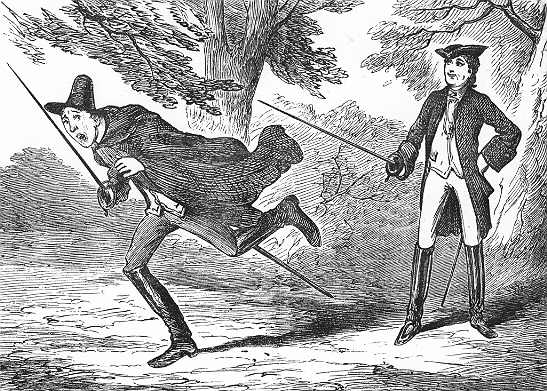
GATHERING HIS SKIRTS AROUND HIM, OBADIAH FLED WITH THE UTMOST EXPEDITION.
CHAPTER XXII.
RALPH ASSISTS LAURA GREY AND HER FATHER IN TIME OF PERIL.
"THERE is one chance," Ralph Moreton said, "if I can only reach the chamber where I had my last meal I can gain access to the outer terrace of the house. But even then�have you a boat in waiting?"
"No!" cried Laura, in despair.
"And tell me," asked Ralph, still more puzzled, as he hurried on the rest of his things, "how did you reach the terrace outside this window?"
"From my window," replied Laura. "My father and I occupy the rooms next yours."
Ralph mused a moment.
He could, indeed, see no way out of the difficulty.
Laura feared he was giving up.
Gently placing her hand on his, she looked imploringly up into his face.
Who could resist the pleadings of those lovely eyes?
Who could resist the contact of that little palm?
"Pray aid me," she said, wistfully.
"Yes, yes, I will," he answered. "But I must first see whether the place is accessible, before we convey your father. He is old and feeble, you say?"
"Very, but may I accompany you?"
"Yes, if you slip off your shoes."
In a moment the tiny feet were relieved of their covering, and presently the two stood upon the landing, listening to the sounds in the house.
All seemed quiet.
The household appeared buried in complete silence and repose.
"This way," said Ralph.
And he slowly began descending the stairs.
Laura Grey followed him noiselessly.
In a few moments they stood opposite the door.
Ralph�s heart had misgiven him when he had heard that Molliver had so closed up the house, for he expected to find the room inaccessible.
It was not so, however.
The door was open; and, as soon as they had entered, Ralph closed it, though he was unable to lock it.
Then he approached the window, and while Laura held the lamp, which was now on to the full again, he soon contrived to undo the irons in the same way as Sir Paxton Greaves had done.
"Now," he said, "remain here a moment while I pass out and see how your escape can be effected. It seems to me, at present, an impossibility."
So saying, he clambered up, and in a moment had disappeared out into the gloomy night.
It was while Ralph Moreton was outside in the darkness of the old bridge that Laura suddenly heard a stealthy step approaching along the passage.
She at once sprang to the door.
But too late.
A tall, thin form glided into the room, and with a smothered cry she recognised the Reverend Obadiah Scramper.
A diabolical smile wreathed itself over his lips as he sat down quietly in a chair by the table.
"So, my lady," he said, "we meet again."
"Yes," replied Laura Grey, who had now recovered her self-possession, and had placed herself so as to hide, as far as possible, the hole in the wall. "Pray, may I ask what you want with me?"
"Nothing," replied Obadiah.
"Then why are you here?"
"Because," replied the preacher, relapsing into his snuffle, "because where the dove goes the hawk follows."
Laura disdained to reply.
Another reason, too, caused her to remain silent.
She heard without a strange scraping, splashing noise, and at once concluded that Ralph, in spite of all peril, had brought a boat beneath the arch of the old bridge.
"Oh, for a moment to speak to him," she thought.
Then a sudden idea struck her.
Shivering, as if with cold, she advanced boldly towards the window and drew across it a curtain.
As she did so she cast a hurried glance out into the darkness.
But in vain.
The scraping, splashing sound continued, but no signs of any human being were to be discovered.
"Well," said Laura, at length, seeing that Obadiah Scramper sat silent and motionless in his chair, "since you are determined to remain here, I will go."
He sprang up.
"Not so, my little one," he said, with a hideous leer. "I am not tired of your company yet. Titus Macintire will be here presently, and will have a few questions to ask you."
At this moment there was heard the sound of someone scrambling in through the opening in the wall, and Laura, assured that her deliverer was at hand, retreated backwards to her old station.
In another instant Ralph scrambled, feet first, into the room.
He stared with unfeigned astonishment as he saw the preacher standing in the doorway.
"Why, you unmitigated old ruffian," he cried, "what are you doing here?"
"I am here," said Scramper, "to spoil a nice little plan of escape."
With these words the preacher took from his pocket a silver whistle.
But he had no time to use it.
With one bound Ralph sprang to the door, and stood there, dagger in hand.
"Quick, Laura!" he said; "remove these bottles and glasses from the table, and tear the cloth into three strips."
The girl without inquiring the reason obeyed at once.
"Now come here," said Ralph, "and stand by the door."
As the girl took up her position Ralph advanced.
"Now, then, my right reverend friend," he said, holding up his dagger, "I�m going to bind and gag you, and if you make the slightest resistance I will plunge my dagger into your heart. You have hunted me enough, and I am now desperate."
As he spoke he seized the now trembling wretch and forced him on his knees.
While Ralph held his dagger threateningly over him, Laura bound tightly the wrists of the abject coward.
They then laid him flat on his back on the ground, and bound his feet and ankles.
"You shall suffer for this," he said, in a bitter voice.
"Oh, you are going to talk, are you?" said Ralph. "We must stop that."
He looked around him, and finding nothing at hand better for a gag he crammed a large piece of bread crumb into the preacher�s mouth.
Then he tied up his jaws with a piece of the table-cloth and left him.
"We must be quick now," cried Ralph, "or the boat will break from its fastening. The surf is heavy, and the wind high."
"Follow me," said the young girl, in tremulous accents. "How we are to contrive my father�s descent from yonder window is, to me, a mystery."
"Do not meet evil half way," exclaimed Ralph. "We must trust that all will be for the best."
There was still abundance of peril to encounter.
Of course Scramper was not without friends in the house.
He was not the man to risk himself in such an enterprise alone, and Ralph, who suspected even Molliver, was extremely anxious to wake no one.
Stealthily they crept up the staircase of the old inn.
At length they reached the door of a chamber which was ajar.
Into this they glided.
The old man lay fully dressed upon the bed, his eyes closed in sleep
It seemed hard to disturb him when, perhaps, he was dreaming of other and happier days�when, perhaps, the angel memories of youth were floating round him, and the bitter present was lost in the bright past.
But there was no time for such thoughts.
The old soldier had been used to sudden arousings from slumber, swift marches in the night, and swifter pursuits through the perilous darkness.
Laura, too, was accustomed to such scenes, and so gently, but firmly, awakened him.
"Dearest father, we must leave this place at once."
He sat up with a feeble smile.
"What, again, my child?" he said. "I begin to feel that I shall not be sorry when an angel, brighter and more beautiful even than you, shall wake me with a whisper��We must leave this place for ever.� "
"Indulge not in such horrid thoughts, father," said Laura. "I feel that our troubles will soon be over. See, here is a new friend who has come to our assistance."
"Yes," said Ralph, stepping forward, "your worst enemy lies gagged and bound downstairs. Once escape from this place in the dead of night, and no one can trace you along the silent highway."
"Well, then, let us go," cried the old man, "although my feebleness will scarcely admit of haste."
Aided by Laura and Ralph, the veteran contrived at length to reach the secret chamber where Scramper lay helpless on the floor.
Arrived here, they carefully closed the door, then they were about to commence the escape when the old man caught sight of the wine.
"Pour me out some of that, it will give me energy for the time, and enable me to drink the toast I love in the face of that wretched villain. Sit him up in a chair while I drink it."
Ralph having complied with this strange demand, the veteran filled a brimming glass, and raising it above his head with unusual vigour cried�
"Long live the house of Stuart, and confusion to his enemies!"
And having said these words, and drunk his wine, he dashed the dregs of it in the face of the infuriated spy.
"Think me no coward for this," he cried, addressing Ralph Moreton; "twice this wretch has assailed me when I have been helpless, wounded, and dying. But the time may yet come when, with the strength of my right arm restored, I shall meet him face to face, sword to sword, and cleave his recreant heart in twain."
"Time presses, and we must be gone," said Laura, gently.
"I will go first," cried Ralph, and hastening to the aperture, he quickly made his way to the outer opening.
It was a wild and stormy scene that he now gazed upon.
Not a star was visible in the black vault of Heaven, and the moon which ever and anon peered through a rifted cloud, only served, with its misty light, to show how gloomy everything was.
Beneath the threatening canopy, the river rushed and reared through the arches of old London-bridge, dashing up the spray almost as far as the spot where Ralph peered down anxiously into the darkness.
Weird shadows from thc houses above trembled on the leaping waters, while on the right of him, amid the almost indistinguishable gloom, was a still denser mass of shade, which he knew was the city of London.
There was no time, however, for hesitation.
He had embarked, rightly or wrongly, in the enterprise, and he must go through with it.
After trying the rope to see if it was secure, he stretched out his hand to the old man, and from his perilous point of vantage began to assist him down.
"Remain on the stonework until I descend," he whispered.
In a few moments the descent had been successfully made, and Laura Grey followed.
Ralph, having been given a whispered signal from below, slid quickly down the rope.
It was perilous work to enter the boat amid the froth and surf of the raging tide.
But anything was better than to return.
Ralph, lying down upon the wet stonework, grasped the side of the boat with both hands, and held it firmly, while his companion and daughter entered.
Then he himself took a seat in the centre of the frail craft, and took to the oars.
In another moment the boat was rushing rapidly along with the tide towards Westminster.
* * * * * *
It was early in the morning when Ralph Moreton crept into the room where Obadiah Scramper had succeeded in rolling on to the carpet once more, and having chewed and swallowed his bread, had fallen into a sleep after a long and useless howling.
The young lad at once released him.
"I know where you will go to-morrow," said Obadiah, with a savage scowl, as he scrambled to his feet.
"You can go where you like," said Ralph; "I am going to bed."
With these words he turned on his heel, and left Obadiah in the dark.
Before breakfast, Ralph entered his master�s room, and informed him of the events of the night.
The baronet made no remark as he listened to the story of the old man and his daughter, but the page could see how eagerly he drank in every word.
"You must leave this place at once," he said. "I will give you a letter to a friend not far distant, where you can remain all day. To-morrow we will meet and defeat this reverend villain; but to-night I have an important mission for you."
"How then am I to receive my instructions?" said Ralph.
"I will bring them myself," said Sir Paxton. "But go at once, here you are in danger."
Ralph at once quitted the room, and in a few minutes was hurrying safely along the bridge.
"Curse that fellow, Scramper," muttered Sir Paxton as the page left him; "he has discovered our secret chamber, but I will be even with him yet."
The baronet was punctual to his appointment.
It was already dark when Ralph Moreton hurried away from the house towards the precincts of Alsatia.
His brain was in a strange whirl of excitement.
A gloomy presentiment of coming evil took possession of his mind.
Was he about to be plunged into some fresh mystery, or was this merely the gradual righting of circumstances?
Considering it unmanly, however, to entertain these dark thoughts, he essayed to cast them off, and pressed on towards his destination.
Eventually he reached Whitefriars, and turning down a narrow street, he found himself opposite a gloomy, murky court, into which, after glancing at the name of it, he walked hurriedly.
He looked at the address of the letter in his hand, and perceived that the number of the house he was about to visit was "4."
A revulsion of feeling flew to his heart.
The house which rejoiced in the designation of No. 4 was the lowest and dirtiest in the court.
It looked a regular den of infamy.
On the left side of it was situated a small tavern, and in front of it hung a signboard which bore the name of the "Sentinel."
Outside the tavern, and ranged round a table, were about half-a-dozen men, whose villainous countenances caused Ralph to feel an uncomfortable sensation.
They were too interested in their beer to notice him.
Fortunately, perhaps.
Could there be a mistake in the direction of the letter?
He looked at it again, the house before him was the correct one.
While he hesitated, a hand was placed on his shoulder, and a rough voice said�
"Well, youngster, what want you here?"
Ralph started in surprise.
Turning round, he observed a tall, sturdy man, dressed in a labourer�s garb.
A sinister look pervaded his features, and even his eyes seemed to sneer.
Recovering his self-possession, Ralph demanded�
"What business is that of yours?"
The man cocked his head on one side and said�
"Now, no impudence, or I shall pitch into you."
"I can take care of myself," cried Ralph. "So I warn you�"
"As sure as my name is Eastbourne, I�m dashed if I don�t�"
"What?" said Ralph. "Is your name James Eastbourne?"
"Yes," replied the man.
"I have a letter for you, then."
This somewhat mollified Eastbourne, and he answered�
"Who from?"
"Sir Paxton Greaves."
The look of fear that came over the man�s face was indescribable.
"Give me the letter," he said, hoarsely.
Ralph handed it him.
One glance sufficed to tell the man that what Ralph had told him was true; then, turning round, he said-
"Follow me."
Ralph did so.
The man led him up the stairs of the house, and then took him into a small and scantily-furnished apartment.
After requesting Ralph to seat himself, he set the example, and commenced the perusal of the letter.
The man devoured its contents eagerly, and, as he did so, his colour came and went by turns.
At length he rose up with a sigh, and, fetching the materials, he began to write a note to Sir Paxton, hurriedly.
For a few moment, naught could be heard but for the scratching of the pen.
Then, having finished the note, the man gave it to Ralph, saying�
"Be careful with this letter. You may be watched."
Ralph took the missive and left the room.
Arrived at the street-door, he breathed a sigh of relief, and made with all speed in the direction of old London-bridge.
Involuntarily he glanced towards the spot where he had seen the ruffianly group of men as he turned the corner of the street.
They were gone.
Keeping in as straight a line as possible, Ralph hurried on.
So wrapt was he in his own thoughts that he did not perceive three dark figures steal across the road in front of him, and conceal themselves in an old ruined house that stood by.
As he neared the spot, however, a slight noise startled him.
Before he could realise the situation the three men surrounded him.
Ralph recognised them at once.
They were Alsatian Bill and two of the river pirates�David Road and Gray Oldham.
"What want you with me?" cried Ralph.
Alsatian Bill answered sternly�
"Revenge!"
"So," sneered Ralph, "you fear to fight me single-handed, and therefore intend to murder me with the aid of these two ruffians."
Bill pretended not to hear these words.
Nevertheless, he fairly foamed at the mouth with rage.
"At him!" he shouted.
With a rush the three men darted at the brave lad.
What was to be done?
Alone, against three such powerful fellows, of what use was he, no matter how brave and resolute he might be?
An idea suddenly struck him.
He was near the kitchen of old Fadge and among the rough and wild members of the strange society which congregated there he knew he should find those who would help him.
So, raising his voice to its highest pitch he cried�
"Alsatians to the rescue!"
The words went leaping in echoes along the streets.
But no response came.
Planting his back against the ruinous wall he was about to shout forth again, when there was a flash of steel in the darkness, and a figure sprang to his side.
It was Sir Paxton Greaves.
"Have at them, Ralph," said he, in a cheery voice, "if we are not more than a match for three such ruffians as these, then may I never wield sword again."
The three men had a hurried consultation as to their next movements.
Not that they for a moment hesitated as to whether they should pursue the adventure.
This idea never once occurred to them.
Infamous villains they might be, and engaged this night in a murderous ambush.
But, as a rule, they were not cowards, and after a few words they advanced warily to the attack.
Three long heavy swords were formidable weapons to meet, but both Ralph and his master prided themselves on the use of their swords; and as soon as the attack commenced the light rapiers circled and flew to and fro like fiery serpents.
Of course the presence of a third enemy was a great hindrance to their evolutions; but suddenly Sir Paxton delivered a side-blow which passed clean through the neck of one fellow, and sent him with a groan to the ground.
"Now, then," said Sir Paxton, shifting his position�" now, then, we are two to two. We can play our game better now."
As I have said, Alsatian Bill and his companions were no cowards, but still this man who fenced so well, and who jested in the very presence of death, alarmed them a little.
They had plunged into the contest assured of victory.
They now felt an unpleasant doubt creeping into their hearts; and they began to fight more warily.
Sir Paxton, on the other hand, without losing his head, fought more brilliantly.
His sword had, as it were, tasted blood, and now he fought for more.
Ralph had not so good an opponent before him as Sir Paxton Greaves, who was pitted against Alsatian Bill.
Though not so well practised as his master, he presently succeeded in pinking his adversary in the arm.
The latter, angered by this, made a rash move, and stumbled over a piece of fallen timber.
This was Ralph�s opportunity, and he was not slow to use it.
With a sudden lunge forward; he ran his sword clean through his enemy�s body, and then, extricating his sword by a skilful move-
103
ent, as he fell, he turned to aid his master. But his services were not required.
Sir Paxton had driven Alsatian Bill back against the stone wall, and here, having caught him at a disadvantage, he pinned him like a fly against the bricks.
Here he nodded forward for a moment, with a dull, gasping cry, and then, as the baronet released his sword, he came with a dull thud to the earth.
"Now, then," said Sir Paxton, as he wiped his sword on the coat of the man he had last slain, "let us be going. Let these assassins remain here until some of their friends pick them up."
So saying, he, without another word, led the way to the river, where they were soon afloat on the waves, on their way to the inn at old London-bridge.
CHAPTER XXIII.
IN WHICH OBADIAH SCRAMPER IS KNOCKED OUT OF TIME.
AS soon as they had reached the thoroughfare which so strangely crossed the rushing waters of the Thames, Ralph saw that Sir Paxton had, during their pull on the dark water, completely disguised himself.
"I should not know you, Sir Paxton," he said.
"No, I daresay you would not," replied the young baronet, with a laugh; "but remember this, the reverend blasphemer, Obadiah Scramper, does not at present know that I am here at the inn, or that I am alive. I have reasons why I do not desire him to do so. Whatever happens, therefore, do not disclose this fact."
"But if he has me arrested?" suggested young Morton.
"Then go�fear nothing, but go with him."
"And you will save me?"
"I will; but here we are. I will enter first."
There was a somewhat large crowd in front of the inn bar.
Sir Paxton Greaves, as he passed through, saw that Scramper was in the midst of it.
Ralph did not perceive him until a hand was laid upon his shoulder, and a voice said�
"Ralph Moreton, I arrest you in the name of the king for murder! This gentleman here is witness and accuser."
Prepared as he was by the words of his patron, Ralph�s heart yet sank within him.
But he assumed a bold face.
"That fellow there," he said, addressing the constable, and pointing to the preacher, "is an impostor, a thief, and a murderer, which I shall in due time prove. I will go with you willingly."
"Well, this �ere don�t look very much like guilt," said the officer; "howsomever, I must do my duty, so come along, youngster. And you," he added in a rather a supercilious way to Obadiah, "must come to make the charge."
That night Ralph slept in Newgate.
An abundance of lawyers presented themselves to him, but he engaged none.
He resolved to depend entirely upon Sir Paxton Greaves.
"I am innocent," he said, "and; can prove it."
As soon as the time arrived he was ushered into court; and there, pale, stern, resolute, he stood in the dock.
A murmur ran through the assemblage as their eyes fell upon him.
"He�s not guilty."
That was the general verdict.
But when the judge entered, the hearts of everyone sank.
He was one of those thin-faced, dark-browed old men, with bending form, and hawk-like nose, and ferretty, restless eyes, to whom one would fear to trust his life.
He eyed the prisoner sternly.
To him, everyone was guilty until he was proven innocent, and his look seemed to say�
"You hardened young villain�so I�ve got to try you, have I? Well, well, your good looks shan�t stand you in good stead. You shall be dealt with with the utmost rigour of the law."
But Ralph looked undaunted.
His faith in his own innocence, and in the power of Sir Paxton Greaves to save him, was illimitable.
The trial commenced�or, rather, the first public examination.
The landlord of the inn, Grunt, and his wife, were the first witnesses against him.
They deposed to the fact that Sir Paxton Greaves, a gentlemen whom they knew well, took rooms in their house for himself and his page on a certain night.
They said that no noise of any kind was heard in the night, but that in the morning an outcry was raised, and, on going up to the baronet�s bedroom, they found Sir Paxton lying in the bed with his throat cut.
Obadiah Scramper was the next witness, and he, of course, gave similar evidence.
Ralph only asked these witnesses one question�
"Would you know Sir Paxton Greaves if you saw him?"
"Yes; but he�s dead."
"Never mind that. Could you swear to him if you saw him?"
"Yes, I could."
"Very well," said Ralph, "I am content. I have only one witness to call."
Various other circumstances were brought forward, such as the bloody knife, the hesitation and excitement of Ralph, and so on, and last, and most suspicious of all, his escape.
Such was the prosecution.
The judge examined the prisoner minutely as to his name, his antecedents, and so on; but Ralph resolutely refused to explain anything.
He resolved not to sacrifice his chance in the future to present fear.
The judge was baffled.
And angry, too.
"Young man," he said, "you are not giving your answers straightforwardly. This will all go against you."
"I am telling the truth, my lord," said Ralph.
"Yes, but keeping back a great deal."
"I acknowledge that, my lord."
"It is very foolish.:
"You will not say so, my lord," said Ralph, "when you hear the evidence of my witness. I am innocent of this crime, and can prove it, and my reason for concealing some things is that, were I to tell them now, they would injure me in the future. Some day I shall be able to prove what I cannot do now, and that is, that the man who gave evidence against my just now is a thief and a murderer."
The judge listened with evident interest.
He had been by no means favourably impressed by the Reverend Obadiah Scramper, or his way of giving evidence.
Still, he could not sit on the bench and hear such statements as these.
"Come, come," he said, "you must not talk like that, until you have something in the way of proof. I cannot listen to an accusation. Where is your witness?"
There was a movement at this moment in the court, and a tall figure came forward.
He had a huge beard and moustache, and none or his features were really distinguishable, save his nose and eyes.
"Your name, sir?" he was asked.
"One moment, before I tell it," said the witness. "I wish to state that I come here to prove that this lad has been placed in the dock for a crime that was never committed. Sir Paxton Greaves is not dead!"
An electric thrill passed through the crowd.
"This is a strange statement," said the judge, whose face seemed to express a great degree of pleasure. "I hope you will be able to substantiate it."
"I can, my lord," said the witness, "for I am he!"
And, taking off his false beard and moustache, he stood calmly surveying the court.
A thrill of wonder passed through the minds of all.
It seemed, after the evidence of the witnesses for the prosecution, like a resurrection from the dead.
"Call back Obadiah Scramper," said the judge.
The preacher, pale and trembling (for he really had believed in the death of Sir Paxton), got into the witness-box again.
"How do you account for this?" said the judge. "Is this Sir Paxton Greaves?"
"Well," stammered the preacher, "certainly it is he�that is to say, the features are his, but�but�"
"But what?"
"It must be his ghost," gasped Obadiah.
"Nonsense. Was the man whom you saw lying dead, buried?"
"Yes, my lord."
"You know where?"
"I was present at the funeral, and saw the coffin laid in the vault."
"You can point out the exact spot?"
"Yes."
"Well, then," said the judge, "the only thing to be done is this: I will send down with you to the place two of the constables, you shall point out the coffin, and upon the condition of that this case must be decided. Where is the place?"
Scramper named it.
"Ah! but an hour�s ride," returned the judge. "The prisoner and the gentleman, here, can remain together in the ante-room while you are gone. They will not be detained long. Call on the next case."
In spite of this, however, he found time to whisper to the constables, ere they started�
"Be careful of that man�let him not escape."
Obadiah, however, had no such idea.
A sudden light seemed to have flashed across his brain, and he was eagerly looking forward to the journey.
To those who waited, and more especially to Ralph Moreton, the time of their absence seemed immense.
It dragged by wearily.
Yet Ralph, though dispirited at having to appear in such a scene, and, in fact, be a prisoner at all, was not afraid.
As Sir Paxton Greaves was there to befriend him, he feared nothing.
At length, at six o�clock in the evening, the constables returned, and with them the Reverend Obadiah.
The whole court was in a state of excitement.
Even the judge was anxious.
In spite of his stern and uncompromising demeanour, he was a good and just man at heart, and he had, during the last part of Ralph�s examination, conceived an idea of his innocence.
When Obadiah Scramper and the two constables re-entered the court, the former looked pale and downcast.
He had the appearance, in fact, of a man who had been thoroughly disappointed.
As soon as the prisoner and Sir Paxton had re-appeared in the court, Obadiah was again placed in the witness-box.
"Well," said the judge, "what is the result of your journey?"
"My lord," said Obadiah, with a melancholy snuffle, "there has been some vile trickery at work. When we entered the vault we found the coffin with the name of Sir Paxton Greaves upon it, but empty."
"I could not be in the coffin and in this court, too," said Sir Paxton Greaves.
"This seems, indeed, a strange case," said the judge; "but if none of you can prove that this is not Sir Paxton Greaves the affair is at an end."
"I do not dispute his identity," said Obadiah, "but I cannot understand it. He was perfectly dead when I saw him at the inn; his throat was gashed from ear to ear. I saw him three days afterwards, and I saw him buried."
"And yet he is here, and you do not dispute it," said the judge.
"I cannot," said Obadiah.
104
"The prisoner is discharged then," cried the judge.
There was not a murmur in the court as these words were pronounced.
As I have said before, there were very few people among the spectators who had not, at the commencement of the trial, been impressed with an idea of Ralph�s innocence.
But a strange feeling had now fallen upon all.
There was something horrible and supernatural in the whole affair, and the judge, and the lawyers, and the audience were all of them glad when Sir Paxton Greaves disappeared from the room.
Among the more superstitious, the idea presented itself that the spirit of the murdered man had returned to the world for some strange reason to save and defend his murderer.
CHAPTER XXIV.
THE ESCAPE.
IN the midst of the fierce and angry scene which was waged at Fadge�s cellar, between the Alsatians and the watch, it was not observed that a figure, wrapped in a cloak, had glided through the combatants, and concealed itself in the shadows of the dark staircase leading to the sleeping chambers.
My readers will not have forgotten that this eventful night was the one chosen by Lily for the escape of Bella from the house of old Fadge.
No one would have imagined that the slightly-built, handsome young man, with the moustache, who waited quietly to see the end of the fight, was Lily herself.
But it was she.
As Tom the Link Boy sprang by her and leapt up the stairs, she had felt an inclination to rush after him.
But she restrained herself, knowing full well how utterly recognition would destroy all her plans.
As soon as the hubbub was over, she hurried up to Bella�s chamber, where she found her sitting as we left her, with Tom.
The young girl started up in amazement as she beheld her visitor.
But Lily soon set her fears at rest.
"Be not alarmed, Bella," she said, "it is I, your friend. I have been compelled to adopt this disguise in order to render my entrance here safe.
"Tom," she asked, turning to our hero, "watch on the stairs while Bella puts on the things I have brought with me; in her present dress she would be followed and captured."
The difficulty now was how to escape.
Bella suggested, of course, the shaft leading to the cellars.
But this was at once dismissed as useless, when they were reminded by Tom it was high water. At length an idea struck Tom.
"Follow me," he said, "and the instant you hear my voice enter the cellar."
He then opened the door, and the three passed down noiselessly towards the large gloomy hall at the bottom of the staircase.
Arrived here Lily and Bella retired into the shadowy corner while Tom boldly entered the den of Alsatians.
The reckless band of bullies and thieves were holding high holiday over what they esteemed the defeat of the watch.
For, although the latter had forced their way to the topmost storey of the house, they had not succeeded in capturing Ralph Moreton.
Drink was flowing about everywhere, and, in spite of broken noses, slashed faces, and cracked skulls, the Alsatians seemed to enjoy themselves immensely.
Nobody noticed Tom�s entrance, and the object with which he had passed into the room was, therefore, more easy of accomplishment.
As he passed by one of the tables he kicked violently the shins of one of the men who was sprawling on one of the benches.
The answer was a severe blow, which sent Tom staggering.
Tom immediately seized a tankard of ale, and at a pretence of throwing it over the man, he cast its contents so that it extinguished in an instant the dull, sputtering oil-lamp that was the only light in the cellar.
Everything was in utter darkness.
Now was the moment for escape.
Amid the universal scrambling, fighting, swearing, and smashing of crockery that took place, there was no chance of discovery, and Tom, therefore, leaping and struggling over the forms and the tables, made his way to the back door.
"Quick; follow me!" he cried.
Taking Lily by the hand, he dragged her, panting and terrified, into the hideous scene.
It was not so easy as Tom had imagined to make their way into the open air.
Everybody was shouting for a light.
And above all the horrid din could be heard the voice of old Fadge, exclaiming�
"Oh, mein Got! mein Got! my peautiful tings! Poys, poys, be careful; have a little
patience, poys, and I will get you a light."
At this moment there was a terrific uproar at the door.
(To be continued.�Commenced in No. 78.)