73
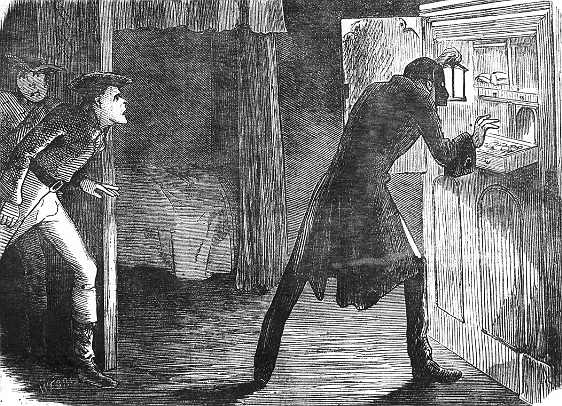
"WELL, I NEVER," SAID ONE OF THE THIEVES, "IF THERE AIN’T SOMEONE HERE BEFORE US!"
CHAPTER XV.
"SWEENEY TODD MAKES A CLEAN SWEEP."
"AND you wish to share the riches, I suppose?" said Samuel, smiling.
The other smiled, still retaining his position half-way through the trap door.
"Well, I wouldn’t mind taking a tenth part of what we discover," said he; "I think that would be fair, if I help you to get rid of that thief and assassin. But, I’ll tell you what, let’s take him alive, bind him, then search the house, take away nearly all his money, and then give him up to the authorities. He’ll swear all manner against us, but he won’t be believed."
"Agreed!" said Samuel, "and let us be at him at once."
The stranger at once leapt up on the floor, and drawing from his pocket a large clasp-knife, he unfastened it and prepared for the struggle.
"I would advise you to give in," cried he, as he warily approached the trembling barber, "it is impossible to save yourself, it will be certain death to resist."
"I may as well die by one means as another," replied the barber. "If I am given up to the authorities I shall be hanged, and I prefer death by the knife. So come on, both of you."
The answer was a simultaneous attack.
They approached warily, like North American Indians.
Then, suddenly, they both struck.
Only one blow took effect.
The blow which the stranger planted in the left shoulder of the barber, which made Todd writhe with agony.
The blow of Samuel was avoided, and his weapon stuck in the woodwork, and, taking instant advantage of this, the barber dealt his enemy a fearful blow in the chest.
At this instant, as Samuel reeled back, there was a chuckling cry heard near them, and then a third figure appeared on the scene.
None other than Mad Cluney.
The barber gazed at him aghast, while over the stranger’s face there wreathed a strange smile of satisfaction.
"Curse that boy!" thought the barber, "he has escaped once more, and this time he will be my ruin."
Then a sudden idea rushed like lightning through his brain.
He knew well the sudden freaks which are taken by mad people.
"Cluney! Cluney!" he cried, "help! help! these men are murdering me, and will then murder you. They are going to set fire to this place, and burn us in the flames. Help me now, and you shall have your freedom; you shall leave the house this night, and go back to your friends."
The boy heard the word "freedom," and opened wide his mouth as if to inhale with it the air.
"You’d let me go?" he cried.
"Yes."
" To-night?"
"Yes, the instant we’ve disposed of these two fellows. Come on, Cluney, in an hour you and I will be off to your cousin’s. There’s a knife in yonder drawer. At them! Strike hard, Cluney; no mercy!"
The knife which the lad drew from the place indicated was a formidable weapon, with full ten inches of blade.
The boy waited for no further orders.
He sprang like a maddened tiger at the very man whom he had, a short time before, been instrumental in saving, and, ere he was aware of it, inflicted a wound in his side.
Both were now sorely wounded.
But still it was only man to man.
The desire for gold kept them both from crying out, and alarming the watch or the public, and so, faint as they were from loss of blood, they renewed the struggle with redoubled fury.
The new accession of strength to the side of Sweeney Todd caused the two men to glance in wondering doubt from one to the other.
One thing was certain.
Their very lives depended on their determination and courage, for from without no help could be expected.
The room in which the conflict was taking place was so peculiarly situated that not a sound could be heard in the street.
So when Mad Cluney, urged on by the hope of freedom, leaped into the affray, the stranger who was the least wounded of the two, at once flew at Sweeney Todd, leaving Samuel to contend with the lad.
Then commenced a fearful and sickening struggle.
The four combatants hacked and hewed at each other, slashing and cutting with desperate fury, the blood pouring out upon the floor and splashing upon the walls and the furniture.
It was a fight for life or death, and, in Mad
74
Cluney’s case, freedom, too, was looming in the distance.
At length Samuel’s strength gave way.
Wounded as he had been during the fight with the demon barber, he could not withstand the attack of his fresh antagonist, and, after a gallant struggle, he fell to the floor.
In an instant Mad Cluney was on him, knife in hand.
"You are mad," cried Samuel, in as loud a voice as he could raise, "if you believe the words of this man. He is a wretch—a very devil—and you cannot trust a word he utters."
The lad did not answer.
His eyes were glaring, his mouth open and panting, his nostrils dilated.
He seemed, indeed, like a wild beast who had scented blood.
Probably he did not comprehend half that Samuel said to him.
At any rate, the one idea was in his mind that Sweeney Todd had offered him his liberty, and that to achieve that he had to kill this man who was now at his mercy—this man whom he knew nothing of, who was an utter stranger him.
And so, beating down Samuel’s clutching hands, he drove his knife deep into the victim’s
breast.
With a crowing cry of delight, Mad Cluney sprang up, and rushed to the help of Sweeney Todd, who was now getting the worst of it.
This settled the matter.
It was impossible for the traveller to withstand the attack of two demons armed in the way they were, and at length, after a desperate conflict, he too, succumbed, and, with two knives buried in his breast, gasped out his curse upon his murderers.
Both Sweeney Todd and Mad Cluney, when they rose to their feet, sank exhausted into chairs.
Anyone less accustomed to horrors would have been terrified and sickened at the scene; the floor slippery with blood, the broken and splashed furniture and walls, the two corpses, hacked and mutilated, lying as the agonies of death had left them.
Both of these wretches had seen 8so many deaths and murders in their time that the spectacle had little new or horrible for their minds.
To Sweeney Todd the death of these men represented the continuance of his career of crime.
To the poor insane lad, who had been led into the sin of assassination, it represented the commencement of a life of freedom.
"Cluney," said Todd, at length, "go to the cupboard yonder and get out some brandy. Then we must clear up this place and conceal the bodies, and so on, or we shall get into trouble."
"And then when we have done, master," said Cluney, "I may go—mayn’t I?"
"Oh, yes. I shan’t want you any longer after that," said Todd, with a diabolical grin, as he tossed off a large glassful of raw spirits, and gave one to Cluney. "Now then, help me down with the bodies of these two fools; and then we must pull up the carpets and wash the floor."
The unfortunate victims were soon carried below, and then, the lights being put out in the shop to show that business was over, the two commenced tearing up the carpets and scrubbing away at the floor.
A fresh piece of carpet was then placed, so as to conceal the trap-door as before.
"Now, then," said Cluney, rubbing his hands with glee, "now, then, all’s over, and I can go."
"Yes," said Todd, and then, as the lad turned, he leaped suddenly upon him, and buried his knife deep in his back.
The blow was well aimed—sure and strong.
Scarcely a speck of blood came, and the unfortunate lad fell to the ground, exclaiming, in a choked and wretched voice, the one word—
"Mercy!"
That word—what a mockery it was in such a place, where the very idea never had an existence.
"Fool," muttered Sweeney Todd, as he lifted him up his arms and prepared to descend the stairs, "to think that I should let him loose upon the world with such a secret on his lips. Well, well, Mrs. Darkman can’t complain of the supply to-night; there’ll be more than we can well use."
And so muttering, the loathsome ruffian took his way to the cellars with his last victim.
CHAPTER XVI.
WHAT THE THIEVES FOUND AT MORETON HALL.
IT will be remembered that when Clara so impressively refused to permit the robbery taking place at Moreton Hall, Captain George told his men to proceed with their work, and that he would answer for the lady.
Clara had too much good sense and too much experience, too, of Captain George’s character not to thoroughly understand the absurdity of running counter to his wishes in any way, under the extraordinary circumstances in which she found herself placed.
So, petulantly and sullenly, she seated herself in her arm-chair and looked at the fire, tapping her little foot on the hearthrug, and expressing her anger more by silence than she could have done by words.
Meanwhile, the men acting under the instructions given to them in minute detail by Captain George, hurried noiselessly on their way.
They knew exactly their destination, which was no other than the private bedroom of Mrs. Moreton, where George knew, by experience, that a large sum of money was kept.
Of course, at this period of the night, Mrs. Moreton, being an early bed goer, was supposed to be in her couch, and asleep.
So, when the thieves reached the door of her chamber, they were surprised to see a dim light flickering to and fro, and the sound of someone evidently moving about.
Angry at the prospect of being thus prevented from capturing their plunder without effort or peril, one of the men pushed open the door gently and peered in.
It was a large chamber, so large that a lamp which illumined one end left the other in complete obscurity.
In the dark part of the apartment was the great fourpost bedstead, in which lay Mrs. Moreton, in a strangely quiet and heavy slumber.
In the light portion was a man in a mask—ransacking the contents of a bureau.
"Well, I never!" said one of the thieves, with a low, dry laugh, "if there isn’t someone here before us."
"S’help me never" said the other; "let’s creep in and see what’s his game."
The two thieves now glided, in their professionally gentle way, into the room, and took up a position behind the heavy bed-curtains.
The man, who was so busy at the bureau that had they made a greater noise he would not have heard them, was a slim personage, apparently about forty years of age.
His features, however, were, as I have said, obscured by a black mask.
Eagerly he read each scrap of paper which he found, throwing some by impatiently, lingering over others, and then again thrusting some eagerly into his pocket.
"Fool!" muttered one of the thieves; "he is wasting time in purloining these useless pieces of paper. We won’t give him much more time, for I’m anxious to see the yellow boys."
But they were wrong if they imagined that the searcher was only seeking for papers; for in a few moments he opened another drawer, and began pulling out the "yellow boys" in handfuls.
A comical idea suggested itself to one of the thieves.
"Job," he whispered, "he’ll eave us the trouble. He can fill his pockets, and then, when be goes downstairs, we can ease him of his load."
"All right, Jacob," said the other. My hi! ain’t he a-lifting of it in."
True enough, he was filling his pockets; dipping his hands in the golden treasure, pausing to gaze at the sparkling coins and chuckle.
At length, when he had emptied the drawer, he closed the bureau again, and turned out the lamp.
Then, in the dim, uncertain light of the room, he made his way to the door.
The thieves waited until he had descended the staircase to the second landing before addressing him.
They walked down noiselessly after him in their stockinged feet, and then, by a preconcerted arrangement, they both stepped forward. Both seized him by the hand, and both said, in an unctuous, jocular voice, though subdued in tone—
"A word with you, gentle stranger!"
The man, whoever he was, at once proclaimed that he was not belonging to the house by the trembling that pervaded his body.
But he endeavoured to put a bold face upon the matter.
"What mean you?" he cried. "Why do you thus detain me?"
"We desire the pleasure of your company awhile, gentle sir," replied Job; "if you will accompany us into the room yonder we will enter into refreshing explanations. This way, please."
Not knowing, of course, who were the persons who were thus addressing him, and naturally conceiving from their bold manner that they belonged to the house, the robber thought discretion the better part of valour.
They were two to one.
And, besides, he saw the gleam of pistols, whereas his own weapon lay still concealed.
He accordingly suffered himself to be led gently into the room where Clara and Captain George still sat.
The latter stared in amazement as his two emissaries entered with a stranger and locked the door.
"Why, what means this ?" he cried. "What farce are you enacting?"
"No farce at all, noble captain," cried Job. "You see this fellow? Well, we found him up in Mrs. Moreton’s room, a-rummaging out all manner of things, papers and such like, and then he comes to a drawer chock full of gold. So says I to Jacob, ‘That ‘ere cove ‘ll save us the trouble of carrying the money downstairs.’ So he has; and now, my noble scarecrow, please dub up."
With which words Job placed against the stranger’s ear the cold muzzle of a pistol.
"Let him take off his mask, too," said Captain George, "so that we may know him at any future merry meetings."
Jacob waited for no further words, but cutting the strings of the mask, let it fall to the ground, and there, exposed to the gaze of all, were the cadaverous, angry, ghastly features of the Rev. Obadiah Scramper.
Captain George eyed him fixedly, while he said—
"Lads, empty his pockets, and fill you own."
The order was at once obeyed.
Every coin was extracted.
"Now for the papers," said the captain.
"What, them scraps of things?" cried Job. "Oh, they ain’t no use."
"Yes, do as I bid you. If they are of use to him they are of use to us—at any rate take them."
This order was also obeyed with the greatest alacrity.
When the performance was over, Captain George walked across, and, standing with his arms folded, surveyed the thief for a moment.
Then he said—
"We have met before?"
75
Obadiah looked sheepish.
But anger was in his eyes.
"You are mistaken," he said.
The captain laughed drily.
"Oh, no," he said. "I never forget faces. You and I have met before. Shall I tell you where?"
"If you can."
"In the yard of Newgate Prison, whence you would have been taken to be hanged for murder, of some turnkey (whose palm itched very much) had not let out!"
Obadiah uttered a gasping cry and clutched at his throat.
"Hanged? No, no!" he cried, "you are wrong. You are thinking of another—you will permit me to wish you all a very good evening."
He was about to hurry off, when Captain George stopped him sternly.
"One moment," he said; "you were known then as Caleb Tadcaster, receiver of stolen goods, &c. What is your name now?"
A sickly smile played over the features of the man.
"You persist in making errors," he said, assuming with some difficulty his snuffle; "verily, I am a preacher of the word, and may name is the Reverend Obadiah Scramper."
"And where’s your drum?"
"Sir!"
"Come, no nonsense—where’s your boozing ken—your flash house where you dispose of your stolen goods? Come—no folly. I must and will know where I can drop on you at any time."
Captain George was holding his arms as in a vice, and there was an angry flash in his eyes.
He was in no mood to be trifled with.
This Obadiah saw at once.
"Well," he said, "my ministrations sometimes lead me into—"
"Stop your blasphemous talk, or I’ll throttle you. Say plainly the place and the hour, or I’ll fling you out of yonder window."
The "preacher" was overcome.
"At Slimy Bob’s," he said, "every night next week, at ten."
And then he shuffled towards the door.
"See him out," said George to Job," and fasten the door after him."
It was now for Clara to speak.
"And you," she cried, "you and your men, are you not going?"
"Yes, but not with him," he whispered; "do you desire such a scandal as this rascal would make?"
In a few minutes Job returned and locked the door.
"He went away cursing all within the building," he said, "and vowing vengeance."
"Let him," said the captain; "I know always how to close his mouth, and take the venom from his bite. And now, Job and Jacob, since you have finished your job, you had better retire to the Bullfrog and await me."
"Do you want any rhino, captain?"
"No; keep all till I come."
And the two men, trusted thus with every farthing of the plunder, moved towards the same window-tops by which they had come, saying—
"Good-night, captain, and best."
"And you, George," cried Clara, agitatedly, as they disappeared, "you must go, too, for my sake. Oh! do not bring utter ruin on me?"
"I will go," said George, "when you have listened to me, and then take your own course. I will not detain you long. Sit down again, and be not afraid."
He seated himself beside her, and, slightly bending over her, took her hand.
"Clara," he said, "you remember those days when you were at school, a handsome, vain girl, knowing full well your attractions, and not caring whose hearts you broke.
"Well, what you did to others, Heaven only knows. As regards myself, I loved you the moment your bright eyes fell upon me, and you, too, loved me in return, or thought you did.
"I was poor; you ridiculed poverty. You were rich; you boasted of it. I wished to marry you, and to do that I was compelled to raise money.
"You proposed a pretended visit to a poor relation, who had to be bribed.
"I accordingly concocted a letter, stating that this person had just come into some property, and begging you to visit her.
"The bait took.
"But then the difficulty.
"Money!
"I had none; I had no profession. I was brought up in idleness as a younger son, and then thrown on the world at my father’s failure.
"I had no friends, no relations who would advance me money, and the poor relation demanded a large sum for her silence.
"Could I lose you?
"Could I cast from me such a prize of love and beauty?
"No!
"In my dilemma there was only one desperate thing to do; and I did it.
"I robbed the Dover mail, and thereby obtained a thousand pounds.
"You know the rest; you know how happy we were; how our child was born upon a second pretended visit; how you desired me to take it to the French Foundling Hospital; how I was arrested and imprisoned.
"You know all this, I say; but you do not know all.
"You do not know that I did not take that child to a foundling hospital.
"With almost my last fifty pounds, I placed it in the hands of a good and true woman, who will be a mother to it. I have visited it again and again; its little arms have clasped its father’s neck in prison; its lips have given me kiss for kiss, without a thought of what its father was. I have seen it this very night;. Clara; and—and prayed that you might forgive me, and stretch out your right hand to lead me back to the right path."
He trembled violently as he spoke, the perspiration stood in beads upon his brow; the hand which clasped her slender palm trembled like an aspen leaf; unbidden moisture stood in his eyes.
But Clara, though her bosom heaved and her face was ashen pale, spoke not.
She sat with downcast look, as if wishing to avoid his gaze.
"Clara," he murmured, in a low voice, "by our old love I entreat you to hear me. From this instant I will quit the profession of a highwayman. I have a chance of a free pardon, and, moreover, have a friend who can place me in a good position. Tell me only, Clara, that you will love me, that you will be the same to me as ever, and I will forgive all your coldness. I will be your slave, your devoted husband. I want but your guiding hand to save me, Clara; do not refuse it me."
She flung away his hand and rose.
"This is madness—utter madness and folly," she cried; "for both our sakes do not repeat it. You have deceived me once, and would again. If the worst comes to the worst I can brave all; acknowledge our marriage, and have it dissolved. I was under age, and was wed without the consent of my parents."
"And little Clara—our child?" he said.
"The child of my folly and wretchedness," she answered, "I have been accustomed to regard as an inmate of the foundling charity. I should reject one foisted on me now."
Captain George rose, and, without attempting to touch her hand even, strode to the window.
"Farewell, madam," he said, "I can forgive all but your last speech. Kneel this night and pray to Heaven that you may never crave for the love and aid of one whom you could have saved, and whom you now send out into the night back to his companions—back to his shame, back to his sin."
And with these words he dashed out.
She remembered those words years after.
Oh! if she could have read the future on that night of her cruelty and folly.
CHAPTER XVII.
THE PIRATES AT WORK.
ABOUT four nights after Tom the Link Boy’s adventure with Lily, the Pirates’ Watch Tower was in a high state of commotion. The desperadoes, of whom Hugh Brandon was chief, had resolved at length to make an attempt upon the ships which lay in the Pool.
To have seen them getting ready for their enterprise you would have imagined that it was the regular boarding-party of a man-of-war.
The men were armed with cutlasses, pistols, and dirks, and, as far as possible, they had assimilated their costumes, so as not to present such an incongruous and riff-raff appearance.
Hugh Brandon looked the very ideal of a pirate, with broad-striped shirt and high boots, and pistols in his shiny belt, and red cap flopping over one side of his forehead.
They were all assembled in the large room of the Watch Tower, when we introduce them again to our readers.
They were an eager, excited throng, none too sober, and Hugh Brandon was addressing them.
"My men," he said, "we are going upon an enterprise of great difficulty, one that requires that those who are engaged in it shall obey the orders of their leader."
"We will—we will!"
"Very good, I’m glad to hear you say so, lads, very glad. We must creep up aboard the Eagle as noiselessly as mice. If we capture the treasure without fighting, so much the better, if we cannot, why we must show them that mice have teeth."
"Bravo! Bravo! noble captain."
"If it comes to a fight, lads," pursued Hugh Brandon, "four of you—Rolling Jimmy, Bob Ashton, Billy Barlow, and Sailor Joe—must make a rush for the money, and seize it, while the rest of us fight for it, and cover the retreat."
A roar of applause followed this speech.
"Are all ready ?"
"Yes—all."
"And the boat?"
"Yes."
"Then let us begin our work. Now—hush! not a word! Let all be silence until I say the words: ‘Out with your cutlasses, and at ‘em!’ "
Not a word was spoken.
The twelve men became instantly silent as statues; and, with almost noiseless tread, they passed through the lower door of the building, and filed down to the margin of the water, where a boat, with muffled oars, awaited them.
Into this they were placed, and were soon gliding over the waters in almost ghostly silence.
The night was a dark one; scarcely a ray of moonlight penetrated through the clouds, which hung in black, angry masses over the scene.
It was just such a night as was suited to the enterprise on which Hugh Brandon and his men had set out on.
The hour was near midnight; the Pool lay in complete and utter silence; the look-outs on the ships scarcely deemed it necessary to cast off their sleepiness, and absolutely dozed at their posts.
Gliding gently up to the side of the black hull of the Eagle, the pirates fastened their boat to the chains; and, having secured it firmly, they began to clamber up.
Not a soul observed them.
The watch was leaning lazily against the bulwarks on the other side, either looking out over the silent city, or seeing pictures of home or far-off lands in the dull, dark, rushing waters.
Hugh Brandon was the first to put his foot on the deck, and his brawny arm was at once and again extended to drag up on deck the less agile among his followers.
As soon as four were on deck, two crept over to where the watch was standing, and waited.
They were just in time, for one of the crew, in clambering up, slipped and kicked his foot against the woodwork.
In an instant the man leaped from the pictures of home, and so into consciousness that there was danger near him.
76
"Who’s there?" he began.
But that was all he had time to say.
A knock-down blow on the back of the head sent him sprawling on the deck.
The other men then scrambled up.
The sailor was hidden away under some tarpaulin. One of the pirates put on his cap and took his place, and then, led by Hugh Brandon, the robbers began their descent into the hold.
All was quite still.
The watch had fallen, aptly broken in his fall by one of the thieves, and the sailors—those few, at least, who had not gone away ashore to see sweethearts and wives—were all fast asleep.
The captain’s cabin was known to be the place where the treasure lay hidden, and as the said captain had been ascertained to be absent, Hugh Brandon and his men anticipated no particular resistance, especially when the defenders were all of them asleep.
In as much silence as was possible with a number of reckless desperadoes such as Hugh commanded, they descended to the door, which, by a sudden jerk, they prized open.
As they did so they started back in surprise.
Seated round the table were a number of men, some engaged in counting bank-notes, others gold, and others going through accounts.
The business was being conducted with the most entire silence, and the port-holes which served as windows were all closed, so as to prevent the slightest light from being seen by those on the outside.
Each man had a pistol on the table before him; and, as for an instant the startled buccaneers stood in the doorway, they sprang up and seized their weapons, sweeping at the same time money, notes, and papers into one confused heap.
One of them, a tall, stalwart fellow—not much shorter or less stout than Hugh Brandon—rushed at once to the front.
"What are you doing here?" he cried. "You are aboard the wrong ship, my friend."
Hugh, though for a moment taken aback by the bold front displayed by the crew of the Eagle, soon recovered his presence of mind.
"No, we’re on board the very vessel we want," be cried; "we don’t make mistakes like that. This is the Eagle, ain’t it?"
"Yes."
"From Rio to London?"
"Yes."
"Captain Bluff?"
"Yes."
"Then we’re right. You‘ve got some cheats of money and other valuables here that we want to remove."
"By whose orders?"
"Mine!" cried Hugh Brandon; and then, as be shouted in a louder voice, "Now, then, lads, at them!" he made a treacherous dash at his opponent, who was none other that the lieutenant of the Eagle.
The words he had just used were the watchwords, and the pirates of the river accordingly made a furious dash into the treasure-room.
But they were met by men as desperately brave as themselves.
First came a volley of pistol shots which laid three of their number low, and wounded another; and, in the midst of the confusion thus caused, they dashed to the assistance of their leader.
The latter, however, was quite a match for Hugh Brandon.
He avoided dexterously the treacherous blow aimed by the pirate at him, and, in return, whirling his cutlass round his head, he brought it round again with such a force that it absolutely sliced a piece of flesh off Brandon’s shoulder.
Hugh Brandon was not dismayed by this horrid wound.
A yell of mingled rage and pain broke from his lips.
Then, with a curse, be dashed at his foe more furiously, regardless of the blood that was pouring in torrents down his back.
A deadly and desperate conflict now ensued, in the midst of which the four men who had remained on deck dashed down to the aid of their companions.
Those who had charge of the ship were brave, resolute fellows, but they were no match in numbers for the pirates.
They had been taken by surprise, moreover, and, never anticipating such a bold and mad- brained attack, they seemed like men fighting and scrambling in a dream.
The reinforcement was a welcome thing to Hugh Brandon.
Besides the fact that he was desperately wounded, be knew full well that the firing of pistols and the clashing of arms would arouse the river constables and the crews of the neighbouring vessels.
So, by shouts, and curses, and so on, he urged his men to further exertions.
Nothing was heard but the hard breathing of the combatants, the clashing of steel, the groans of wounded men.
At length the pirates began to gain the ascendancy; and along the boards, slippery with gore, they drove the unfortunate seamen back towards the heap of gold.
"Hurrah! Give it to ‘em, lads!" shouted Hugh Brandon, at the same time spitting the lieutenant on the point of his sword. "Now, then, for the booty. Now, then!"
At this instant there was a sound which was easily recognisable by Hugh Brandon, and which stopped at once his boastful speech.
It was evidently caused by the leaping of men over the bulwarks on to the deck.
Were they friends or enemies?
That was the question.
And a dangerous question it was.
Brandon, still fighting on, listened eagerly.
He had not long to wait.
"Andromeda to the rescue!" cried a loud, manly voice—the voice of Hubert Courtenay. "Now, then, boys, follow me!"
And, with a ringing cheer, the brave crew of the Andromeda poured into the hold.
It was evident now, even to Hugh Brandon, that the case was a desperate one.
His men were now reduced in numbers, some desperately wounded; and there was no mode of exit except by surrender, or by cutting their way through the new and old enemies as well.
What was to be done?
To surrender was a thing to which the river-pirate was decidedly averse.
To cut his way through was a matter of impossibility.
Suddenly one of his men approached him, and whispered something in the ear of his captain.
Hugh Brandon’s face lit up with intense excitement.
"Stand back, my men," he said; "stand back!"
His followers at once obeyed.
"Now," he cried, as he drew his last pistol from his belt, "now, I give you fair warning. If my men are not permitted to pass untouched from the ship I will blow you all to perdition!"
As he spoke, be had been edging further and further away, until be reached the other end of the cabin.
Here be paused for a moment, and threw open the door of a small inner chamber, disclosing to his astonished enemies at least half-a-dozen barrels of gunpowder.
He pointed towards them with his pistol.
"See," he said, "mine was no idle boast. I have sworn that this night the treasure on board the Eagle shall be mine. It shall be, or we will all die together."
The looks which were cast on Hugh Brandon, on all sides, were strangely various in character.
There was no one present who did not feel a sensation of horror as he gazed at the face of the river-pirate, distorted as it was with the intensity of his passion.
But upon the features of several of his own followers could be discerned plainly a strong disapproval of his sentiments.
His heroic words, in fact, found no echo in their breasts.
They did not, indeed, quite see the necessity of departing this life in such an abrupt manner, simply to prove their determined bravery.
Had they had time to think, moreover, they would have seen the matter in a far more absurd light still, as, if Hugh Brandon’s threat was carried into effect, nobody would have survived to tell the tale.
However, the same man who had whispered to Hugh Brandon before, now spoke a few words to him again in secret, and then, before any one could stop him, or even, in fact, know what he was about to do, he sprang through the port-hole out into the river.
While all this had been going on, a hurried consultation had been taking place between young Courtenay and the lieutenant of the Eagle.
The situation was certainly a perilous one.
There was no doubt that what Hugh Brandon threatened to do he would do, and in his present position it was dangerous to attempt the slightest aggression.
His eyes were watching keenly the movements of every one around him, and it would require but an instant to hurl them all into eternity.
"Well," he cried, after a while, in a loud voice, "have you decided?"
Herbert Courtenay approached him.
"Are you mad ?" he cried. "Why should you hurry a score of fellow-creatures to a fearful doom to satisfy a paltry thirst for vengeance? You are outnumbered, the fortune of war is against you. Surrender, then, like a man."
Hugh Brandon burst into a hoarse laugh.
"Why you flimsy-looking young jackanapes," he cried, "what do you mean? Is that the kind of lesson you teach your sailors? If it is, it not my style. I’d rather never drink another cup of sack, or eat another piece of roast beef, than budge a single inch until I choose."
This instant, as the young lieutenant of the Andromeda was about to issue some hasty order, there was a loud cry above on deck.
"Fire! Fire! the ship’s on fire!"
And at the same moment one of the sailors of the Andromeda came leaping into the cabin.
"Please, your honour," he cried, in a voice which trembled with excitement, the ship’s all in a blaze, and the Andromeda, too."
The lieutenant turned hastily towards the door; and, as he did so, Hugh Brandon beckoned eagerly to his men.
They gathered round him anxiously, glad of anything that would make a diversion.
"Scramble up the money," he said, "and let us be off with the rest of them. There will be no more fighting to night."
He had scarcely spoken the word when the lie was flung into his teeth, for a pistol shot aimed by the lieutenant of the Eagle caught him on the wounded shoulder, and sent him reeling back among the gunpowder barrels, just as a huge tongue of red and yellow flame came lapping down the companion-ladder.
* * * * * *
On the same night as the attack was made on the Eagle, a tall, thin man, of cadaverous aspect, might have been seen dodging from door to door in the dark and dismal street which contained the establishment of old Fadge, the Jew.
Every man or woman who came scuffling along the lane was eagerly scrutinised by the stranger, until at length, in his hurry, he peered into the face of a more than usually mysterious passenger, he lost his footing, and came full butt against the other’s protuberant stomach.
The object of the thin man’s scrutiny at once seized him by the nose, and dragged him into the light of the dingy oil lamp which showed the dismal way to the thieves’ cellar.
"Well, you half-starved, parchment-faced, lantern-jawed son of a blue gooseberry," cried the stout man, "what are you prowling about here for?"
"I was looking for a friend," said the other, trembling.
"Looking for a friend, eh? Why don’t you put your nose in a bag, then, it’s sharp enough to cut a fellow in two?"
"Oh, I beg pardon, I’m sure," stammered the alarmed stranger.
(To be continued.—Commenced in No 78.)