[33]
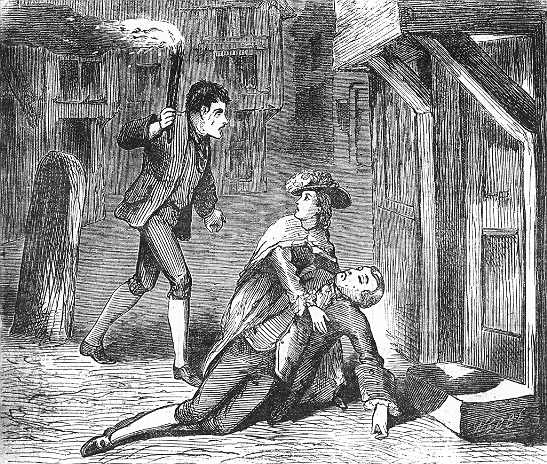
"OH! MY BOY," CRIED THE GIRL, AS TOM THE LINK BOY CAME UP, "PRAY RUN FOR ASSISTANCE—PRAY GET A COACH."
34
CHAPTER X.
RALPH MORETON RESCUED BY MOONLIGHT TOM.
"WHAT ails you?" asked young Moreton, eagerly.
"Nothing," said the preacher, recovering himself quickly, and resuming his snuffle; "nothing save a passing memory, which is a very sad one for me—very sad, indeed. But, to return to our former conversation, can you give me the information I require?"
"I cannot," replied Ralph, "and as to the other matter, I could almost have sworn that I saw you in disguise Combe Deane Heath the other night, when an unfortunate man was murdered."
Obadiah was now prepared for any emergency, and, though great drops burst out upon his brow, he said, with singular calmness—
"Never swear to a lie—be assured that the truth will prevail. But you are resolved that you will say nothing?"
"I am."
"You understand your danger if you refuse?"
"I do."
"Disgrace, loss of honour, and—death!"
"Yes."
"Very well, then," said Obadiah, between his set teeth, "very well. Your blood be upon your own head."
With these words, the solemnity of which were spoilt by the rancour with which they were uttered, the Reverend Obadiah Scamper made his way towards the door.
Here he paused, as if about to make a last appeal Ralph.
But one look at the boy’s face decided him what to do.
He pushed the door open.
"Farewell," he said, "and ponder well my words. I have offered you safety and liberty—you have chosen disgrace and death! I would have been your friend—you will find me your bitterest enemy."
And so he passed on into the night.
Ralph heaved a deep sigh.
Liberty was sweet, and he yearned for it; but he would not purchase it at such a price.
"I will trust in Providence," he said, as he cast himself upon his straw bed. "Heaven will never allow me to be sacrificed thus."
The dull light of the lamp, reflecting the murky yellow glare on the dingy walls, acted upon him rather as a soporific than otherwise, and before he had even hoped he would court the embraces of the sleepy god, he fell into a deep slumber.
How long he had slept he did not know, but when he awoke he was in total darkness, and there was a strange scraping at the door.
He sprang up, rubbed his eyes, and then, rushing to the entrance, listened.
It was evidently some one trying to pick the lock.
"Who’s there?" he cried.
"Hush! A friend," was the answer.
"Who are you?"
"Moonlight Tom. Hold your tongue, and we’ll have you out."
"It’s of no use," cried Ralph.
"Why?"
"There’s a padlock on each bolt outside," returned Ralph; "it will take all night to remove them."
There was silence outside at these words, and Ralph waited impatiently to see what was going to be done.
For a long time there was no movement among his friends.
Then suddenly he heard a sound as if someone was trying to clamber up the wall.
Ralph eagerly listened.
For some moments no sound was heard, and then he could plainly distinguish a kind of scratching, scraping sound, as if some one was endeavouring to make his way through the roof.
He guessed at once the design of Moonlight Tom, and eagerly he waited the result.
Presently there was a fall of mortar; and then a tile fell in dangerous proximity to Ralph’s head.
Then another, and another—until a large opening was made.
"Hallo there!" cried the voice of Tom the Link Boy, cheerily, as he threw the gleam of his lantern upon the interior of the round-house. "Hallo, there!—here’s a rope."
"I have got the end," said Ralph.
"Are you ironed?"
"No."
"Then haul yourself up; there’s no time to lose," said Tom.
And young Moreton lost no time in obeying his friend’s injunctions.
Hand over hand he made his way up the rope.
On reaching the top, he found no difficulty in descending to the ground, where he found Tom and two or three rough-looking beings awaiting him.
"I’m very grateful to you, Tom," cried Ralph, as he grasped his hand and shook it warmly, "I’m sorry I spoke as I did when we parted."
"Don’t preach," cried the Link Boy, "it’s all I serene; you didn’t mean no harm, and most likely did me good. But come on, we mustn’t stand talking here, or well have the constables on to us."
With these words he began leading the way to a dark place on the high road, where they found a hackney-coach in waiting.
This they entered, and were soon being driven rapidly towards London.
In order, now, to explain how it was that Tom the Link Boy arrived so opportunely to the rescue of Ralph, we must retrace our steps for awhile, and follow our hero on his journey to the Pirates’ Watch Tower.
It was a strange name to give to a place situated near the margin of the River Thames.
Yet thus, to a large band of men, it was known.
It was no more and no less than an old, disused house, built on the edge of the stream, and whose top story was far higher than anything else around.
From this elevation it was customary for one of the gang, to whom I am about to introduce my readers, to observe the incoming of the various ships, and report to the rest.
For what purpose we shall presently see.
Tom, on this night, after pulling steadily for a considerable time, shot through the strong currents of London-bridge, and, pulling to the right side of the bank, brought his boat up within a few yards of the old house.
Here he moored his skiff, and, seeing it safe, made his way over the rough stones to a black-looking, tar-covered doorway, beneath a kind of murky platform of wood.
This he opened with a key, and found himself in utter darkness.
But this had no horrors for Tom.
He was a regular night bird, and, after closing the door carefully behind him, he felt for the stairs, and began his ascent up the steps, which creaked and groaned with every footfall.
On ascending to the first-floor he entered a large room, which was filled with a strange crew.
A crew which seemed half watermen, half pirates.
They were a swarthy, sunburnt set, with rugged features, and elf-locks, and broad, sinewy frames, and wild, defiant, restless eyes.
Their dress was varied—in fact, no two seemed attired alike; but all wore long dirks, pistols, and cutlasses.
They looked, indeed, more like the boarding party of a pirate vessel than anything else under the sun.
A cheer arose as Tom the Link Boy entered the room.
"Hullo! here you are, then," exclaimed one of them, a tall, broad-shouldered ruffian, with a black beard, and raven tresses, too, falling over his face in corkscrew curls; "you’re the werry identical indiwidgel we wanted to tumble across."
Tom smiled.
Hugh Brandon was just the one person of all others from whom praise came pleasantly to him.
He was leader of the gang—head in all its robberies and piracies, the one who could punish and reward.
"I’m glad I’m here, then," he said, "I always like to be in the nick of time. What am I wanted for? Are we going into a vessel to-night?"
"No; but we are to-morrow night," said Brandon, with a chuckle, "and if we do what we think we can, a nice pretty slice of luck it will be. What we want you to do is easy. Now, keep both ears open, and hear what I have to say."
"I’m all attention, cap’n," said Tom, as he drank out of a large pewter pot full of foaming ale, which a shaggy-headed old curmudgeon had just brought in; "go ahead."
"Well, then," continued Hugh Brandon, "last night there arrived in the Pool a vessel called the Eagle. She lies yonder, by the side of the Andromeda. According to what we have heard she is full of specie and good things, but the captain has stolen a march on us."
"How’s that?"
"Why, he has all his wealth stowed away in tremendously strong boxes, the breaking open of which would delay us so long that we should be discovered. He has the keys with him, and we have traced him to an inn not far from Croydon."
"What inn?"
"The Three Reapers."
"And is he there now?"
"No; that’s where we lost sight of him," continued Hugh Brandon. "Now what we want you to do is to go down with two or three of your young pals and find out what you can. Say you are after him because you want to join his ship, pitch some yarn, find out where he is, and, if you can’t get the keys yourself, we’ll soon get them without troubling you."
"All right," said Tom, "but it ain’t five, minutes walk to Croydon! Oh! no, I can go there and back in a jiffy, can’t I? How am I to get there?"
"Rolling Jimmy will take you in hackney. -coach," returned Hugh Brandon, "so you needn’t make any bones about that. Get some grub, have a drink, and slope."
"And when am I to bring you word?"
"To-night. We will await you here."
In a few moments Rolling Jimmy had brought his lumbering hackney-coach to the door of the old house.
"Drive to old Fadge’s," said Tom the Link Boy, "and wake up the mare, too, or River Joe will be gone."
"All right, my rummy one," said Rolling Jimmy, and, lashing the sides of the old horse, he was soon rumbling along the rugged pavement towards London-bridge.
Within half an hour, River Joe and another of the occupants of the Jew’s den had entered the coach with Tom, and the crazy vehicle was being driven along the Brighton-road.
The road was dark and lonely enough, but they met with no adventures on their way to the Three Reapers.
Rolling Jimmy pulled up at the door with an attempt at grandeur which nearly brought the wretched horse on his haunches, and, as may be supposed, the ostler, as he rushed to open the door, stared with astonishment at seeing three ragged, shoeless boys descend from the coach.
Neither Tom nor his companions, however, took any notice of his gaping mouth and staring eyes.
Smacking him on the back with all his might, Moonlight Tom cried, aloud—
35
"Have you got a cove here as answers to the name of Captain Bluff?"
"Don’t know as he’s here now," said the ostler gruffly; "and look here, young ‘un, next time you lays your hand on a gentleman, be a little more gentle."
"Never mind, old stick-in-the-mud," said Tom, "come and have a drink. And I tell you what, if you will give me a little information about this ‘ere captain you shall have a crown."
It happened, as luck would have it, that this was the exact sum that the captain of the Eagle had paid him to hold his tongue.
However, there was no harm, he thought, in doubling the coin, especially as it was not to be supposed that the three lads had followed the captain with any villainous purpose.
The ostler was a man of some common sense, and he wisely concluded that the appearance of three such ragged objects in the bar would create an excitement which would lead to the destruction of his money-grubbing plans.
He determined, therefore, that the interview should be as private as possible.
"Come this way with me," he said. "If you wants to talk about the captain, you must do it on the sly. Is your friend, the coachman, coming in? It’s quite safe—that horse will never run away."
Rolling Jimmy, elevated at the prospect of dipping his beak into a fresh tankard of ale, at once descended from his perch, and the four adventurers followed the ostler through the gate of the yard.
The man led them across the rough stones to the door of a little room, which seemed the last on the basement story.
"Stop here, on the quiet," he said; "I’ll fetch you what you want."
In a few minutes the ostler and his new friends were seated comfortably around the table, discussing the merits of some strong ale.
"Now, then," said the former, after he had recovered from the effects of choking himself with nearly a quart of beer, "what’s this about that ‘ere captain?"
"Well, what we want to know," said Tom, "is where he’s gone to, and how long he’s been gone."
Sam, the ostler, placed his hand, palm upwards, on the table, and at the same time gazing with melancholy firmness at Tom, with eyes which had scarcely yet recovered from the shock of his deep potation.
"Dub up, my noble son," he said. "The sight of a crown will sharpen my intellect."
Tom at once produced the required money, which the ostler bit, banged on the table, spat on, and then placed in his pocket.
"Now," said Sam, "now you wants to know where the captain is?"
"I do."
"Well, he left here about two hours ago, and he said he was going to Rock View."
"And where is that?"
"It’s a villa, about two miles hence."
"And did he go?"
"Leastwise, I believe so," said the man; "there’s no reason why he should have told a lie about it, ‘cos it did no good. He said he was going to Rock View, and that he wasn’t to be split on; no one was to know, ‘cos his business was private, and he didn’t want all the chaps from his ship prying after him."
"And so you’ve told me," said Tom, with a chuckle.
Sam shook his head deprecatingly.
"Now, that ‘ere ain’t fair," he said. "Leastwise, I’ve told you on the square, and, if you blows the gaff on me, ‘tain’t generous. Rock View’s a place as is inhabited by a widow lady and her daughter—you’ll know it by its being near what they call the Lone House, a deserted mansion what’s not been occupied for years. But it’s no use of your going there, he won’t see you."
"Why?"
"Oh, I knows him well; he’s one of the stern and blunt kind o’ chaps. He don’t care about being disturbed in any of his little games, so I can tell you. What do you want him for?"
"We want to go aboard his ship,"
"Well, it’s a curious game to—"
"Never mind, we know our game," said Tom, "You’ve told us enough now. Go and get some more ale, and some bread and cheese, and we’ll slope."
This order being executed, Sam partook of some more of the intoxicating beverage, and departed to other duties.
The three lads and Rolling Jimmy (so called from the miserable vehicle he drove) finished off the repast, and prepared to go.
It was as they were leaving the place that the incident occurred which made the visit to Croydon of service.
As they passed the window of a little room next to that in which they had been seated, Tom the Link Boy heard distinctly the name of Ralph Moreton.
The rebuff which the young lad had given him after his robbery of Sweeney Todd had, as we have said, in no way embittered his feelings towards him.
He at once stopped, and asking his companions to go on and he would follow, he drew near the window and listened.
The casement was slightly open, and the Reverend Obadiah Scramper and Mrs. Grunt, the landlord’s wife, were in eager conversation.
"Well, as the boy is caged, and the evidence against him is so strong, you are in no danger, Obadiah," she said.
"No; but I feel wild that I could extract nothing from him in regard to Sir Paxton Greaves and that strange visit to Croydon," replied the preacher. "Verily, the lad suspected me—it must be so."
"In what way?"
"He thought that if I once obtained the knowledge I desired I should not trouble myself to let him escape from the round-house."
"Which was correct?"
"Yes."
"But are you sure that he is the Ralph Moreton you have alluded to?"
"Certain."
"Then your reward will be a good one?"
"Yes; and the sooner," snuffled the preacher, "we shall be able to leave this ungodly land, and fly to another home."
In other words, the Reverend Obadiah Scramper and Mrs. Grunt were planning to run away from the latter's husband.
Tom had heard enough from these worthies.
Enough to show that, in some way or another, Ralph Moreton had got himself into trouble, and was locked up in the round-house.
Sam, the ostler, was again called into requisition.
Tom found him at the door of the yard.
A few words told the terrible news—the murder, the discovery, and the arrest of Ralph Moreton.
"What a game, eh?" said Tom, as if in a maze.
But he was not.
"Drive us towards Croydon a little way," he said to Rolling Jimmy, as he entered the old coach. "There’s a cove in trouble as is a pal of mine, and we must get him out of the round-house."
We have seen how it was accomplished.
"Well, this is, indeed a strange meeting," said Ralph, as the crazy old coach rumbled along the highway. "You are, of all persons, the last from whom I should have looked for assistance."
"It was quite by accident," said Tom. And he told, briefly, his adventures, omitting, of course, all allusion to the fact of the intended night attack on the "Eagle" ship in the Pool.
"It will be necessary for you to keep out of the way, Ralph," he said. "This reverend scamp has got his knife into you, any one can see that. I know where I can hide you for awhile."
"You are very kind," said Ralph. "I am, indeed, glad to find a friend. In Sir Paxton Greaves I thought I had indeed found one who would benefit me in every way. And now I am thrown suddenly helpless on my own resources again. I wish almost that I had dared every danger, and remained at Moreton Hall."
"Don’t say that," cried Tom. "Depend on it, all’s for the best. I know a chap as’ll be just the thing for you. We calls him the lawyer, he’s a rummy cove, but a clever one, I can tell you, and up to snuff. But tell us, how did you get into this scrape?"
"I will tell you another time," replied Ralph, who required time to think how much of his story he should reveal to Tom; "at present I am too tired and confused."
They were not long before they reached the precincts of the Pirates’ Watch Tower.
Here Rolling Jimmy and Tom entered for a moment, and made their report to Hugh Brandon, after which Ralph and his three strange friends made their way on foot towards the den of Fadge, the Jew.
CHAAPTER XI.
RALPH ASSERTS HIS RIGHTS.
THE noise which rolled forth from the cellar of old Fadge showed that the inmates were in a high state of excitement. Ralph Moreton instinctively drew back. Not from fear.
This, as we have seen, was foreign to his nature.
But there was a feeling in his breast that told him how he was plunging now into a new life.
A new life, and not a better one.
"What’s up?" cried Tom, whose quick sense at once appreciated the repulsion of Ralph. "You ain’t afraid—never?"
"Not I," replied Ralph. "But I haven’t been used to such places as this seems to be, and consequently I was startled at first. But lead on; I may as well get it over at once."
The scene in the cellar when they entered it baffles all description.
It was ten times as rollicking and mad as when I first introduced it to the reader.
It was crowded in every part.
All its occupants, moreover, seemed in the possession of abundant funds to supply the cravings of their thirst.
Here a youth, ghastly with potations, and the dirt through which his pallor struggled, was leaning moodily over a table, with a girl, blowzy with drink, asleep on his shoulder.
Here a huge Alsatian bully was squatted on the table, singing some brawling song to himself, and raising his glass ever and anon as he yelled out the chorus.
Here another fellow, of the same stamp, had a girl on his lap, and was whispering soft nothings in her ear.
All and every one were drunk.
A roar of applause greeted the return of the three lads, and the arrival of their new companion.
"Hist! Ralph," whispered Tom, suddenly; "hist! one word with you. Have you any money?"
Ralph flushed.
"No, I have not," he said.
"Take this, then," cried the Link Boy, as he slipped a guinea into his friend’s hand, "it would never do for a new member to show his face here penniless, especially when the fellows are drunk. Send for some drink at once, as soon as I have introduced you."
There would, at any other time, have been a certain compunction in the mind of Ralph Moreton in regard to accepting money from Tom the Link Boy.
But now there was no room for hesitation.
He saw at once in what company he had fallen, and how he ought to treat them.
"Well, my fine coveys," cried the Alsatian who was sitting on the table singing opposite the other bully with the girl on his lap, "you’ve returned safe and sound, I perceive; but who is your friend? Is he one of us?"
"He comes to be made so," said Tom the Link Boy, quickly, "and he will go in for our rules to begin with by standing drink all round."
There was a roar of applause.
36
But the man on the table eyed Ralph with a suspicious glance.
"And what’s his game? What’s he here for?" he asked, loudly.
"He comes here for protection," said Tom, "and I’ve told him he’s sure to get it here. I know the Wolves of the Fleet will never refuse it to a pal in distress. And this is a pal in distress, I can vouch."
"What’s he away for?"
"He’s accused of murder."
"Oh! he’s gone in for the big lot, has he?" cried the huge fellow. "All right. Let him shell out his coin and he’s one of us."
"Without reference to you!" muttered Ralph.
Fortunately only Tom heard it.
"Hush!" he cried, plucking him by the sleeve. "If you don’t want to see murder done somewhere, or be a victim yourself, be quiet."
"Is he, then, cock-o’-the-walk?"
"He’s the strongest in the room," said Tom, "and when he’s drunk he’s dreadfully quarrelsome. Here, Toby Snort, go for some ale."
Toby Snort at once emerged from the corner.
He was a peculiar-looking personage.
He was not more than four feet in height, but was evidently about five-and-twenty years of age.
He had an enormous head, with a round, knavish-looking face, and a long, heavy nose, which, being too small in the bridge, caused a stoppage of some kind, which made him continually snort, like some dog after leaping into the water.
He received the money at the hands of Ralph, and at once shambled out of the place, snorting like a grampus.
In a few moments he returned with two huge cans of foaming ale, and gave some change to young Moreton.
The Alsatian, as he was passing it to Ralph, leaped from his seat.
"Fool!" he shouted, "we give no change here to new-comers."
And as he spoke he dashed the money out of Toby’s hand, so that it was scattered far and wide over the crowded cellar.
In an instant Ralph lost all control.
With all his strength he struck the ruffian a blow in the face.
For an instant, as the Alsatian reeled back, there was a pause—an utter silence.
"Well, well!" he cried, "you have brought a fine young springald with you, Tom o’ the Link. Clear the decks, my lads; may Alsatian Bill never drink another cup of sack if he doesn’t find what metal this youngster is made of. Clear out, let’s have fair play."
The gang were delighted.
Women and all were now awake.
The centre of the cellar was cleared as if by magic.
The front door was bolted, and round about the open space was gathered, on benches and tables, an eager throng.
Their food was excitement.
And here there promised to be excitement in abundance.
Moonlight Tom was trembling.
"You’re mad, Ralph," he said; "he’ll kill you!"
"He must, then," returned Ralph; "I can’t draw back."
"But he’s a man, and you’re only a boy; there would be no disgrace. Withdraw while you have yet time."
"Never!" said Ralph, and stood up boldly.
To all appearance there could not have been a more unequal match than was presented by Ralph and his opponent.
Alsatian Bill was a big, burly ruffian—one of that order whose face it seemed impossible to spoil with a blow.
His fists were like shoulders of mutton, and his whole aspect was that of a man of enormous brute force.
Ralph was, as we know, only sixteen years of age. But he was splendidly formed.
He was of a lithe, active figure; his shoulders broad, his waist small, his limbs admirably proportioned.
His face, too, though rather pale, showed an undaunted courage, which gave Moonlight Tom hopes that there was just a chance for Ralph after all.
As the lad stood up before him, bold and defiant, Alsatian Bill saw that he was not so contemptible an enemy as he had bargained for.
Although, of course, he had from the beginning recognised in Ralph a bold and likely lad, he had anticipated being able to run in at once upon him, and pitch him across the room.
Now, however, he saw that it was useless to attempt any such tactics.
Young as Ralph was, he would have to fight him on even ground.
He warily prepared, balancing his great body, and glancing steadily in his young antagonist’s eyes.
Then he struck heavily.
Had the blow fallen it would have been an annihilator.
But Ralph avoided it.
Jumping aside, he let the whole force of it expend itself on the air, and, as the bully came forward with the useless blow, Ralph administered a stinger on the right ear.
"Curse you!" cried Alsatian Bill, furiously, as a peal of laughter and applause rang out on all sides; "but I’ll be even with you."
He drew back, and, poising himself for a second tremendous blow, he gazed fiercely in Ralph eyes.
He meant it this time.
This you could see in his fierce eyes, his heightened colour, and his set teeth.
He had murder and hate in his heart at this moment.
There was a long pause between the first and second blow.
Then it came—rapid as a shot.
It was far better delivered than the other, and the arm with which Ralph warded it off fell for an instant powerless to his side.
Then, with a light movement, like the spring of a panther, the young lad leaped towards his adversary, and planted a blow between his eyes which sent him reeling back.
"That is a taste of my quality," he said, laughing, as his foe again fell back.
It was at this instant, or rather a moment after, when Alsatian Bill was just recovering from the blow, that Ralph caught sight of something which sent his heart beating more quickly than before, and was fatal to his chances of victory.
It was a fair face—a beautiful face, framed in a mass of golden hair; and, as the deep blue eyes fell upon his, with a kind of pleading wistfulness, his utter wonder at such a sight in such a place made him entirely unconscious of the blow aimed at him by Alsatian Bill.
It caught him on the left shoulder, and, spinning round, he fell in a heap on the floor of the cellar.
Moonlight Tom rushed to him with a cry of consternation.
He expected to find him smashed.
But it was not so.
Ralph was only much shaken.
He sprang to his feet directly.
Once more he faced his adversary—firmly, resolutely, boldly.
Again, too, the wistful blue eyes watched his movements eagerly.
But Ralph had now learned the necessity of wariness, and, though he felt the influence of the tender glance, he looked full in his adversary’s eyes.
"How like you my quality?" cried Alsatian Bill, with a triumphant chuckle.
"Very well," replied Ralph. "But you are twice my size, and should hit twice as hard; so,
after all, there is nothing to boast of."
The fight now recommenced, and it was evident at once to all that Ralph Moreton intended on this occasion to take the offensive.
He suddenly, while affecting to parry a blow, rushed in upon his opponent, and rained in a shower of blows which fairly astonished and overwhelmed his antagonist.
They fell in a storm upon the eyes, and the nose, and the mouth of Alsatian Bill, who, bleeding and blinded, struck vaguely and wildly, and at length staggered back on the table.
A friend rushed to his head and wiped his face.
But it was all over.
He was quite unable to see, and so, amid a roar of applause, Ralph was proclaimed victor.
"He won it fairly," growled Alsatian Bill.
But his inward thought was—
"I will take a deadly revenge for this."
The glasses were now passed round once more, and the merriment, interrupted for a time by this exciting interlude, was again commenced.
But Ralph had had enough.
"I should like to go to bed," said he. "Is it possible?"
"Yes. Follow me."
Tom led the way to the door where Ralph had seen the fair vision which had so nearly lost him the day.
"Take my hand," he said; "I know my way in the dark. We can light a lamp when we reach the room. But tell me, Ralph, how did you come to let him hit you? I thought you were killed."
"I was startled suddenly."
" By what?"
"By a face at the door," said Ralph. "A young and lovely face—such as I should not expect to see in such a den as this."
Tom’s heart beat high with pleasure.
He liked to hear her praises.
"Oh, that was Bella." he said. "You shall see her to-morrow, perhaps to-night. She may come to our door before we go to bed."
At this moment, just as they reached the top landing, there was a light pattering of feet behind them.
"Here she comes," whispered Tom.
"Is that you, Bella?" he added, aloud.
"Yes. Who is with you?"
"A friend—it is all right. Come up, and I will light the lamp."
In a few minutes they stood within the room—the young girl and the two boys, so different in appearance and character.
The lamp was quickly lit, and, as its rays diffused themselves over the chamber, Bella’s eyes, instead of glancing at Tom, wandered at once to Ralph.
He was nicely dressed, and, though still flushed and excited from his recent encounter, looked fresh, handsome, and a gentleman.
Bella had never seen anyone like him.
Before his well-cut face Tom’s semi-comic features paled at once.
"How handsome he is, just like the heroes in those books I have learned to read," she thought; and then, suddenly finding her voice, she said, with timid gentleness—
"I am very sorry for what I did to-night. I nearly lost you the battle."
Ralph smiled.
"Never mind," he said, "you did not know that; besides, I’ve beaten him after all, and my best reward is knowing that your bright eyes saw it all."
Bella blushed.
She had never heard such words before.
"Oh! how nice he talks, and how prettily he dresses, and—oh! I hope he won’t go away soon," thought Bella.
And she sat down in a chair, and was silent.
Tom the Link Boy hadn’t noticed much of this.
He had been busying himself closing the windows, and making the bed more comfortable, and so forth; but, now that he had finished, he came and sat down by Bella.
"Haven’t you got a kiss for me to-night, Bella ?" he asked, laughing.
Bella felt a strange feeling invade her heart at this request.
For the first time in her life she rebelled against the idea of kissing her old companion, and her eyes furtively sought Ralph’s.
"You don’t deserve one," she pouted.
"Why not?" asked Tom.
37
"Because you oughtn’t to have let this gentleman man fight Alsatian Bill," returned the girl; "he’s a great bully, and a murderer, and would kill him if he could."
"Tom hadn’t anything to do with it, Miss Bella," said Ralph, smiling.
Bella burst into a laugh, throwing herself lightly forward, and clapping her hands on her lap in delight.
"Why, what makes you laugh so?" cried Tom.
"Oh! he called me ‘Miss Bella,’ it sounded so funny," returned the young girl; then, suddenly reassuming an air of gravity, she added, "but I’m sure I’m so sorry. I know it mast be rude to laugh at anyone."
There was something in this girl that charmed Ralph’s heart.
He took her hand, and pressed it gently.
"You have not offended me," he said. "I’ll call you Bella, if you like."
"I’d rather," she said, innocently.
"Very well, then, Bella," he said. "I hope we shall be very good friends, and, to amuse you, I’ll thrash Alsatian Bill again some day."
"Oh! you mustn’t," she cried, clapping her hands, "though it would be so fine, and you are so brave and strong. But there! I mustn’t stop here, or old Fadge will be after me. Good-night—and, Tom dear, good-night."
She let him kiss her, just putting her lips to his, and then whisked out of the room.
Tom moodily bolted the door.
"I’m deuced tired," he said, and hurried into bed.
"Good-night," said Ralph, as he turned in also.
But his companion was asleep, or pretending.
CHAPTER XII.
"LINKS! LINKS! THIS WAY."
THE next evening was the one on which the mysterious lady had arranged to meet Tom the Link Boy. At any other time he would have been full of expectation.
But, somehow or another, his mind was in such a whirl of excitement that he could not think of it.
Some vague uneasiness was on his mind for which he could not account, although he knew that, in some way or another, it was connected with Bella.
The day passed on leaden wings.
Ralph, of course, did not go out.
And Tom, also, only for a few moments left him, for Bella always kept the former company when he remained at home in the day-time, and he did not care to leave them alone together.
At length the weary day came to a close, and with the heavy fog which settled suddenly over the metropolis, Tom’s spirits revived.
He was always eager for an adventure, and the darkness promised that every chance would be afforded him for carrying out this one properly.
It was late, of course, when he had arranged to meet the lady, and he therefore did not start early, although he might have picked up something while waiting.
The truth was, he did not desire to be interfered with.
The night was terribly dismal when Tom took his way along the Strand, towards the theatre.
People were out in crowds, jostling one another, bawling aloud, shouting for "links," whose filthy glare and smoke made the darkness more horrible.
It was a veritable fact that you could not see a yard before your nose, except when some lamp, less dismal than the rest, shed its light over the streets, and away the link boys hurried by, shouting—
"Clear the way, there. Links! links!"
Tom, with his flaming torch, hurried on, singing a song to himself.
On he went, merrily singing, in spite of a dense fog which would have choked anyone with ordinary lungs who attempted to open his mouth.
At length, as he reached the precincts of the theatre, the passers-by became less frequent, for the roads were not so well attended—there being little business to attend to, and the pleasure-seekers being comfortably housed within the theatre.
He had plenty of chance to secure custom, for every now and then he would hear a faint cry proceeding from the middle of the road, or the other side of the road—
"Here, this way! links! Links!"
But he ignored all but one.
For his own sake, and for the sake of the one he loved so well, he was resolved that nothing should prevent him from meeting the mysterious lady.
However, as he neared the theatre, and was about to ensconce himself in one of the alcoves to await the arrival of the hour of meeting, a shrill cry arose on the night air, which rivetted his attention and caused him to pause in spite of himself.
"Help! this way—links!"
It came from the middle of the road, and was so full of entreaty that he could not help debating.
And as "the man who hesitates is lost," so was it with Tom.
As he stopped to debate, he decided to go, and plunging through the fog to the spot whence the sound proceeded, he found a strange group.
A young girl—he could see that she was young, but whether ugly or pretty he could not tell—was kneeling on the ground, supporting in her arms an old man, who had either met with some mishap or had fainted.
His head rested on her lap, and his eyes were closed.
"Oh! my boy," cried the girl, as Tom the Link Boy came up, "pray run for assistance—pray get a coach."
"That is impossible," said Tom; "no coaches will venture out to-night. I can light you to your home, or aid you with the old gentleman here, or run and fetch you some spirits to revive him—that is all."
A shudder ran through the young girl’s frame.
"Home!" she said. "No, I do not wish to go there. If you cannot procure us a coach, tell me where there is a tavern to which I can help my father, and where he could obtain a bed."
(To be continued.—Commenced in No. 78.)