[17]
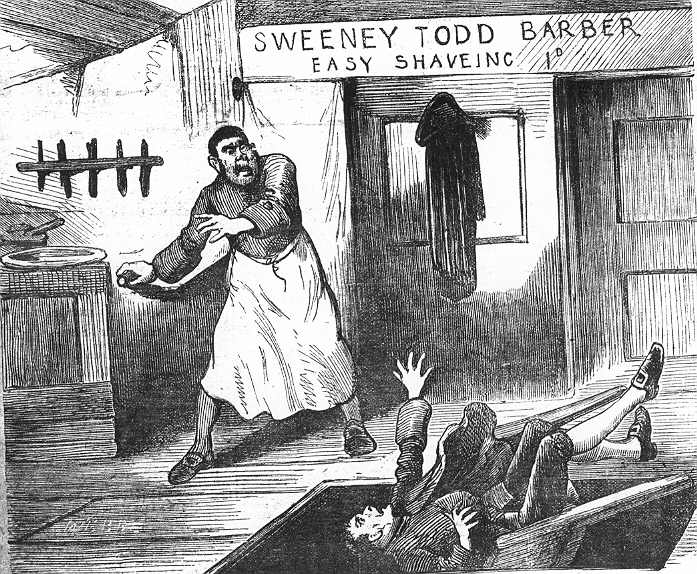
"HELP! HELP! MURDER!" SHOUTED THE SEA CAPTAIN, AS HE DISAPPEARED DOWN THE TRAP.
18
CHAPTER VII.
TOM THE LINK BOY’S HOME.
ALTHOUGH dismissed so abruptly by Ralph Moreton, Moonlight Tom felt no enmity against him. Ralph’s words had acted as a lesson to him, and as he hurried away along Fleet-street, towards the place he called his home, he indulged in many grave reflections as to his mode of life.
He was by no means, however, convinced that Ralph was right.
It seemed to him that Sweeney Todd and his companions had been plotting a murder, and that money in the possession of such villains was the legitimate prey of the poor.
"Leastwise I didn’t ask him to ‘ave any," he said, "and he needn’t have cut up so rusty. He’s been kind to me, however, and if ever I can do him a service, why I will."
He little guessed then how those words would rise before him; how cruelly he would be tried.
Hurrying on, he turned presently to the right, nearly opposite to the Red House, on the front of which was painted the words, "Sweeney Todd, Barber," and made his way down a street which boasted of being within the precincts of Whitefriars—the famous refuge of the thief, murderer, the poor debtor, and the ne’er-do-well.
He did not pause, however, at the entrance of any of the flash taverns or, resorts of Alsatians.
Even these, apparently, were too grand for him.
He hurried on along the gloomy thoroughfare until he came to a narrow lane, the other extremity of which led to the very water’s edge.
Here, close to the river, he stopped, descended the steps of an old, tumble down house, and, pushing open the door, entered a large cellar.
At least what had once been a cellar.
It was now converted into a room by various contrivances; its grimy walls being hidden by pieces of cloth and canvas, and old prints of hideous device, while part of one side had been broken down to admit the formation of a large fireplace, the smoke from which passed through a hole out into the open air.
The cellar was filled with a motley crowd of persons of both sexes, some eating, some cooking, others love-making; but all left off at the entrance of Moonlight Tom.
"Hullo! here’s Tom the Link Boy back again," cried one.
"Yes, come back like a bad shilling," said another.
"Where have you been, Tom—been doing a good trade?"
These and sundry other remarks were addressed to Tom as he passed up the room.
But he only answered with a nod and a smile until he reached the chimney-corner, where sat a youth of sickly aspect, but of a cast of features far superior to those of most of his companions.
He held out his hand to this lad at once, and grasped it heartily.
"Well, River Joe," he said, "I’m glad to have met you again. I’ve been in some rum adventures, and had a rattling good chance of never coming ac again."
"Oh! tell us all about it," returned River Joe, eagerly.
"Not now, it’s too long," said Tom the Link Boy, or Moonlight Tom, as he was sometimes called. "Tell me, is she all right?"
"Yes, right as a trivet," cried Joe, "she’s upstairs, asleep."
A smile of pleasure passed over the face of Moonlight Tom at these words.
His eager manner at once subsided.
"Ah! that’s right,’" replied he, rubbing his hands.
Then, turning to the others, he said, in a loud voice—
"Now, my pals, who’s for some drink? I’ve been lucky, and will sport a guinea with you."
At these words there was a loud shout of enthusiastic applause.
"Drink! drink!"
The drink which deadens sorrow, which hardens guilt, which stills conscience.
Drink! which leads man blindfolded to the very verge of the grave, into which he too often falls ere he can grasp, with unsteady hand, the only chance of safety.
Drink! Drink!—which makes the young boisterous; the old, young; which rouses mad laughter, and banishes all thought of yesterday and to-morrow, but which makes the awakening more terrible.
If Moonlight Tom had offered food he would have been cheered too.
Bu not so joyously.
Now the cellar rang again, smiles sat on careworn cheeks, light sprang from dull and heavy eyes.
The beggar would now forget his long and weary tramp, the thief his crime, the disappointed man his hopes and fears.
In a few minutes the drink was on the rough table in the centre of the room, and soon the eager lips were drinking the strong ale or spirit, according to their fancy.
They were in the middle of their merriment, and had just drank the health of Tom with due honours, when the door at the end of the cellar opened, and a strange-looking individual entered, at whose appearance the scene once assumed a quieter character.
And yet his aspect was by no means imposing.
He was a short, thick-set man, with his head stooping forward—ahead much too large for his body, and seemingly overweighing it.
The face was, of course, proportionately large, his nose being immensely prominent, his mouth large, thick-lipped, and heavy, while his eyes had a dull, fishy glare in them, which made him peculiarly unpleasant to look at.
It was evident that he was a Jew.
This you saw directly you looked at him.
If it had not been so, his speech would have settled the question.
"Vell, vell—you are making a very great noise, lambs," he cried. "Vot is the mattersh? Do you vant the vatch here, ‘cos if ye do I can call them?"
Tom the Link Boy sprang up.
"Don’t be cross, Fadge," he cried, laughing, and addressing the old Jew in a familiar way. which made his hair bristle. "It’s my fault. I’ve tumbled into luck, and I’ve been giving the kiddies some drink—that’s all."
"Oh! vell, vell," he said, mollified at the idea of Tom having money, knowing that some of it would find its way into his own pocket. "Enjoy yourselves as much as you like, but don’t make too much noise. I’ll drink your health, my poy."
And so saying, he took up a large tankard of ale, and drank it off at a draught.
After which, the excitement caused by his appearance having subsided, he took a seat near Tom.
"Vell, I’m glad to hear of your good fortune," he said. "I hope you won’t forget you owe me two weeks’ rent."
"I don’t forget," said Tom, pulling out a piece of gold. "Here is what I owe you, and two
weeks in advance besides."
The Jew seized it, bit it, and then gazed at it again, with eager joy in his fish-like eyes.
"Ha! ha!—you’re a good poy, Mister Tom," he cried, digging him in the ribs, "an artful poy, too. This didn’t come of link-carrying—eh? Gold, real gold! No, no! But never mind, it is nothing to do with me—nothing. You are very good to come to me when you have money."
Tom said nothing.
He chose to take the compliment quietly.
He knew well that it was from no scruples of conscience that he had returned to the Jew’s den, nor for any special desire to pay rent for his wretched lodging.
What had brought him back out of the smiling fields and the sunshine was a golden head, which he pictured to himself lying on a pillow upstairs, two blue eyes closed in sleep, a fairy form at rest.
"Bella is all right, I suppose?" said Tom, whose comical face was rendered quite different when speaking of subjects near his heart.
"Oh, yes, very vell," replied the Jew, somewhat evasively.
"Has anyone been here after her?"
"No."
At this moment, as the Jew, apparently to hide his confusion, raised a huge tankard to his lips, the door behind him opened, and a face appeared.
A lovely face—framed in a golden halo of waving hair—the face of a girl of sixteen.
She remained only an instant.
Just long enough to put her finger to her lips by way of caution, and then to beckon Tom to come.
Then the door closed noiselessly.
Tom glanced nervously around.
But noisy revelry was at its height, and no one had observed the apparition save Tom.
Prudently he kept on the conversation with Fadge, the Jew.
He spoke of a variety of things which he knew to be interesting to the old Hebrew, avoiding the subject, now, of Bella, which he know to be unpleasant to the Jew for some reason.
Presently, however, he rose.
"I am going up to my room, now," he said, "just for a moment, then I’m off out again."
He rose at once to avoid any further talk with the old man.
But Fadge rose also.
"I must go up with you to get the keys, my poy," he said; "you see, you have been away a week, and I thought you wasn’t coming back, so I locked the door."
Tom laughed.
What you mean is that you have been amusing yourself ransacking the place," said he; "but I fear, Fadge, you didn’t find yourself rewarded for your pains."
Inwardly wishing the old Jew a miles away, Tom the Link Boy led the way upstairs, going first to warn Bella of the approach of the enemy.
In order the more effectually to do this, he kept up a running conversation as they ascended the dark staircase.
As he passed the second landing he thought he detected a deeper shadow in the darkness, and the breathing of someone striving to conceal the sound.
But he hurried on, and presently, by aid of the Jew, he was within his old bed-chamber.
Here the Hebrew left him with the candle, which was ready for lighting, on the mantelpiece; and, after an injunction to him to be sure to lock his door, he tottered down the creaking staircase.
Tom crept to the head of the staircase, and listened, with beating heart, to see if the Jew observed Bella as he descended.
But he did not.
Evidently he was thinking too much of the guinea he had so unexpectedly received from Tom the Link Boy, and cogitating how he should best extract some more, to permit any other thoughts to enter his brain.
As soon as Fadge had fairly reached the lower regions, Tom heard a light step ascending the staircase, and in another moment Bella sprang to his side.
Tom clasped her to his heart.
He might be homely in appearance, but his heart was full of love, and Bella was the one green spot in all the waste of his desolate life.
Bella responded warmly to his embrace.
Tom the Link Boy was, then, to her the only loveable being in the world.
She had seen no one else who had been kind to her; he was the only youth who had crossed her path and spoken words of kindness to her.
Who shall wonder, then, that, knowing no one else, her heart had gone out to Tom?
"Come into my room, Bella," said Tom, in a
19
whisper, "I want to explain a number of things, and I want, too, to hear from you what has happened since I have been away."
The young girl at once made her way into Tom’s room, and, having locked the door, they sat down together on the side of the wretched bed to talk.
Tom was not long in giving Bella the history of all he had passed through since he left her.
"And now," he said, when she had expressed her wonder and astonishment at his story (never dreaming of blaming him for the robbery), "now, will you tell me if you have heard anything of your own mystery?"
The young girl turned pale even at the thoughts which his words conjured up.
"Yes, I have heard more of it," she said; "they were here this very night."
"They?—are there two of them now?" asked Tom, eagerly.
"Yes, there was only a man before, now a woman was with him. They were brought up into my room by old Fadge, who was very obsequious to them. I fancy they bribed him."
"Very likely," said Tom, between his grinding teeth, "he’d sell his own soul or anyone else’s for gold. But tell me, what did they say?"
"They asked me numerous questions—at least, the man did. The lady, she sat motionless, not speaking half the time. He made me tell him all my miserable story over again, dotting all my answers down in a book. He wound up by saying ‘How would you like to leave this place?’"
"And what did you say?" asked Tom, eagerly.
The girl’s cheeks flushed, and she looked down on the ground.
"Well, Tom," she answered, "you know this is a wretched, miserable place, and of course I should not like to think I was going to spend all my life in it. He then whispered to the lady, at which she shook her head, and then they both rose to go.
" ‘Well,’ said the man, as they were departing—‘well, you’ll probably hear of me again soon.’
"And then, as the lady went out, she took my hand, pressed it, and left in it a small packet, whispering—
" ‘See to this when I am gone.’
"I waited with impatience until she had disappeared, and then, locking my door, I opened the paper. It contained a guinea and these words—
" ‘Beware of the man whom you have seen with me to-night. I have heard you have a friend, one Tom the Link Boy. Let him come to the theatre in Newcastle-lane to-morrow night, at eleven o’clock, and wait until a lady in mask says to him, "This way, on your life!" Then let him follow her. This is for both your interests.’
"Here is the letter—read it for yourself."
Tom took the note eagerly.
"Ah! dear Bella," he said, "I will go. How impatiently I shall wait for to-morrow night. How pleased I am to think that at last I shall have a chance of doing you a service."
As he spoke, he pressed the young girl fondly to his heart, and she raised her cherry lips for his to kiss.
Fondle and caress, young hearts.
Have now your fill of love!
Ye know not how soon the dark cloud which is hovering over you will burst and overwhelm you.
"I must go now," said Bella, "or old Mother Fadge will discover my absence, and be searching everywhere for me. You know," she added, laughing, "I’m more valuable—more worth keeping—now that these people, whoever they are, have thought it worth while to bribe them to look after me."
Tom trembled at these words.
A cold shiver passed through his frame as he thought of his probable separation from Bella.
But he said nothing.
If it should prove to be anything for the good of the girl he loved he would not stand in her way.
Never should his selfishness be a hindrance to her happiness.
He bade her adieu tenderly; and then, hurrying downstairs, made his way through the cellar, and down to the water-side.
Here he hastened down some steps, and, entering a boat which was there moored, pushed off upon the dark river.
The words of Ralph Moreton now came ringing in his ears.
What if he were going the wrong way to work to secure Bella’s happiness and his own?
What if honesty were, after all, the best policy?
It was difficult for him to believe so.
He had tried honesty; he had been a link-boy; had picked up stray, honest pennies in the street; but nothing like enough to keep him going.
It was only when he quitted the straight path, I and dived into the crooked ways, that he touched gold in quantities enough to make up for past misfortunes.
"Oh! how I wish I could be honest—for her sake!" he muttered, bitterly, as his boat swept onward towards London-bridge; "though she knows no better now, she will know, some day, how wrong it is to thieve; and then what will become of me? Well, well, it’s no use now; so here goes for the Pirates’ Watch Tower."
Whatever these mysterious words meant, they had an inspiriting and encouraging effect upon Tom the Link Boy.
CHAPTER VIII.
THE BARBER’S DEATH-TRAP.
ON the same night that saw Moonlight Tom in search of strange adventures at the Pirates’ Watch Tower, and Ralph Moreton following Sir Paxton Greaves to the old house at Croydon, the good ship Andromeda, from Andalusia, cast anchor in the Pool.
The great expanse of water was not, as it is now, a forest of masts; but still it could boast a goodly assemblage of ships of all countries, and the Andromeda, on this particular night, had to anchor almost in the centre of the river.
As she paused in her career, the captain, who bad been watching the proceedings of the sailors, turned to his chief mate.
"Hubert," he said, "come down into my cabin. I have said that I had something of importance to tell you when we reached England once more, and now is the time for it."
So saying, he abruptly turned, and led the way down the ladder.
On entering his well-appointed cabin he brought from out of a locker a bottle of spirits, and sat down, inviting Hubert to sit down also, and help himself.
They were both young men.
Captain Andrew Drake was, perhaps; about thirty, but looked older, with brown, curly hair, and a face well tanned, which showed that he had been, during his lifetime, beaten about by all weathers.
Hubert Courtenay, his chief mate, was some four years younger, though looking every inch a sailor, and giving evidence, too, that he had roughed it in his time.
The latter poured out two glasses of spirit, and having handed one to Drake, took the other himself, and drained it.
"Here’s your health, captain," he said. "I must say you have excited my curiosity; you know I have a great liking for the mysterious."
Captain Drake smiled.
A dreamy, unhappy smile, which Hubert Courtenay did not forget.
"Well, then," he said, "I will commence with a very strong mystery. Read that, and judge for yourself."
With these words, he took from the breast-pocket of his coat a paper, which he handed to Hubert.
It ran as follows—
"To HUBERT COURTENAY.
"If I do not return to my ship, the Andromeda (now lying in the Pool), at the expiration of one week from the date of this letter, I give up all claim to my ship, and desire that you shall become its owner, and do with it as you please; and if any one shall, in my name, try to enforce any claim against you, I declare such claim to be made against my express will.
"(Signed) This — day of —, 1700.
"ANDREW DRAKE.
"Witnesses, Robert Dolt, Arthur Sharpe, able seamen."
The young lieutenant glanced in wonder at this strangely-worded document.
"Others know of this, then, captain!" he said, in a bewildered air.
"Yes, I was compelled to have witnesses," returned the captain; "but they’re our two best men, and I’d trust them anywhere with anything. But how’s this, lad, you don’t seem half-pleased?"
"No, dash my buttons if I do!" exclaimed Hubert Courtenay, flinging the document down on the table. "I said I liked mysteries, but hang me if I like this one!"
"Why not?" asked Drake, in a vexed tone.
"Nay, then, captain," said Hubert, "don’t take it to heart. I don’t mean to say anything to offend you; quite the reverse. What I mean is this—that this kind of will you’ve made out sounds very much as if you didn’t think you’d ever come back."
The captain tried to assume a cheery air.
"No, it isn’t exactly that," be said; "but I want to provide against what might happen. If anything did occur to me, there are certain people whom I do not wish ever to get my money. I have no real friend but you, and to you I desire my ship to belong if I die."
"But are you going among enemies?"
"I am."
"May I not accompany you?" said Hubert. "My right arm, captain. although I say it myself, has often stood you in good stead."
"True, dear friend," said Drake, with tears in his eyes; "but it cannot be. I am going somewhere where I could not well take you. I am going to discover whether the dream of my youth is about to be fulfilled, or whether I have been indulging in idle folly. If the latter, I may, perhaps, be in peril; if the former, not."
"Then you will not accept my aid?"
"I cannot."
"And in case of your non-return are there any papers which you desire to be destroyed?"
"None, until you have read them," said Drake, as he drained another glass of spirit. "Now I’m off. I suppose you’re going on shore?"
"Yes, till morning."
"Very well. Bolt can row us both across, and after just a glass at the Seven Mariners we can part."
The boat was soon out and across the dark waters. The captain and the lieutenant were rowed over to the shore.
At the Seven Mariners they indulged in the parting glass, and at the corner of the street they said "good-bye."
"Take care of the Andromeda if I never return," said the captain, as he grasped his friend’s hand and shook it warmly, "and remember, don’t be taken in by land-sharks. That ship’s mine or yours, no one else’s—unless, indeed—. But there, it’s no use talking folly. Good-bye, God bless you!"
Hubert Courtenay watched him as he passed along the dark street and disappeared.
Then he turned away sadly.
"Something tells me," he murmured, "that I shall never see him again. Well, well, things must have their run. If I am destined to be the captain of the Andromeda I suppose it is so, and I can’t help it. Poor Andrew Drake!—he’s a nice fellow, true to the core, honest as steel."
And so discussing the matter as best he could for the time, he made his way towards the spot where he hoped to meet his lady-love, after an absence of two years.
Captain Andrew Drake, meanwhile, hurried along with eager strides.
His heart was in a flame of excitement.
20
He had come home to claim a young and lovely bride.
One who had pledged her heart to him long years ago.
He had waited until now, until he had amassed sufficient money to provide her with a home such as he deemed proper for her.
And now, as he came homewards over the sea, there had come to him in the dead of the night a terrible vision.
The vision of a rival, of a bridal, and then a scene of horror and bloodshed.
Overwhelmed, then, with a sense of treachery—of subsequent disaster and death, he was now travelling like one in a dream.
A dream in which the face of his beloved one was the centre picture.
Thinking of her—of her bright eyes, of her lovely form—he gradually became better, and stronger at heart.
The doubts disappeared; and a cloud of joy overspread his features as he approached the Fleet.
Perhaps, after all, it was but one of those foolish dreams which go "by contraries," as the vulgar say.
At any rate, when he had reached the busy thoroughfare, he was caught by the glare of a jeweller’s shop.
He strolled up to it and glanced in.
There was an abundance of glittering gems to tempt the eye, and the glance of the rough sailor was soon rivetted upon a beautiful pearl necklace.
" That would just suit my darling," he murmured, and then, after cogitating with himself, he opened the shop-door and entered.
The purchase was soon effected.
But quickly as it was done, someone had noticed it.
A tall, lank youth, who, immediately that the purchase was made, dashed off at headlong speed down the street.
Gratified with what he had bought, and fancying already that he could see it round the neck of the one be loved, Captain Drake hurried on, in excellent humour.
He was thus hastening, when a voice near him said—
"Shave, sir—shave, sir? Done in a moment, sir!"
It was the voice of Sweeney Todd, who, with his spotless white apron over his ample stomach, was standing at the door of the Red House.
The captain paused.
"Might as well look as nice as possible," he said to himself. "Might as well have my hair trimmed."
He looked up as he spoke, and saw the face of the barber.
He had been in many climes, had passed through many adventures, but never in the course of his whole experience had he come across a more villainous cast of features.
Drake, however, was a man who was not to be turned aside from a purpose by so simple a circumstance as this.
"Yes, my man," he said, "I will be shaved, provided only that you will be quick about it, as I am in a hurry."
"Polish you off in a moment, sir," said Sweeney Todd, and he cast a rapid glance up and down the street, to see if anyone was observing his actions.
Then he entered the shop, followed by the captain, after whom he at once locked the door.
"One a time’s enough, I always say," he cried, by way of apology. "I get nervous if I have a lot of fools gaping at me."
"You’re not very polite to your customers," said the captain, laughing. "If you were busy, I myself might be one of the gaping fools."
"No offence, sir, I hope," apologized Sweeney Todd, bustlingly, as he busied himself in preparing for his work.
The shop was, to every appearance, an ordinary barber’s shop.
There were the usual appurtenances, the usual decorations of a shaving shop of the period, and in the centre of the room was placed a large arm chair, of more than usually comfortable dimensions and softness.
In this chair Sweeney Todd requested his customer to sit.
Then he went to the sideboard to fetch his razor.
What followed was the work of an instant.
Without the slightest noise the floor opened, and the chair, with its living victim, fell.
But not as Sweeney Todd desired it should be.
The captain, just as he went down, clutched at the edge of the flooring, and, to the horror and astonishment of the vile assassin, the intended victim began dragging himself up.
But this was not to be.
Too long had the ruffian carried on his career of crime to be able calmly to contemplate the results of discovery.
"Death and fury!" he cried, and with one leap he sprang to the edge of the open trap.
Then kneeling down, he began gashing away at the victim’s hands with his razor.
"Help! Help! Murder!" shouted the sea captain.
But in vain.
A gash across the face with the terrible blade made him suddenly gasp with pain, and release the hold he had maintained with his half-severed fingers.
Down, down into the black pit he fell, and as a last yell of agony resounded through the shop the chair righted itself.
At this moment there was a loud knock at the outer door.
"Curse the people!" he cried; "and here is that blood on the floor. What am I to do?"
Hastily dragging a piece of carpet over it, he hurried to the door and opened it.
It was Rossitor, one of the constables of the parish.
He looked Sweeney Todd very hard in the face.
"What is the matter, Mr. Todd?" he asked.
"Matter?—nothing," said the barber, with a ghastly grin from ear to ear—a grin which was peculiar to him, and which made him appear as though his head was coming in two.
"Well, you made a great fuss about nothing, that’s all I have to say," replied the officer. "I heard someone just now calling ‘Murder!’ and ‘Help!’"
Sweeney Todd grinned more horribly still.
"Oh! if that’s what you’re alluding to," he said, "you’re likely to hear it often again."
How is that?" asked Rossitor, in surprise.
"Why, I was thrashing my apprentice for robbing me. He sauced me when I found him out, and I gave him such a clouting that his nose bled."
He added this on observing that his hands were blood-stained, and that the officer was looking at them.
"Oh! if it’s that, it’s all right," said Rossitor. "Poor Bill, he gets more kicks than halfpence, though, don’t he?"
"Not he," said Sweeney Todd, eyeing his companion keenly from beneath his shaggy eyebrows; "not he, be gets lots of presents made him. There was a sea captain here just now that gave him sixpence."
The object of this remark was obvious, and its result was apparently just as Todd desired.
"Oh, indeed," said the officer. "I’m going to have a glass of ale at the Green Dragon. Will you come?"
"I don’t mind if I do," said Sweeney Todd, who, among his other commendable qualities, reckoned that of drinking. "I’ll lock the house up; and you, Bill," he added, in a shrill voice, and talking to an imaginary boy in the next room, "mind what you’re at while I’m away."
Of course it was not a pleasant thing to leave the house while the man was below, not even yet dead, perhaps.
But he could scarcely refuse.
And besides this, he wished to put the officer off the scent.
So hurrying the officer out as quickly as possible, be closed the door behind him, and hastened across the road to the tavern.
Here he drank up his ale hastily—paying, of course, for both.
When they emerged again, Sweeney Todd slipped a crown into the constable’s hand.
"I haven’t given you anything to drink my health for a long time," he said; "take this, keep good watch. I have a good many valuables in my house, and it is old and ricketty. Good-night."
And with these words he hastened across the street to his own door.
On opening it, and once more closing himself in, he was horrified at hearing deep groans proceeding from below.
"Curse that constable!" he muttered, making use of a horrible oath; "if I had not been disturbed I could have settled his hash in a moment."
He lowered the light of his lamp, and, having seen that all was secure, he proceeded to the next room.
Here he removed a table, and drew aside a carpet.
Then, kneeling down, he searched for a bolt, which was evidently the fastening of a trap-door.
As he shot it the woodwork fell in with a dull thud, and disclosed a flight of steps, down which Todd hurried, with eager, though evidently excited footsteps.
On reaching the bottom he found himself in a cellar, which appeared to have turnings passing away in all directions.
Here he turned on the full light of the lamp he carried, and drew a long knife from belt, which was concealed beneath his barber’s apron.
Then he glided like a tiger towards his prey, his face distorted with a hideous grin.
As he passed on, he could hear the groan of a man in mortal agony.
Awful mutterings were mingled with the cries of pain, as if the unfortunate man were striving to call upon those he loved to relieve him from his death struggles.
"Who comes here?" he gasped, as Sweeney Todd crawled rather than walked to his side.
"A friend," he said, as he sheathed his knife in his victim’s breast, and chuckled at the success of his plan.
The wretched man fell backwards, with a last sigh of agony.
All was over.
The horrible deed was done, and Sweeney Todd cast the full light of his lantern on the spot where the man lay, that he might gloat over his last and most troublesome victim.
It was a hideous sight.
Beneath the trap in the shop, upon which stood the shaving chair, was a square piece of stone, fitted with long points of steel.
When the chair revolved, the wretched victim was cast headlong upon these spikes, where, if not killed instantly, he would writhe in terrible pain, until he was put out of his misery by the butchering knife of Sweeney Todd.
At the moment that the demon barber was gloating over his victim a third figure appeared upon the scene.
This was a tall spare lad, of about seventeen years of age, who came gliding along from out a dark, subterranean passage.
His face was a strange mixture.
Cunning seemed to be struggling with idiocy.
His eyes were glistening, and his mouth was wreathed in a smile, but there was no reason for either.
Suddenly, however, as he caught sight of Sweeney Todd and the wretched victim, whom the barber was now divesting of his clothes, he uttered a shrill cry of terror, and fell upon his knees.
Sweeney Todd turned hastily, and in terror.
He rushed at the boy, and seized him by the hair.
"What are you doing here?" he cried, brandishing his knife.
"Don’t know—don’t know," stammered the boy.
"How did you get out of the bakehouse?"
21
"Don’t know—don’t know."
"You know that then," yelled Todd, dealing him a blow on the side of the head which
nearly rendered him senseless; "away with you to your duty—yet no, I will see you safe."
Still holding him by the hair, and dragging I him ruthlessly along, the barber led the way through one of the subterranean passages.
They proceeded full fifty yards along the dank and murky corridor, until at length a fragrant smell fell upon their nostrils, and a warm air pervaded the place.
"You have left the door of the bakehouse open, you young villain!" cried the barber, "it has never been opened for years—where did you get the key?"
"Stole it," said the boy.
Sweeney Todd gave vent to a gasping yell, like the cry of an enraged wild beast.
Then, lifting the boy by the hair, he rushed forward until, arriving at the open door of a bakehouse, he flung him in with such force that the wretched creature sank, crushed and half-dead, in a corner.
Then he shouted aloud—
" Mrs. Darkman—here—quick! I want you."
For a few moments there was no reply, but presently the door at the other end of the bakehouse opened, and a woman entered.
She was about five-and-thirty years of age; fat and rosy, and not unattractive, but there was a cat-like look in her eye, which was anything but pleasing.
She stared as she saw the infuriated condition of the demon barber.
"Why, what is the matter, Todd?" she cried, "you seem in an ill-humour."
"Ill-humour! Thunder and fury!" he shouted, "isn’t it enough to enrage one when I find our cook here—mad Cluney—wandering about the passages, and poking his nose into every corner. I’ll be hanged if I don’t shove him into one of the furnaces alive if I find him there again. But it’s your fault for not taking care of the key. As for that, it ought to be thrown away, for the door should never be open."
"May fault, as usual," said Mrs. Darkman, with a winning smile, which was intended to captivate Sweeney Todd; "but the boy is always running about. I think he’s too artful, and if he doesn’t behave better you’ll have to shave him."
"What, give him a taste of the chair?" said Sweeney Todd, with a grin. "But I say, Mrs.
Darkman, how are the pies selling tonight?"
"Splendidly, we are nearly sold out," said the woman. "I’ve put a little extra seasoning tonight, and Rossitor, the constable, ate six at the counter."
"Good," said Todd, turning, "but I’ve a new subject to dissect. Good-night for the present, and mind, if that boy gets troublesome send him up to the shop, and I’ll send him down again to you silent enough."
With these words Sweeney passed out of the door, locking it carefully after him.
Then, with eager footsteps, he hurried back to the side of his victim.
CHAPTER IX.
RALPH IN A FRESH MYSTERY.
AS the Reverend Obadiah Scramper uttered the strange words to Ralph Moreton in the round-house, the warning of Sir Paxton Greaves flashed across his mind.
"What right have you to ask?" he said.
"Because I am an old friend of his family," answered the preacher, with a snuffle, "and knowing that you are a friend of his, I wish to do you good. I am aware that Sir Paxton, .. before this dreadful affair, took a journey, but, in order to be able properly to exculpate you from this horrible crime, I must understand all that happened last night."
"You did not speak of exculpation just now," replied Ralph Moreton," you said you would aid my escape."
"I did", answered Obadiah. "I am aware of it, but surely you have some regard as to the opinion of the world; you do not desire that one of the Moretons of Moreton should be regarded as a treacherous ingrate."
Ralph glanced at him in astonishment.
How did this man know his name?
But he did not permit himself to be led into any damaging admissions.
"You speak to me in riddles," he said; "but if I can escape from here that is all I desire. I will trust in Providence to clear me from the foul charge which you were the first to cast upon me."
"I thought you guilty."
"And what has occurred to change your sentiments?"
"That is a secret at present," returned Obadiah; "but in due time you will know all. But come, give me the information I wish, and within an hour you shall be free."
Not for an instant did the idea cross his mind that he ought to betray his dead patron’s secret.
But he could not help regarding in silence, for a moment, the face of Obadiah Scramper.
The preacher imagined that he was gaining the day, and that the lad was rapidly yielding to his wishes.
It was not so.
Two strange thoughts had entered Ralph’s mind.
In the first place, he felt certain that if he were to betray the secret of his patron, Obadiah would not release him.
In the second place, there was now, as he stood in the fading light, a strangely familiar expression in his features.
A sudden idea leaped into Ralph’s brain.
"Were you ever at Combe Deane?" he asked, quickly.
The effect was miraculous.
The Reverend Obadiah staggered back, and the cadaverous hue of his features became still more ghastly.
(To be continued.—Commenced in No. 78.)