[1]
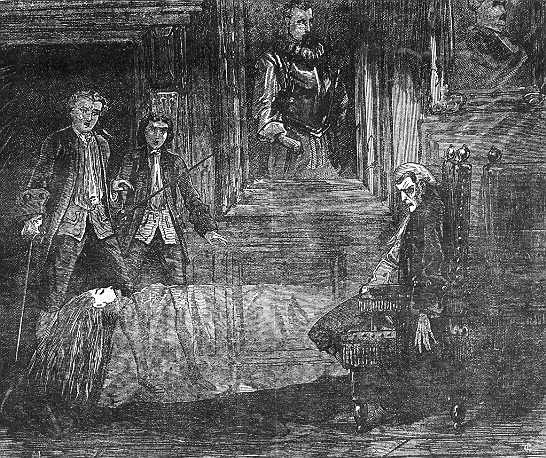
THE SIGHT WHICH MET THE EYES OF THE BARONET AND RALPH MORETON RIVETTED THEM TO THE SPOT.
CHAPTER III.
ON THE EVE OF A MYSTERY.
THE baronet smiled with pleasure as he saw Ralph enter.
"Punctuality seems to be one of your virtues, Ralph," he said. "To-night will prove whether discretion can also be numbered among your good qualities."
Ralph "hoped so."
He asked no questions, but, in obedience to his new friend�s desire, he sat down to partake of an early meal.
"We have some distance to go," said Sir Paxton, "and I always believe a good meal is necessary before undertaking any mission, whether it be of consolation, or vengeance, or love. Eat and drink well, Ralph, and you�ll find yourself full of courage. Starve, and you�ll turn out a nervous, timid driveller. Can you ride?"
"It is my favourite pastime," said Ralph.
"Good. We seem formed to be friends," returned Sir Paxton; "and now, ere we start, let me tell you what I am going to do., and what I wish you to do. See at the door there that there are no listeners."
Ralph at once leaped to the door, but not a soul was in sight.
So, when he had reseated himself, Sir Paxton began�
"I am going to visit a man whom I have not seen for years. He lives some litt1e distance�near Croydon, in fact. I am going to enter his house alone. I wish you to remain outside�at the door, in fact�and prevent, if possible, the entrance of any intruders. But no matter what you may hear going on within, you must not interfere�not even if you have reason to believe that I am being killed."
Ralph stared, as well he might, in wonder.
"Not even if you cry out for help?"
A smile, almost of scorn, passed over the lips of Sir Paxton Greaves at this remark.
"That is unlikely," he said; "but, if I should need your support, I will shout for you by name. But stay, there is one thing I have forgotten."
"What is that?"
"I shall not leave you unprovided," replied the baronet. "I have taken you into my service, and this night I not only run into peril myself, but I drag you into it. Here is a paper, which you can open and read, if at any time I am killed or disappear. And now�to horse!"
He gulped down a large glass of wine, and then swung out of the room, followed by his page.
In the yard were two horses, saddled�the one the brown gelding which had brought Sir Paxton to the inn, the other a fine grey cob, which made Ralph�s eyes water with pleasure.
In a few minutes they were mounted, and rattling along towards London-bridge.
On the way Ralph cast a glance at the barber�s shop.
Within he could see the man with the red head, and the tall, thin, dark man, both shaving customers.
"What can it mean?" he asked himself, with angry impatience.
But it was useless cogitating then.
At another time he would follow up the extraordinary mystery.
After passing over London-bridge, they were soon rattling along a broad and dark highway, over which the moonbeams fell in patches, varied with the shadows of the hedges and the tall trees.
Presently they left the high-road, and dashed at a good gallop across a wide moor.
Then, turning into a narrow lane, Sir Paxton spurred eagerly forward until, on reaching the summit, he pulled up suddenly at the gate of a large mansion.
It was a dreary-looking, deserted place, with a thick blackthorn hedge facing the high road, and a dreary wilderness of garden between the hedge and the solemn-looking portico.
Not a single light was anywhere to be seen.
"It seems deserted," said Ralph, as he glanced, in somewhat of awe, at the gloomy-looking domicile.
"No, no; there is something or someone in it," said sir Paxton Greaves. "Come with me. Remain under this portico, with your sword drawn, and await my summons in patience."
In a few moments the heavy door was swung open.
Sir Paxton Greaves entered, and Ralph Moreton was left alone in the gloom, on the door, as it were, of the strange mystery.
CHAPTER IV.
A RECOGNITION.
THE consternation which prevailed at Moreton Hall when it was discovered that Ralph had fled may easily be imagined.
Guilty consciences, they say, proverbially, need no accusing, and Mrs. Moreton and Denvil, the lawyer, at once set it down as a fact that the lad had overheard their conversation, and had taken himself off to London in order to expose them.
To Harry and to Clara it was, of course, useless to say anything now.
At the first discovery, consequently, both Denvil and Mrs. Moreton expressed a hope that the disappearance was only the result of some boyish freak.
But as the hours went on, and no tidings came, they both pretended to be seriously alarmed, and the neighbourhood was at once scoured in search of him.
As may readily be supposed, they were really anxious to find him.
At home he might be wheedled and coaxed into believing them his friends.
Away from home he was decidedly dangerous.
On Harry and Clara the news, as it grew to be more certain, had an equally similar effect.
But neither showed it to the other.
Both regarded the disappearance of the young heir as a stepping-stone to fortune.
Harry wandered moodily through the pleasant grounds of Moreton, and fancied himself already master, ordering the servants hither and thither, and riding roughshod over everyone.
Clara dreamily surveyed the landscape from between the misty gauze of the drawing-room curtains, and fancied herself already the admired of all admirers, and the sought after by all suitors.
It was a pleasant vision.
But how rudely might it be dispelled!
Only the return home of the wayward boy, and all would be lost.
It was on the same night�almost at the same time�when Ralph was waiting outside the gloomy portico of the desolate-looking house near Croydon, that Clara Moreton was undressing herself before the glass in her chamber.
She looked very lovely.
Her dark hair was flowing negligently over her white shoulders, her large, dreamy eyes were fixed upon her own sweet semblance in the mirror.
She was about to remove her dress when a slight scratching noise near her made her start.
Then, as she turned in alarm to see what was the matter, the lamp was suddenly extinguished.
Too full of terror now to cry out, she stood trembling, where she had stood before, with one hand leaning on the toilet-table.
What could it mean?
Was she in the power of murderers?
Or was she frightened only by some cat or by some wayward gust of wind?
She was soon undeceived.
A hand stole to her wrist, and held it as in a vice.
Then a voice said, in a low, but stern accents�
"If you promise not to move, or cry out, we�ll light the lamp again and leave you alone. If you don�t we�ll settle you."
"Oh! pray light the lamp," said the trembling girl, "I will not move or utter a sound."
The lamp was accordingly rekindled and, as the pale and terrified girl sank into a chair near her bedside, she saw two men in crape masks and dingy clothing.
Men of the ordinary burglar class.
She was about to speak to them, and about to appeal for their mercy, when one of them, slapping his thigh, exclaimed in a voice of excessive surprise�
"Well, I�m bothered, Jack, if it ain�t�well, so help me never! I say, young lady, Captain George is down at the hut yonder; Slocum�s the rummy cove�you know!"
Whatever these strange words implied, they had a peculiar effect upon Clara.
She stared wildly at the speaker�clutching the arm of the chair with nervous hands.
"What is that you say?" she cried. "You are trifling with me�George is not in England, he has been transported long since."
The man chuckled.
"Aye, aye, my fair mistress," he cried, "that�s all very well, but a man as �as got any sense and pluck in him can make good his escape, �specially when he�s got to look after such a�"
"Hush!" said Clara, rising up; "say no more, do as you desire and quit the place at once."
The thief scratched his head.
"Well, I don�t see my way quite clear," he answered; "I don�t know whether the captain �ud thank us for doing the trick now you�re here. I think we�ll put off this �ere little bit� leastwise, I will if you make me a promise."
"And what is that?" asked Clara, glad to get rid of them at any price.
"Why, if we come again to-morrow night, will you promise not to do anything to hinder us?"
"Yes, I promise."
" �Pon your solemn davy?"
"Yes, whatever that means."
"Leastwise, that�s a lawyer�s term," said the thief, "which yer can�t be expected to understand. We�ll go, but if so be as Captain George says we�re to come again we must, and there�s an end to it. Good-night, mistress."
"Good-night," she said, and, as the two ruffians stepped out on the balcony, she bolted the windows and then sank down in a flood of tears.
"Oh, Heaven have mercy on me!" she murmured, "and avert this calamity. Why has he come back? Why has he escaped to bring back to England and to me the curse of his crime?"
For more than an hour she sat thus, wrestling, as it were, with her sorrow.
Then, flinging herself on her bed, she slept a heavy, though a restless sleep.
The next day passed on leaden wings, and in sad forebodings.
Nothing had been heard of Ralph, and Clara, not caring now to think or speak of anything which did not concern her own immediate sorrow, avoided her brother as far as she could.
At length evening came, and with a heavy heart she retired to her room.
But not to sleep.
She had there to await the arrival of the thieves.
With an eager heart she sat by the half-closed windows.
Not long did she have to wait.
She heard presently a step on the gravelled path, then the sound of some one scaling the balcony, and finally the windows were pushed cautiously open and a man entered.
A tall, dark-browed man, about five-and-twenty.
Dark-browed he might be, but he was, nevertheless, handsome.
There was an eager fire in his hazel eyes, a stern decision upon all his features, but yet there was that about his plastic mouth which spoke of one who could be a woman�s favourite.
He smiled as his glance fell upon Clara, who, pale and with tear-dimmed eyes, awaited him
3
"Why, Clara, my darling," he cried, as he closed the windows, and, sitting by her side, took both her hands in his. "Not one smile�not one kiss?"
The young girl trembled.
"How can you ask me such a question, George," she cried, "when you have deceived me so utterly�so cruelly?"
The man laughed.
"Deceived you?" he cried. "How can you say that? Have you forgotten the boarding-school, have you forgotten the escape, the marriage, the man who stood up for you and brought down vengeance on his own head to save you? Surely no!"
The first of these words were said with a jaunty air.
But his voice deepened as he proceeded, and the last syllables were whispered loudly and earnestly.
Clara Moreton looked down upon the ground and trembled.
"I have not forgotten," cried she; "it is all too deeply�too bitterly engraved on my memory to be effaced. But why are you here? Why have you come to cast a shadow over my life again?"
"A shadow?" he answered, in slow, measured, accents. "Why should it not be sunshine?"
"Because that you never bring," said Clara.
"Clara, do not speak such nonsense, " he cried, impatiently. "I have escaped from my place of confinement in the sure hope of finding you. I have acquired an abundance of money. I shall soon have enough to place me in independence and�"
"Hush! do not talk thus to me," said Clara; "do I not know how you are acquiring this money? Do I not know that you are carrying on the old system of plunder? Were not your men here last night to commit a robbery�not knowing whom they would meet? Leave me, George, to myself. Haunt me no longer! I cannot forget, or forgive!"
Captain George bit his lip.
"You have, indeed, changed," he said.
"No, not changed," said Clara; "only now I tell the truth."
And she suddenly sprang to her feet.
"I will not endure this any more," she cried; "I will not be under these trammels for ever! Do as you please�I defy you!"
Captain George gazed at her in surprise.
"Well, come, this is something new," he said; "but I am not at all afraid of your airs and tempers, my lady. I will alter my plan of action, and that is all."
So saying, he re-opened the window, and gave a low whistle.
In an instant there appeared upon the scene the two men whom Clara had seen the night before.
"Bob," said George, taking no heed of the young girl, "you can proceed to work. I will answer for the silence and discretion of the lady."
"All right, captain," cried the man addressed as Bob, as he touched his hat respectfully; and then, passing through the door, the two men began adventure, the end of which they little dreamed of.
CHAPTER V.
RALPH�S ADVENTURE IN THE OLD HOUSE.
RALPH waited patiently enough at first outside the door of the old house to which Sir Paxton Greaves had led him. The mystery which surrounded this mansion, and still greater mystery which overhung this first adventure pleased him excessively.
Lads of his age like to be trusted, and especially in a case like this, where danger was supposed to attend upon the enterprise.
He waited, consequently, with a beating heart for some time, watching the windows and the door, and eagerly hoping to see his new patron appear.
At length, when he had almost exhausted his patience, he saw Sir Paxton Greaves appear at the door with his drawn sword in his hand.
Even in the gloom of the evening it was easy to see that he had either undergone a great disappointment or a great fright, for his face was livid, and his eyes were glaring out of his a head.
"Are you there, Ralph?" he cried, eagerly, not perceiving our hero in the darkness.
Ralph at once sprang to his side, with his weapon drawn.
"Here I am," he cried.
"Then follow me," said Sir Paxton, in a low, hoarse voice. "I have seen this night sights which almost make me ask myself if I am sane."
He turned as he spoke, as if to re-enter the house.
But Ralph detained him.
"Let me ask you one question," he said.
Sir Paxton raised his finger warningly.
"Remember our compact," he said, "there were no questions to be asked."
"Certainly no questions of the kind you mean," said Ralph. "All I wish to inquire is this�am I, when I enter this house with you, to plunge unreservedly into its mysteries in the same way as yourself?"
"Yes, yes. But come, let us hasten, or it may vanish."
Without vouchsafing any explanation of this strange remark, Sir Paxton re-entered the house hurriedly though cautiously.
Ralph kept close behind him, peering anxiously through the darkness.
At length, after traversing the wide hall, and ascending the broad staircase, the baronet halted upon a spacious landing.
Here he leaned over Ralph, and whispered�
"See the light streaming beneath yonder door. That is the chamber of mystery."
He clutched Ralph�s arm as he spoke these words, as if to gather strength.
Then cautiously he opened the door, and in a moment they were within the room.
The sight which met the baronet�s and Ralph Moreton�s eyes riveted them to the spot.
It was a large chamber, with dark-panelled walls, and a ceiling decorated with strange devices.
On the walls were pictures whose faces gazed sternly down upon the spectator with warning, accusing glances.
By the side of the large fireplace sat an old man of some eighty years.
He was sitting bolt upright, and his face was turned towards the centre of the room.
But it was easy to see that he was dead.
His skeleton hands, his parchment-like cheeks, his eyeless sockets, told the terrible story of dissolution.
What was in the centre of the room, however, was the most terrible of all.
On tressels lay a velvet-covered board, the large folds of the soft cloth waving gracefully down to the ground.
Upon it was lying the body of a woman.
A woman�very young and beautiful.
Beautiful, not in regularity of features, but in the gentleness of her expression.
Homely she might have been called by those who understood her not.
But not by those who had loved her, and knew her, perhaps, in all her virtue and goodness.
She lay, untouched by the hand of decay, calm and lovely, as in a placid sleep, with a smile upon her pretty lips.
It was Death looking at Death.
And yet it was not this which made Ralph and his patron so utterly overcome.
It was the terrible unreality which seemed to surround the woman.
She was there, certainly, visible to both their eyes.
But around her form, and around the bier, there was a halo of light which seemed supernatural.
And, more than this, as they concentrated their gaze upon it another awful fact was discernible.
For, through the bier and the body, covered over as it was with a satin and gold cloth, the objects beyond could plainly be seen.
Ralph at length roused himself to glance round at his companion.
Sir Paxton Greaves was standing with folded arms, his sword still clutched in one hand.
There was a wild, yet icy look in his eyes, as if he was fighting with the demon that was in his heart.
He did not observe our hero as he turned round.
Ralph touched his arm.
The effect was magical.
He at once started, and recovered his voice at the same time that his expression changed.
"This is a terrible thing," he said, "it is an apparition which shows itself to two persons at the same time. It is a warning of some terrible calamity. Hark! what is that?"
There was a strange, grating sound without.
Both of them started, and listened, with their hands nervously clutching their swords.
After such a sight it was not to be wondered at if a slight noise disturbed their equanimity.
But a still stranger thing now happened.
No sooner had the sound been heard than the woman and the bier vanished into thin air.
The dull light of the oil lamp suspended from the decorated ceiling took the place of the brilliantly-illuminated couch of death.
The old man sat in his chair�dead, and silent, and ghastly.
But all else was gone!
Ralph�s senses fairly reeled.
He clutched at his companion�s arm, but, missing it, his sword came in contact with the dead body.
In an instant it collapsed.
The clothes fell in a confused heap upon the chair, but the body itself crumbled into dust.
A fine dust, which quickly diffused itself through the atmosphere and penetrated the nostrils of the astounded and horrified lookers on.
"I can stand this no longer," said Ralph, in a half-choked voice. "I must go into the fresh air."
Sir Paxton himself was greatly moved.
In fact, though it was not a coward�s fear which assailed him, he was trembling.
Taking a flask of brandy from his pocket, he drank some, and then passed it to Ralph.
"Drink," he said, "and be not afraid. If you yield thus to fear, you will never be able to serve me. We have yet further adventures to go through, and I fear me the one we have just met with is the least perilous of all."
Roused by these words, and stimulated also by the brandy, Ralph now professed himself ready for action.
His heart was bounding within him.
His very pulse beat wildly.
His blood seemed on fire.
"I am prepared," he said, "fully prepared, lead on."
"Be cautious, then, and follow me," replied the young baronet.
"With these words, he led the way up a broad staircase, which ascended to the next storey.
But all was dark here.
Seemingly, the old house was left to its horror.
Suddenly, however, a low murmur was heard.
The murmur of men�s voices.
"Now, then, begins the explanation of the mystery," muttered Sir Paxton, and, without
further parley, he advanced in the direction of the sound.
It proceeded, evidently, from a room close at hand, although the doors seemed closely shut.
On approaching nearer, it was evident that there was a double door, and pulling open the outer one without difficulty, Sir Paxton listened.
"Now," he said, in a whisper to Ralph Moreton, "remain here with your sword drawn; and if you hear me call for help, rush in at once. These are the men of whom I spoke before. No matter what you hear, therefore, do not enter unless my voice summons you."
Before Ralph could make any reply, Sir Paxton had hurried in, and the door was closed, leaving our hero in utter darkness.
4
The murmur of voices ceased as Sir Paxton entered the secret chamber.
Ralph remained waiting impatiently, as he had done before.
But with far different feelings.
Then his mind was only occupied with wonder at his future career, mingled with surprise at his patron�s strange conduct.
Now his brain was excited by the extraordinary visions he had seen, and he felt as if he had indeed been treading on the confines of another world.
The extraordinary silence in the other room continued.
The time passed slowly; and, to the bewildered mind of Ralph Moreton, a thousand wild fancies presented themselves.
He saw again the old man, sitting, dead and ghastly, by the old chimney corner, and the young girl stretched, in all the silent majesty of death, upon her bier.
He was in the midst of these thoughts when the door was flung open, and the form of Sir Paxton Greaves hurriedly came to his side.
"Quick!�follow me!" he said, in hoarse accents.
"Is all settled, then?" asked Ralph, almost mechanically.
"Yes," said Sir Paxton; "ask no questions."
Saying these words almost sternly, the baronet led the way down the old stairs, and hurried from the house to the spot where they had left their horses.
These they mounted and rode rapidly away.
But they did not proceed to London.
Instead of doing so, they put up at a little tavern midway between the metropolis and Croydon�a little tavern, by the way, which was situated in a somewhat gloomy and deserted spot, and which was scarcely the sort of place to invite the weary traveller to rest.
However, Sir Paxton seemed to observe nothing of this.
He was evidently far too much occupied in his thoughts to observe anything.
He asked at once for two rooms; and said quickly to Ralph Moreton�
"Come to my room early in the morning, at eight; until then be silent."
Then suddenly, as he grasped Ralph�s hand, he added�
"Remember one thing�if ever at any time something should happen to me, let the secret of this night�s adventure be buried in your own breast, unless some one (man or woman, it does not matter which) comes to you and says��The Lone House at Croydon�Death and Sir Paxton.� Good-night, and may Heaven protect you."
The last Ralph remembered of him was seeing his well-turned figure ascending slowly the gloomy staircase of the inn�solemnly, as if his own thoughts were weighing him down and oppressing him too much for endurance,
CHAPTER VI.
MORE TERRIBLE SECRETS.
THE night seemed a long and horrible one for Ralph Moreton. Scarcely half an hour together could he keep his eyes closed.
Dreadful visions floated before his brain.
When asleep, and when half awake, he could see nothing but the grim old man and his strange companion, the old house looming gloomily over the landscape.
Now and then the death-companions sprang over him, and chased him hither and thither, mating hideous grimaces, and indulging in discordant yells.
Then at last he fell into a heavy and dream-less slumber, and did not awake until the rays of the morning sun were pouring their full warmth upon his bed.
Just as he sprang up, the clock of the inn chimed the hour of eight.
Hurrying on his clothes, he proceeded to the room of the young baronet, as he had been requested on the previous night.
He knocked lightly at the door.
But no answer came.
He knocked again�this time more loudly.
But still no answer.
Gently turning the handle of the door, he pushed it open and entered.
He stood, struck with amazement and horror, as his eyes fell upon the scene within.
Stretched upon his bed was the form of Sir Paxton Greaves.
His throat was cut from ear to ear, and he had evidently been dead some hours.
The blood was flowing over the bed and dripping on the floor, where it had stagnated in blackening pools.
Approaching the side of the couch of death Ralph saw that on the little table which stood by it lay a knife, reeking still with the gore of the victim.
Mechanically he raised the blade in his hand and examined it.
It was a long and broad blade, and on it were the initials "A.M."
The handle was of common horn, and rough, while the point and edge of the steel seemed recently to have been sharpened for the murder.
Ralph Moreton started as his eyes fell upon the initials.
Well he remembered them.
They were those which were affixed to the document which he had found in the pockets of the murdered man on Combe Deane Heath.
And then the knife itself.
What double mystery could this be?
It was exactly similar to that which he had seen in the breast of the victim.
"Well, well," he said, "mysteries are certainly thickening round me. Here is another link in the chain which is settling upon me. But no matter! I must be brave and firm, and live to avenge my master. This will be best done by silence, and that I am resolved to preserve."
Suddenly Ralph was startled, as he still stood examining the knife, by hearing a voice exclaim, close to him�
"Verily the assassin stands before us. We have caught him red-handed in the act. Seize him!"
Ralph dropped the knife, and glanced round him.
There were four people in the room.
The landlord, his wife, the ostler, and the man who had just uttered the words which had so startled our hero.
He was a man who, wherever seen, would not easily be forgotten.
Tall, thin, cadaverous-looking, he had somewhat the appearance of those Puritanical preachers who canted about the country in the time of the Commonwealth, and brought such disrepute upon the true men of our glorious Republic.
He was attired in a coat full a foot longer than was usually worn, a white handkerchief was twisted round his throat, and all his attire, from his hat to his hose, was, with this one exception, black.
His face was unpleasant to a degree.
It was long and thin, with a wide, heavy-lipped mouth, an immense aquiline nose, and eyes which, though deeply sunken in their sockets, glittered, nevertheless, with a bright and evil light.
"See," said Ralph, addressing the landlord, and disregarding the man who had spoken. "See�this gentleman has been murdered during the night. He was my master, and I will watch here until you fetch the constables."
The man with the Puritan cast of features shook his head.
"So young, and yet so hardened!" he cried. "Alas! this is very sad. Send for the constables at once, good sir," he added turning to the landlord, "I will be the one to place him in custody."
Ralph Moreton reddened with anger, although it was impossible to repress a certain feeling of dread.
"What do you mean?" he cried fiercely. "Do you dare to accuse me of the murder of my dear master?"
"Dear�very dear!" said the man, with a smile which seemed like the movement of an evil spirit. "A master to whom you have only been page a few hours. But peace to your folly�a truce to your treacherous speeches. You must persuade the justice of the peace of your innocence. I shall be bond to state all I know, and all I have seen,"
"Great Heavens!" exclaimed Ralph, glancing round him wildly, "am I in a dream, or am going mad? Surely you, good people, do not believe me guilty?" he said, appealing to the others.
The landlord shook his head, and the landlady rolled her eyes heavenward, while the ostler hummed a tune between his teeth.
"If the Reverend Obadiah Scramper says that he thinks you guilty," said Boniface, "it must be true."
Whereupon the landlady, who was a pretty, buxom woman of thirty, made eyes at the Reverend Obadiah, and sighed deeply.
"Well, Jonas, you had better go for the Constable," said Boniface, who rejoiced in the name of Solomon Grunt. "It is sad to see one of such tender years in such a scrape. His looks would give him credit for innocence, but the Reverend Obadiah Scramper saw him red-handed, and what the Reverend Obadiah says must be true."
"Amen!" said the wife, with another look at the preacher.
And then Jonas, the ostler, whisked of down the stairs in search of Bigtop, the head constable.
"Young man," said Obadiah, solemnly, as he once more turned towards Ralph, "allow me to give you a caution, permit me to advise you for your good. You know in your heart that you have committed this�"
"Speak not your jargon to me," cried our hero, angrily. "I will exonerate myself to the justice, not to you."
And so saying, he folded his arms and turned his back upon the preacher.
He gazed for a few moments at the prostrate form of the man who, at any rate, for a time, had been a kind friend.
He seemed to have died a quiet death, for his features were settled in a deep repose.
Only the wide gash in his throat, and the blood-stains on the bed and on the floor, told of the hideous crime which had hurried him into eternity.
He could scarcely be said to have yet imbibed any affection for Sir Paxton.
Their connection had been of too short a duration, but still he had a great respect for the man who had dragged him up from the mire, and had promised him so much in the future; who had, moreover, exhibited to him every possible kindness.
His thoughts now were in a whirl of excitement, but these thoughts were principally occupied by his own future.
What was to become of him now?
If carried before the magistrates and accused of this crime, how could he avoid giving his real name, and so utterly ruining his prospects for life?
These ideas were coursing wildly through his brain when the constable arrived, ushered in pompously by Jonas, the ostler.
The head officer glanced with the usual official horror at the body on the bed, and then, turning to the landlord, said�
"And who is the offender?"
"The lad yonder is the accused," said the Reverend Obadiah, pointing to Ralph. "I charge him with the crime. It is unnecessary to indulge in vain repetition, as the heathens do. I accuse him, and will make my statement before the magistrate."
The constable tapped Ralph upon the shoulder.
"Young sir," he said, "you�ve got to come along o� me."
"I�m ready," replied Ralph, firmly; "but remember, once for all, I am innocent of this charge. I only�"
"There, don�t say nothing," cried the constable; "the least said the soonest mended, as the old proverb says. You hain�t obliged crimulate yourself. What I�ve got to do is my duty, and that�s to run you into the lock-up."
5
"May I be excused for suggesting that he should be taken before the justice at once?" said the Reverend Obadiah.
"The justice ain�t a sitting to-day," replied the constable; "he don�t come to the hall till to-morrow, so he�ll have to go to the round-house. Come on, youngster."
With a glance of withering contempt and disdain, the lad turned and faced his accusers, and, yielding to the gentle pressure of the constable, passed through them, and made his way downstairs to the courtyard.
Here a curious and gaping crowd had already assembled.
There are some people who really seem to scent blood; and a crowd appears always ready to gather round any spot where a murder has been committed.
A groan of abhorrence and disgust burst from the lips of the rustics as Ralph made his appearance.
"He be young to do such a thing, eh?"
"Aye; but he be dreadful artful-looking."
"Yes, he�s got a sly look wi� him."
Such were the comments which were freely bandied about among the crowd.
But Ralph took no notice of anyone.
His mind was in a whirl of strange excitement.
What was to be done?
Should he, after all his trouble and trials, be compelled to confess his identity?
No!
He was conscious of his own innocence, and so, determined to follow out his fortune in his own way, he resolved to assume another name, and trust to the chapter of accidents.
The round-house, towards which the constables were now leading him, was situated at no great distance from the inn where the murder was committed, and consequently a crowd of no inconsiderable dimensions followed Ralph and his captors.
If he had been in a different state of mind, this would have been excessively galling to Ralph.
As it was, however, his mind was occupied with other things, and regarding the assembled throng with contempt, he passed on his way.
The round-house itself was, as its name implied, of a circular shape.
Situated on an acclivity at the side of the road, and having a painted roof with a weather-cock at the top, it looked like an immense pigeon-house more than a receptacle for prisoners.
It had only one room in it, and, in fact, was, on a large scale, of the same model as that from which Jack Sheppard made his famous escape.
On reaching it, the head-constable took from his pocket a ponderous key, and admitted Ralph Moreton to a room whose dimensions were large but whose conveniences were few.
It had in it only a table a chair, and a straw mattress flung in a corner.
"I�ll bring you some grub directly," said the constable, "and I tell you what, if I was you I�d make a clean breast of it. You�re sure to be convicted, and where�s the use o� dying wi� a lie in your mouth?"
Ralph vouchsafed no reply, but sat down on his chair.
Presently the constable brought him some coarse food, and then, after a few parting yells from the rustics, the place was left to itself.
The day passed most dismally.
With no one to speak to, and nothing to read, the hours dragged on on leaden wings.
But everything must have an end, and so an end came at last to this long weary day.
The darkness began to fall heavily over the earth, and as no light was brought him, Ralph, tired out with the dull monotony, threw himself on the straw mattress, and endeavoured to court sleep.
But in vain; no rest would come to him.
Try as he would, nothing but hideous visions presented themselves to him.
Again he saw the old man sitting dead and ghastly by the fire; again the vision of the beautiful girl upon the bier, and then again, the body of his master lying in its blood upon the bed at the inn.
He was not sorry, accordingly, when, in the midst of these visions, he heard the jingling of keys, and saw the gleam of a lantern.
Made suspicious by recent adventures, he at once sprang from his bed, and glanced in eager surprise at the door.
His wonder was of short duration, for in a moment there entered a constable with some supper.
But who was it that followed him?
Who was it that, cloaked and disguised by a wide slouched hat, stood in the shadow and remained standing silently as the constable retired, leaving his lantern on the table?
As soon as the door was once more closed, the man threw aside his cloak and removed his hat, and disclosed the form and features of the Reverend Obadiah Scramper.
"Youth," he said, in a solemn voice, as he took a seat in the only chair, "I am come here to offer you liberty. You are surprised, no doubt, to see me?"
"I am," replied Ralph, "and still more surprised to hear your words. If I am a murderer, why do you suppose yourself justified in releasing me?"
"I am disposed to think you innocent," replied the preacher; "but your liberty can only be purchased on one condition."
"And what is that?" asked Ralph.
"On the condition that you tell me before you leave this place what occurred last night to Sir Paxton Greaves at the Lone House at Croydon," replied the preacher with an eagerness which, in spite of his efforts, he could not disguise.
"Tell me the watchword, then," said Ralph Moreton.
The preacher ground his teeth with rage.
"Boy," he said, playing with a knife in his girdle, "beware how you tamper with me! I am not disposed to put up with much. Your life shall answer your refusal!"
(To be continued.�Commenced in No. 78.)