197
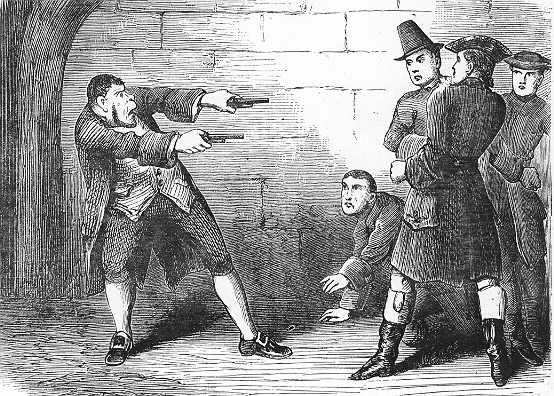
"BACK THERE!" SWEENEY TODD CRIED—"I AM A DESPARATE MAN—WHOEVER APPROACHES DIES."
CHAPTER XLI.
A MYSTERY EXPLAINED.
IN response to Sir Paxton’s summons a serving-man entered.
He stared at seeing Sir Paxton, but suddenly approached with a pleased smile.
"Is it possible—Sir Paxton Greaves returned?" he cried. "What if Sir Alton Guard were to arrive?"
"Fear not," said the baronet; "he will never come back. When I leave this place I shall proceed to those who will explain to him that I am master here. I possess the papers which have so long been hidden from me, and I am now, as I ought to be, Lord of Armale once more. But go tell the lodge-keeper I want him."
The man was not long in executing his errand.
The old lodge-keeper, wondering what on earth was about to happen, entered the room, respectfully doffing his hat.
"Collins," said Sir Paxton, "I have taken possession of my house. I will undertake that neither Sir Alton Guard nor his men shall interfere with you. Before to-morrow a proper number of servants shall arrive here to protect you. Meanwhile, I make you steward of Armale Hall."
The man looked in pleased wonder as Sir Paxton Greaves uttered these words.
He stammered forth his thanks; and then the young baronet proceeded to give him instructions as to his future conduct.
They were not interrupted in this.
The men who had fought on the side of Charles Northern were, in fact, too afraid to make their appearance while Sir Paxton and his friends were there.
Leaving the new steward in charge of Armale Hall, Sir Paxton Greaves and Ralph Moreton proceeded, as fast as possible, back to the inn where they had left Laura Grey and Captain George.
Their intention now, of course, was to bring things to a crisis at the hall.
Bella’s immediate danger was, however, not known to them.
They imagined that she was with her mother, away in the county of Essex, hidden somewhere until the time for revealing her whereabouts arrived.
Little did any of them imagine that she was placed between two evils—a marriage with Lawyer Denvil, or death by poison.
Immediately on the arrival of Ralph and his patron at the inn, they communicated to their two friends the result of their journey, in so far as the recovery of Sir Paxton’s estates were concerned.
"How I contrived to appear here, and there, and everywhere at the same time, or at least to appear to be so," he said, "is easily explained.
"I had a twin brother who was in face and form exactly like me.
"But, unfortunately, he was strange in his mind from his birth, and would act, child-like, according to my directions.
"Whenever I went on a night journey I left him in my place, and so, poor fellow, he met his untimely end at the hands of one on whose track I now am—the Reverend Obadiah Scramper."
"Are you certain of this?" asked Ralph.
"I feel sure."
"Then why did you not wreak your vengeance on him before this?"
"He has, like all of us, a mission to fulfil," said the baronet; "he must not die until we can extract from him the papers which he stole from the Hall.
"If those are lost there will be much difficulty in proving your identity and your claims."
Sir Paxton, of course, knew not now the real story of Bella’s life.
"This very night, Ralph," he said, "we will make our appearance at Moreton Hall, and confront the villains who would deprive you of your birthright."
CHAPTER XLII.
CLOSING IN.
THE lawyer, as I have said, was utterly dumbfounded and astonished at seeing Clara Moreton so suddenly break in upon him.
After his first wondering glance he lifted Bella up, and without a word sat her up in her chair, while he placed a glass of cold water to her lips.
"You need not have been in such a hurry to restore her to consciousness," said Clara. "I wish to have some private conversation with you."
"She is recovering, nevertheless," returned the lawyer, "but you needn’t fear that that will prevent your speaking with me in private. I will beg her to retire to her room, and then you can converse with me alone."
Bella presently opened her eyes and glanced around her in wonder.
Then, seeing Clara and the lawyer together, she rose, and glanced suspiciously from one to the other.
"What is this?" she cried, as she leaned faintly on the table, "am I the object of some new conspiracy?"
The lawyer hastily took her hand.
"No, no!" he cried, pressing it gently; "I can assure you that Miss Moreton entered the room unexpectedly and unbidden."
"Yes," said Clara, "I did; in time to overhear the very pretty plot which you have been hatching against my mother."
The lawyer smiled grimly.
"Whatever plot we may have been hatching," he said, "it is certainly not half so good as yours. Miss Clara, it seems, intends to retain possession of Moreton Hall as the wife of Ralph."
Bella turned pale at this.
"I was not aware," she said, while a sickening feeling invaded her breast, "that your cousin and yourself were betrothed. At any rate, it is scarcely in your mother’s programme."
The lawyer recovered his courage at this.
He imagined that Bella was taking this stand for his sake.
"Pray say no more, Miss Bella Moreton," said he, "I will settle this matter. When Mrs. Moreton returns home I will introduce to her one whom she has not seen for many years—her brother-in-law, Alfred Moreton."
Clara turned upon him a glance like that of a tigress.
"Good! good! Mr. Denvil," she cried; "you have at length thrown off the mask. We will see now who will get the best of it!"
And so saying, she passed haughtily from the room, and left the lawyer once more alone with Bella.
"My dear girl," he said, enthusiastically; "this matter can be settled more quickly than we thought. Now that I have thrown down the gauntlet your father shall come here to-night."
"But the papers?"
"I have them here," said the lawyer, tapping his breast pocket. "He shall have them at once when we have arranged matters."
Bella’s bosom fluttered with dread.
"Are there, then, conditions to make with him?" she cried.
"Well, you know one," he said, with his ghastly leer. "Your hand."
She had feared this.
But what could she do?
She must, for a short time at least, continue her deceit, and trust to time and circumstances to extricate her.
"Yes, yes," she cried, "but nothing more?"
"Nothing."
"And my mother—you will release her?"
"She shall be here this very night to meet your father," replied Denvil. "I do not desire to do things by halves. I wish, while happy myself, to make all others equally so. Well, I must tear myself away, now, from your beautiful presence," be added, raising her hand to his lips and kissing it. "I will at once proceed to London, and there prepare for to-night’s strange denouement."
Bella now gladly returned to her own room.
Her heart was in a whirl of excitement, and she was glad to be alone.
Meanwhile, Clara had scarcely reached her room when a servant came to the door.
"A gentleman desires to see, you, miss," she said.
"Who is he?"
"I do not know, miss. I have never seen him before. But he sent this note, which he says will explain the object of his visit."
Clara took the note, and opened it eagerly.
It ran thus—
"MISS MORETON,—I desire an interview. You need not fear that I come to interfere with you in any way. I come for the last time to explain that you are free, and will never be troubled with me again.—GEORGE."
"Admit him," cried Clara. She awaited his arrival with a mixed feeling, not altogether a feeling of satisfaction.
Captain George, as be entered, was pale as death.
There was a strange look of determination upon his stern features.
"Madam," he said, as the door was closed upon him, "I have come here to tell you of something which I should have kept to myself had our child lived. But I have this day heard from the person in whose care I left it that Heaven has claimed it for its own. It is dead, and there is, therefore, nothing to bind us longer together."
"Except our accursed marriage?" said Clara, in a low tone of inquiry, although she did not intend that he should notice it.
"That, madam," said George Harrington, "exists no longer.
"What mean you?" she cried.
"It means," he said, triumphantly, "that what you desired has come to pass, in a way you little dreamed of. You are not my wife, and never were. The man who united our hands was no minister at all."
He paused.
But she made no reply.
Her eyes assumed a fixed stare, a ghastly pallor pervaded her cheeks, and she sat with her hands tightly clenched upon her knees.
Then, briefly hut clearly, he told her the story which he had heard from Sir Toby Pimplenut.
She listened aghast.
Every word he uttered went like a dagger to her heart.
It was one thing to reject a man when an indissoluble tie was between them.
It was another to be cast off disgraced.
"Villain!" she gasped, at length, "you knew of this?"
"I did not," he said; "had I done so, I should have told you of it when you uttered those shameful words to me on my last visit. But enough is said. I preferred bringing you the intelligence, that it might not have to be written, and so chance falling into the hands of others. I will now say adieu. A better and a happier life awaits me in another land, whither I shall soon go—rich and respected, and, I hope, loved. The highway has seen me for the last time. My associates will know me no more. May you with another man be happier than you thought you would be with me."
She took one glance up into his noble, handsome features as he moved to go.
There came into her heart a strange feeling of loneliness.
The fortunes of her house were crumbling.
198
She had built her delusive hopes upon the sands of treachery and deceit, and she saw that the result would be ruin—utter ruin for herself.
And now even Captain George was about to leave her.
In an instant there came to her mind a sense of utter despair and loneliness, and she sprang up suddenly.
"Oh! George! George!" she cried, "don’t leave me!"
A smile—perhaps it might be a cruel one—played over his lips.
"Clara," he said, quietly, "a few days—we may almost call it a few hours—ago I gave you I every chance to live a happy life. I told you that I had resolved to abandon the wicked course into which my love for you had plunged me, and, endeavour, by honest means, to make a home for you. You rejected me; you jeered at me; you insulted our poor innocent child, and I told you then that the time would come when you would bitterly regret the hour when you sent me an outcast into the world alone. The hour has come sooner than I expected. Your home is about to be taken from you. Your mother has already fled—ah! no wonder you start and turn pale. She knew that vengeance was advancing sure and swift, and she has deserted the falling house!"
As he spoke, Clara tottered, and fell back fainting in her chair.
He crossed the room, and finding that she was insensible he pressed a kiss upon her lips.
"She was the mother of my child!" he murmured, "may Heaven guide her aright, and make her a better and a happier woman."
He then withdrew quietly from the room, and, having told a servant that her mistress was ill, he quitted the house—for ever!
In his own mind Captain George felt very differently towards her.
He had, days before, never dreamed that he could be indifferent to the fact of leaving Clara.
But she has turned the tide against herself.
Her utter heartlessness in regard to her own child had begun for her a career for which she could never have been prepared.
And he, finding he had thrown away his love upon a worthless being, felt a sudden happiness in being so easily, so rapidly released
He had, in his own heart, feared the result of this interview.
But he had escaped now, and he made a stern resolution never again to see her—never again to fall within the circle of her baneful influence.
On quitting Moreton Hall he went straight to Sir Toby Pimplenut.
The old fellow he now began to look upon as a friend.
He had shown his good-heartedness, and he resolved that he should be the first to hear of his resolute action.
Sir Toby was glad—indeed, delighted to see him.
"You have come just in time," he said; "I have had a communication which affects you."
"Indeed!" said George, in surprise. "What is it?"
Sir Toby took from his pocket a document, and handed it to him.
The highwayman started back in astonishment.
It was a free pardon.
"That will enable you to remain in England," said Sir Toby; "there will now be no fear of your being arrested. Let us hope that you will never again be tempted to do such evil deeds."
Captain George was quite overwhelmed.
"I no not deserve such kindness," he said; "but I will endeavour to prove myself worthy of it. I have news, also, for you."
"I congratulate you," cried Sir Toby, after he had heard all. "No woman who would speak so of her own child is fit to be the wife of any man who has any respect for himself."
They soon after this parted, and Captain George hurried to the inn to explain what he had heard and seen to Laura Grey.
CHAPTER XLIII.
THE BARBER’S DOOM.
UTTER darkness had fallen over the city when Sweeney Todd left the precincts of the Temple with a slow and stealthy steps and made towards the shop occupied by Mrs. Darkman.
As he neared Fleet-street he cast a hurried glance around him, and, perceiving that no one followed him, he turned the corner of the narrow street he had been traversing, crossed over to Bell-yard, and entered the pie-shop.
It was ablaze with light, and Mrs. Darkman was driving a roaring trade.
Crowds of hungry customers made the rafters ring with their clamorous demands, and, as the waiters came hurrying towards them with trays covered with snow-white cloths, and full of steaming hot pies, their glistening eyes told the pleasure they felt while one after another the pies disappeared down their throats.
Elbowing his way through the mass of people, Sweeney walked towards a sidecounter, where he observed Mrs. Darkman, surrounded by her waiters, to whom, ever and anon, she gave some hasty command.
Extending his hand with a malicious grin, Sweeney Todd said—
"Your trade is prosperous to-night, Mrs. Darkman. Can I speak with you in private for a few moments?"
Mrs. Darkman paled slightly at these words, but she replied with firmness—
"Yes; enter the parlour. I will be with you shortly. John, take a pie to that lady; and you, Robert, ascertain what that gentleman in black requires."
Todd walked into the parlour; but, owing to the agitated state of his mind, he did not seat himself, but strode to and fro like a caged lion.
At length Mrs. Darkman sailed in with a queen-like air, and, after locking the door, inquired what was the object of his visit.
Sweeney, noting the alteration in her manner with a slight misgiving, answered—
"What is the object of my visit? What is it that I am waiting for? Why don’t I immediately leave the country? Simply because I want money. You and I have amassed an immense amount of wealth. It is in your possession. I want exactly half."
"I know not of what you speak," said Mrs. Darkman.
"It is not of any avail to feign ignorance," exclaimed Todd. "You have ten thousand pounds—you must give me five thousand."
"And what if I refuse?"
"Then you and I will swing together."
Mrs. Darkman smiled at him in scorn.
Sweeney was now getting in a fury.
"Do you intend to allow me my money or not?"
"I refuse."
"Very well. then," said Sweeney Todd, rising from the seat which he had occupied during the discussion; "you will pay dearly for this."
At this moment he glanced out of the window, and as he did so he uttered a cry of terror.
For, standing in the midst of the customers, he saw the form of Rossitor, the constable, surrounded by his men, and as Sweeney Todd opened the door he heard him addressing the crowd that thronged the shop.
"Where is Mrs. Darkman?"
Todd waited for no more, he scented danger; dashing round the side counter before mentioned, he flew down the steps leading to the bake house.
The cook that was employed there, under compulsion, rushed out of the vault directly Sweeney entered, and, despite all his shouting for him to come back, the man kept on his course.
Sweeney Todd’s next move went was to bolt the door firmly, and to place all the furniture of the vault against it.
Then he ran along the vaults of St. Dunstan’s.
At length he arrived at the steps that led to the trap-door in the room next to the shaving-shop.
Hurrying up these, he lifted the trap and, rising to his feet, he walked towards the shop and opened the door.
He started back in astonishment.
The shop, instead of being in utter darkness and silence, consequent on its being closed up as he expected, was full of constables who the moment they perceived him enter, gave a shout and made a dash at him.
One glance was sufficient for Sweeney Todd and then, turning on his heel, he rushed down the steps; but, unfortunately, in his hurry he had left the trap-door open, and he had scarcely proceeded fifteen yards along the vault, when to his terror, he looked behind him and saw the constable dashing in hot haste after him.
Sweeney Todd purposed to lock himself in the bakehouse, and so secure himself for a time; but this plan was frustrated—for, as he entered it, the officers dashed in after him.
You may track the tiger to its lair, but when it once turns to spring upon you your fate is sealed.
Thus it was with Sweeney Todd, for when he found himself at bay he turned upon his pursuers with the fury of an enraged tiger.
The man who had so recklessly, and with such hideous cruelty, hunted down and murdered his fellow-creatures was terrified at the idea of death himself, and resolved to make a desperate stand.
It was literally true that his eyes blazed through the darkness.
"Back, there!" he cried, in a voice hoarse with fear and fury. "I am a desperate man. Whoever approaches dies."
They saw, as one of them opened a dark lantern and threw the light upon him, that he held a pistol in each hand.
It was evident that some stratagem would be necessary.
One rush, of course, would be required, but it was certain that in that rush someone must perish.
A whispered conference took place among those at the back, while the leader said—
"Sweeney Todd, your hopes of escape must be those of a madman. What chance have you against those who now surround you? Yield, then, and let the law decide your fate."
While he was speaking, one of the men had glided down upon the ground, and was crawling towards the spot where the wretched man stood.
So silently did he go that Sweeney Todd had not the remotest idea that anyone was approaching him.
"I will never yield!" he cried, "I deny your authority. You have burst into my house illegally, and I will resist to the last."
As he uttered these words, the constable, who had made his way round, rose suddenly, and, darting between his legs, threw Todd on his back.
In an instant the officers were upon him.
But even now he did not relinquish his hold upon his weapons.
As they dashed up he discharged them both, sadly wounding two of the men, and as the others sought to seize him he grappled with them desperately.
He knew now that his last hour had come.
All the results of his hideous malignity were now as naught.
The wealth he had amassed would be enjoyed by others, and he would now be hurled into eternity to meet those who had died cruel deaths by his hand.
He fought and kicked desperately.
The men, who were determined to seize their prey, cared not for wounds, now that their blood was up.
In spite of the fact that Sweeney Todd succeeded in drawing his knife, and stabbed wildly in the dark, they struggled to wrest from him the weapon.
Their hands and even their faces were slashed by the knife, held with a giant’s strength by the desperate man.
199
But they heeded not.
Little by little his strength oozed away; his breathing became short and hot; the heaving of his chest could be readily discerned by the men as they struggled over him.
His efforts every moment became feebler, and at length, just as he clutched the throat of one of the officers, a dagger plunged up to the hilt in his breast laid him still upon the ground.
"Curse you!" he hissed, with his last breath, between his clenched teeth.
The Demon barber was no more.
"The villain is dead," exclaimed the leader; "let him lie there, while we seek his partner in crime."
During part of the time that Sweeney Todd was struggling with the officers, the widow Darkman had been heard to give vent to the most heartrending cries.
But during the last part of the contest silence had reigned throughout the place, and now, as they passed up into the shop, they found that it had been closed by the constables.
Mrs. Darkman lay on a couch in the room at the back of the shop, with her face turned downward, as if hiding it from observation.
"The barber is dead; the seller of his kind is no more," said the chief constable solemnly.
"And so is she," said Rossitor, pointing to the body on the couch.
"She dead, also?"
"Yes; when she heard the scrimmage," said Rossitor, "she knew that all was over, and she drank some poisonous fluid which she had concealed in her pocket. She never gave any notice of her intention, not even speaking a word to any of is. She suddenly fell like she is not, face downward."
"A good riddance of two wretches," said the head officer, "for there is no death devised by law, except burning, which is bad enough for them. Come, let us fasten up the place, and quit it."
In a few moments the house was vacated by the constables, in presence of a large crowd, and left to its darkness and its horrors.
CHAPTER XLIV.
A STANGE FAMILY MEETING.
NIGHT had fallen over Moreton Hall once more. Mrs. Moreton had not returned. The words of Captain George were evidently coming true.
She knew her peril, and had fled to avoid it.
Mr. Denvil was buoyant.
He never had seemed in better spirits in his life.
And no wonder.
Was he not expecting the father of his betrothed bride?
To him the disappearance of Mrs. Moreton was most opportune.
It relieved him, in fact, from an immense deal of anxiety.
He had no one now to oppose him, for in his own mind he seriously believed that Bella would adhere to her promise.
Harry Moreton had watched with strange bewilderment what was going on around him.
He had, from the commencement, been kept in the dark in regard to the proceedings of his mother, and his sister did not now care to take the responsibility of enlightening him.
Well, as we have said, darkness had fallen over Moreton Hall when the great bell at the gate was rung violently.
Presently the servant announced the arrival of Sir Paxton Greaves and Ralph Moreton.
Mr. Denvil smiled, and rubbed his hands.
"We will very quietly dispose of them," he said. "Let them in, let them in."
In a few moments Ralph and Sir Paxton Greaves entered the room.
Of course the former remembered Mr. Denvil only as the unscrupulous lawyer, the man whom he had heard plotting with his aunt to take from him his property.
As such, too, the young baronet regarded him.
He had no conception that Mr. Denvil had, in any way, opposed Mrs. Moreton’s murderous a schemes.
"Sir," said Sir Paxton Greaves in a stern voice, "I imagine that you know well the purport of our visit?"
"If I do know it," replied Denvil, in an oily voice, "I feel for your disappointment. You come here, I presume, in regard to Master Ralph’s claim to the property?"
"We do."
"Then, as I, said before, I regret very much that for a long time a great mistake has been, made," said the lawyer, "Ralph Moreton is not the heir to this estate."
Both Ralph and Sir Paxton Greaves looked aghast at what they deemed his impudence.
"Not the heir!" exclaimed Ralph; "then, pray, who is the heir?"
"That you will know before another hour is over," said Mr. Denvil. "Yet stay. I see no reason whatever for delay in this detail. I may tell you at once that the real heiress to this property is the daughter of the oldest brother of the family—Alfred Moreton."
"Who is she?" asked Sir Paxton Greaves. "From all that I have discovered it seems that he died long since, and that he never married."
"On the contrary, he did not die long since, and he did marry," said Mr. Denvil; "his daughter is now in this house."
"This is some imposture!" cried Sir Paxton; "how can this girl—whoever she may be—prove her identity?"
"Listen, and you will see," said Denvil.
Then, carefully and minutely he told the story of Alfred Moreton.
They both listened attentively.
It certainly seemed as if the story was a true one.
"Well, Mr. Denvil," said Ralph, "it certainly does seem as if there was a great foundation for your story. Is the young lady here?"
"She is. Do you wish to see her?"
"I should wish it, certainly."
With a peculiar smile, Mr. Denvil was about to proceed to Bella’s room and call her down, when there was another loud summons at the great gate.
The huge bell once more rung out sonorously on the night air, and the servant announced Mr. Foster Barclay.
Denvil was now pale and nervous, though exhibiting symptoms of delight.
"The denouement is at hand now, gentlemen," he said, and stood watching the door.
The new-comer entered, and as he did so Ralph Moreton staggered back, and uttered a cry of fear.
"Oh! can this be?" he cried; "the spirits of the dead are walking everywhere. This is no real presence, Mr. Denvil. By what devilish arts have you conjured up this spectre?"
Foster Barclay smiled.
"Be not afraid, Ralph," he said; "you recognise in me, no doubt, the man whom you saw lying for dead on Combe Deane Heath. I am he; I do not deny it; but I am real flesh and blood."
He explained briefly his story, as we have before heard it told to Doctor Burns.
"My name, I need scarcely say, is not Foster Barclay," he added, "but Alfred Moreton—your uncle, Ralph!"
Was he glad or sorry?
What were his real feelings towards this man, who came suddenly, as it were, from the land of spirits to dispossess him of his property?
His Uncle Alfred had been good to him in his babyhood, had danced him on his knee, had told him wonderful tales, and—and there was the old familiar gleam of good nature in his eye, the familiar look in his face—the likeness to his own father.
He went frankly forward and held out his hand.
"I am glad, indeed, to see you, uncle," he said, smiling, "although you do take from me an inheritance to which I had looked forward. No matter, the world is wide, my arms are strong, and—"
"There may be other ways of finding a fortune," said Alfred Moreton; "but tell me, Mr. Denvil, where is my daughter? I long to see her and her mother."
"Her mother is now on her way hither," said the lawyer, nervously; "your daughter shall be here in a moment."
He hurried from the room, and in a few minutes returned with Bella.
Ralph was, of course, the only one of the trio whom she knew, and in an instant she was nestling, weeping with joy, in his arms.
Alfred Moreton turned with a smile to the lawyer—
"Ah!" he said, "there seems to be a chance of a very different settlement of affairs. There will be no need for any fear on Ralph’s part of losing his fortune."
Mr. Denvil was turning all the colours of the rainbow.
He saw his grand plan disappearing as if by magic.
"Miss Moreton," he said, as he placed his hand upon her arm and gently drew her away, "this is your father."
She gave one glance at the handsome, sunburnt face of the man who was looking so wistfully at her, and then, advancing, she took his hand and kissed him.
"I am glad, most glad, to see you, dear father," she said; "be assured of that; but of course Ralph here is best known to me. I have never since I was a mere baby seen your face; but I shall love you, I know I shall."
"Well, well," said Alfred Moreton, "I think we shall make a far more happy family than has been residing of late in this home. But come, Mr. Denvil, you must do the honours to-night, for we are strangers."
Mr. Denvil bowed as he rang the bell.
His heart was too full for words.
Again and again he glanced suspiciously at Bella, but she would take no notice of him.
CHAPTER XLV.
WHICH IS FIN AL.
SHE knew well that she had defeated him, but she did not wish for a revival of hostilities. Supper was ordered in the dining-hall, and Clara and Harry were invited to join, that they might meet their uncle and cousin.
But they declined.
"They would leave Moreton Hall in the morning," said the servant, "and reserve for a court of law the question whether this was usurpation or not."
This, however, did not spoil the enjoyment of the united friends.
Mrs. Graham (or rather Mrs. Alfred Moreton) arrived safely in the midst of the meal, and their happiness was complete.
The only question was—Where was Captain George?
He had been invited to be one of the party, but he had not come.
Why was this?
Captain George had, as arranged, remained behind at the inn while Sir Paxton Greaves and Ralph proceeded to the hall to arrange preliminaries.
He did not in any way disapprove of this arrangement, as it gave him an opportunity of talking alone with Laura Grey.
At length, however, he tore himself away from agreeable company, and took his way along the high-road towards Moreton Hall. The front door was open, and passing up the deserted staircase, he saw, on the broad landing, the form of Clara Moreton.
She was listening at the door, and so engaged was she with what she heard that she did not perceive George.
He crept up, therefore, and listened and watched too.
Clara did not remain long at her post.
200
With a face blanched with passion she turned away, and sought her own room.
As she passed the highwayman he distinctly heard her say, "Curse them all! But I will foil them yet. The papers are still in my power, and I will destroy them!"
She passed into a small room, where stood a square bureau on slender legs—an old-fashioned article of furniture, in which all the family documents were kept.
To this she hastened, and, taking from her bosom a tiny steel dagger, she began forcing the lock.
Captain George hurried to her side, and she started back with a wild cry on seeing him.
She guessed his purpose at once, and with an angry exclamation she leaped towards him, raising her tiny weapon.
"Back!" he cried, levelling his pistol. "I will not suffer this wrong to be done. Quit the room or I will alarm the house."
There was no chance now of attempting anything further, and so, with a muttered promise of revenge, she sailed from the room.
"We shall meet again, George," she said, bitterly, as she reached the door; "and you will rue this hour!"
They never did meet again.
Locking the door of the room Captain George made his way to the apartment where they were all making merry— Denvil having slunk away on the excuse of having a headache.
Before he joined them at their feast he insisted upon Alfred Moreton securing the papers.
There were many documents missing, but all these were supplied by Captain George, who, it will be remembered, purloined them from Obadiah Scramper when he was paying his thievish visits to the house.
The reunited husband and wife, the lovers, and the others kept up the festivity to a late hour, and it was not until the small hours of the morning that quiet reigned once more in Moreton Hall.
Before the ordinary hour of breakfast the following morning Clara and Henry quitted the place.
Against the latter no one had the remotest enmity, but he chose to follow the fortunes of his sister, and Alfred Moreton, therefore, concluded to give him, as he wished, an annual sum of money so as to enable them to live abroad.
It was over in Paris that they chose to locate themselves, and there Clara’s personal charms soon procured her a husband, with whom she lived an indifferent life, often regretting the handsome daring fellow whose utter ruin she had so nearly been.
Mrs. Moreton never returned to the hall, and became, after all, the wife of Lawyer Denvil, who received an abrupt dismissal from Bella on the first renewal of his advances.
Two years after a grand double wedding took place at the hall—that of Ralph Moreton and Bella, and George Harrington and Laura Grey.
At this wedding Sir Paxton Greaves met a fair lady, who took his heart captive, and served in a great degree to heal the wounds of years.
And what of Tom the Link Boy?
Escaping by means of the vaults where Sir Greaves had re-buried the twin brother; whose existence had caused him such strange surprises, he made his way to the office of the constabulary and gave information against the Reverend Obadiah and his partner.
Finding his danger, however, the latter made himself scarce, while the former was seized, and, being recognised as a long escaped murderer, was handed over to the tender mercies of Jack Ketch.
Ralph did not forget his old friend.
Immediately that the affairs were settled at the hall, he sought out Tom, and not finding him at Fadge’s he left a letter for him, to which, about a week after, he received the following reply, written for him by an older hand—
"DEAR RALPH,—I accept with great pleasure the offer of money you make me, as it will enable me at once to quit England. Send it to the address I give, and I will write again and let you know where I am settled. I shall not come and say good-bye, as it would revive old feelings, which are better dead. I must have known that Miss Moreton was too good for me, and that she would most naturally take to one better favoured in every way than myself. God bless her, and you, too, and may you be happy! "MOONLIGHT TOM."
Years after they heard that, out in the then wild continent of America, Tom had found a wife and a fortune, and was a happy and a thriving man.
The many letters he wrote over to them, however, were not signed "Tom the Link Boy," but Tom Moreton, a name he had taken for old friendship’s sake, he said; but they guessed the real reason when they afterwards heard that his beloved and only girl was christened "Bella."
THE END.