165
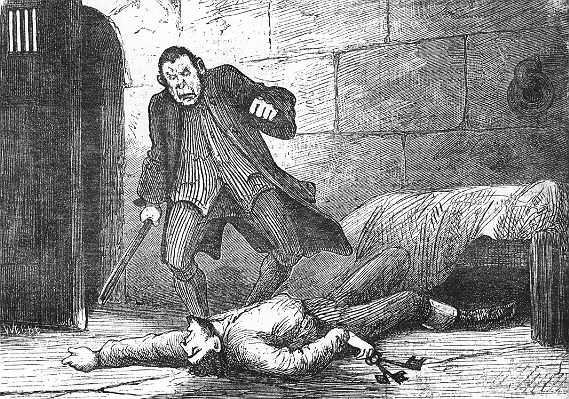
RAISING THE IRON BAR HE HAD DISCOVERED THE PREVIOUS NIGHT SWEENEY TODD FELLED THE MAN WITH ONE BLOW.
CHAPTER XXXV.
FURTHER ADVENTURES OF RALPH.
"THE deuce take the fellow!" growled Sir Toby; "he�s a highwayman, he robbed me, made a laughing-stock of me, and yet I like him. He acted kindly to me, and I�ll do something for him. He�s left the five hundred pounds, too. I�ll make him take it next time he comes."
Meanwhile, Captain George made his way from Pimplenut Hall with strange and oppressive feelings.
What he had heard had entirely changed the current of his thoughts.
He had but a few hours before, as it were, threatened Clara, spoken of their love, appealed to her for their child, and warned her of the future.
And now the vengeance of whish he had spoken was within his grasp he seemed to draw back from it.
He passed along gloomily and moodily, resolving in his mind a hundred plans of action, until he at length reached the very inn where Sir Toby had met with such ignominious treatment.
As he passed into the vestibule some people were entering it from a carriage which waited outside.
There were four persons.
One man, tall and elegantly dressed, was assisting an old man, who was weak and feeble, while another younger gentleman had on his arm a female, who was deeply veiled.
Captain George started as he saw the younger man.
"Ah!" he cried. "well met. Do you remember me, Mr. Ralph Moreton?"
"I do, indeed," said Ralph. "Captain George Harrington. Allow me to introduce you to Sir Paxton Greaves, Mistress Laura Grey, and Sir Henry Grey."
"We will sup together," said Sir Paxton, when the introduction had taken place; "let us enter this room, where we can be alone."
Captain George�s eyes fell upon Laura�s face.
What was it that sent a thrill through his heart?
We shall see.
* * * * * *
We left Ralph on the high-road to Orpington, whither he was despatched by Sir Paxton Greaves. The woman who dashed out into the road to warn him of his danger drew him into the courtyard of the house, and, as he leaped
from his steed, she drew him into a dark, barn-like building, and closed the door.
"Remain here," she said, pointing to a heap of straw in one comer. "Hide yourself among that; will see to your safety."
Ralph lost no time in following the woman�s directions.
Hiding himself beneath the truss of straw, he remained perfectly quiet, listening.
He had scarcely been there more than a minute when a horseman thundered up.
The woman had by this time dragged Ralph�s horse into the stable, and had herself retired into the house.
The horseman drew up and knocked loudly at the door.
At the same time he shouted�
"House! house!"
The woman, who had so strangely and opportunely come to his rescue, kept the man waiting as long as ever she could.
When she did at last appear she pretended to half-asleep.
"Whatever is the matter?" she cried. "What do you want?"
"Have you seen a horseman pass this way?" inquired the man, eagerly.
The woman paused a moment before replying.
"Why, you impudent, good-for-nothing vagabond!" she cried, "to come here and dare to knock up a woman when she is asleep in bed to ask her such a question. Go to the inn and ask�I won�t give you any information, you insolent fellow."
And with the words she slammed the door in his face.
The man was thoroughly discomfited.
Finding himself bolted and barred out, without any further knowledge than before, he put spurs to his horse, and went dashing away along the road.
The woman prudently permitted some time to pass before she came out again to the barn.
When she did so she said�
"Rise, sir, pray fear nothing more. The fellow will go straight on to Orpington now."
Ralph struggled up, and shook himself clear of the straw.
"How did you know I was going to Orpington?" said Ralph.
The woman laughed.!
"Ah!" she said, "that is my secret. I must not reveal it to you. Suffice it to say that I have a brother here who will take you by a short cut to the place you desire to reach. By that means you will reach your destination before that fellow, who has just gone dashing away on a wild-goose chase. Follow me."
Following her, he found himself in a moment in a small room, with a cosy fire.
"Sit down there," said the woman, whom he now saw to be a strongly-built but comely-looking woman of some twenty-five years of age. "I will go and rouse my brother, and, in the meantime, drink some of this home-brewed beer, for the night is cold."
The woman handed him a foaming tankard of home-brewed ale, and then hastened up the stairs, leaving him, as may be imagined, plunged in perplexity.
Who could she be?
How was it that she was thus linked with the mystery of Sir Paxton Greaves?
But questioning was vain.
It was utterly impossible to investigate the matter then.
Quite as useless to try to imagine the meaning of these constantly-recurring mysteries.
In a few minutes the woman returned, accompanied by a lad of some fifteen years of age.
"This is my brother," she said, "he will ride with you across Flexham Wood, and within the hour you will be at Orpington."
The little black pony which stood at the side of Ralph�s horse in the stable was soon saddled, and, after a hearty grip of the hand from the woman who had saved him from pursuit, the two proceeded on their journey.
It was a somewhat dreary one.
The night was dark, and over the narrow path which led through the wood the trees cast an impenetrable shadow.
But the lad appeared to know his way well.
With his rugged little pony he led the way at a quick trot, which Ralph found it difficult to follow at first.
But, after a few minutes, he became used to the journey, and, with a steady trot, they soon reached the other side of the wood.
"We are now not half an hour�s ride from Orpington," said the lad; "we have a broad road now before us, and can proceed at a rapid yet more easy rate."
So they trotted on, side by side.
"What is your sister�s name?" asked Ralph, after a moment.
"Mrs. Edgecombe."
"She knows Sir Paxton Greaves well?"
"She does."
"Did you know I was going to Orpington?"
"Yes."
"And how was that?"
The lad laughed.
"Ah!" he said, "that is my secret."
"You seem to live in mystery."
"No we don�t."
"Then why not answer me?"
"Because these secrets are not ours to tell," replied the boy.
He said it firmly and boldly.
There was a ring of power and decision in his voice that Ralph could not help admiring.
"You are right not to tell," he answered, "quite right. You oughtn�t to say a word if it is not your secret. It is a most fortunate thing your sister knew me. But how did she? Is that another secret?"
"No."
"Then may I know it?"
"She didn�t know you; she had to take her chance. She asked everyone that went by the same question."
"That was a dangerous thing to do."
"Very likely it was," said the lad; "but, as it was the only way, she had no choice. Luckily, only two horsemen came by before you."
"What is your name?"
"Leonard Harford."
"Good," said Ralph; "I won�t forget how you befriended me to-night."
And so, for a while, they jogged on in silence.
The adventure, from this point, may be said to have been over.
Leonard Harford knew that part of the country well, and in less time than he would have imagined possible, Ralph found himself at his destination.
The house to which he had been directed by Sir Paxton Greaves was a strange one.
A house situated by itself, on the edge of the black high-road, with a drawbridge crossing a kind of moat.
It was here that he anticipated that he would be annoyed and intercepted, if at all.
But it was not so.
The man who had pursued him appeared to have lost all trace; and, within half an hour after his arrival�a half-hour during which he saw no one but an old servitor of terribly dolorous appearance�he was again on his way home.
The mystery of this journey has yet to be unravelled.
At any rate, he reached the side of Sir Paxton Greaves once more in safety.
On the following day he was taken by his patron in a boat up the river to a house where he met Sir Henry Grey and Laura.
It was here, and now, for the first time, that he became aware that Sir Paxton was acquainted with those people for whom he and Tom the Link Boy had so often laboured.
It was easy to see at once, however, that they had, in some way or another, become mixed up in his affairs, for the direction in which they travelled on that day was that of Moreton Hall.
It was thus, at the inn near the old hall, that the meeting took place between Captain George and Laura.
A meeting which was destined to change entirely the destiny of many lives.
But, before we describe this wonderful and unexpected change in our history, we must return for a time to the strange mystery of Fleet-Street.
CHAPTER XXXVI.
THE ESCAPE.
WHEN Sweeney Todd found himself securely locked in a prisoner�s cell in Newgate, his feelings were of a description impossible to describe.
Todd was one of those characters which one seldom finds in real life.
Instead of doing what nine men of ten in his position would have done�namely, devising some means of escape, he wasted his time in savage and bitter retrospections.
Indeed, so occupied was he with his thoughts of the past, that it was not until a warder entered his cell with the coarse food provided for criminals that his present situation dawned upon him.
166
Then it was that the idea of escape occurred to him.
After watching the warder out, he hastily searched the place, and had the great satisfaction, in a few moments, of discovering a large piece of rusty iron lying unnoticed in a corner.
He hid it under his clothes, and fairly grinned from ear to ear with the excess of delight occasioned by his good fortune.
"This is exactly what I want," he muttered. " But it will not be of service till to-morrow. I shall not be interrupted any more to-night, so I shall take the rest I need."
Feeling satisfied that he would not be visited by any of the officials again that night, Sweeney laid down on the bed, and was soon in a deep sleep.
When he awoke, silence and gloom had fallen over the old prison.
Sweeney Todd, for the first time in his life, felt the twinges of conscience.
One by one, spectres of his murdered victims seemed to rise before him, and to point downwards. This continued for such a length of time that he became quite delirious, and short, nervous ejaculations issued from his lips.
At last he started up in an agony of terror, and as he did so he uttered a horrible shriek, and held his hands over his eyes.
For there, standing with outstretched arms, he fancied he could see the figure of Mad Cluney.
When Sweeney took his hands from his eyes he recovered self-possession by a sudden effort, and chided himself for his folly and cowardice.
Once more he laid down and slept.
But the second slumber was destined to be far less dreamless than the first one.
He thought that a tall, dark man came to the side of his bed and commanded him to arise, and that, with the helpless obedience so common to dreamers, he followed him to the other side of the cell.
Here the man stopped, and, pressing a spring in the wall, a block of stone slid aside, disclosing a long flight of steps.
Then the man led the way down till they came to a large stone vault, brilliantly illuminated, where he halted.
In the centre of this stood a coffin, and on the plate was marked his own name.
He fancied a loud, sepulchral voice said�
"Show him the body!"
He was then forcibly dragged up to the coffin, and in it he beheld himself. He sprang towards the entrance, and�
"What the devil�s the matter?" cried the warder, as he entered. "Why, you cuss, you�ve been a hollerin� as though Old Nick had got you. I�m blowed if all the clothes ain�t on the floor. You look like a dying duck in a thunderstorm, too!"
Sweeney Todd rose up in the bed with a gasp.
"What have I been doing?"
"Doing�you�ve bin screechin�, and kickin�, and such like. I never seed sich a chap. If you are a fool, why let everybody know it? Come, be a man; if you are to die, die proper and respectable, and not annoy people about it. Why, I knew a chap as took his death so quiet that I�m blowed if he didn�t look as if he was a-eatin� of his dinner. Says I to Bill, �He don�t deserve to die, he doesn�t�no he doesn�t, sich a fine chap as he is, too.� "
During this harangue, Sweeney Todd had arisen and commenced dressing himself rapidly; but the official was in a chatty mood, and did not notice it, but continued�
"Yes, and then there was Dick Pole, be stood and cheeked the magistrate as though he was his equal. When we left the court he called the judge an ass, and said he ought to be kicked. And, Lor� bless you; there wasn�t the slightest bit of fear about him, although he knew he was to die to-morrow."
Todd was now completely dressed, and he walked across the room with a pretence of obtaining some article.
"Now is my time, or never," he thought.
Raising the iron bar he had discovered the previous night, he felled the man with one blow.
"Curse you!" he groaned. "I�ll�"
Another blow completely silenced him.
Kneeling down, Sweeney felt his heart�the man was dead.
The next move was to strip the dead warder of his clothing; and, having done this, he quickly doffed his own clothes, and assumed those of his victim.
Then, without delay, he strode out of the cell, imitating, as well as he could, the warder�s walk, and in less than fifteen minutes he was hurrying from Newgate-street on an errand of the governor�s�from which, of course, he never intended to return.
"Ah!" he muttered, as he sped along, "Mrs. Darkman will not expect me so soon. But, I think I have been away long enough. I wonder how she has managed about the meat for the pies? Very badly, I expect. I suppose she has been obliged to use real mutton."
Todd at length arrived at Mrs. Darkman�s shop, which was just opening, it being a very early hour in the morning.
He strode inside with an air of importance, and Mrs. Darkman started back in fear when she observed the official dress.
Todd grinned, and said�
"Be not alarmed. It is only me."
Bending forward, Mrs. Darkman uttered a cry of amazement.
"Why Sweeney, how came you here?"
"I will explain that presently. How are the pies getting on?"
Glancing round to ascertain that there were no eavesdroppers, she said, in a whisper�
"I have been obliged to use real mutton, and the people have complained of the difference in the flavour!"
Sweeney scratched his chin thoughtfully.
"Let�s see," he said, "what ought to be done? The man whom I left at the shop knows nothing of the revolving chair, so I suppose all is right as regards secrecy in that quarter."
Then, after a moment�s reflection, he added�
"We must dismiss that subject for the present. Have you any disguise that will suit me? My escape will be discovered, and the runners will be after me. But for the time being I am safe; they will not think of coming here directly."
Mrs. Darkman thought a moment.
"Yes, I think I have some clothes that will answer your purpose." Here her natural curiosity overcame her other scruples, and she said, "But how did you succeed in making your escape?"
Sweeney Todd placed his finger on his lip to enjoin silence, and he walked into the parlour, saying�
"Of that presently."
Then, quickly but accurately, he told her all.
Soon after this, Sweeney Todd might have been seen limping along the streets towards the riverside, disguised like an old pedlar.
He passed along the Temple Gardens, and at length arrived before a dingy, murky street, at the corner of which stood a small alehouse.
Into this he hobbled, and called for a tankard of beer, which was served him, and, having examined the group at the bar minutely, he retired to a corner.
Sweeney Todd�s purpose was to hide about the Temple till the excitement caused by his escape had subsided; when fully assured of this, he intended to proceed to Mrs. Darkman�s and claim his share of the wealth which they had both gained.
Of course it was to Mrs. Darkman�s interest to help him to evade the law, for if Sweeney were again to fall into the hands of his enemies her fate would be certain.
She knew that his vindictive temper would insure her ruin, were that to happen.
Although Sweeney Todd was extremely satisfied with the events of the day, he was not devoid of nervousness.
Every man who entered caused him an uneasy start, and he was glad, therefore, when he was able to slink out unnoticed.
What his new plan was we shall presently see; but we must, for the present, leave him to follow the fortunes of other important personages in our history.
CHAPTER XXXVII.
FROM DEATH NEW LIFE.
IT was, indeed, a strange coincidence, the meeting of Captain George and Sir Paxton Greaves� party at the old inn near Moreton Hall.
But it seemed to him as if his life altogether was about to undergo a change.
The strange way in which he had been received at the house of Sir Toby Pimplenut, the story which had been told him by the old magistrate, and the prospects of a new and honest life, seemed such an extraordinary reverse in the order of events that he was prepared for anything.
Even the thrill which had passed through his breast when he first cast eyes on Laura Grey.
What could it mean?
Could he forget Clara?
Had fate placed in his way the means of carrying out at once the revenge of which Sir Toby had spoken?
Could he now punish, in the most terrible way�by indifference, by the flinging off of her chains�the woman who had driven him out into darkness and despair?
His thoughts, of course, were sent into other channels by the scene at the supper-table.
The party endeavoured to keep up a lively discussion from the first, and, as soon as they had become more accustomed to each other�s society Captain George became the life and soul of the party.
Who, in listening to him�in hearing his polished sentences�would have imagined that the perfect gentleman was nothing more nor less than a highwayman, used to wild adventures, to reckless and desperate company, to slang and drinking bouts?
Alas! we are what circumstances make us.
It fell out, during the progress of the meal, that the Moreton family were discussed freely, and, ere they separated for the night, confidence had been given for confidence, and they were all on very good terms.
The only one of the party who seemed to take scarcely any interest in the proceedings was Sir Henry Grey.
Long since he had wearied of his sad pilgrimage.
Used to wild adventures in his youth, the staunch partisan of the Pretender�in whose service he had grown gray, and suffered the storms of battle, and the wearying pursuits of which he had spoken so feelingly at the inn on the old bridge�he at length felt the hand of the destroyer strong upon him.
And now, as he listened to the words of those around him, and heard their plots and counter-plots, how little it all seemed to his mind.
It was past midnight, and all in the tavern had retired to rest, when Captain George, who was unable to sleep, pushed open the French casement of his bedroom, and stepped out on the clumsy balcony.
The night was now quiet, but there was a wild and stormy sky.
Black bands of cloud girt the canopy of Heaven, relieved by lighter ones, with a star here and there hovering timidly on the edge of utter darkness.
The stillness, indeed, seemed to portend a thunderstorm.
Everything was indeed so quiet that the slightest sound in the inn could he heard, and, as Captain George leaned on the ricketty railing of iron, he thought he heard near him the sound of sobbing.
Could it be?
He listened intently.
Yes; there was now no doubting it.
Near him some woman was sobbing in deep agony.
There were only two rooms whose windows looked out upon the balcony�his and another�and he at once hurried to the casement of the latter.
He could not have told what instinct made him do it.
It was scarcely the approved thing for a
167
man to throw himself into a scene of sorrow unmasked.
Yet, in the dead of night, with no one near to comfort her, why should a woman be left helpless and alone?
He peeped in.
The bed which stood in the room was on the left of the window.
But this he could tell, that by the bedside knelt a woman, whose body was agitated continually by violent emotion.
Only a moment he hesitated.
Then he resolved to enter.
He was, of course, an adept in the art of entering houses without keys, and in a few moments, so to speak, he was within the chamber.
The noise of his entrance disturbed not the sorrowing woman.
He touched her gently on the shoulder, and, as he did so, is gaze fell on the figure on the bed.
Sir Henry Grey was dead!
She glanced up at him with wondering eyes, and then staggered to her feet.
"Oh! why and how have you entered here?" she said, in broken accents. "Surely my sorrow�"
And then she broke down.
He took her hand and pressed it gently.
"Believe me," he cried, "it was from no wish to intrude upon your sorrow that I entered here. Some instinct told me that death had entered here, and I came so say what words of consolation I could without impertinence."
He spoke so gently, so tenderly, with such feeling, that all irritation passed at once from her mind.
"Forgive me for my words," said Laura Grey, "I did not mean rudeness to you; but I am overcome by grief, and scarcely know what I say. My father, as you see, is dead."
"It is very sudden�it is but an hour since we quitted the supper-table."
"Yes, but even then it was easy to perceive that his life was ebbing from him," replied Laura. "After he had gone to bed he called to me and asked my to sit with him until he slept. I did, and when he fell asleep it was that of death."
"But why did you not call someone?" asked the captain. "It will seem strange to others that you sought no assistance."
"What care I for others!" cried the lovely girl, raising her tearful eyes to his. "I have lost my only friend. I have no one in the world to care for me, and they may think and do as they please."
This was the turning-point.
Had Captain George permitted this remark to pass unheeded the whole current of his life would have been changed.
But it seemed to fated.
"Come to the window and let me speak to you," he said, in a low, soft voice; "then I will rouse someone in the house."
She came without a murmur.
Somehow or another she felt faith in this strong man.
"Your name is Laura Grey, is it not?" he said.
"Yes."
"That is your father?"
"Yes."
"Well, you must know�you must feel�that his race is rightly run. He is old; he has done great service in his time, and he has gone calmly and peacefully to his rest. You should not repine against Providence."
"I do not; but it is very hard."
"Only hard because you do not look to the future, and remember that your life was not meant to be bounded by your father�s. You were designed by Providence to live a life of your own; and if you desire to be loved, you will find someone to love you."
He pressed her hand gently as he spoke, and then added�
"I will now rouse the house."
He quitted the room by the window, gently closing it after him.
Laura Grey stood for a moment transfixed.
A new light shone before her.
A new feeling sprang up in her breast.
What was it that made her so yearn for the coming of this man, who, even in the presence of death, spoke words of cheering hope, which did not seem out of place or wrong?
She knew not.
But she knew this.
Death had taken away from her one light, and the glimmer of another to replace it was just discernible on the horizon.
And so she turned and knelt down once more by the lamp whose light had fled.
Rude voices presently roused her.
Captain George, very properly, had awakened the inmates; the landlord and landlady, at least�for in the hard and selfish hearts of lookers-on a hundred suspicious reasons might be invented for secrecy.
The usual curious glances were given at the dead; the usual common-place and irritating words of condolence spoken; and then the young girl�much to Captain George�s delight�was forced gently from the chamber of death into her own room.
The awful encasement which a few hours before had held a soul, and now was senseless clay, was left alone.
On the following day Air Paxton Greaves and Ralph Moreton had intended to make their journey to Moreton Hall.
But the change in the tide of events had decided them to alter their plans for a few days at least.
The dead must be disposed of before they dreamed of vengeance on the living.
CHAPTER XXXVIII.
RIVALS.
WE left Clara Moreton and Bella Graham�as we must continue for a time to call her�closeted once more in the chamber of the latter in the old Hall.
The conversation which they had overheard between Mrs. Moreton and Lawyer Denvil had entirely changed the ideas of the former.
She had intended to befriend Bella in a far different way to what appeared now possible.
Now her only idea was how to enable her to escape, or rather drive her to escape.
The only way in which it appeared possible to effect this was to appear still to be a firm and fast friend.
As soon as they had secured the door, Clara said�
"Well, did not the conversation astonish you?"
"It did," said Bella, musingly.
"My mother is your deadly enemy," continued Clara, as if the words were dragged from her; "if I had succeeded in my first intention, I should have avoided the publication of what is a shame and disgrace to me, but now you know all, and it cannot be avoided."
"I am glad I came here," said Bella; "I have learned much by so doing."
Clara affected, of course, not to understand her.
"Yes," she said, with a pretence of emotion�"yes, you have discovered my mother�s treachery. She does not really, of course, believe the lies which that Lawyer Denvil told her in regard to you and your relationship to us; but she is still your enemy. I must contrive your escape."
"I shall not escape," said Bella.
Clara looked aghast.
"Not escape?" she said.
"No," replied Bella, firmly; "you have brought me here, at least your friends have, and here I will remain until I discover more. Lawyer Denvil has told no lies; he has spoken truly, I am convinced by his manner. I know, I feel that I am Bella Moreton, heiress of this place, and if I am destined to die by the hands of assassins in the home of my ancestors, then I will not shrink from the all-powerful commands of Fate."
Clara was astounded.
Well she might be.
Bella herself was amazed at her own intrepidity.
"Do you know that my brother Henry is the heir of Moreton Hall?" said Clara.
"Not so," replied Bella; "I am heiress of Moreton. If I die then Ralph, my cousin, is heir."
"You know Ralph?"
"Yes."
"But he is dead."
"You are wrong; he is even now on his way hither to prove his right, and to place himself in his own home in the power of those who will befriend and keep him in safety."
Clara bit her lips.
"You are mistaken," she said. "Ralph fled hence through some misunderstanding, and we have good proof that he is dead. But why waste time in talking of things which cannot possibly interest you? You have now a chance of escaping from those who seek your life. I will befriend you now, but if you attempt to stay here after my warning I cannot renew my offer. Which do you choose?"
"I shall remain."
"And why?"
"Because it would be cowardice to go. I feel that I have a right to be here; and, moreover, by stopping I shall best befriend poor mother, who is in the power of your friends."
"You remain, then?" said Clara, savagely.
"Yes."
"Then on your own head be all your misery and peril," exclaimed Clara, and swept from the room.
Brave Bella watched her go, and then sank on her knees by the bedside, to ask for strength to prosecute with courage the task she had undertaken.
She knew that it was now Clara�s desire as well as her mother�s to destroy her.
She had a desperate battle to fight, but she would fight it.
On the next day she had breakfast served in her own room, and about twelve o�clock she was told that Mr. Denvil desired to see her on important business.
Now the struggle was coming.
But Bella was nerved for it.
She had a great battle to fight, and she was resolved to win it.
Mr. Denvil was alone in the library.
He looked very pale and ill, doubtless from the effects of the fright of the night before, when he had seen the gleaming eyes in the cupboard.
But he had his wits about him, and he had so arranged that Mrs. Moreton had gone out, and that therefore there would be no chance of being overheard by her.
But Clara!
He had overlooked her.
Or rather he had not dreamed that she would have the chance or the inclination to listen.
"Sit down, Miss Graham," he said, as she entered; "I have a very serious matter to talk about."
He gave her a chair near the fire, and sat down close to her.
"My dear young lady," he said, "can I trust you?"
Bella stared at him.
"Yes; I hope so."
"But it is important that not a word that I say should go to Mrs. Moreton," said the lawyer, in a low voice. "If you had been here last night�"
"I was," said Bella.
"Yes�no�but I mean�"
"I was in yonder cupboard."
"And heard all?"
"Yes."
The lawyer looked somewhat crestfallen.
He had expected to have been the one to make the declaration to Bella of her name and station.
At his first step he was defeated.
168
But he was not one to give up too easily.
"Well, in this case," he said, with a grin, "the proverb does not hold good. You did hear good of yourself."
"Yes, in one way," said Bella; "but pray explain what it is you mean. Why am I called to your presence?"
The lawyer fidgeted and drew nearer until he took her hand in his.
"You are sure, of course, to keep all I say from Mrs. Moreton, eh?"
"I have said so."
"Well, then," pursued Denvil, still imprisoning the unwilling hand. "I will repeat my story first and then explain what I desire done."
He did.
Taking occasion whenever he said anything impressive to give her hand a warm pressure.
When he had concluded, he said, in a low tone�which, however, did not escape the listener in the cupboard�
"And now comes the great question of all. Mrs. Moreton was once my betrothed bride. She married Moreton out of pique, and now she expects that I will marry her after all these years�absurd! absurd!"
"But you have promised," said Bella.
"I have, but there is a reason for that," replied the lawyer. "If I for one moment, permitted her to think that I had swerved from my allegiance I should not be safe, my life would not be worth a moment�s purchase. We must continue to thwart her. We must keep up this deception."
"We?" said Bella. "I do not understand what part I have to take in the matter."
"Much," said the lawyer, with another affectionate squeeze. "I most, I see, speak plainly. I alone know the secret of your birth. I alone can prove it, and, therefore, I have a right to demand something at your hands. Consent to be my wife, and I will defeat your foes. I will prove your identity, and more than that, I will�but stay, not so fast! not so fast!"
Checking himself in this peculiar manner the lawyer gazed eagerly at the young girl, awaiting her reply.
His eyes, as he looked, took in all the exquisite beauty of her form, and there was nothing that the old, doting fool would not have done to secure her to himself.
Bella�s mind was in a strange state of turmoil. She did not like deception.
And yet would it not in the present instance, be justifiable? Yes.
For a time, at least, she would temporise.
"This offer is most sudden," she said, in a voice which really trembled with emotion. "You must give me time to think."
A gleam of delight sparkled in the lawyer�s eyes.
"You give me hope, then?" he said
"Yes," whispered Bella, horrified at herself as she said it.
The lawyer, at this, bent forward, and, before she knew what he was doing, pressed his lips to hers.
She shuddered, and drew back.
"Sir," she said, "I have not yet consented. Pray do not do that again, or I shall quit the room."
"Indeed, indeed, I beg pardon, my dear girl," said the lawyer, smacking his lips, as if he had been drinking a glass of good wine; "but listen to me. You have said the words which have given me new life and energy. I will tell you. Your father lives."
Bella uttered a cry of joy, and forgetting all else in the pleasure of the moment, placed her hand upon the lawyer�s shoulder and gazed into his face.
"Oh, Mr. Denvil," she cried, "you are not deceiving me? If you restore to me may beloved father, I shall love you always. I shall."
The lawyer took advantage of the position she had assumed to pass his arm around her waist.
"I am not deceiving you," he said; "I can swear it. Say that you will be mine, and this very night your father shall be restored to you."
"This very night!" answered Bella. "Oh! you overpower me!"
And she sank in a death-like swoon into Denvil�s arms.
"Ah!" he cried, as he pressed her senseless form to him; "my plan is nearly matured. She is mine�mine now. The fortune and the girl are both mine. How lovely, how exquisite she is."
And, ere attempting to revive her, he pressed her closely to his breast, and planted kiss after kiss upon her lips.
This amusement, however, was rather rudely interrupted.
The door of the secret cupboard was suddenly flung open and Clara entered.
Pale, defiant, she stood before the lawyer.
"You say you have all," she cried; "the girl and the fortune too. I have heard your plan. I have heard that my uncle lives. I will thwart you, and live to reign here as Ralph Moreton�s wife!"
The lawyer turned ashen pale.
"I will kill you first!" he gasped, between his quivering lips.
(To be continued.�Commenced in No. 78.)