148
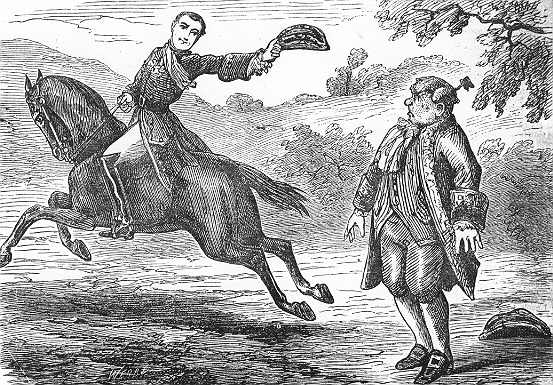
WHILE THE MAGISTRATE HAD BEEN RAVING, CAPTAIN GEORGE HAD REMOUNTED THE STEED AND DASHED AWAY ALONG THE ROAD.
CHAPTER XXXII.
THE STRING OF PEARLS.
"SO, SO, my little bird," exclaimed Sampson; "I have caught you."
Lily made no reply, but suffered herself to be led to the place where the horse stood.
Once more placing Lily before him, Sampson leapt up on to his horse, and dashed away along the high-road.
They had not now far to go.
A quarter of an hour�s ride brought them to their destination�a large, dark, and gloomy mansion, situated on the outskirts of Healham Forest.
Dismounting, Sampson assisted Lily to alight, and, grasping her firmly by the wrist, he led her up to the gate, and rang the great bell.
Scarcely had the loud clang died away in the night air, when a dark, evil-looking, but well-dressed woman, appeared at the door.
The woman evinced no surprise as she admitted the pair, but gently closed the door after them.
Lily was handed over to the charge of a servant, who led her to a room, the door of which was then carefully locked.
She threw herself upon a couch, and burst into tears, exclaiming�
"Who is there now to help me in my deadly peril?"
* * * * * *
Our readers will remember that we left Hubert Courtenay, the young captain of the Andromeda, dashing upon deck to assist in putting out the fire which had seized upon the good ship Eagle.
In the dire confusion which ensued, Hugh Brandon and his friends escaped with more blows than booty; but the Eagle was burnt down to the water�s edge, and the Andromeda escaped with difficulty a similar fate.
Master of his own actions now, Hubert Courtenay could, of course, have left England at once, and started on his voyage; but something seemed to keep him to his native country�something seemed to warn him that some task remained unfulfilled.
In fact, a vision of the bluff sea captain who had been so kind to him, and who had gone off in such a strange and mysterious manner, would haunt him day and night, and at length the feeling became so strong that he determined to follow up the slight clue he had, and ascertain, if possible, what had been his fate.
To do this, of course, was a work of no ordinary difficulty.
He had scarcely anything to guide him.
The captain had certainly not intended that he should follow up the clue.
He had given him no information whatever
149
which would lead to any discovery; but among the papers which he had left in the ship Hubert Courtenay had found a letter which settled at once the question as to the identity of the lady in whom the sea captain had taken such an interest.
To this lady Hubert resolved to apply at once.
If he was guilty of any impertinence in so doing, he knew well that the motive which actuated him would be sufficient excuse.
No sooner thought of than put in practice.
Leaving the Andromeda in the care of his mate, therefore, he one morning set out, and made his way towards the Strand, where the fair lady resided.
To reach this spot he had, of course, to follow the same route as had been followed by the captain, and it so happened, happily for the cause of justice, that he was attracted by the same display of gems in the jeweller�s window.
"While I am about it, I will buy a present for Rachel," he said, and entered the shop.
Little did he imagine that the first step which he took over the threshold was the first step towards the discovery of a fearful tragedy.
He examined a great many sets of gems, and presently the shopkeeper brought out a string of pearls.
"Well, sir," he said, "you�ll of course excuse my remarking that you�re a seafaring man�a captain I expect?"
Hubert laughed.
"No offence, sir," he said; "we�re proud of our profession."
"Well, then," pursued the jeweller, "here is a pearl necklace, exactly like one I sold to a sea captain a short time ago. It�s a beauty; and, as it�s the only one I�ve got left, I�ll sell it five pounds cheaper than I charged him."
Hubert started as he took the string of pearls.
"A sea captain!" he murmured; "this is strange. Of course you do not know his name?" he added, aloud.
"Strange to say, I do," replied the man; "when he was here he dropped a letter, and I found from that that his name was Captain Andrew Drake."
"Bless me; it�s very strange," murmured Hubert; and then, as he caught sight of something on the necklace, he uttered a low cry, and started back.
The mark was unmistakably that of blood.
Hubert looked up into the man�s face with an eager, searching look upon his pale countenance.
"Where did you buy this necklace?" he asked.
The man changed colour.
"Well," he said, "we don�t generally tell our customers where we buy things."
"I will explain to you," said Hubert.; "let me beg of you to grant me a private interview in your room. Send your apprentice, here, for a bottle of wine, and let him mind your shop."
"Well," replied the jeweller, with a smile, "you are a strange person; but I have no objection to the arrangement. Thomas, here, is at your service,"
Within ten minutes the wine had been fetched, and the young sea captain and the jeweller were closeted together, with doors locked.
"Now," said Hubert, "I must begin by saying that I entirely absolve you of any knowledge of the transaction of which I am about to speak. You I hold innocent, but I want you to aid me."
"Well, of course," replied the jeweller, "I shall be very happy to aid you, if I can; but I really understand nothing. Of course you must explain all."
"In that case," replied Courtenay, "I must repeat my question�where did you buy this necklace?"
"Of Sweeney Todd, the barber. He lives just below here."
"Ah! then I see my way clearly," said Courtenay; "this is the identical necklace that you sold the other night to Captain Andrew Drake. See, there is blood upon the string�he has been murdered!"
The jeweller�s face now expressed astonishment, not unmixed with fear.
"What makes you think so?" he stammered. "Dear me! that Sweeney Todd has a very bad reputation I know, and�bless me! I wish I�d never bought it."
"You must have known it was the same, and, therefore, stolen," said Hubert; "but come, I will tell you the story, and you will then be able the better to assist me."
Quickly, and yet minutely, Hubert Courtenay told his story.
The jeweller listened intently.
When he had heard all, he said�
"The truth is, sir, that this Sweeney Todd, who bears such an evil repute in the neighbourhood, brought me this string of pearls, and told me that a sea captain had been at his place and had lost it. I gave him half price for it, but I never dreamed that the wretch had murdered him�and yet, dear me! we are talking strangely. We have no right to suppose that he has done so."
"No, no," said Hubert, quietly, "I have no right to say so, for I have not yet been to the lady�s house. Keep what I have said for the present a secret between you and me. I will take the pearls with me and return shortly. Here is the price of the article."
With these words he rose and hurried from the shop.
The jeweller waited until he had departed.
Then he rushed into the shop, and seized his assistant by the arm.
"Quick, Thomas!" he cried; "quick; run to Mr. Todd, the barber, and tell him to meet me at the Griffin. Don�t let that sailor chap see you. Quick! on your life."
The lad thus admonished dashed out of the shop, and flew off towards the barber�s shop, where Sweeney Todd was standing at his door with his hands in his pockets.
"Be quick, Mr. Todd," cried Thomas, "master will be at the Griffin in a minute. He wants to see you particular."
"But I�ve no one to mind the shop," said Sweeney.
The boy dodged back.
"No, you don�t," he said, with a chuckling laugh. "You don�t get me in there. Ain�t got no pocket-money, Mr. Barber�ain�t worth killing."
"Hold your row, you infernal young scoundrel," cried Todd with a scowl. "I don�t like your jokes. I�ll shut up the shop, and be over in a minute."
When Tinson the jeweller made his appearance at the bar of the Griffin, he found Sweeney Todd smirking lugubriously at the barmaid.
"You�ll grin the other side of your mouth, Sweeney," said Tinson, "when you hear my story."
"Why, what on earth is the matter?" cried the jovial barber; "your face is as long as a parish sermon on collection day."
"Hush; be not a fool," said the jeweller, in an undertone; "it�s all found out."
The barber turned of a greeny pallor.
"What mean you?" he said. "Don�t joke with me, I don�t like it. What�s found out?"
"The robbery of the sea captain," replied Tinson. "A friend of his has just been at my shop."
"And the string of pearls?"
"Is in his possession."
"Curse you!" yelled the barber, forgetting where he was; and then, as the barmaid came hurrying up, he said, smilingly, "Forgive me, Annie; it was a sudden burst of feeling. Tinson, come into the parlour."
The jeweller followed his accomplice into the little room at the rear of the premises.
"What in the devil�s name, possessed you to let him see the pearls?" said Sweeney. "Your accursed avarice prevented your breaking them up! But I know nothing of it; I shall put all the blame on to you."
The jeweller eyed his companion with an evil glance.
"Do so, if you please," he said; "it will give rise to a little investigation, and ugly secrets may come out."
This was but a random shot, but it struck home.
"Curse the fellow!" thought Sweeney; "ugly secrets, indeed! I�ll make a pie of the traitor, and close his mouth for ever."
"Here,� he cried aloud; "we can�t talk here, you�d better come to my place."
"I�d rather not," said Tinson; "I might not come out again. Your razors have the reputation of being very sharp. Well, I�ve given you the tip, and all I get in exchange is abuse�so I�ll be off."
Sweeney assumed a genial smile, which was simply horrible.
"No, no; let�s be friends," he said, clapping Tinson on the shoulder with his huge, flabby hand; "our necks are in danger, ands as we should hang together then, it would be better to hang together now. Ha! ha!�see the joke�eh?"
"No," said the jeweller, "I don�t; what is it you mean?"
"That this impertinent, meddling friend of the sea captain must be at once got out of the way. We must follow him, Tinson; our lives depend upon it, remember�it is his life or ours."
The jeweller shuddered.
"Has it come to this?" he muttered, more to himself than the barber.
"To this," said Sweeney. "I have more respect for my own neck than his; and as if you swing I have to swing too, I say come, and you must come."
Tinson had no resource.
He was completely in the barber�s power, and it was useless to fight against it.
"Well," he said, "order in some brandy. I feel cold and trembling. Then let us get this job over quickly."
"Spoken like a man!" cried Sweeney, slapping him on the back; "we�ll have our drink at the bar, and be off."
It was growing late now.
In the immediate vicinity of Temple Bar all was very dark and quiet.
At the corner of what was known until a few years ago as Searle�s-place, men and women of doubtful character lounged and scowled at the passers-by.
It was about midnight when Captain Courtenay left the house of the lady to whom Captain Drake had stated his intention of going.
His look was sad, yet determined.
His worst fears, in fact, were realised.
The lady had waited long and eagerly in expectation of the man who had so bravely, and for such a weary time, ploughed the stormy seas gain a fortune for her.
But nothing had she seen of her lover.
The evidence, now, was conclusive.
He had been murdered.
And now, with a heart over-burdened with sorrow, yet relieved from the sad weight of presentiment, the young sea captain wended his way back towards Fleet-street, planning vengeance on the dastardly assassin.
As he passed by one of the narrow streets , which led down from the Strand towards the river he heard a cry as of someone in distress.
He stopped for an instant and listened.
The sound was repeated, and this time more plainly.
"What can it be?" he thought; and in an instant his generous heart forgot his own troubles, and he darted, sword in hand, into the dark thoroughfare.
When, however, he reached the spot where the sounds had appeared to proceed, no one was there.
"This is strange," he thought.
But the idea never occurred to him that he was being enticed into a trap.
He returned his sword to its sheath, and began slowly to retrace his steps.
As he did so, two figures suddenly detached themselves from the shadows of the wall, and gradually, by gliding movements, lessened the
150
distance between them and the young sea captain.
"We�ve got him now," said Sweeney to Tinson, for these were the gliding figures. "A quiet blow, and all is over."
These words were not unheard.
Though they did not reach the ears of the intended victim, they, nevertheless, reached those of someone who was approaching the spot from the opposite direction.
In an instant he drew back into the darkness, and, unsheathing his sword, crept after the three men.
Meanwhile, as Captain Courtenay neared the outlet of the thoroughfare, the two men sprang forward.
But not in time.
The fourth figure darted forward.
"Turn, stranger!" he cried, as he touched the young captain on the arm. " Turn�beware�assassins!"
In an instant Courtenay had turned round, though not in time to avoid a wound in the arm.
Of course he saw at once how matters stood.
He understood that he was attacked by street ruffians, though he never supposed for a moment that they had anything to do with the mystery of his captain�s disappearance; and, planting his back against a wall, he at once engaged his foes.
He was not alone in this.
The person who had so opportunely warned him of his danger espoused his cause with ardour, and Sweeney Todd and Tinson the jeweller found themselves unexpectedly more than matched by their adversaries.
"Oh! if I had only done this job myself," thought Sweeney; "if I had left Tinson out of the affair altogether, and let this fellow down my trap, how much better it would have been."
But regrets were useless.
He had, of course, desired to keep Tinson entirely ignorant of the doings in the cellars of St. Dunstan�s, and yet to implicate him in the crime so as to have a secure hold upon him.
It was necessary, therefore, that the attack should be made openly as it had been, but neither of them had bargained for such a change in the programme.
The young sea captain was a splendid swords-man, and the stranger who had run to his assistance seemed equally a master of his weapon. In a few moments the state of affairs had entirely changed.
Instead of being the attackers, the two assassins became the attacked.
While Hubert Courtenay and his companion thrust and parried, and every now and then inflicted a wound upon their adversaries, they shouted loudly fur the watch.
Again and again they endeavoured to make their escape. But in vain.
A man whose life they have sought has resolved they shall have no mercy.
At length, just as the captain�s mysterious friend had pinned Tinson against the wall, there was a rush of feet, and the watch came running down the hill.
The efforts of the ruffians to escape were now desperate indeed; but they were of no avail, and in a few moments they were surrounded by the night watch.
All resistance was now useless, and in a few moments they were prisoners, and being conveyed to the lock-up.
Sweeney Todd walked firmly and defiantly, though ghastly pale; while Tinson staggered along between his captors, trembling with loss of blood and fear.
Here the charge was taken from the lips of Hubert Courtenay, and the name of the witness was written down.
His name was Tom the Link Boy, and his address Fadge�s Kitchen.
CHAPTER XXXIII.
CAPTAIN GEORGE�S ADVENTURE.
WHEN Captain George left the house of the Moretons, full of angry feelings against Clara and all connected with her, he plunged away along the high-road desperately.
He cared no which way he went, or what became of him.
He had laid such wild schemes of reformation upon this interview with his wife.
He had had visions of a reconciliation which would lead to the entire change of his life�s programme.
He had had dreams of forgetting entirely the strange, wild, and eventful life which had been his for so many years, and of settling down with her, and burying entirely the misdeeds of past days.
But it was evidently not to be.
He had thrown the die and lost.
What remained for him now?
Only vengeance.
And the desire for this now burned within his heart�consuming all else�taking him, as it were, from without the pale of all other things�concentrating within his brain with fearful intensity.
At length, reaching an inn, he entered, and ordering a large glass of brandy, drank it off at a draught.
Having refreshed himself with this strong drink, Captain George proceeded hastily on the London-road.
On nearing a point in the road were some trees over-arched and cast shadows on the ground, he came across a dark object which was lying in the centre of the high-road, and over which he nearly stumbled.
He saw at once that it was the body of a coach which had been overturned.
"Ah?" he cried; "what have we here? There has been some robbery I expect. I wonder whether my two lambs have been up to their tricks? It is strange that I have not met them."
As he spoke thus, he made a second discovery.
The horses had been taken out, and had entirely disappeared.
At this moment he heard the sound of horses approaching.
With a chuckling laugh he crept into the coach, keeping his head just above the broken door, so that he could observe everything that came towards him.
As the sound came nearer he drew a pistol from his belt, and held himself in readiness for any emergency.
Now that he was once more on the road, all his old instincts revived within him.
He cast from him altogether the scene which had occurred at Moreton Hall; if he remembered it at all, it was only to make him more reckless.
The good thoughts which had sprung up in his brain had given place, now, to a firm determination to follow up his old trade, and, by so doing, raise sufficient money to enable him to carry out his scheme of revenge.
In a few minutes two horsemen rode up quickly to the scene.
The one was a sour-looking man, of some forty years of age, attired in the dress of a serving man.
The other was a short, fat, stumpy man, of most comical appearance, with a huge head, which was rendered more absurd by the quantity of powdered hair which stuck out from behind his wig at the side of his pimply face.
As the two men rode up, Captain George popped his head out of the carriage, saying, while he playfully presented a pistol at them�
"One word with you!"
The two horsemen drew up in surprise.
"Who the devil are you?" cried a gruff voice.
"Well," said Captain George, "I do not know that my name will assist you much; what I require is money, and the loan of one of those horses."
"Then, by gad! sir," cried the man with the blotchy face, "you will have to fight for it, or my name is not Sir Toby Pimplenut."
But, despite this valiant speech, he was quaking with terror, and he whispered to his companion�
"When I cry out �Now!� turn your horse and make a bolt for it."
Unfortunately for him, Captain George was very quick of hearing.
"No you won�t," he said. "If you attempt to fly, I will blow your brains out. I am glad you have told me your name, by-the-bye, as I have now not the slightest compunction in robbing you."
"What the devil does the scoundrel mean?" growled Sir Toby.
"Why, �the scoundrel,� as you call him," cried Captain George, "was once sentenced by your worshipful pimpleship to be hung at Tyburn Tree. But, as you perceive, I declined that kind little attention of yours, and here I am."
"I have no money with me," said Sir Toby, "so you are cheated of your intended plunder. You had better be off, and quit this part of the country at once, or I shall give information, and have you strung up."
Captain George indulged in a loud, chuckling laugh.
"Ha! ha!" he said, "I fancy you would find it very difficult to do so, as you have not the slightest conception who I am. But come�shell out the coin, or I shall send a bullet through your skull."
The worthy magistrate, who had a thorough appreciation of "filthy lucre," was resolved to make one trial at escape.
He knew it was dangerous.
But then there was just the chance that he would escape being hit in consequence of the darkness.
He slowly moved his horse�s head, and again whispered to his companion.
But in an instant Captain George saw the manoeuvre.
He had no desire to commit murder.
Blood-letting was a game of which he was by no means fond; but he had resolved to give the old fellow a good frightening.
So, as the worthy knight moved his horse�s head, he fired right over him.
As the report rang out, a frantic shriek was mingled with it, and the old fellow tumbled clean off his steed.
But it was only from sheer alarm.
Not even a piece of wadding had struck him.
With a loud laugh Captain George scrambled out of the coach, and knelt down by the side of the prostrate man.
"Oh! mercy! mercy!" gasped Sir Toby. "I�ve broken every bone in my body, I think."
"Well, if you have I can�t mend them," said George; "but I�ll ease you of some of your weight."
And so saying, he began ransacking the old fellow�s pockets.
The magistrate had told very nearly the truth when he had said that he had no money.
He had scarcely anything in his purse.
"Why, what have you done with your cash?" cried George.
"I told you; had none," said Sir Toby, with a hollow groan. "I did not bring out more than I absolutely required."
"Then I will place you on your horse again, mount behind you, and when we reach a lamp, you can write me out an �I.O.U.� I will call and see you soon for the money."
The magistrate could only groan again and consent, and so, in a few minutes, the highwayman and the knight were riding along the high road on the same horse.
The servant had taken advantage of the fall of his master to turn his horse and ride off, so Sir Toby was completely at his captor�s mercy.
As soon as they reached an inn, where a lamp spread its feeble light over the high road, Captain George stopped.
Jumping off the horse, he helped Sir Toby to alight also.
Then he took out a pocket book and a pencil.
"Here," he said "are materials for writing. Give me your name and address�correctly, remember, or it may be the worse for you."
The magistrate, cursing and swearing under his breath, wrote out his address.
151
"Here is my address, you impudent scamp," he said handing the highwayman the paper; "but I advise you to keep away. I�ll have you watched for, you vagabond. I�II�here�stop�thief�stop�help�help�he�s got my horse!"
This was true.
While the magistrate had been fuming and raving, Captain George had placed the paper in his pocket, and, remounting the steed, dashed away along the road.
Of course Sir Toby�s cries were useless.
The people of the inn rushed out in a moment.
But in vain.
Before the spluttering magistrate had got out his account of what had happened to him, the clatter of the highwayman�s horse had already begun to die away in the distance.
"Confound him!" he cried. "I�ll have revenge on him for this. There�s my carriage lying in the road spoiling�my horse stolen�my servant run away. What a position for me!�a magistrate for the county, too."
And so, puffing and blowing, the little fat man waddled into the inn.
He presented, now, a most comical appearance.
His face was furiously red with rage; his wig was on one side; his hat smashed on his head; and altogether he looked so unlike an administrator of the law that he was greeted in the bar with a roar of laughter.
His eyes goggled out of his head with fury.
"How dare you!" he cried; "and you, sir," he added, addressing the landlord, "why do you allow me to be insulted?"
"I can�t be answerable for my customers," said the innkeeper; "we don�t know who you are. You say you are a magistrate, but we can�t tell whether or not it�s the truth."
"Why, bless me, if I ever heard such insolence!" he roared. "I�d have you to know, sir, that I�m Sir Toby Pimplenut, magistrate for this county. I�ll have your house indicted as a harbouring-place for thieves! Curse you! let
me have some brandy�I feel quite faint and ill from that ruffian�s treatment."
The innkeeper surlily enough poured out some spirit, and the little man swallowed it at a draught.
Then he put his hand in his pocket to find his purse.
Horror!
There was no purse there!
He felt in all his pockets.
But in vain.
Evidently Captain George had helped himself.
"That villain has robbed me of my money," he cried. "I haven�t a penny-piece."
There was a cry of derision at this.
"Come, come," cries the landlord, "this won�t do; shell out the money, or I shall have to give you into custody."
It so happened that no one had seen the arrival of Sir Toby and Captain George at the inn; nor, indeed, had anyone been cognisant of their presence until the knight had brought the people out by his bellowing.
Consequently, what he was now saying was put down as part of his imposture.
The bystanders, chiefly rough labouring men, began to hustle round him.
"Ha!" cried one; "ha! that ain�t a bad way of getting a drink for nothing!"
"How much for your wig, old chap?"
And soon.
Sir Toby was furious.
But his rage only made matters worse, as it prevented him from entering into any proper explanation.
At length, however, when he saw that the landlord really meant business, and was going to send for a constable from the lock-up, he calmed himself down by a great effort, and demanded that one of the servants of the establishment should be sent with him.
By dint of great trouble he told the story�how his carriage had been overturned�how he had in vain tried everywhere, with his servant, to find someone to set it to rights, and how he had been robbed.
His protestations at length changed the tide of affairs.
The people began to believe him; but, unfortunately, they; saw the comic side of the story, and greeted his doleful narrative with roars of laughter.
The landlord at length consented that one of his men should accompany him.
As for the carriage, it would have to remain where it was till morning.
This settled, the unfortunate knight cooled down a little, in spite of the shafts of wit levelled at him, and it was not long before, with ironical cheers, he rode away along the dark road.
CHAPTER XXXIV.
CAPTAIN GEORGE HAS TWO STRANGE ADVENTURES WHICH GREATLY ALTER HIS PLANS OF LIFE.
CAPTAIN GEORGE lost no time in putting his threat into execution. His first plan was to discover the whereabouts of Sir Toby Pimplenut�s house, and then to make inquiries into his way of living.
He found that the old fellow inhabited a house situated in the centre of park-like grounds.
He was most eccentric in his habits.
He had no wife or family, and his only domestics consisted of his coachman, his gardener, and one maid-servant.
With this slender household he inhabited a place big enough for a large family.
Of course the whole of the house was not used, and they inhabited one wing only; but Sir Toby had a great idea of dignity and keeping up the family prestige.
"The Pimplenuts, he would say, "were always distinguished people," and he was resolved the name should not be disgraced by him.
It did not take Captain George long to discover this, or to learn that the gardener slipped off to the nearest tavern of a night at ten; that the coachman sat making love to Annie, the housemaid, to whom he was going to be married, sometimes till midnight; while Sir Toby, surrounded by bottles and books, shut himself quietly up in his room on the first floor.
There could not have been a better chance for him.
The old fellow would be absolutely alone, and he could, consequently, have a fine game with him.
It was on a dark night, the third night after the scene on the high-road, that Captain George made his way to Pimplenut Hall as the dwelling of the worthy magistrate was named.
He had carefully ascertained beforehand the best means of making his way into the house, and, consequently, when he reached the building, he had no difficulty in entering the premises.
It was not a deed of great daring, of course; for, even in case of discovery, he would only have to encounter the gardener and the coach-man.
However, as fate would have it, those worthies were indulging in their usual amusements, and Sir Toby, up in his room, was deep in the mysteries of a legal book.
He had that day had a discussion with a person who had insisted that Sir Toby was wrong upon a point, upon the knowledge of which the knight prided himself.
He was sitting by his fire, with a strong glass of grog before him, and a large volume on his knees, and at the moment that Captain George peered into the room he was talking to himself.
"I knew I was right�I knew it," he was saying, triumphantly; "the tenant would be the loser. I knew well that he would be. Yes, the party wall�eh! eh!�what�s that?"
He started and looked round.
Captain George had pushed the door open.
The magistrate, hearing no recurrence of the sound, drank up his grog, brewed himself another glass, and then buried himself again in the book.
The captain now crept in, and, by slow and gentle progression, he reached the other side of the table.
Here be took a seat.
"Good evening, Sir Toby!" he said.
The old fellow started up in surprise and alarm.
"Eh! eh!�oh! dear me!" he cried, trembling with fear and indignation. "Why, you confounded vagabond, what do you mean by coming here? Be off, or�"
"Stop, stop!" said the captain, laughing, "pray do not excite yourself. If you were to raise an alarm, or pull a bell-rope, I would run you through the body at once. I will draw my chair up to the fire, if you please, and join you in some grog. Then we can compare notes."
"Amazing!" exclaimed Sir Toby, "amazing! Why, I never heard of such impudence. Well, I�m�"
"Just so," cried George; "but don�t swear. I promised to visit you, and I�ve kept my word."
Sir Toby felt for a moment utterly bewildered.
And no wonder.
What was he to do?
He was utterly helpless in the hands of this man.
If he ventured to call out or ring a bell he would be murdered.
Alone he was no match for such a resolute and daring robber.
"What do you want?" he cried, at last.
"I wish to he shown over the house," he said.
"What for?" asked the astonished owner.
"I wish to see all your possessions, that I may select a few keepsakes. Come, brew me some punch, and we will begin at once. I don�t wish to keep you up late."
Sir Toby pointed to the bottle.
"Help yourself," he said.
George obeyed.
"I won�t keep you waiting," he said, "while I am brewing hot grog; I�ll drink it neat. So! deuced good brandy, I declare. Well, now Sir Toby, I�m ready."
It was utterly useless making any further comment or denial.
The captain was master of the situation, and the only thing, therefore, that Sir Toby could do, was to rise up and prepare to show his visitor over the premises.
Inwardly he groaned terribly in spirit.
He had only a week before brought home a large quantity of money from his goldsmith�s, and he knew that in one of the rooms this lay in a drawer without even being locked.
The only way to avoid this being discovered was stratagem.
And, with a man like the highwayman, what possible stratagem could be devised?
However, he said, sullenly�
"Well, you had better search this room."
"Precisely," said the captain, and forthwith he proceeded to do so.
Every drawer, in table or in bureau, was turned out and examined.
But with no effect.
"We will proceed to the next," said the captain.
One after another the apartments were examined and searched, until the captain lost patience.
"What the devil game are you having with me?" cried Captain George. "You must know where your money is kept. Take me there, and don�t waste time like this."
With a muttered curse, the magistrate flounced out of the room where they were then standing.
As he did so, he slipped on the top of the grand staircase and went headlong down�his wig falling off, and his body seeming to slide from top to bottom.
Captain George uttered a cry of alarm.
He had no desire to do any injury to the old fellow, and he consequently dashed down after him.
But in vain.
152
Toby Pimplenut slid down the whole of the stairs, and lay a bundled heap at the bottom.
"I didn�t bargain for this," muttered the captain, as he sheathed his sword, and knelt down by the side of the old man. "What an ass he must have been to try to go downstairs backwards. Here, Sir Toby, get up!"
But he was not at all in a condition to do so.
In fact, he was quite insensible.
On ascertaining this, he raised the unfortunate man in his arms, and bore him up into the room where he had first seen him drinking grog.
Here he placed him in his chair, and poured down his throat a small portion of neat spirit.
Then be chafed his hands, and bathed his head, and presently had the satisfaction of seeing him open his eyes.
Sir Toby started round him in wonder, and passed his hand, in a bewildered manner, over his brow.
"How did I come up here?" he asked.
"I carried you up!" said Captain George; "you fell such a cropper that you he came quite insensible; but by dint of a little brandy, and a little cold bathing, I managed to get you round."
"Well, dear me! that�s very strange. I�m sure I�m much obliged," said Sir Toby; "but I suppose you�ve robbed me while I lay insensible?"
"By no means," replied Captain George. "I wait still for your guidance."
"You�ve not robbed me?"
"No; come down and see!"
"I�m dashed if I ever came near such a strange mortal in my life," cried the magistrate. "Bless my soul and body! Well�well�take this key, go down those stairs, go into the room at the bottom, on the right-hand side, open the bureau on the left-hand, and bring up two bags of gold you will there find. We�ll divide them. I suppose I�m entitled to a half share?"
Captain George smiled.
"Yes, I think you are," he said; "especially as you trust me."
In about ten minutes he returned with the bags of gold, which he placed on the table.
"Each of those bags," said Sir Toby, "contains five hundred pieces. Now, I reckon if you had robbed me as you intended. you would have taken both?"
"I should," said the highwayman.
"Then in order to show my gratitude," said Sir Toby, "I will give you one of them, containing five hundred pounds. This will be your own, and you will not have it on your conscience that you obtained it by robbery."
"I will accept them with pleasure," cried Captain George, with a quiver of the lip, which told of intense emotion; "and I will some day repay you."
Sir Toby was not bad-hearted.
He noted at once the young man�s feelings.
"Mix yourself a glass of grog," he said; "and listen to me. Why do you pursue this life? Why not try to be honest? Why not endeavour to forget all the past, and live a future of honesty and happiness?"
Captain George turned very pale.
"If you will listen to me," he said, "I will tell you my story."
"Certainly," said Sir Toby; "I shall listen with great pleasure."
Minutely and carefully, though with many breaks which were necessitated, he told his history.
Sir Toby listened with attention, though every now and then be murmured something, as if taking mental notes of every point.
When the captain had finished speaking, he said�
"Will you excuse me if I question you?"
"Certainly."
"Do you still cling to this wife?"
"No, no; to the child I do, but on the unnatural mother I desire to be revenged."
"Good," returned the magistrate, "you can be; but this much I must tell you�the revenge will include the child."
"In what way?" asked Captain George, in wonder.
"In a way, unfortunately, which you cannot help recoiling upon the child some day," said Sir Toby, "and which you must forgive me for reminding you of. You say you were married privately at Greenland?"
"Yes."
"You gave me the correct date?"
"Yes."
"Then I beg to inform you that that fellow Martin Arnold�the Reverend Martin Arnold, as he called himself�was not a clergyman. He had been turned out of the Church two years before."
Captain George fairly trembled with emotion.
He rose from his seat.
"I can hear no more now," he said; "what you have told me has almost turned my brain. Will you permit me to return here in a few evenings, when I am less distracted?"
"Yes, certainly," said Sir Toby.
"Thank you; good-night, Sir Toby," and Captain George hurried from the room.
And left the live hundred pounds on the table!
Sir Toby noticed this at once.
(To be continued.�Commenced in No. 78.)