133
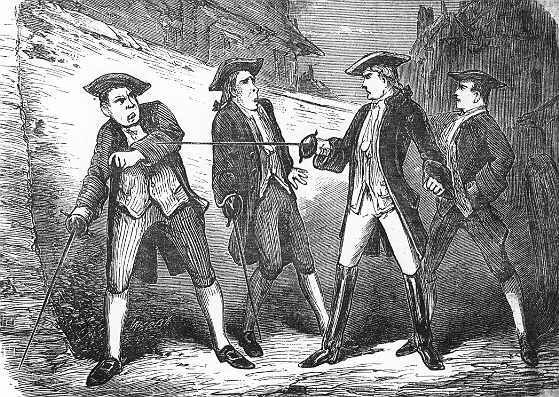
SWEENEY TODD AND TINSON, THE JEWELLER, FOUND THEMSELVES UNEXPECTEDLY MORE THAN MATCHED BY THEIR ADVERSARIES.
CHAPTER XXVIII.
FOSTER BARCLAY�BELLA�S FIRST PERIL.
"BUT you were stabbed, my good sir," said the still trembling doctor, as his extraordinary patient helped him to a chair.
"I was, and I know by whom," said the man. "I shall yet live to avenge my wrongs. When the cold knife entered my breast I seemed to become numbed and dead, and yet still could see and hear and feel."
"Take some of this brandy," replied the doctor, "and then tell me your story."
The man smiled.
"I will accept your kind hospitality," he said, "but, as for my story�that must remain buried
in my breast."
"Stay," said the doctor, "there you are, I think, imprudent. To avenge yourself on your enemies you should keep your existence unknown, even to your friends. To do this you must not even apply to them for the means�the money you need. I have an interest in you now. Tell me your story, and, so far as is reasonable, my purse is at your disposal."
The man flashed with pleasure, and pressed warmly the hand of the old physician.
"You are, indeed, a friend," he said, "and I will tell you all. But, in the first place, let me beg of you a suit of clothes, that we may quit this abode of death and horror, and speak some- where more at our ease."
The surgeon at once hurried up to his rooms, and within half an hour the two men were sitting in the study discussing some supper, while the second doctor, who had been summoned to take part in the dissection, was dismissed with some excuse.
And in that study the man told to Andrew Burns a strange, wild, wonderful story, which held his listener spellbound.
When he had heard it all, the doctor took his patient�s hand in his, and said�
"I am your friend, firm and fast, throughout this matter. Command me in everything. We will avenge this awful wrong."
Who this strange man was our story will soon show; but from this moment Andrew Burns had an assistant in his laboratory, whose name was Foster Barclay.
* * * * * *
Having no one now to guide them�having lost all trace of Tom the Link Boy�Lily and Bella were compelled to shift for themselves.
It was no use for them to wait about in the dense fog of the river.
Lily, of course, could at any time communicate with Tom, and the great question of the moment, therefore, was how to get away in the quickest and safest manner from the neighbourhood of the Alsatians� cellar.
The river at once suggested itself, and, finding that Tom did not put in an appearance, Lily hurried down to the nearest stairs and engaged one of the watermen, who, at this period of London�s history, plied for hire at all hours.
There were no bridges up stream then, to span the broad and turbulent river, and the only manner in which it could be crossed was by boat, unless the patient wayfarer chose to make his way to old London Bridge, and pass thus to
the Surrey side.
The two were soon afloat on the Thames, and hurrying on towards the Pool.
They passed close to the spot where Tom was struggling with the ruffians who were assaulting the old man and the girl, and they heard cries for help.
But the boatman pulled on.
"Can we render any aid?" said Lily anxiously.
"No, no, mam," said the boatman, "we mustn�t interfere. It�s only one of them Alsatian wenches a-quarrelling with one of the gentlemen of the long sword. Best out o� them sort Is of troubles, that�s my motter."
And so they drifted by, little dreaming that Tom, their friend, was so close to them.
On reaching London Bridge they landed, and Bella proceeded at once towards the little cottage of a person she knew, where she had changed her clothes, and where they could now re-adjust their garments.
These people, a worthy old couple, she knew well she could trust, and yet she resolved to put even them off the scent.
When, accordingly, the fugitives had changed their habiliments, Lily said�
"We are leaving England now, Mrs. Ramsey, this very night we sail from its shores. But no matter where I may be, I shall never forget those who so kindly aided me in my escape from my enemies."
She then gave her some money, and refusing all escort, she bade the worthy people adieu, and made her way to an inn which was situated on the Middlesex side of the bridge.
Here a carriage was in waiting, and entering this, they were soon being whirled away towards the new home which was to be such a strange era in Bella�s life.
The young girl felt a wild feeling come over her.
Something she had never experienced before.
Since babyhood she had never been away from the noisome den which was known as Fadge�s, and it seemed such an extraordinary thing to her to be whirling away in a carriage along the highway.
The fresh breezes which blew in at the window seemed to endow her with a new life.
It appeared like a refreshing food, and she turned suddenly to her companion, and, throwing herself into her arms, burst into a torrent of tears.
"Oh!" she cried, "I am so happy."
"Happy, and yet you weep."
"I weep because I feel happy."
Lily laughed, as the girl nestled to her bosom.
"Ah!" she cried, "you will soon miss your friends."
She did this as a trial, and it hit the mark.
A kind of chill passed through the heart of the young girl.
"Yes," she said, "l know I shall love the country�the beautiful green fields of which I have been told so much�but I shall miss Tom�s face, and�and�"
"Ralph�s, too."
The young girl blushed, but her companion could not see this evidence of the truth of her words.
"I did not know you had ever heard of Ralph," she said.
"Heard of him? Oh, yes!" cried Lily, in a sweet voice, "and I hope to see a great deal of him."
They were now speeding away along a hard and even high-road, which allowed of the horses dashing along splendidly.
But suddenly they came to a standstill.
The horses stopped so suddenly that they nearly fell on their haunches.
"What can be the matter?" said Lily, as she put her head out of the window. "Good Heavens! we are surrounded. Who can have betrayed us?"
"No one," said Bella; "we must have been watched."
At this instant, as the trembling women clung to each other in despair, a head was seen at the window.
"Sorry to trouble you, ladies," said a voice, "but we are short of cash. Your purses and other valuables will be highly acceptable."
"Thank Heaven, I am unknown," thought Lily, and hastily she drew out her purse.
"I have none," said Bella, in a despairing tone; "and I have not a particle of jewellery on me."
"Oh, you�re a kid, you are," laughed the man; "but as for you�let�s have a look at you!"
And so saying he held into the carriage a dark lantern.
Only an instant he gazed at the face of Lily.
Then he shouted at the top of his voice�
"Here, Sampson�hi! Come here!"
In an instant a man galloped up.
"Look in there," cried the first ruffian.
Again Lily�s features were submitted to a scrutiny.
"Why, as I live," cried the man, "it�s Mistress Lillian Graham. Here�s a find!"
"Yes, we�re in luck to-night," said the other; "it�s as good as a hundred pound in our pocket. Just as luck was low, too. Here, you ladies, we�ll trouble you to get out."
With rough civility the two trembling women were assisted to alight.
"Now, then, Mistress Graham," cried the one who had been spoken of as Sampson; "who�s this girl with you?"
"A companion; one whom I love. Pray do not part us!" pleaded Lily.
"That�s just what we must do," said Sampson. "I�ll tell you what, Bagstock, this, I expect, is the kid as was lost so many years ago. She�s worth her weight in gold. You�d better take her off to Mr. Denvil�s at once. I will myself see to Mistress Graham."
"Oh! do not separate us. Pray do not separate us!" cried Lily.
But all this was in vain.
A man at the moment dashed up, and whispered something in Sampson�s ear.
"Come, we must be quick, madam," exclaimed the latter. "I don�t want to be rough, but if you make any resistance we shall be compelled to use harsh measures."
Resistance, of course, would have been worse than useless.
It would only have subjected them to a series of insults.
So, with a passionate embrace, a few words of comfort, they parted.
Lily Graham was helped up in front of Sampson, and Bella in front of Bagstock, and away the two were hurried in different directions.
To Mrs. Graham this was, of course, a terrible blow.
But to Bella it was far worse.
It was a sudden crushing out of all her hopes of life.
Everything was at once annihilated, and, as the rude hand of the man encircled her waist, and he rode off in the darkness, she fainted away.
CHAPTER XXIX.
THE PLOT BEGINS TO CLOSE IN.
AWAY through the wood they dashed at full speed. The man, fortunately, was an excellent rider, or, ever and anon, as they flew over the uneven ground, they would have stumbled headlong to destruction.
He slackened pace, however, when they had proceeded about a mile from the spot where the rencontre had taken place.
It was now for the first time that the man saw that the girl he bore in his arms had fainted.
"Bless my soul!" cried Bagstock. "The kid�s been and gone and lost her senses right away. She�s a pretty one, too. Ah! I remember, I�ve got some brandy."
"With that, he drew a flask from his pocket.
"Blow me!" he thought, "I�ll have a kiss before she wakes up."
And, so saying, be pressed his ugly lips to hers.
The contact was electrical.
She wanted, now, no brandy to awaken her.
She opened her eyes, and drew back in horror.
"Where am I?" she cried; and then, as her eyes fell upon the ugly fellow who was grinning over her, and holding the brandy-flask, she uttered a shriek of despair.
"Here, here; come, don�t make that ere row," cried Bagstock. "If you do you�ll have to he gagged. Why, you�ll wake up all the neighbourhood."
134
Bella shuddered.
She recognised at once her position.
"How much farther have you to take me?" she asked.
"About six miles," said the man; "you�d best be quiet. I don�t mean any harm; only, �pon my honour, when I looked at them red lips o� yours I couldn�t help having a smack, blowed if I could."
The young girl complained no more.
She saw that she was utterly in the power of this man.
What could she do, no matter what violence he offered?
So the best thing was to be civil.
"All right," she said, "I forgive you, only, I�m frightened of this place�this darkness�I was never out in such a place before."
"Likely not," said the man, as he urged his horse once more; "it�s a darksome, gloomy place, and a night, too, pitchy enough to give you the horrors. However, you needn�t be afraid of me and I�ll take precious good care that no one else hurts you."
"And who is this to whom I am going!" said Bella.
"Mr. Denvil."
"Yes; but who is he?"
"He�s a lawyer chap," said Bagstock; "one of the downy ones, too."
"But what does he want with me?"
"Ah; that�s not what I can tell yer," replied the man. "It�s quite evident that he does want yer, very bad, or he wouldn�t be so anxious arter yer. Leastwise, I expect he don�t want to marry yer, �cos he�s a hold fellow, and they do say Mrs. Moreton�s got him pretty considerable under her thumb."
Bella shuddered at the idea of marriage.
Even this was not too outrageous a thing to fear.
She knew that a secret surrounded her birth, and this secret might be in regard to property.
In this way she might be a good catch.
And yet who was this Mr. Denvil?
She had never heard Mrs. Graham or Tom speak of the old lawyer.
All, therefore, she could imagine was that he was an enemy, new to her, but who at any rate was connected, in some strange way, with all her former misery.
So she said no more.
It appeared to heighten her misery to hear from this man�s uncouth lips his ideas of the cause of her abduction, and so she settled herself as comfortably as possible in her position, and said no more.
The road was even, the horse strong and sure-footed, and in a short time, consequently, the man drew up before a house, which, in the dull and gloomy vicinity they were in, seemed, in spite of its few lights, like an oasis in a desert.
A sudden idea struck Bella.
At any rate she would know where she was.
"Where are we?" she asked.
"At Mr. Denvil�s, or, rather, Mrs. Moreton�s."
"Yes, yes; but in what part?"
"Combe Deane," replied the man," that was Combe Deane Heath we�ve just passed. This is Moreton Lodge."
So saying, be aided her to alight.
Then he rang the bell, whose unsightly wooden handle hung by the side of the large iron gate.
After a few moments a surly-looking servant came to the summons.
She stared as her eyes fell on Bella with her beautiful hair in disorder, and without a cloak or hat.
But Bagstock took no notice of her looks.
"Is Mr. Denvil here?" he asked.
"Yes."
"I want to see him."
"He is engaged."
"Here, none of them games with me, Mistress Snub-nose," said the man. "We don�t want to waste time on slaveys. Just tell your master, or whoever he is, that Joe Bagstock�s here with a young lady. Be quick�stir your stumps."
The girl, muttering something about "impudence," and "ruffians," and so on, went into the house.
She was gone but a few moments, and then returning, said�
"You�re to come in."
Joe chuckled.
"You see, my dear," he said, sneeringly, as he chucked her under the chin, "you see you don�t know your business, or you don�t know Mr. Denvil�s friends. Be more particular another time. Come on, miss."
Bella, pale now, and trembling with a strange emotion, entered the garden as they desired, and in a short space of time she had been ushered into the house, and into a large room.
The young girl glanced round her in astonishment.
To her the place, which was well furnished, of course, but which had nothing in it of luxury, seemed a fairy palace.
Accustomed to the bare boards and the general wretchedness of old Fadge�s, she could scarcely understand the soft sofas, the springy chairs, the carpets, the pictures, and the glasses which now surrounded her.
"I wonder whether Mrs. Graham was taking me to a place like this?" she thought.
As the idea framed itself in her mind, the door was opened, and two persons entered.
The one was Mrs. Moreton.
The other Mr. Denvil.
The latter took one long comprehensive look at the girl, and then stood without making any remark.
"So this is the girl, is it?" said Mrs. Moreton.
"Yes."
"The girl whom you told me was safe at the old Jew�s?"
"It is."
"And why is she here?"
"I can explain that," said Bella, proudly.
"Speak, then."
"I have a dear, dear friend," said the young girl, standing with downcast, tearful eyes, and heaving bosom before the lady. "She promised to save me from old Fadge�s den, and this night she succeeded. I have passed weary days and nights enough in that horrid place, and I had hoped I had for ever escaped. We were making our way towards Mrs. Graham�s home when we were attacked by a set of ruffians; one seized on Mrs. Graham, and one brought me here. And now, since I am here, why is it, and how soon can I go again?"
Mrs. Moreton gazed at the young girl in some astonishment as she gave vent to this elaborate speech.
The lawyer himself seemed spell-bound.
"We have here rather a strong-minded young lady," said Mrs. Moreton, turning to him.
But he heard her not.
He was admiring the flushed, handsome face, the petite form, the trim ankle.
Already strange dreams were passing through his head.
"Mr. Denvil," cried Mrs. Moreton, in a loud voice, "I spoke to you."
"Oh! I beg pardon, I am sure. I was thinking," stammered the lawyer, "what on earth we should do with this young lady."
"Ah! and forming, doubtless, some very pretty plans," said the lady. "Well," she added, turning to Bella, "I will show you to a room where you can sleep to-night, and to-morrow we can settle what is to be done with you."
"You can spare yourself any trouble on that score, madam," said Bella, "I have no desire to remain here."
"But wiser heads than yours think that it is best you should stop," said Mrs. Moreton. "Come with me."
"I will do so, as your prisoner," said Bella, firmly; "but on the first chance I will escape."
Mrs. Moreton bit her up.
She was not used to hear such words of independence.
She rang the bell.
"Show this young lady to her bedroom," she said to the servant who answered her summons. "I desire a few words with Mr. Denvil. Take her up some supper, Susan and, having seen that she has all she wants, lock the door and bring me the key.
She then turned her back upon Bella and sat down gravely opposite Mr. Denvil.
CHAPTER XXX.
FAMILY SECRETS.
"MR. DENVIL," said Mrs. Moreton, as soon as she was closeted with the lawyer, "I think it is high time that we came
to a decision in regard to our affairs." "Ugh!" thought the lawyer, "she�s going to make me an offer now."
Truth to tell, he was disenchanted.
He had at first thought it a grand thing to become the husband of Mrs. Moreton and the proprietor of Moreton Hall.
But the old adage was true in his case.
"Familiarity breeds contempt."
He had seen enough of Mrs. Moreton to become heartily sick of her.
And now that he had once set eyes on the lovely face and fairy form of Bella, his thoughts had at once changed their direction.
He had not expected to see such a girl.
He had imagined, of course, that, brought up as she had been, in such a den, in such a sink of iniquity, as it might well be called, she would be crabbed, ugly, ill-formed, ignorant.
He had not been in any way prepared to see such a beauty, and his sensitive heart, as well as his avarice, was aroused at sight of her.
But why his avarice?
That secret will be educed by-and-bye.
"Well, madam," he said, "I have no objection to come to a settlement. My books are always open to inspection, and I may say, without, flattering myself, that up to this moment I have managed the Moreton property to a nicety."
Mrs. Moreton bit her lips.
She saw his evasion, but how could she resent it?
She was not, as may be imagined, anxious, as a personal matter, to marry the lawyer.
Although there had been a love episode between them at a former part of their career, he was not now a man whose style or appearance would be likely to excite in the breast of any woman the feelings of passion.
But she desired to marry him to further her own interests�to have him under her thumb�his mouth sealed, and to have him at hand always, to save, to advise, to be her slave and mouthpiece.
"Mr. Denvil," she said, "you place me in a most peculiar and painful position. Why should I have to remind you of an affair which happened on the night when that boy fled from home?"
"Hang it all!" thought Denvil, "there�s no getting out of it. There�s no false modesty about her. She means to have me, or put me to the denial, and no mistake."
"Madam," he said, with a smile, as he leaned forward, and took her hand in his; "you allude, I know, to a tender subject."
Mrs. Moreton blushed and sighed.
Both were good actors.
"I do," she said.
"Well, madam, may I confess the truth?" he said.
"Pray do," she answered, not without trace of agitation.
"The truth is, madam," he replied, "I thought you had given the idea up; in fact, that you were slighting me."
The hypocrite.
"You have quite mistaken me," said Mrs. Moreton, "I have been so pressed and worried on all sides that I have been unable to show, perhaps, the distinction that I ought to have done. But I have not, and never shall forget our compact."
"The devil!" thought Denvil, "I only wish you would."
135
But he said aloud, in a silky tone, and with a smile that was intended to be captivating�
"I am sincerely glad to find that I am mistaken, madam."
Then bringing his chair closer to hers, he passed his arm round her waist, and said in a way and a voice which, no doubt, to his lawyer-like mind, seemed tender and loving�"Emma�I think I may say Emma now�when shall we fix the happy day?"
"In a month," answered Mrs. Moreton.
"Only a month to work in," groaned the lawyer inwardly.
Taking out his tablets in a quiet and methodical manner, he consulted his almanack.
"Let me see; this is the fourteenth of this month, shall we say the fourteenth of the next?"
"Yes, let it be so," said Mrs. Moreton, with a smile.
The lawyer bent forward and kissed her, in much the same way as he would have kissed the Book as witness on a trial, and this little ceremony having been performed to their mutual satisfaction, he said�
"And now, Emma, I think we had better go right through this case, and see how we stand."
"Very well," cried Mrs. Moreton; "I am anxious to know what is going to be done, for new difficulties seem to be cropping up every moment."
"They do, indeed," said the lawyer. "You will excuse me, of course, if I repeat things which you already know. I shall feel myself compelled to do so, in order to explain properly."
Mrs. Moreton nodded her assent, and the lawyer proceeded.
"Well, the case as it stands now is simply this. Your nephew, Ralph, whom you desired to dispossess of the property, disappeared on the night when we concocted our plan, evidently having heard all we said."
"I take it that you have no enmity against the boy, personally, and that had he not appeared to you to be the heir to the property, you would have been a friend to him. Yes? I thought so. Well, it turns out that Ralph is not the heir at all."
"So you say, Denvil," replied Mrs. Moreton; "but how can you prove it?"
"I can prove it," answered the lawyer, "but it remains to be seen whether others can."
"Ralph�s father assumed the rights over the estates according to the old will, upon hearing that his eldest brother, Alfred, had died abroad.
"Alfred married, while in Cuba, a beautiful girl, by whom he had one daughter. He, somehow or another, was fond of a roving life, and instead of coming home to claim his property, he left his wife and child in Cuba, while he went searching for gold.
"The last injunctions he gave to his wife were, �If I am not back in one year, go to England, and await me in London.� He gave her the name of a place where she was to remain, and, having supplied her with abundant funds, he quitted her in search of adventures."
"He did not return within the twelve months, and his wife, acting upon his instructions, came to England with her infant child."
"It had always been always a fixed, though foolish, idea of Alfred�s that Robert, Ralph�s father, had kept up an ill-feeling towards him in consequence of an early quarrel, and was his enemy.
"Nothing could have been more wrong than this, for time and absence seemed only to make the wound rankle more, and he expressly impressed upon his wife the necessity of keeping out of Robert�s way.
"We know how wrong all this was, for Robert would have been delighted to have taken the mother and child to his heart; but I, by your directions, stole the child, and placed it with old Fadge, the Jew."
"Why do you tell me all this?" asked Mrs. Moreton, "when I know it beforehand."
"Because," replied Denvil, "I wish you to grasp the subject�to remember how well I have served you, that you may know that what follows is not my fault.
"The child whom I stole had upon it birthmarks so singular that there could not be the slightest doubt of her identification. There would not, however, be any proof that she was Alfred�s daughter if there did not exist a will
signed by him years ago, in the presence of six witnesses, who still survive."
"That will! that will!" gasped Mrs. Moreton.
"Until the last few hours, as I may say," replied Mr. Denvil, "that will was in my possession."
"And now! and now!" aid his companion, clutching him by the arm.
"It has been stolen. I know not where it is."
Mrs. Moreton fell back in her chair, with a look of horror on her face.
All her fondest hopes seemed about to be scattered to the winds.
Suddenly she roused herself, and, taking him a by the hand, she gazed steadily into his eyes, saying�
"If Bella Moreton were dead the will is useless. The will makes no further provision. Is it not so?"
"Yes; except only a legacy to the wife. All is allowed to lapse to his brother Robert, and his heirs."
"Good," said Mrs. Moreton, still clutching him by the hand; "Bella is now a great stumbling-block. She is here, and in our power. What then?"
Denvil smiled.
"Well, Emma," he said, in the most conciliatory tone possible, "she must, I suppose, be removed from our path."
"For the present, then, I leave it in your hands," said Mrs. Moreton; and, having taken leave of him for the night, she quitted the room.
The lawyer remained for some time leaning on the table, with his face buried in his hands.
At length he rose, and began pacing to and fro impatiently.
"I have only a month to work in," he cried; "but still, much can be done in that time. Ah! what is that noise?"
He halted in the centre of the room, and listened, as a strange scratching sound came to his ears.
The sound was near, and it seemed to be in the chamber.
But where could anybody be concealed?
His eyes at length lit upon a large cupboard in the corner.
Towards this he glided, not without a quicker beating of the heart, and a doubt as to whether he was not foolhardy.
Arriving noiselessly at the door of the cupboard, he swung it suddenly open.
He took one glance within, peering eagerly into the darkness, and then fell back with a cry of horror.
For there, in the gloom, far back in the large recess, he could see a pair of gleaming eyes staring wildly at him, either in fear or in anger.
CHAPTER XXXI.
BELLA OVERHEARS A PLOT.
WHEN Bella had been ushered into her bedroom, she at once dismissed her attendant.
"I have no desire for refreshment," she said, "I would rather be alone."
"Will you take nothing?" asked the servant.
"Nothing�nothing but rest," replied the young girl.
In the wild turmoil in which her mind now was, all she wished for was time to think, and she was glad, therefore, when she heard the key turned in the lock, and she was left alone.
The footsteps of the servant had scarcely died away, when there was a slight sound, as of another door opening, and as Bella turned her head a young lady glided to her side.
It was Clara Moreton.
Her face would have perplexed the cleverest student of character.
Doubt, fear, anxiety, curiosity, were all struggling for the mastery, and she stood for some moments surveying the young girl with a perplexed and wondering glance.
Like the lawyer, she had expected to see a poor, wretched creature, with evident signs upon her of being dragged up in a home of misery; whereas she beheld a lady�elegant, graceful, beautiful as herself.
"I am your friend," she said, taking Bella�s hand; "but there is no time now for explanations. Will you trust me, and follow me through yonder corridor?"
"I can be in no greater danger than I am," said Bella. "I will trust you."
Without another word, Clara took the lamp and led the way through the secret door by which she had entered, and along a dark and gloomy passage.
After a short progress they reached the top of a steep staircase.
"We must leave the lamp here, and proceed in the darkness," said Clara.
Taking Bella by the hand, Clara descended slowly until a door stopped their passage.
As they halted, the sound of voices were heard.
"I have come the wrong way," said Clara, in a whisper; "let us retrace our steps."
"No, no," said Bella; "I heard my name mentioned�let us listen."
This was not what Clara had bargained for.
She had been willing to assist in Bella�s escape from the place, believing her to be a rival to herself, but she had no desire to aid her in discovering the secrets of the house.
"Come away," she cried, eagerly; "we shall be discovered!"
Bella, however, was resolved.
"No," she repeated; "I am determined to remain."
"Then I shall help you no longer," said Clara.
"You must please yourself as to that," answered Bella; "I must look after my own interest."
Clara made no further remark, but, with a vengeful look upon her face, which, of course, in the darkness her companion could not see, she watched Bella as she gently opened the door in front of her, and entered what turned out to be a large cupboard.
Stationed here, our heroine listened in amazement to the conversation between Mr. Denvil and Mrs. Moreton.
The whole history of her life was now thrown open to her wondering mind; she saw her terrible danger, and the necessity for her immediate escape.
She was about to turn towards the door when the cupboard was suddenly thrown open, and Mr. Denvil appeared.
As we have before seen, their eyes met but for a moment.
The horror of that glance saved Bella from further molestation, while it gave the young a chance, which was not lost, of observing the features of her enemy.
She felt certain, from the manner in which Denvil had fallen back, that he had not recognised her.
There were now, therefore, two courses for her to pursue.
She could decide either to make her escape, or she could stop and face her destiny�forewarned and forearmed.
The latter course was the one she chose.
"This has turned out better than I had hoped," she whispered to Clara, as she moved away from the cupboard, after securing the door behind her. "I shall be able now to cope with my enemies,"
"We will talk in your room," returned the other sullenly.
Bella was too excited to notice the peculiar tone in which these words were spoken.
Her mind was full of the wonderful news she had heard.
How she longed for the companionship of Lily.
136
And before we proceed to describe the extraordinary interview which took place between Clara and Bella, we must relate the strange adventure which befell Mrs. Graham.
As soon as Bella was once fairly on horseback behind Joe Bagstock, Sampson bade Lily mount, and away they dashed in an opposite direction, though not towards London.
Lily�s mind was so confused and dazed with the events of the night that she did not observe that Sampson was making towards Brookdale, a village ten miles from the north of London.
Her captor observed a strict silence during their journey, and the only time that his lips moved was when encouraging his horse to greater speed.
This adventure was not to be the last that night.
In his anxiety to reach his destination in a short time, Sampson had neglected to pay the toll at the commencement of the highway leading to Tiphill, and the tollgate-keeper, determined not to be cheated, had despatched a man after him on horseback, who was now galloping with all haste after him.
Away dashed Sampson with his captive.
The pursuer, perceiving that Sampson was gaining upon him, redoubled his speed; but he was loth to do so, for he was a man who believed in slow and sure riding.
At length Sampson�s horse showed signs of giving way.
With a triumphant shout the pursuer urged on his steed.
Lily, during the whole of the pursuit, watched eagerly the success of the tollgate-keeper�s emissary.
It was with a beating heart that she observed him nearing them.
Her first impulse was to cry out, but she deemed it prudent to remain silent.
Gradually the horse grew fainter and fainter.
Sampson spurred it savagely, but neither this nor any other mode of urging the horse forward succeeded; for with a gasp more like that of a human being than that of an animal, it stumbled forward and fell on its knees.
All hopes of flight were now useless; his only resource was to remain and fight.
Leaping from the steed with his burden, Sampson drew his sword and awaited the arrival of his enemy.
Lily�s heart sank as she saw these preparations for resistance.
At last the pursuer arrived.
As he drew up at the spot where Sampson stood holding Lily with a firm grasp, he looked as if half-inclined to draw back.
The man had not reckoned on resistance.
However, it was too late to retrace his steps, and, therefore, with an assumption of bravery, he dismounted and drew his sword.
Advancing towards Sampson, he said, in a threatening tone�
"Deliver up your sword, and return with me. I command you, in the King�s name."
And with this he threw off his disguise, and showed himself in the uniform of an officer.
"Ah!" thought Sampson, "he had other reasons besides the desire for the paltry toll for following me."
Assuming an air of virtuous indignation, he demanded�
"Why should I return with you?"
"Good reasons enough. You are a highwayman, and such are condemned by the law of England. Are you coming without resistance? Ah! whom is that you have with you?"
Sampson answered, savagely, "You have pursued me, and you shall meet with your reward," and, drawing his sword, he made a lunge at his enemy.
The man stopped the sword�s passage with his own, and in less than three minutes the pair were engaged in a furious contest.
Mrs. Graham had fallen fainting to the ground at the commencement of the dialogue between Sampson and the officer, and, consequently, Sampson�s attention was not required to be drawn from his occupation.
The conflict was not to be of long duration, for suddenly the officer�s foot slipped, and in an instant Sampson drove his sword up to the hilt in his chest.
The poor wretch fell to the ground without a groan.
Hastily kneeling down, the ruffian felt the man�s heart.
All was over.
He was dead.
Sampson turned round towards the spot where he had left Lily.
As he did so, he uttered an exclamation of rage. She was gone.
At last his eyes fell upon a deserted path that led through a wood.
He at once made for this.
Fortunately for him, he had hit the right nail on the head, for in front of him he could see a female figure hurrying along.
"Stop!" he shouted. "It will be the worse for you."
Lily took no heed, but flew along the path quicker; but she was no match for the stoutly-built ruffian, and in less than five minutes he had once more captured her.
(To be continued.�Commenced in No. 78.)