[401]
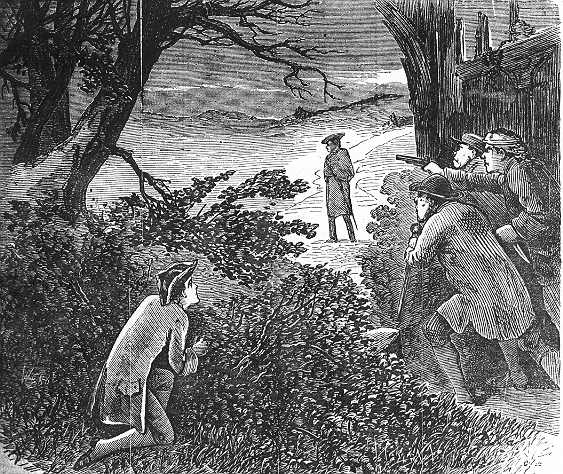
AS THE MAN NEARED THE PLACE OF DOOM THE THREE MEN DREW THEIR KNIVES AND GLIDED THROUGH THE OPENING IN THE WALL.
402
THE LINK BOY OF OLD LONDON.
CHAPTER I.
THE MURDER ON COMBE DEANE HEATH.
THE sun was just going down over the hills of Combe Deane when Ralph Moreton sat down upon a little stile which crossed a brook between two meadows.
Ralph was a lad of sixteen years of age, with bold and defiant eyes, a broad, open countenance, and a lithe and active form.
He was a lad whom you could at once set down as one who would not fear a fight for fortune, though his attire now was indicative of weary travel, if not of poverty.
He had, indeed, been walking since nearly sunrise, hurrying on unceasingly, even running at full speed, when a strange, suspicious form was seen approaching.
An unheard-of change had that day taken place in his fortunes.
Left, a month before, an orphan, he had been placed in the hands of an uncle, who had always been the favourite brother of his father.
This uncle had died, also, in the most mysterious manner, a month after his brother, and the house was then left in the charge of the aunt and her son and daughter�Henry and Clara.
The aunt was one of those women who, at the first glance, would be suspected.
She was a tall, queenly woman, with that kind of flaxen hair which marks a peculiarly deceitful character.
Her lips were thin and compressed, and her eyes sharp and hawk-like.
Her son Henry was a lad of the same age as Ralph, with fair hair, light-blue eyes, and a reckless, roving disposition, while Clara was a tall, stately girl, with large dreamy eyes, a beautiful figure, and a graceful and elegant carriage, which had in it some of her mother�s hauteur and pride.
On the night before we meet our hero on the site near Combe Deane, a meeting had taken place at Moreton Hall between Mrs. Henry Moreton and her lawyer, Mr. Denvil.
It was when all else were supposed to be in bed that the precious pair met, and, as the lawyer sat down in a large arm-chair by the fire opposite his client, a grim smile of satisfaction passed over his sallow features, and he rubbed his thin hands together.
"Well, Mrs. Moreton," he said, as he gazed into the haughty face, "I am glad of this meeting�very glad; and I fancy, from everything, that you are glad for the same reason."
"I am glad," said Mrs. Moreton. "I am glad, because I desire revenge,"
"And what is your plan? For I am sure your fertile brain has not been idle."
"Well," said Mrs. Moreton, drawing her chair closer, and speaking lower, "I am resolved that the son of Ralph Moreton shall never really inherit these estates, for the insults and sorrows of the past I will be revenged; but I am not fool enough to use the common means of vengeance."
"I do not understand you."
"I can readily explain," said the evil woman. "Fate has played into my hands. My husband�s death has cleared away one terrible obstacle to my wishes. I might risk all and destroy this boy at once, but I will not run that peril. My plan is simple, but far more to the purpose."
"I listen," said the lawyer eagerly.
"It is simply this," continued Mrs. Moreton. "I propose that my son Henry and his cousin Ralph shall go abroad for a tour. I propose also that you shall accompany them as a tutor. You can remain away three years, and at the end of that time one of your pupils can return with you. That one will be Henry, but he will return as Ralph Moreton, heir to the Moreton fortune."
The lawyer�s eyes gleamed with sympathetic malignity as she spoke.
"Good, good!" he said; "you were always a woman of spirit, enterprise, and pluck. This shows you have a more fertile brain than even I gave you credit for. But, of course, you see one thing."
"And that is?"
"That a grave responsibility rests on my shoulders." said Denvil. "I am the one to whom is given the duty of destroying this heir of the Moretons. What reward am I to receive for this?"
Mrs. Moreton smiled, and extended towards him her white, jewelled hand.
"This," she said.
Mr. Denvil was handsome, rich, and an old friend of the widow�a former suitor, in fact.
So he raised it to his lips, and rising, said quietly�
"I am satisfied; but it grows late and I must away. When will you make this proposition to the two lads?"
"To-morrow."
"But how know you that Henry will accede to this terrible revenge?" asked Denvil.
The widow smiled placidly.
"Henry loves his mother," she answered; "and will do as she wishes. Fear not. Once away from England, you will find no such obstacles."
"Your wishes shall be obeyed," said Mr. Denvil, as he prepared to quit the place.
At this moment a small, dark figure, who had been standing near the door, which was ajar, sped away lightly along the passage.
This was Ralph Moreton.
Before dawn, after a short sleep, he quitted the house with a stick and bundle, and hurried on, as we have seen, towards Combe Deane.
It was growing dark when he once more rose, and began his journey across the moor.
It was a wide level, with here and there a few stunted trees, but not a single habitation within sight.
The only thing which broke this level was a depression in the centre, surrounded by a kind of ruined wall, which was in parts overgrown by undergrowth, brushwood, and ivy.
On reaching this he glanced round him, and seeing nowhere near him any possible restingplace for the night, he passed through a break in the wall and sat down.
Near him was a place where the dense growth formed a kind of canopy overhead.
"This is just the place for a snug pitch," thought Ralph, whose schoolboy romance made him all the more ready to accommodate himself to his situation. "I�ll save my money, and sleep here. It is a warm night, and I shall have all the more chance of getting quickly to London if I spare my funds."
Taking from his pocket a bundle of bread and cheese which he had bought at a neighbouring tavern, he began his nightly meal, washing it down with some beer he had also brought in a bottle.
His mind was in a state of great excitement.
He had fled, he knew well, from a nest of murderers.
But who would believe him if he told his story?
He would have plenty to deny it, and none to attest its truth.
How, also, should he be able, after a time, to return and claim his own?
Of course industrious reports would be spread in regard to his death, and Henry Moreton would be placed in possession.
Hark!
What is that?
The current of his thoughts was suddenly interrupted.
It was the hasty tramp of heavy feet.
In an instant he crawled under the friendly shelter of the brushwood, and there awaited the approach of the strangers, who might, as he reasoned, be in the pay of Mrs. Moreton, and in pursuit of him.
In a few moments there entered the circle three men.
Two of them were in the dress which is usually worn by labourers, the other was attired in a garb of the poacher type.
He had a furry cap on his head, and a red handkerchief bound round his head and over one eye, gave him a peculiarly sinister appearance.
His face was red, either with drink or excitement, and his manner was altogether that of a man who had worked himself up to a high pitch in order the better to execute some great purpose.
They took one rapid glance round the landscape ere they dived into the hollow, as if to assure themselves that they were not followed, and then, so sitting that their persons could not be observed in any way from without, they began their conversation.
"So far, so good," said the man with the red handkerchief over his eye, as he wiped the moisture from his brow. "I don�t think that a single soul followed us, or that we have excited the slightest suspicion on our journey."
"No; I do not fancy that a single soul saw us," said one of the other men, a burly, brutal looking ruffian; "but at what time do you expect him?"
"He will cross the moor about half-past nine," said the first speaker; "and then, remember, let there be no hesitation. He must die, or other lives and fortunes will be sacrificed; and, as you have undertaken the job, strike home, and strike hard."
"Aye, aye," said the other two, as if in chorus; "pass the brandy, though, for killing a man isn�t just the same as killing a sheep, and one must have a little pot-courage."
The brandy bottle was now passed round, and Ralph Moreton, hiding in his leafy covert, saw that the three brutal ruffians were becoming even more influenced by drink.
Murder of the foulest kind was evidently in contemplation.
And he was powerless to prevent it.
He had no knowledge whatever of the name or the abode of the intended victim, or even what route he would take on his way towards the fatal spot.
Once the idea occurred to him that he would start up and warn the stranger of his fate.
But this he knew would be not only useless but would involve his own doom.
So he lay still�scarcely daring to breathe, lest he should betray his presence.
For a long time there was not a sound over the moor but the rustling wind and the sound of men�s voices.
But presently, becoming more distinct as they approached the spot, were heard the foot-falls of a man.
Ralph�s heart beat more quickly, and his head swam with a dread and a sickness.
He could even then, as it were, see the sickly scene about to be enacted�a scene he was powerless to prevent, for he was utterly unarmed, and the three men had pistols and long knives.
As the man neared the place of doom, the three men drew their knives, and, rising from their positions in the hollow of the glen, glided through the opening in the wall.
"Thank Heaven!" thought Ralph, as he shivered as if with cold, "they are not about to commit the deed here."
The moonlight had now struggled through the clouds which had previously obscured it, and shed a bright effulgence over the barren moor.
It was with great difficulty that they prevented themselves being seen, as they hastened forward on their ghastly errand.
But in their nefari6us purpose they were aided by the victim himself.
He was so absolutely occupied by his own thoughts that he was taking no notice whatever of the objects surrounding him, and consequently,
403
as with an involuntary growl of brutality the three men sprang upon him, he was taken utterly by surprise.
Not being without arms, he made some show of resistance, and, hearing the clash of steel, Ralph rose from his hiding-place, and, selecting two or three large stones, prepared to rush to the scene of combat.
But all was over then.
Ere he approached, the victim lay dead upon the sward.
"At any rate I will discover who he is, and I will aid in avenging him," he murmured; and, with a wild excitement at his heart, he hurried back towards the dell, and concealed himself once more.
He had not been there long before he heard the tramp of the men returning with the body of their victim, and presently they entered through the broken wall, and laid the body down on its back in the broad moonlight.
It was impossible then to distinguish his features, but yet Ralph could see the still, white, solemn face of a man who was evidently in the prime of life, and was dressed in a fashionable garb of the period.
"Well, he�s dead, that�s sure enough," said the man with the bandage.
"Yes, we did the job clean," replied one of the other men; "he hardly resisted and scarcely squeaked. Now for the papers and the gold."
"The former for me, the latter for you," said first speaker, whose red face had assumed an ashen hue since the perpetration of the crime.
The other two now anxiously turned his pockets inside out, and in a few moments a roll of papers was in the hands of the man with one eye, while the thieves with him had each secured a goodly supply of gold.
"Now, then we�ll bolt," said their chief; "it�s of no use remaining here. To-morrow night, remember, at the Cat and Whistle, at eleven, and meantime close your peachers."
With these word, the three men quitted the place, leaving their victim lying with his glazed eyes turned upwards towards the sky.
CHAPTER II.
MOONLIGHT TOM�THE MYSTERY.
THE first thought of Ralph Moreton was that his best plan was to fly at once from the murder, in order to avoid all possible connection with it.
But, on reflection, he decided to remain until the morning broke.
The light of dawn might, perhaps, enable him to see some relic�some scrap of paper, some bit of jewellery�which might form a clue to the mystery of the hideous crime.
So, curling himself up beneath the green bushes, he endeavoured to snatch a few hours� repose in spite of the ghastly object which lay near him.
At first he found sleep impossible.
But at length youth�s natural elasticity of temperament asserted itself, and he sank into a deep slumber.
When he awoke, the sun was high in the heavens.
He roused himself up at once, and as the remembrance of the hideous scene of the night before came into his mind he hurried out and approached the dead body, which lay as it had been stricken down, with its pale face towards the sky, and the knife in his heart.
He had just reached it, and had drawn himself on his hands and knees beside the body, when he was startled by a chuckle near him, and looking up he saw a sight which, even in presence of death, was full of comedy.
Extended on his stomach on the other side of the murdered man, just raising himself on his two hands, was a lad about Ralph�s own age.
But what a difference between them!
The new comer, who introduced himself in strange and comic way, had a mass of unkempt hair shading his brow; his round eyes were wild with a mirthful excitement, his whole features, in fact, were expressive of a rude geniality, though there were in the lines of his mouth something which told of a lurking demon.
His attire was picturesquely ragged, his knees protruded from the rents in his trousers, and his feet were bare.
He stared at Ralph in a queer, comical way, which made the lad laugh out, even in the presence of death.
"Who are you?" asked the heir of Moreton Hall, as his mirth subsided.
"I�m Moonlight Tom," said the other. "Is this a bit of your doing?"
"Mine! no. Do I look like a murderer?"
The boy chuckled.
"That�s good," he said. "Do you look like a murderer? Did Dr. Rooke, when they shoved him off the cart at Tyburn, look the sort of cove as �ud kill �alf-a-dozen kiddies and their mother? Murder don�t go by looks, you see."
"It�s no use talking nonsense," returned Ralph. "If I�d done the deed, I should not have remained here all night, hiding near it, but have fled at once. Can�t you see he�s been dead for hours?"
"Why, yes, he�s a pretty stiff un," said Moonlight Tom. "Has he got any rhino on him?"
"No; I fancy he�s been pretty well cleared," returned Ralph. "And, at any rate, my object is not to rob him. I want to know him again, so that I can follow up his murderers, and punish them. It seems to me that Fate sent me hither as his avenger."
Moonlight Tom did not understand half that he was saying, but he did know that Ralph objected to robbery.
"Oh, very well," he answered. "I�ll help you to overhaul him�so here goes."
They were not long in turning out the pockets of the murdered man.
They found very little that pleased Moonlight Tom�only one guinea, which Ralph bade him keep.
But on the hand of the dead man was a signet ring, with the initials "A. M."
And in the breast-pocket of his habit was a scrap of paper, a portion of a letter, which ran thus:�
"DEAREST MAUDE,�I have risked all, and returned to England. I fly on the wings of
love. My enemies are even now on my track, but even Robert D�"
This was all.
The remainder had been destroyed.
"Very slight links in such a mystery," said Ralph, as he consigned them to his pocket-book, "but, nevertheless, these may serve to renew a chain which may drag the wretches to their fate."
"Which way are you trotting?" asked Moonlight Tom, interrupting a reverie, during which he had amused himself by spinning his guinea in the air.
"I�m going on to London," said Ralph.
"Do you know your way?"
"No�that is to say, I don�t know the nearest way; but I have a tongue in my head and can ask."
"That ain�t no consequence," returned Moonlight Tom. "I expect you want to get there on the quiet, or you would not be a-sleeping under a wall. Tell us what�s your game, and how this �ere cove got his wind-up?"
Suppressing, of course, the real names of the persons concerned, Ralph told his story up to the meeting with Moonlight Tom.
He had no sooner completed his narrative, than the lad in rags bent himself double, roared with laughter, and then threw a somersault which brought him across the glen, nearly to the other side of the wall.
Ralph eyed him in astonishment as he went through this extraordinary performance.
He fancied for the moment that his newly-found friend had gone mad.
Evidently he was intensely electrified about something or other.
"Ho! ho! ho!�Ha! ha! ha!" he shouted as he rose to the perpendicular, and held his sides. "This is too good. Do you see any green in my eye? Do you think my mother knows I�m out eh?"
Ralph looked indignant.
"What do yon mean?" said he.
"Why, do you suppose I�d swallow such a story as that?" said Moonlight Tom. "It�s too good�no�no, it won�t do for me. Everyone who�s got no friends, or is picked up on a dungheap, or is found trudging along a highroad with a pack on his back, and not a stiver in his pocket, is a nobleman in disguise. I believe all about the murder, but the other�oh! no; it�s too good."
Ralph was very angry.
But, of course, he saw it was of no use quarreling with his strange companion.
"Well," he said, "if you don�t believe me, I can�t help it. At any rate, I�m going to London, and if you can aid me in finding the shortest route I shall be glad."
"All right, then, my cove," cried Moonlight Tom, who was still admiring his guinea. "We can travel by night, and at day time we can rest. It won�t take us long. We�re only thirty miles now from Charing-cross. We�ll start now�get our breakfast, do a ten miles� spin, and then rest till dark."
Leaving the dead man with his face covered with some fern leaves, the two lads now made their way across the moor, and, with great pleasure, greeted the sight of a little inn.
Here they stopped, and partook of a good breakfast, and, revived by this, they began what Tom had called their ten miles� spin.
And so they went on until a dark and gloomy evening overtook them at an inn near Charing-cross.
They had now nearly completed their journey, and so, having no cause to hide themselves any longer, they passed into the large room and ordered supper.
Having partaken of this, they ordered a bed, and, in spite of the great wonderment of the landlord, they passed up into one room, a large double-bedded chamber, which overlooked the back-yard.
They were tired out, and, therefore, wasting no time in conversation, they were soon in bed, and would have been asleep in a few moments had not some voices in the next room aroused them.
The walls seemed solid enough, but, just where the head of Ralph�s bed stood, there appeared to have been a part broken away, so that the very words of those in the next room, though not spoken loudly, could be heard distinctly.
"Tom," said Ralph, in a low voice, to his companion, "come here. There is a mystery going on in the next room."
Moonlight Tom crept along on tip-toe, and in a few moments was standing near the bedside of his strangely-found friend.
What�s up, Ralph?" said he.
"Hush!" answered Ralph. "Listen, but do not say a word. Ah! here is a chink, we can see as well as hear."
In the adjoining room were seated three men, one of whom was of such peculiar aspect that he would be at once recognised wherever he might again be met.
He was a short, stout man, with a round head and shaggy, red hair.
His face was expressive of low and brutal passions, and his eyes, set close together against the bridge of his narrow nose, gave a peculiar vindictiveness to his expression.
The other two were ruffians of the ordinary Alsatian-bully type�broad-shouldered, bullet-headed, huge-fisted giants, with faces and noses which proclaimed their frequent potations.
They were gathered round a table in the centre of the room, and were discussing some strong spirit while they were engaged in conversation.
"You�ve quite disappointed me, Simon," said the man with the red head. "I hardly know how I shall get on with my business to-morrow. I had fully expected a quantity of travellers to-day."
"Well, it will happen so, sometimes, Sweeney Todd," said the one addressed as Simon; "but
404
to-morrow you ought to have a fine harvest. At eleven Sir Paxton Greaves comes to London, and will put up at the Blue Boar, in the Strand. I will see that he comes to your shop."
"Is he a good customer, and young?" asked Sweeney Todd. "You know old people are no good to me."
"Oh! yes; he is a fine, plump, healthy man, about twenty-five," replied Simon Adder. "Just the sort of man to suit your purpose. Then you will have a second �subject� at one o�clock, young Joseph Marner, a farmer, who is coming up to see the sights. Then up to six o�clock in the evening you will be supplied very well; and up till ten business will go swimming."
Sweeney Todd rubbed big hands, and his eyes twinkled with a hideous glee.
"Ha! ha!" he cried�"ha! ha! you are a capital decoy-duck. But how about your arrangements for the next day?"
"Stop!" said Simon, "you are insatiable�pray let one day be settled first."
"Besides," grunted the third man, "I�ll provide for the next day. I have several in my eye."
Ralph Moreton and Moonlight Tom listened with wonder, not unmixed with horror, to this conversation.
What could it mean?
Were they vampires?
Or were they men who supplied the doctors with living victims?
At any rate, one thing was determined upon by Ralph.
He would warn Sir Paxton Greaves, and he, at least, should be saved from the demons who evidently threatened his life.
He communicated his thoughts to Moonlight Tom, who at once offered to help him.
"I�m your kiddy," said he, "I don�t mind a little prigging, but blow me if I can stand people being murdered, or given over to them �ere doctors."
At this moment the jingling of money was heard, and both the lads looked anxiously into the adjoining room.
Sweeney Todd was emptying on the table a large bagful of coins�gold, glittering coins, which he divided equally between the two men.
"My hi!" whispered Moonlight Tom, in a voice tremulous with emotion; "my hi! there�s a lump of money! They don�t do nothing for such pay as that. Here�s for a lark!"
The men were now moving out of the room, and, as they did so, Moonlight Tom rushed to the window, and throwing it open, looked out.
The moon was shining brightly, and the lad saw at once that a friendly waterspout led down from the window into the yard.
In an instant he had clambered out, and, without a word to Ralph Moreton, he went hand over hand down it, and, running across the yard, was soon lost to view.
"Well, that�s a funny thing," said Ralph Moreton, to himself. "Never a word to tell me where he is going, or what he is about to do. I shall not stop up for him, that�s certain."
When he had once more settled himself under the bedclothes, he made the most virtuous resolutions that he would lie awake; but he was tired, and, indeed, regularly worn out, and in a few minutes he was wrapped in a deep slumber.
On awaking, he found that the sun was high in the heavens.
The casement was closed, and locked on the inside, and Moonlight Tom was sleeping peacefully.
Ralph dressed himself, and then quickly roused the owner of the shaggy head.
"Why, where have you been?" asked the young heir of Moreton.
Moonlight Tom�s mouth widened with a broad, chuckling laugh.
"I�ve been on a business-errand," he said, and, placing his hand underneath his pillow, he drew forth a handful of gold.
"See," he said; "I followed those villains, and as they were passing along, staggering with drink, they never observed who was following them; so I dipped my hand into the pockets of both, and helped myself to a nice haul. Will you have some?"
Ralph shook his head.
"No, no," he said; "I cannot take anything from the proceeds of a robbery, even if you have taken it from the pockets of such villains. Here we most part, Tom. Our ways in life are different. I thank you for bringing me to London, and here is a guinea to reward you. I would give you more, but I have it not."
A strange look came upon Moonlight Tom�s face, and a strange moisture came into his eyes.
"Well, I own I�m a prig," he said; "but I�ve been square with you. Couldn�t I have taken all your money if I�d have liked? Couldn�t I have rounded on you to your people? Couldn�t�"
"Stop!" cried Ralph; "pray stop! I�m not saying that you have not been a good friend; but I�ve been brought up in the paths of honesty, and I know that we could never get on together. Let me know where you are to be found, and at any time when I can do you a service I will do it. But come�let�s go down and have breakfast together. At the door of the inn we can part."
Ralph spoke in such a firm and resolute tone that Moonlight Tom saw be meant every word he said, and yet meant it in no unkindness.
He grasped his hand, while tears stood now freely in his eyes.
"All right, old covey," he said; "I know you don�t bear me any ill-will. I believe your story now, and I hope you�ll get back your rights. When you want to see me, come to old Fadge, the Jew�s�No 1, Plough-alley, Hounsditch, and he�ll find me."
The two lads now descended to the big room, where they partook of a good breakfast, and then, at the door, they parted.
Ralph Moreton�s first destination was the Blue Boar, in the Strand.
It was now past ten o�clock, and at eleven Sir Paxton Greaves would be there.
He had resolved to save this man from his mysterious fate.
Some strange destiny appeared to be urging him forward for this purpose.
At any rate, having found his way, he proceeded with all speed towards the hostelry, and under the old-fashioned porch he waited the arrival of the traveller.
At length, when his patience was nearly exhausted, there approached the inn a gentleman mounted on a handsome brown gelding.
Ralph at once, as he saw him, guessed him to be the one of whom he was in search.
But be resolved, of course, to be certain before he let out the secret he had so strangely heard at the queer old inn at Charing-cross.
He waited, consequently, until the supposed Sir Paxton Greaves rode up to the door of the tavern and dismounted, before be approached him.
The first words convinced him that he had not made much mistake.
The ostler, hurrying up to the alighting gentleman, touched his hat as he took the horse�s bridle, saying�
"Good-morning, Sir Paxton; shall I take the horse into the stable?"
"Yes, my good man; take him round and unsaddle him. I may not want him again until late this evening�if, indeed, at all to-day."
And the speaker leaped lightly from his horse, which the man at once took charge of.
He passed immediately into the inn, where, after nodding to the landlord, be made his way up to a private room, as if used to the place.
As he did so, a man, whom Ralph Moreton at once recognised as one of the ruffians whom he had seen at the inn, was peering at him from behind a wagon.
He was disguised in a very far different garb to what he had worn then; but, nevertheless, he seemed unable to conceal his face.
He peered at Sir Paxton with an eager glance�a kind of vampire glance�which gave a crawling sensation to Ralph as he gazed at him.
He resolved to let no time slip through his hands.
Without any fear or doubt, he boldly entered the tavern, and asked for the room of Sir Paxton Greaves.
"Have you special business with him?" asked the waiter; "for if you have not he will scarcely care about being disturbed. He comes here to be quiet and alone."
"If I send my name, he will probably fancy I know him," thought Ralph.
So he said boldly�
"Tell Sir Paxton that Ralph Moreton desires to see him."
Supposing, of course, that a stranger would not send up his name to another, the man at once hurried up.
The result was strangely surprising, indeed, to our hero.
The man returned with a most deferential manner, saying�
"Sir Paxton will see yon at once."
Scarcely believing his own ears, the lad hurried up the staircase, and in a few moments was ushered into the presence of the young baronet.
The latter eyed him for a minute without speaking.
"Ralph Moreton, of Moreton Hall?" he then said, inquiringly, as he glanced at our hero�s black clothes�dusty, and stained with travel.
"Yes, Sir Paxton," returned Ralph, eagerly. "Do you know the Moretons?"
A strange smile flitted over the baronet�s features at these words.
"Know them!" he cried; "yes, I think I do. But come, tell me what brings you here? And tell me, too, why you appear in such a guise?"
" Shall I weary you? My story is somewhat long," replied Ralph. "My own part may prove uninteresting, but the other affects your very life."
Sir Paxton glanced at him in surprise.
"Bless me!" he cried, "you quite alarm me. But I will give orders for some lunch, which you can partake of with me, and then you can speak at leisure."
The lunch was soon brought in, and after partaking of a little refreshment, Ralph Moreton
narrated his story.
The baronet listened with eagerness.
He seemed deeply interested in all the lad told him of his home.
Even more so, in fact, than about his own danger.
About the latter, indeed, he seemed puzzled.
"I can�t understand at all what this means," he said. "I�ve no conception who the man can be. I have a good mind to follow up the mystery, and see what it all means."
"That might bring you into danger," said Ralph.
Sir Paxton laughed.
"Oh! As for danger," he said, "I�m used to that, and rather like it than otherwise. I�m only doubting because I have a duty to fulfil, which hardly leaves me, for the moment, my own master. At any rate, it might be well for me to see this villain who is lurking about, that I may know him again."
"Yes; he is in the courtyard�still watching, no doubt," replied Ralph.
"Of course he does not suspect you?"
"No, he cannot."
"Then he will await my coming down," said Sir Paxton. "And now as regards yourself. My advice is to you to keep quiet for a time. Let there be a mystery about your disappearance, and then you will see how they act. Have you friends in London?"
"None."
"Then why did you come?"
"To escape death!"
Sir Paxton smiled.
"Well, well," he said, "you have done a bold and foolish thing in rushing up to the metropolis without the slightest idea of what you are going to do. But still I do not blame you. What do you propose?"
"To seek employment, and bide my time until I can obtain a friend to aid me."
"Good. And what is your own secret reason for not denouncing these villains at once?"
"Because, in the first place, my story would
405
not be believed," returned Ralph; "secondly, my relatives would either say I was mad or under the influence of some horrid dream. They would pretend to receive me back with open arms, and I should die a victim to poison, or some other villainy."
"Quite right, my lad," said Sir Paxton. "And now, since I agree with you in all you say, let us see if we cannot agree in another matter. What say you to taking service with me for a time?"
Ralph flushed with pleasure.
But a moment before he had been wishing that Sir Paxton would make him some such offer.
"Willingly and gladly I would, Sir Paxton," he said; "but in what way can I serve you?"
"Well," replied the baronet, "as you desire a disguise, you might be for a time my page. When we are in the presence of others you will have to assume the attributes of that position; when we are together alone, you are my friend."
"I accept this offer gratefully," said Ralph, enthusiastically, "the more so that you have made it without knowing anything of me. When shall my service begin?"
"At once�that is, to-day, if you please," said Sir Paxton. "Take this note to Emery, the tailor, in Fleet-street, and you will receive before this evening a suit of clothes suitable to your supposed station. After which, meet me here at seven; we have strange work to do this night."
With these words the young baronet placed in Ralph�s hand a note addressed to the tailor he had mentioned, and a purse of money as well.
Then, after handing him another glass of wine, he dismissed him with the words�
"Remember the place and the hour."
"But the man who is lurking in the yard?" suggested Ralph.
"Ah! truly. Go down and see if you can find him. Tell him that Sir Paxton Greaves has received information that he desires to speak with him, and can now grant him an interview."
Our hero at once descended to the yard and searched everywhere.
At length he saw him, hiding as before, behind a cart.
He at once made towards him.
The man at first moved, as if to shuffle off.
But Ralph was too quick for him.
Darting beneath the tail-board of the waggon, he neared the ruffian before the latter was aware of it."
"Ho! here!" he cried. "Sir Paxton Greaves wants to see you."
The man�s face expressed intense astonishment.
"What do you say?" he asked with chattering teeth.
"Sir Paxton Greaves, I repeat, has heard that you desire an interview with him, and he is now ready to give it. He wishes, I believe, to speak with you in regard to the arrangements you were making at the inn at Charing-cross."
This was enough.
Drawing suddenly from behind his back a long stick, he dealt Ralph a blow, which fortunately missed his face, but caught him on the neck, and sent him reeling back.
It had the desired effect.
When our hero recovered himself, the man was nowhere to be seen.
Ralph hurried back, and reported what he had seen to Sir Paxton, and then made the best of his way towards Fleet-street.
Of one thing he was certain.
He would know the villain whenever and wherever he met him.
At the tailor�s he was not detained long.
After paying for the clothes, he found himself still in the possession of two gold pieces.
He had, therefore, enough to pass through the day with; and accordingly he resolved, while he was waiting, to see what was to be seen.
As he was passing through Fleet-street he was startled at the face of a man who was
standing, with an apron on, at the door of a shop on the opposite side of the road.
He was evidently not attired in any way like the leader of the ruffians of the night before.
But, nevertheless, it was he.
"Here, then," thought Ralph Moreton, "there is one clue to the mystery."
Waiting till a vehicle had gone by, which for a moment obscured the view of the shop, he rushed over.
As he did so there was evidently a banging of doors.
But no one was standing there.
He knew the shop again, however�a barber�s shop�and he at once opened the door.
Within was a man, reading a book.
A tall, thin, cadaverous-looking fellow, with a curious-looking face, made more strange by contrast with his jet black hair.
"What is it you want?" asked he, looking at Ralph Moreton�s smooth cheeks.
"I wish to speak with the man that has just entered with an apron on."
"No one has been here," cried the dark man immediately.
"I think you are mistaken," said Ralph with impatient civility; "I saw him not a moment ago, standing at the door. He was rather a short man, with red hair."
The dark man resumed his seat, and still shook his head.
"I am the master of this shop," he said, "and if anyone had come in I must have seen him."
Ralph was crestfallen as he retired.
His first impulse was to make inquiries at the shops on both sides.
But a moment�s reflection persuaded him of the folly of this.
If he gave rise to suspicions, the mystery would, without a doubt, be lost.
So he passed away, angry and dispirited, resolving to speak with Sir Paxton Greaves before acting in any way.
The appointed hour found him presenting himself, in full page�s attire (and a very becoming attire it was) before his patron.
(To be continued.)